First-principles thinking means breaking a problem down not to "because everyone does it" but to the root facts that cannot be divided any further, and then building the answer back up from there. It is the best clue for reading the background of "off-the-wall" work like Tesla's and SpaceX's.
In this article we avoid difficult words and explain in order, from everyday examples to examples Elon Musk himself has told. When you finish, you will be able to say in your own words: "so that's what thinking from first principles means."
What is first-principles thinking?
"First principles" is originally a word from philosophy. The ancient Greek Aristotle called "the most root starting point, which does not need to be proved from anything else" a "first principle."
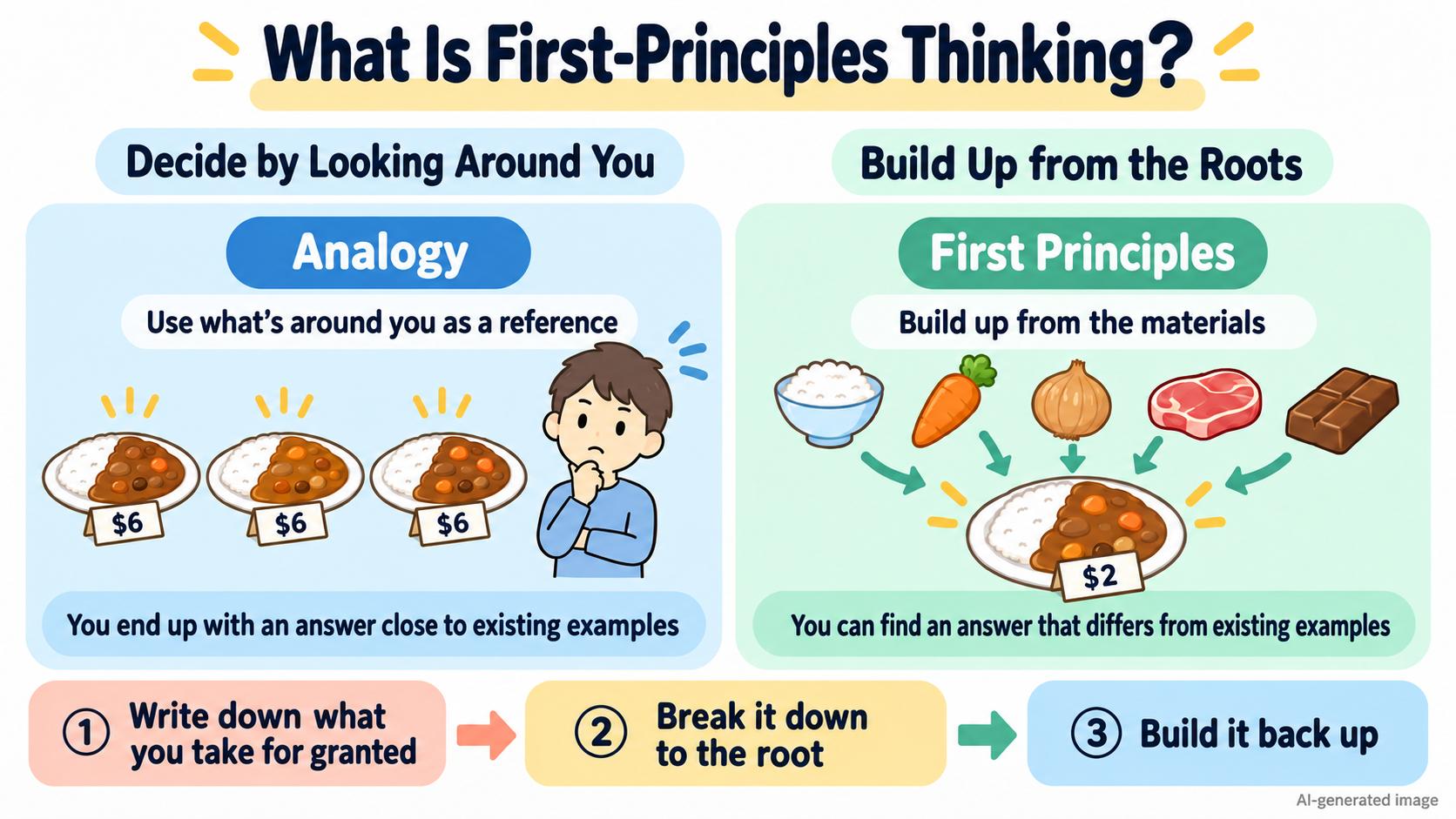
From this, the way of thinking that "starts from basic facts and laws that cannot be divided any further" came to be called "first-principles thinking." There are two key points.
- Doubt what you take for granted, and take it apart.
- From the "facts that truly cannot be moved" that remain after taking it apart, build the answer back up.
The difference from "analogy"
What first-principles thinking is often contrasted with is "reasoning by analogy." Analogy means thinking in a similar shape by referring to "the way that worked before, or the way those around you do it."
| Analogy (copying what's around you) | First principles (thinking from the root) | |
|---|---|---|
| Starting point of thought | What exists now, precedent | Facts and laws that cannot be moved |
| Example question | "What do other people sell it for?" | "What is it made of, and what does it really cost?" |
| Suited to | When you want to decide quickly and safely | When you want to doubt common sense and change things greatly |
Neither is "the right one." For most daily decisions, analogy is enough. But when something is "too expensive the way it is done now" or "said to be impossible," thinking from first principles can turn up an unexpected answer.
An everyday example: the cost of a curry meal
Before Musk's story, let's try a familiar example: "I want to cut my daily curry cost" (the example in Fig. 1).
Thinking by analogy: "Curry at a restaurant is about $6 a meal. Even a convenience-store retort pouch is about $3. So let's look for a slightly cheaper pouch." Since the price of those around you is the starting point, the answer settles near it.
Thinking from first principles: "What is curry actually made of? Rice, meat, vegetables, roux... How much does each cost at the supermarket? Add them up for one serving, and the ingredients might be about $2 a meal." If you accept the "effort of cooking," an answer different from the market price (the option of cooking at home) comes into view.
*The numbers are just an illustration and vary with your household. What matters here is that the starting point was not "everyone's price" but "the price built up from ingredients."*
But ingredient cost alone leaves out cooking time, utilities and the risk of failure. A first-principles answer is a "starting point," not the correct answer as it stands. We explain this in more detail later.
What did Musk himself say?
In a 2013 TED conversation (the interviewer was Chris Anderson), Elon Musk said, in effect, the following about his way of thinking.
Thinking in the way of physics, that is, "thinking from first principles," means breaking things down to the fundamental truth and building up from there. It is different from reasoning by analogy.
In English it is contrasted with "reasoning by analogy." Musk also says that "thinking within the framework of physics" lies at the base of how he thinks about things.
Examples of batteries and rockets (stories Musk told)
As examples of first principles, Musk often tells the following two stories. Both are introduced as Musk's own explanation, and we state up front that the numbers have not been backed by third-party materials.
Example 1: the price of a battery pack
In a 2012 interview with Kevin Rose, Musk said, in effect, the following about the price of battery packs.
- Historically, battery packs have cost about $600 per kWh (kilowatt-hour).
- But if you buy the battery's contents (materials) at market prices and add them up, it comes to about $80 per kWh.
- Thinking from the materials, batteries should be much cheaper to make than everyone thinks.
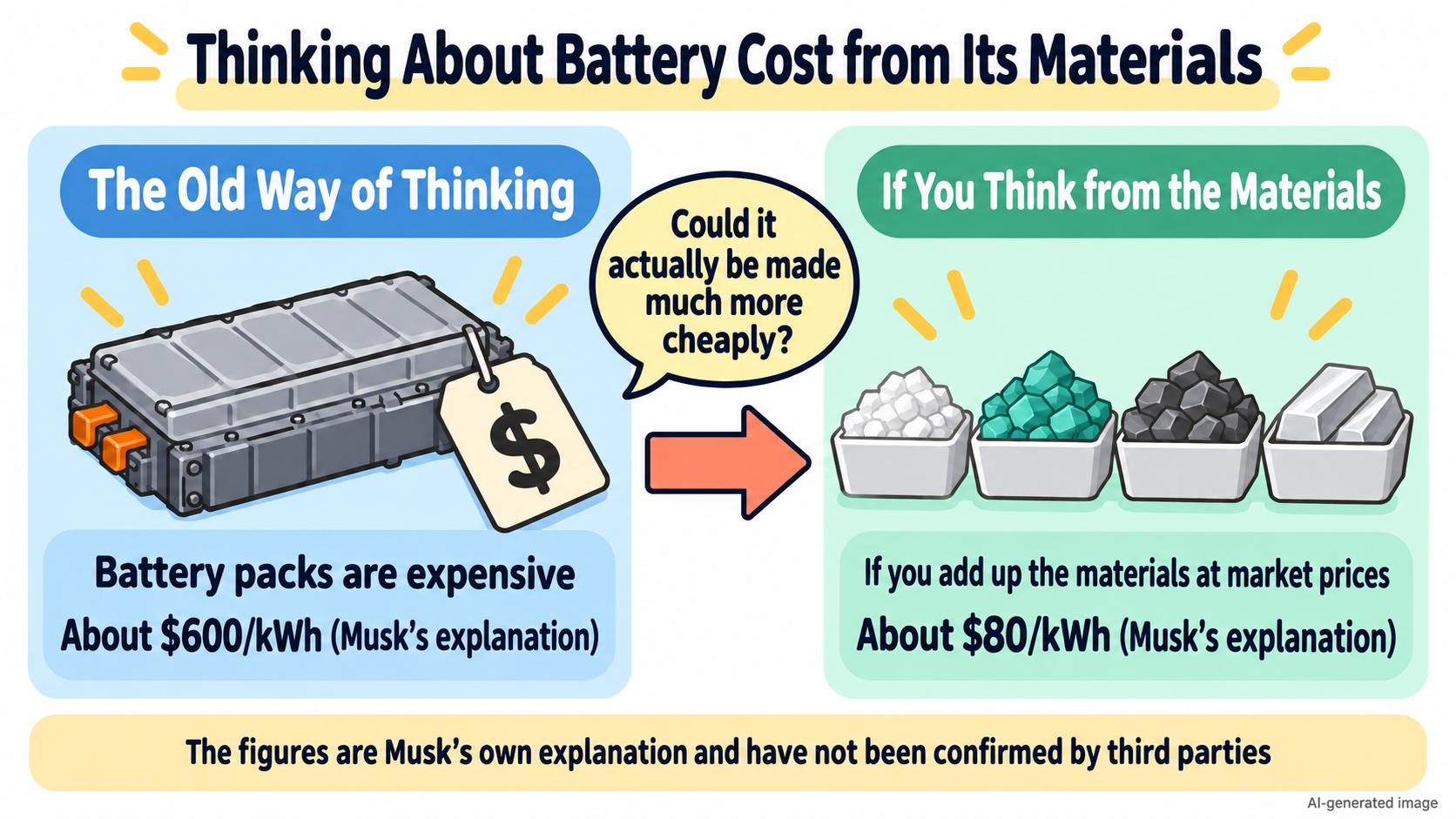
In other words, instead of the precedent that "batteries are expensive" (analogy), he started from the "price of materials" (first principles) and asked: "it should be possible to make them cheaply."
Incidentally, there is also a survey (BloombergNEF, introduced in a third-party explanatory article) saying that the average price of battery packs exceeded $700 per kWh around 2013. It is roughly the same level as Musk's "$600." But the figure "$80 for materials" itself has not been confirmed.
Example 2: the price of a rocket
Musk tells the same story about rockets.
- Buying a rocket is very expensive.
- But if you add up the materials used to build a rocket (aluminum, titanium, copper, carbon fiber and so on) at market prices, it comes to only about 2% of the rocket's price.
- Which suggests that the reason it is expensive lies not in the materials but in how it is made, and in the fact that it is thrown away after use.
For this "about 2%" as well, we cannot back it with third-party materials. We introduce it as Musk's explanation.
How to do first-principles thinking [3 steps]
Putting Musk's stories into a form you can use yourself gives these three steps (the band at the bottom of Fig. 1).
- Write down what you take for granted. Write out what those around you assume: "batteries are expensive," "rockets are thrown away," "cars have this shape," and so on.
- Break it down to the root. Keep asking: "What is it made of?" "What laws of physics or prices of materials decide it?" When you reach facts that cannot be divided further, that is your starting point.
- Build it back up. From the starting point, think: "so what should we really do?" An answer different from precedent may come out.
Things to keep in mind
First-principles thinking is useful but not all-powerful.
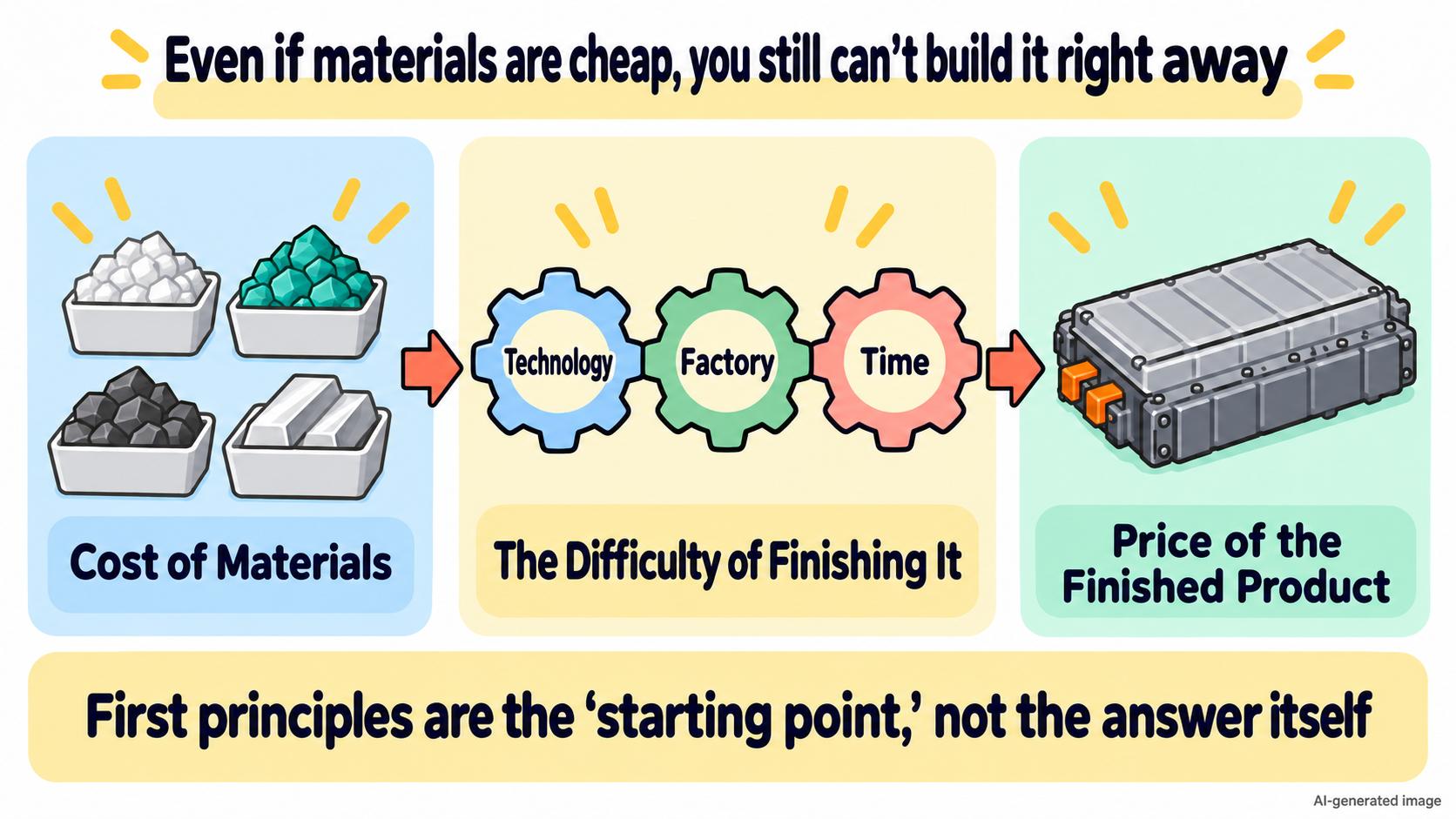
- If you get the root fact wrong, the answer is wrong too. "Materials are cheap" does not mean "it is easy to make cheaply." The technology and factories that turn materials into batteries or rockets are another big difficulty.
- It takes time. Thinking about every daily decision from the root is not realistic. The trick is to limit it to important moments.
- Precedent (analogy) is not useless either. Precedent is full of wisdom learned from failures. First principles is used not to throw precedent away but to doubt it and check it.
FAQ
Is first-principles thinking the same as "first-principles calculation" in physics?
The words are the same, but how they are used differs by field. This article explained the usage derived from philosophy, meaning "thinking from the fundamentals."
Can anyone do first-principles thinking?
Yes. But finding the "root facts" requires basic knowledge of the field. That is exactly why this series explains in order, starting from the basics of batteries, motors and so on.
Did Musk really decide things by thinking this way?
This is an introduction of what he himself said. How far he thought this way in actual decision-making cannot be checked from outside. This article uses Musk's way of thinking as a tool for reading.
Summary
- First-principles thinking is breaking a thing down to its root facts and building it back up from there.
- It is contrasted with "analogy," meaning "because those around you do it."
- Musk says he thought about the price of batteries and rockets from the "price of materials" (the numbers are his own explanation; third-party confirmation is pending).
- Three steps: write down what you take for granted → break it down to the root → build it back up.
- Even if the price of materials is low, it does not mean building is easy.
Next article: Why are batteries expensive? Start from materials (with the trend in battery-pack prices). We explain concretely what it means to "think about a battery's price from its material costs," while looking inside a battery.
Sources (checked 2026-10-11)
- TED 2013, "The mind behind Tesla, SpaceX, SolarCity" (Elon Musk, interviewer Chris Anderson, February 2013): https://www.ted.com/talks/elon_musk_the_mind_behind_tesla_spacex_solarcity (summary introduced; the content of the remarks was also checked against a third-party transcript)
- Interview with Elon Musk by Kevin Rose's "Foundation" (2012): YouTube (the relevant part) (the story of the battery-pack price is said to be in that part of the video)
- Aristotle's "first principles" (usage in philosophy): Stanford Encyclopedia of Philosophy, "Aristotle's Metaphysics": https://plato.stanford.edu/entries/aristotle-metaphysics/
- Average battery-pack price (over $700 per kWh in 2013): a third-party explanatory article introducing a BloombergNEF survey (confirmation in the primary source is pending)
This article is for learning about science and technology, and is not investment advice. It is also the author's reading, not a confirmation of Musk's own thinking. Figures are AI-generated illustrations.