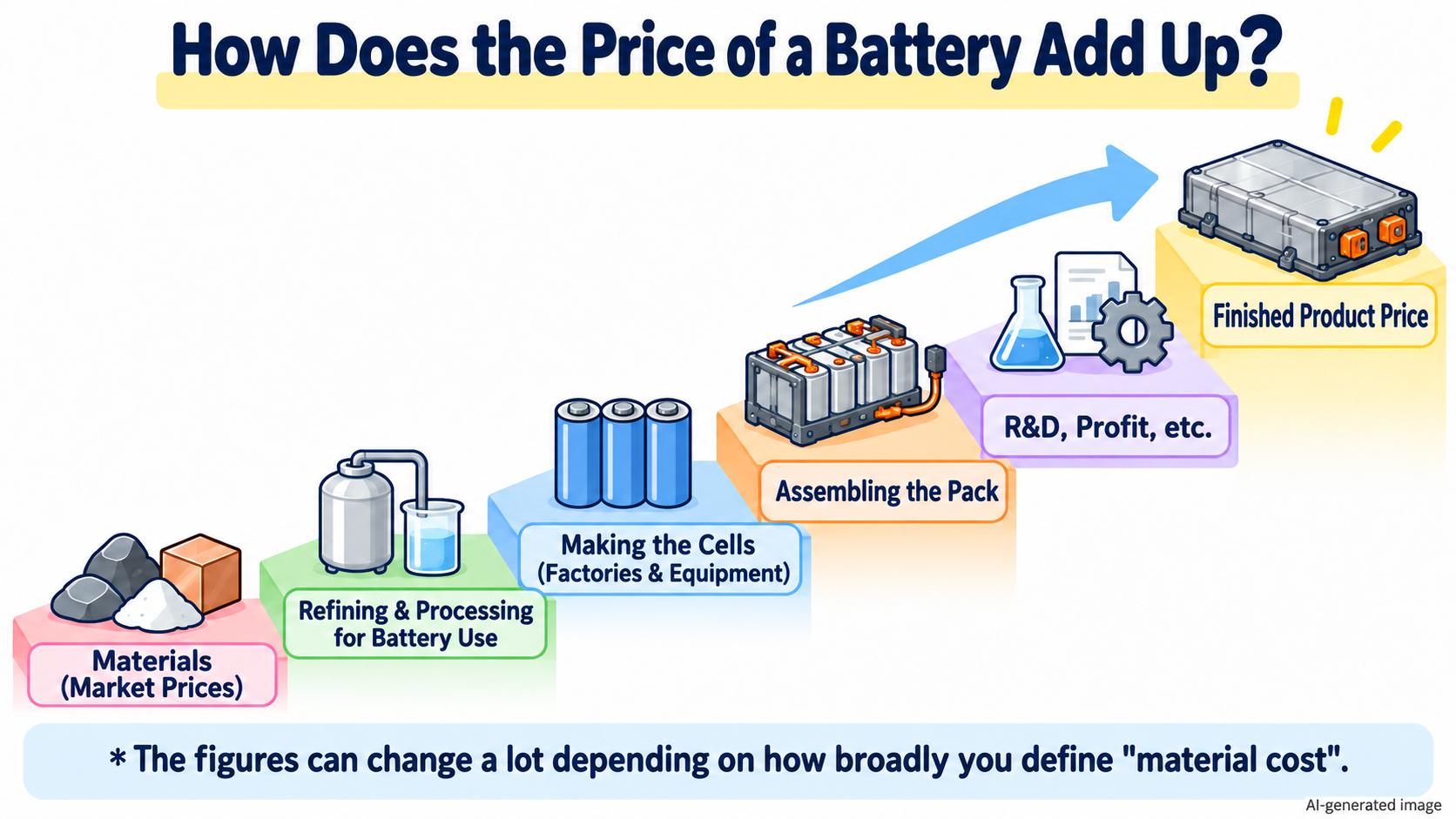
The average price of an EV battery pack fell from over $1,200 per kWh around 2010 to $108 in 2025 (according to BloombergNEF). That price is not decided by simply adding up the price of materials. Only after materials are processed for batteries, made in factories, assembled into packs, and joined by R&D and profit does the finished-product price emerge.
In the previous article, "What is first-principles thinking?", we introduced Musk's story that he "thought about batteries from the price of materials." This article explains, in order and while looking inside a battery, what that "price of materials" actually is. We also check with numbers the history of falling battery-pack prices.
What is 1 kWh?
When talking about battery prices, people often say "how much per kWh (kilowatt-hour)." The kWh is a unit for the amount of electricity.
- 1 kWh is the amount used by running 1,000 W (watts) of electricity for one hour.
- Running a 1,000 W hair dryer for an hour uses about 1 kWh.
- An EV's battery pack is often several tens of kWh up to around 100 kWh, and this decides "how far it can run."
So "price per kWh" is the battery's price divided by the amount of electricity it can store. It lets you compare prices even when batteries differ in size.
Inside a battery: six materials
A lithium-ion battery mainly contains the following materials (as organized in a 2013 battery-technology paper).
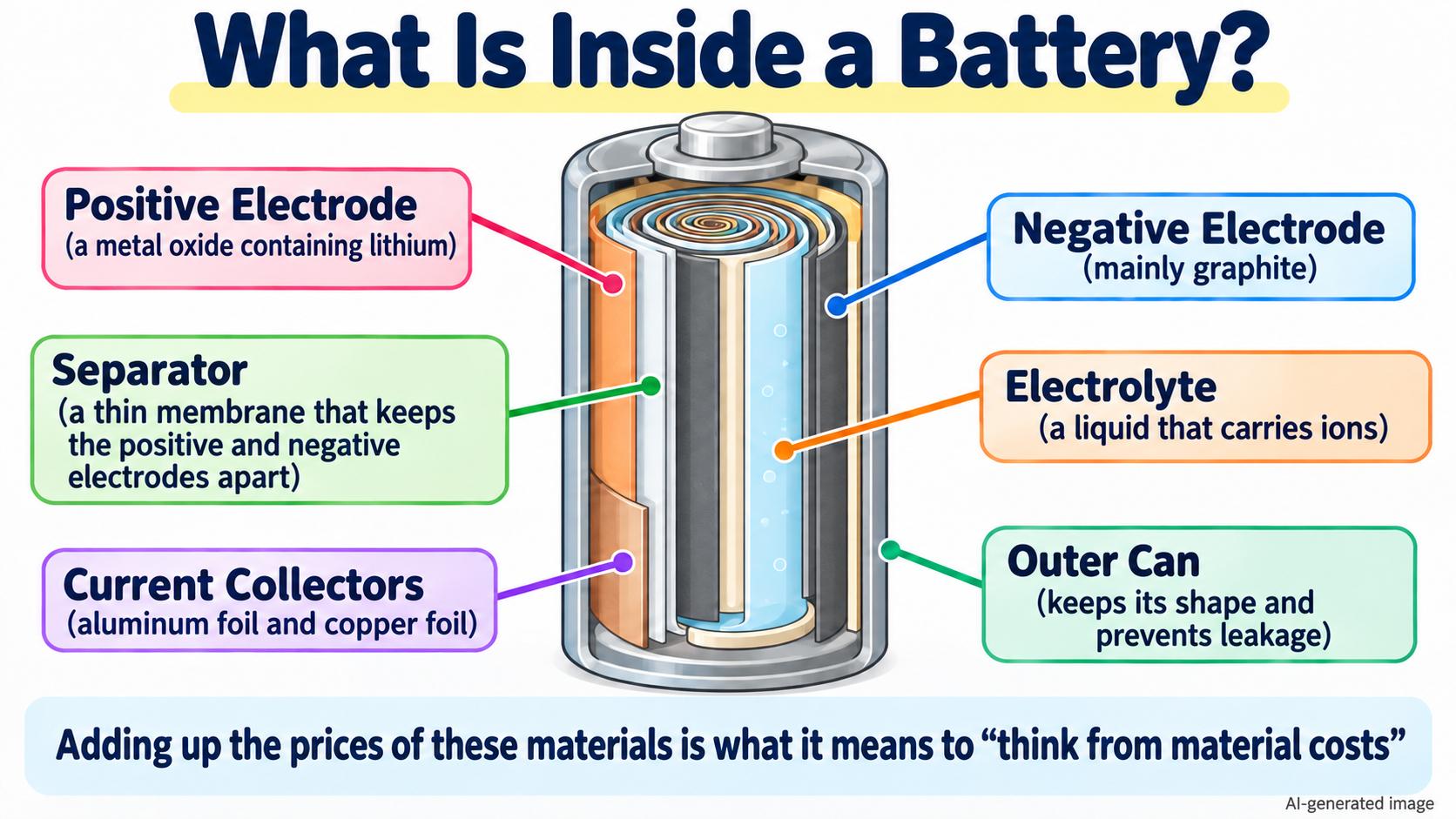
| Material | Role |
|---|---|
| Positive electrode | A metal oxide containing lithium. One of the main players that store electricity. |
| Negative electrode | Mainly graphite. Lithium goes in and out. |
| Electrolyte | A liquid of lithium salt dissolved in an organic solvent. It is the road the ions travel. |
| Separator | A thin film with tiny holes, of polyethylene or polypropylene. It keeps the positive and negative electrodes from touching and lets only ions through. |
| Current collectors | Aluminum foil on the positive side, copper foil on the negative side. They lead the electricity (electrons) out. |
| Outer can | Holds the shape and prevents leaks. |
The "tabless" design introduced later in this series is a refinement in how electricity is taken out of this current collector (explained in a later article).
What does "think from material costs" mean?
"Thinking from material costs" means buying each material inside a battery at its market price and adding them up. It is the same idea as adding up the ingredients of curry (rice, meat, vegetables, roux).
In a 2012 interview with Kevin Rose, Musk said, in effect, the following (summary). Battery packs have historically cost about $600 per kWh. But if you add up the materials at market prices, it is about $80. These numbers are Musk's own explanation, and could not be confirmed by third-party materials.
What matters here is that "adding up materials" is not directly "the price at which it can be made." In the next section we look at how real battery-pack prices have changed, and after that think about why the gap arises.
How far has the price fallen?
The average price of battery packs is surveyed and published every year by BloombergNEF (an energy research company).
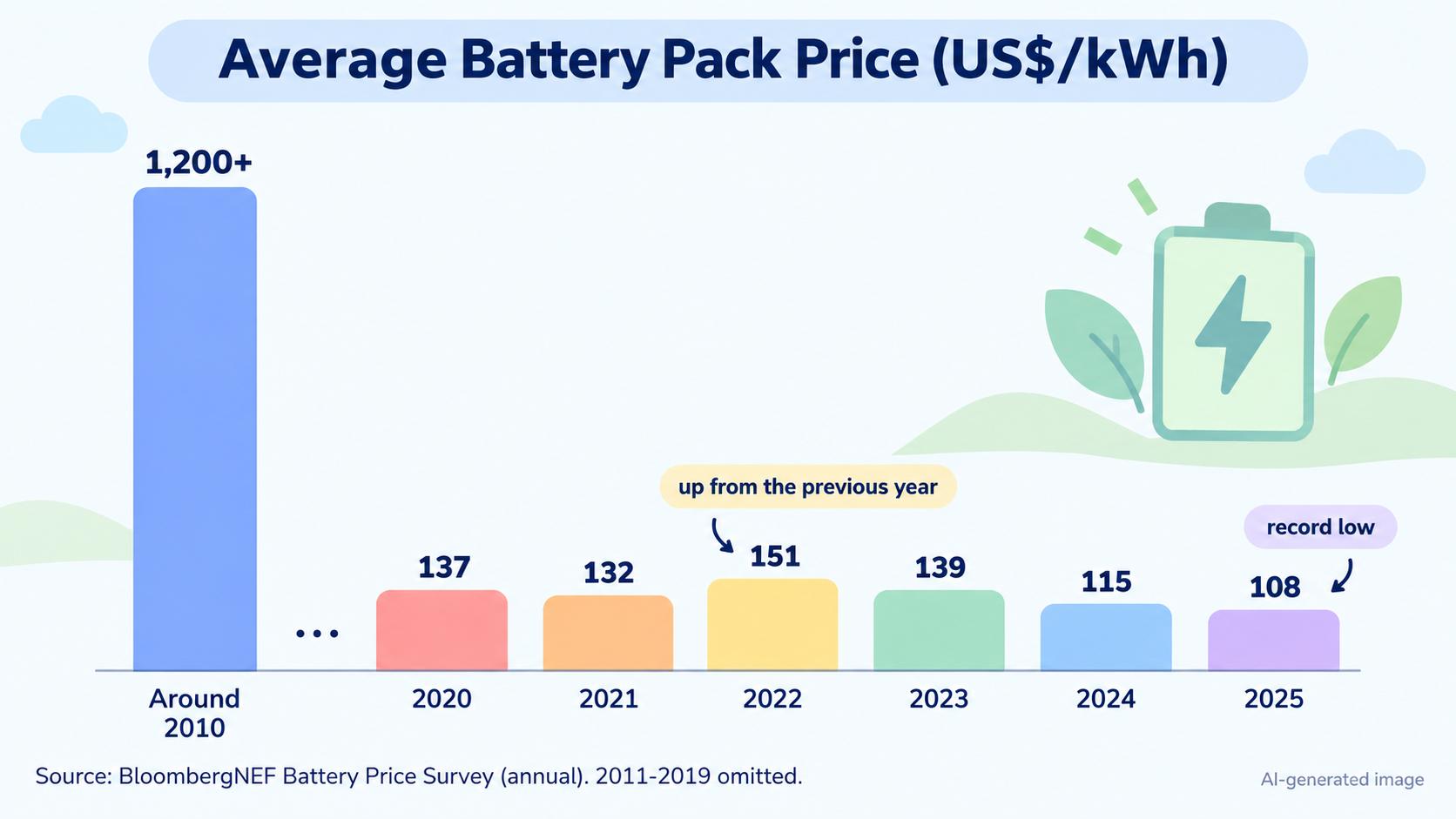
| Year | Average battery-pack price (US$/kWh) |
|---|---|
| Around 2010 | Over 1,200 |
| 2020 | 137 |
| 2021 | 132 |
| 2022 | 151 (up from the previous year) |
| 2023 | 139 |
| 2024 | 115 |
| 2025 | 108 (announced as a record low) |
Take a 60 kWh battery pack as an example. At $1,200 per kWh, the battery alone would be about $72,000. At $108, it is about $6,500. Behind electric cars coming within reach of ordinary buyers is this fall in price.
But the price did not fall in a straight line. In 2022 it rose from the previous year.
The gap between material cost and the finished-product price
So what is the gap between Musk's "about $80 for materials" and a "battery-pack price of several hundred dollars"? Battery papers and the like sort out that, beyond material costs, the following are added.
- Investment in equipment and its depreciation (spreading the cost of factory machines out little by little as expenses)
- Manufacturing costs (electricity, people, and yield, the share of what is made that is usable)
- R&D costs
- Profit
A 2013 battery paper has an estimate, on the assumption of mass-producing 18650-type cells, that "materials processed for batteries" make up about 80% (78–80%) of a cell's cost. Musk's "about $80," on the other hand, sounds like the market price of raw materials before processing. Because the scope the words "material cost" point to differs, the numbers may look very different. But this is the author's guess, and we have not checked the breakdown of Musk's remark.
What we can see from this is that "adding up materials" is convenient as a starting point but is not the price of the finished product itself. It is the same as the caution introduced in the previous article: "first principles is a starting point, not the answer itself."
How did Tesla try to shrink it?
At Battery Day in September 2020 (a technical presentation about batteries), Tesla is said to have presented a plan to review how batteries are made and greatly cut costs. The gist is that combining several technologies could cut costs by about 56%. We have not yet been able to confirm the relevant page of the official slides.
The plan includes the large tabless cell (the 4680 cell) introduced in the previous article, and a review of how electrodes are made. Each is explained in turn in this series.
FAQ
Are batteries expensive because of rare metals?
The price of materials is certainly one part. But as we saw in this article, the costs of processing materials, making them in factories, and assembling them also take up a large part. What share it is varies greatly with the assumptions.
Will battery prices keep falling?
This article makes no forecast. There was a year, 2022, when it rose. What we have confirmed is the fact that, over the long run, it fell greatly from around 2010 to 2025.
Is Musk's "about $80" a correct number?
It is introduced as Musk's own explanation. We cannot confirm a number with the same premise in third-party materials.
Summary
- Battery prices are compared as "how much per kWh."
- Inside a battery: positive electrode, negative electrode, electrolyte, separator, current collectors, outer can.
- The average battery-pack price fell from over $1,200 around 2010 to $108 in 2025 (BloombergNEF).
- "Adding up materials" is a starting point. Processing, equipment, manufacturing, R&D and profit are added to the finished-product price.
- Musk's "$600 → $80" is his own explanation, with third-party confirmation pending.
In the next article, we take apart "Is a rocket really expensive?" with the same way of thinking.
Sources (checked 2026-10-11)
- Brodd, R.J. & Helou, C., "Cost comparison of producing high-performance Li-ion batteries in the USA and in China," Journal of Power Sources, June 2013, DOI: 10.1016/j.jpowsour.2012.12.048 (battery materials and roles, estimates of material costs)
- BloombergNEF, "Battery pack prices cited below $100/kWh for the first time in 2020, while market average sits at $137/kWh" (December 2020): https://about.bnef.com/insights/clean-energy/battery-pack-prices-cited-below-100-kwh-for-the-first-time-in-2020-while-market-average-sits-at-137-kwh/
- BloombergNEF's yearly battery price survey announcements (November 30, 2021: $132; December 6, 2022: $151; November 27, 2023: $139; December 9, 2025: $115 for 2024 and $108 for 2025): https://about.bnef.com/insights/ (URLs of the individual pages are being confirmed)
- Interview with Elon Musk by Kevin Rose's "Foundation" (2012): YouTube (the relevant part)
- Tesla "Battery Day" (September 22, 2020) explanation of cost reduction: the relevant page of the official materials is unconfirmed (from secondary sources)
This article is for learning about science and technology, and is not investment advice. It is also the author's reading, not a confirmation of Musk's own thinking. Figures are AI-generated illustrations.