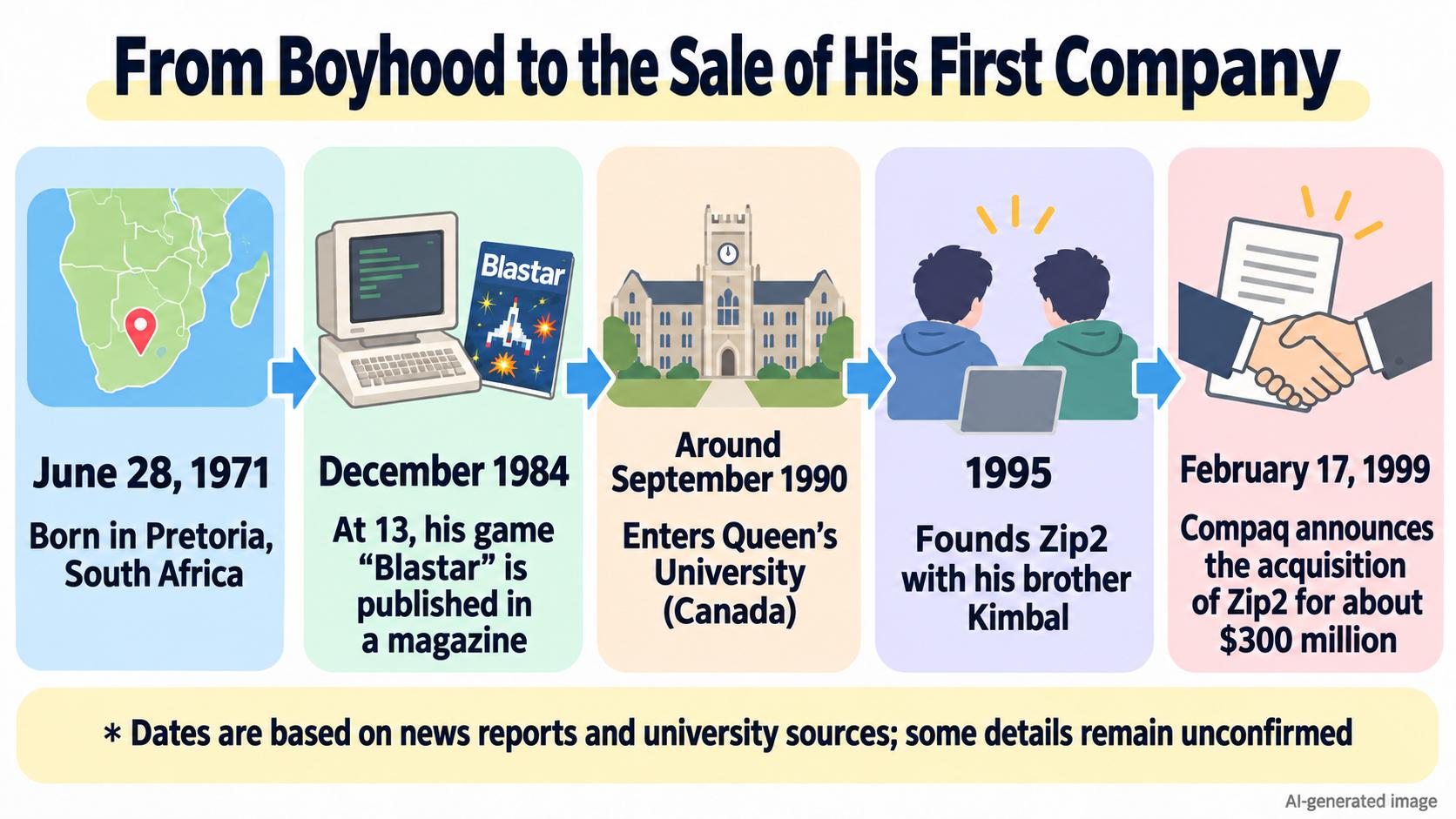
Elon Musk was born on June 28, 1971, in Pretoria, South Africa, and at 13 a game he wrote, "Blastar," was published in a magazine. He later moved to North America and, in 1995, founded his first company, Zip2, with his brother Kimbal. In 1999, Compaq acquired Zip2 for about $300 million.
This story starts with "a game made by a 13-year-old."
What kind of boy was the man who would go on to drive electric cars, rockets and many other businesses? And when, and in what form, did he start his first company?
This article follows him from boyhood to the sale of his first company, in order. Facts we could confirm in sources are kept apart from stories that are only "said to be" true.
1971, in Pretoria
Elon Musk was born on June 28, 1971, in Pretoria, South Africa (according to press reports). His mother, Maye Musk, is from Canada and his father, Errol Musk, from South Africa. He is the eldest son.
There are also reports that he was bullied as a boy. But these rest on his father's account, and we could not confirm the timing or the details. We do not go further into it here.
At 13, a game in a magazine
In December 1984, a space shooting game Musk wrote, "Blastar," was published in the computer magazine *PC and Office Technology*. Musk was 13 at the time (he is said to have written it at around 12).
The fact that it was "published in a magazine" is the part that is easy to check, because records of the game are public.
The famous story that he "sold it for $500" appears in biographical articles, but we could not confirm the payment or the amount in the magazine materials. So this article centers on the fact that "a game made by a 13-year-old was published in a magazine."
To North America, and to university
Musk then moved to North America.
- Around September 1990: he is said to have entered Queen's University in Kingston, Ontario, Canada.
- He then went on to the University of Pennsylvania in the United States, where he is said to have studied physics and economics (we could not confirm the year and month he earned his degrees from official university materials).
As for the year of his first move to Canada, some sources say 1988 and others record his entry to Queen's University in 1990, so it is not settled.
Physics and economics. The "physics way of thinking" (first-principles thinking) that Musk later talks about, and business experience. Keep in mind that he studied these two things at the same university (What is first-principles thinking?).
1995: his brother, and a first company
In 1995, Musk dropped his plan to study at Stanford University and started a company with his brother Kimbal. It was called Zip2, based in Silicon Valley, California.
It made an online city guide for newspapers. It combined information about local shops and facilities with maps and provided the service to newspaper companies. It was a business from the time when the internet was only beginning to spread.
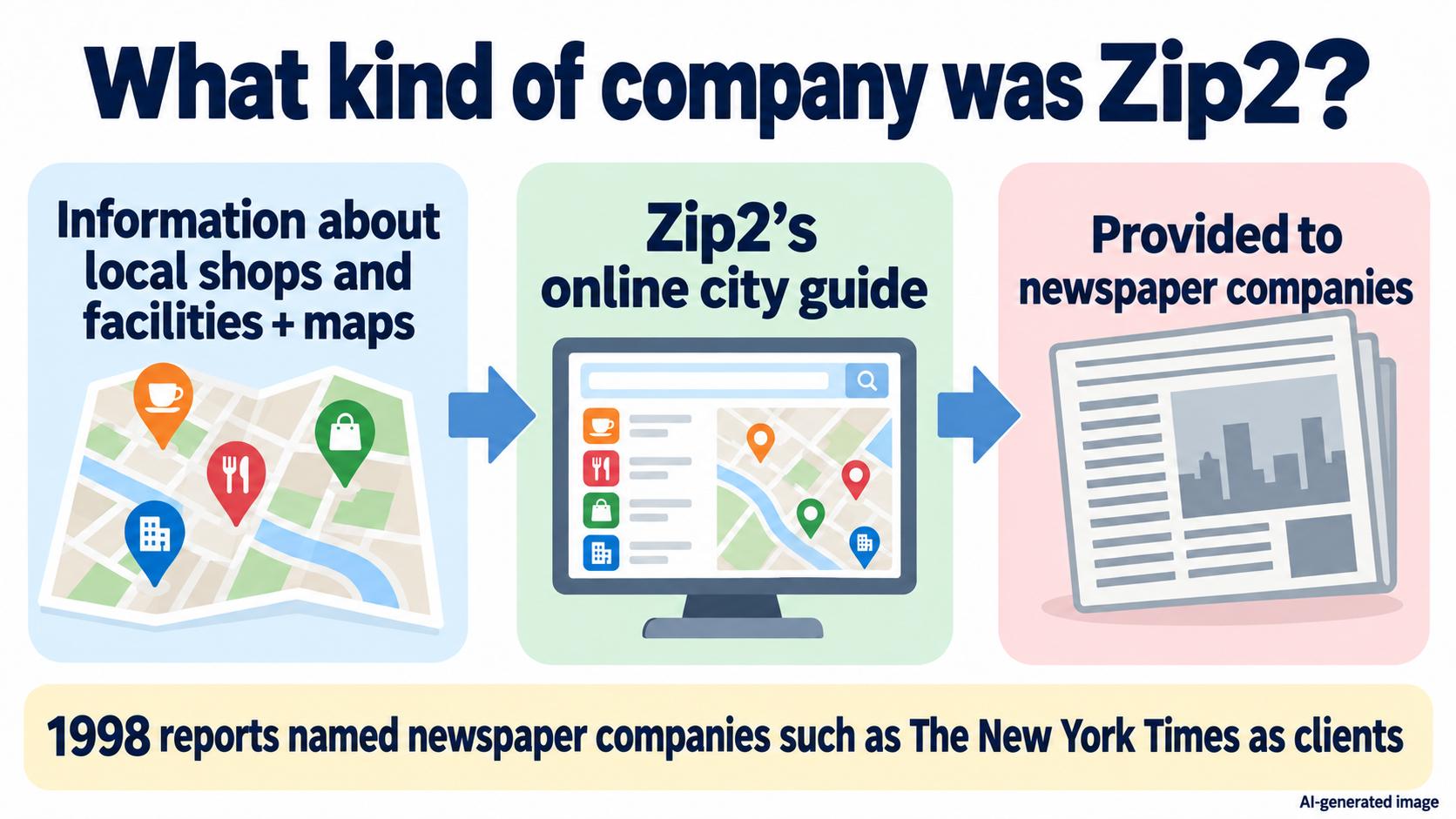
In 1998, press coverage (WIRED) named newspaper groups among Zip2's customers, including The New York Times, Knight-Ridder, Landmark Communications, Hearst, Times Mirror and Scripps Howard affiliates. It shows that a small company had deals with major newspapers.
According to the same report, on April 6, 1998, Zip2 announced a merger with another city-guide service, CitySearch. Under the merger plan, Musk was to become an executive in charge of products and technology. (We have not confirmed what became of this merger.)
As for the office and daily life in the early days, and the first customers, we could not find reliable sources in this research. There are famous anecdotes, but we include only what sources can back up.
1999: the first sale
Then, on February 17, 1999, Compaq announced it would acquire Zip2 for about $300 million in cash (reported by The Wall Street Journal). Zip2 was to be folded into Compaq's search business (AltaVista).
A company founded in 1995 became the target of a major acquisition in about four years.
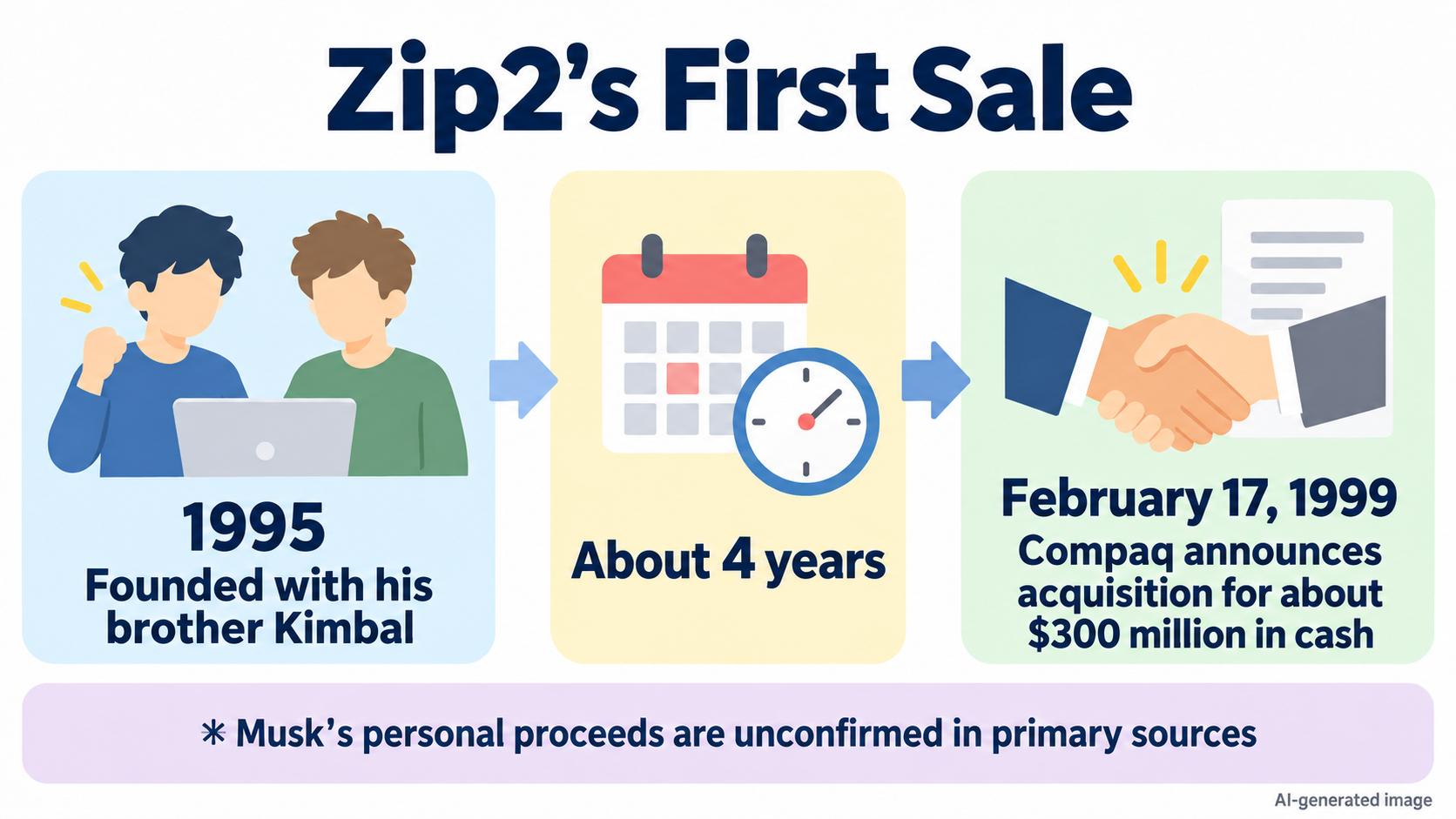
University publications give a figure of about $307 million for this sale, and say Musk received about $22 million from his roughly 7% stake. However, the amount Musk personally received is not confirmed in primary sources.
At 13 a game in a magazine, then physics and economics, then a company in his early twenties, sold after about four years. Rather than "doing one thing to the extreme," his path looks like learning, building and selling repeated in short cycles. But this is the author's interpretation from the outside.
The next article is about the company Musk built after selling Zip2. It was an online bank.
FAQ
Is it true he sold Blastar for $500?
That it was published in a magazine can be confirmed, but the magazine materials do not confirm the payment or the $500 figure.
When did Musk move to Canada?
Some sources say 1988 and others say he entered Queen's University in 1990, so it cannot be settled.
How much did Musk receive from the sale of Zip2?
The acquisition price of Zip2 is reported as about $300 million, but the amount Musk personally received is not confirmed in primary sources (a university publication mentions about $22 million).
Summary
- Born June 28, 1971, in Pretoria (press reports).
- December 1984, at 13: the game "Blastar" was published in a magazine. The $500 story is unconfirmed.
- Around 1990: Queen's University. Said to have studied physics and economics (dates unconfirmed).
- 1995: founded Zip2 with his brother Kimbal (an online city guide for newspapers).
- February 17, 1999: Compaq announced it would acquire Zip2 for about $300 million in cash (press reports).
Next: After selling Zip2, Musk founded an online bank, "X.com." What waited there was something unexpected.
Sources (checked 2026-10-11)
- Blastar (said to be published in *PC and Office Technology*, 1984): https://archive.org/details/blastar-elon-musk-spectravideo (the original for the publication month and payment is not sufficiently confirmed)
- Queen's Alumni Review, "Elon Musk" (February 1, 2013): https://www.queensu.ca/alumnireview/articles/2013-02-01/elon-musk
- WIRED, "Citysearch, Zip2 join forces" (April 1998): https://www.wired.com/1998/04/citysearch-zip2-join-forces/
- The Wall Street Journal, on Compaq's acquisition of Zip2 (February 17, 1999): https://www.wsj.com/articles/SB919181288287063500
- Report on his boyhood (based on his father's account): https://www.thestandard.com.hk/world/article/190786/Stern-South-African-childhood-fueled-Musks-ambition-says-father
This article is for learning about science, technology and corporate history, and is not investment advice. Facts and the author's interpretation are kept separate. Figures are AI-generated illustrations.