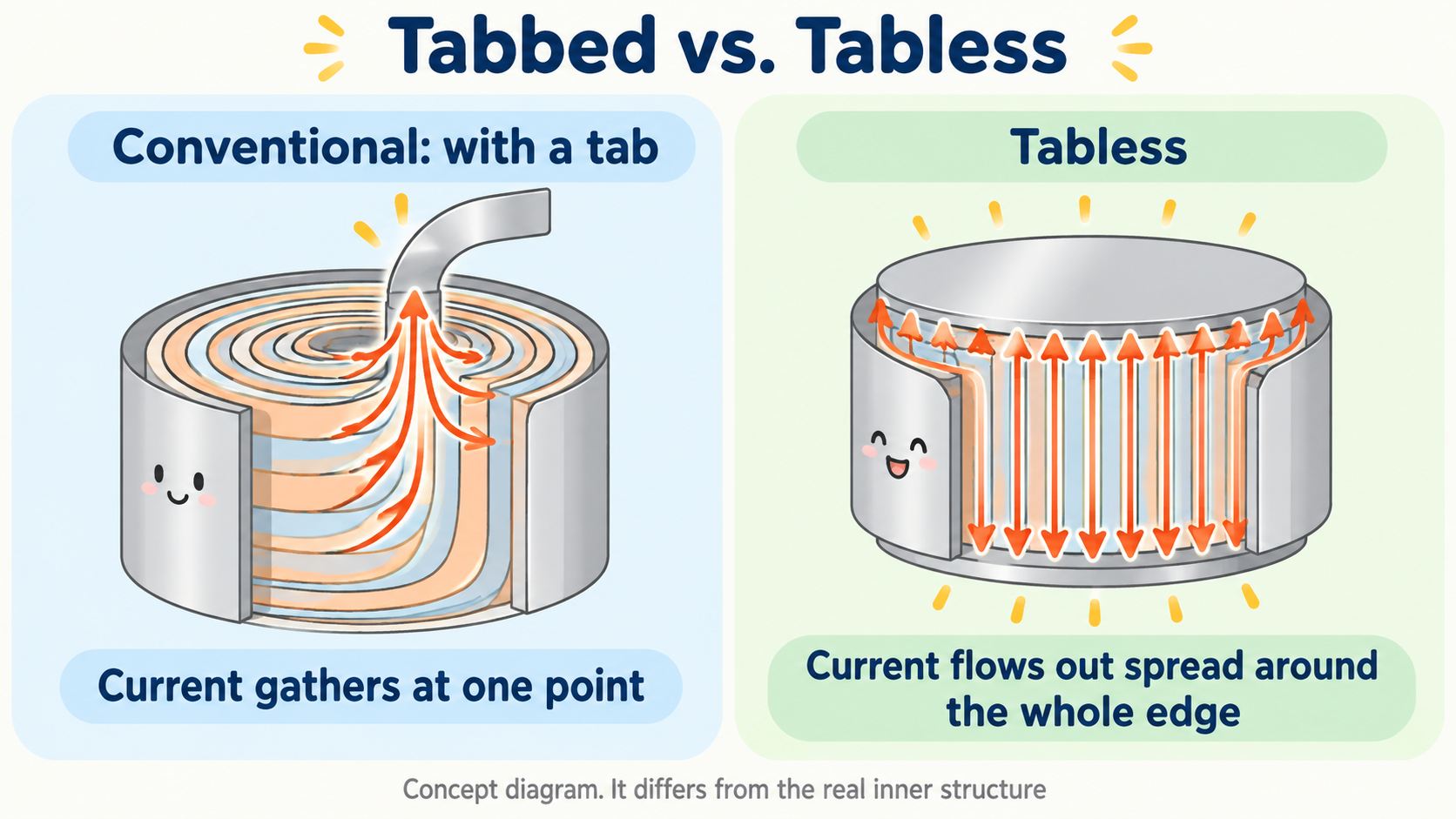
In a tabless cell, the metal strip (tab) that carries current out of the electrode is removed. Small protrusions (flags) at the edge of the electrode are welded directly to the upper and lower collector plates, so current flows out from the whole edge. Tesla's patent US11749842B2 (granted September 5, 2023) says removing the negative tab reduces the ohmic resistance from the negative electrode to the can. But we could not confirm measured values for real cells.
In the previous article, What is Tesla's 4680 cell?, we saw that a bigger cell traps heat more easily. What Tesla paired with it is tabless. In this article we explain what tabless is, checking against Tesla's patents.
The conclusion: tabless spreads the current's exit from one point to the whole edge
Inside a battery cell is a jelly roll: thin electrode strips wound up in a spiral. There are two ways to take current out of this roll.
| Conventional (with tabs) | Tabless | |
|---|---|---|
| How current is taken out | A metal strip (tab) comes out of part of the electrode strip and is connected to a terminal or the can | Small protrusions (flags) made at the electrode's edge are connected directly to the upper and lower collector plates |
| The current's path | Current gathers at the tab, one point | Current flows out spread across the whole edge |
Tesla's patent describes the tabless-electrode cell like this.
"This reduces ohmic resistance through the negative electrode to the can."
(This lowers the ohmic resistance, the difficulty of current flow, from the negative electrode to the can.) — International application WO2020096973A1, paragraph [0047], explaining the effect of removing the negative tab
What is a conventional "tab"?
In conventional cylindrical cells (such as the 18650 and 2170), a metal strip called a tab is welded to the wound electrode to carry current to a terminal or the can. The tab is a narrow path for current, and because current gathers at one point, electrical resistance and heat are thought to concentrate there (this is a general explanation).
In a small cell this is not much of a problem. But in a big cell like the 4680, the electrode strip is longer and the distance to the tab gets longer.
How tabless works
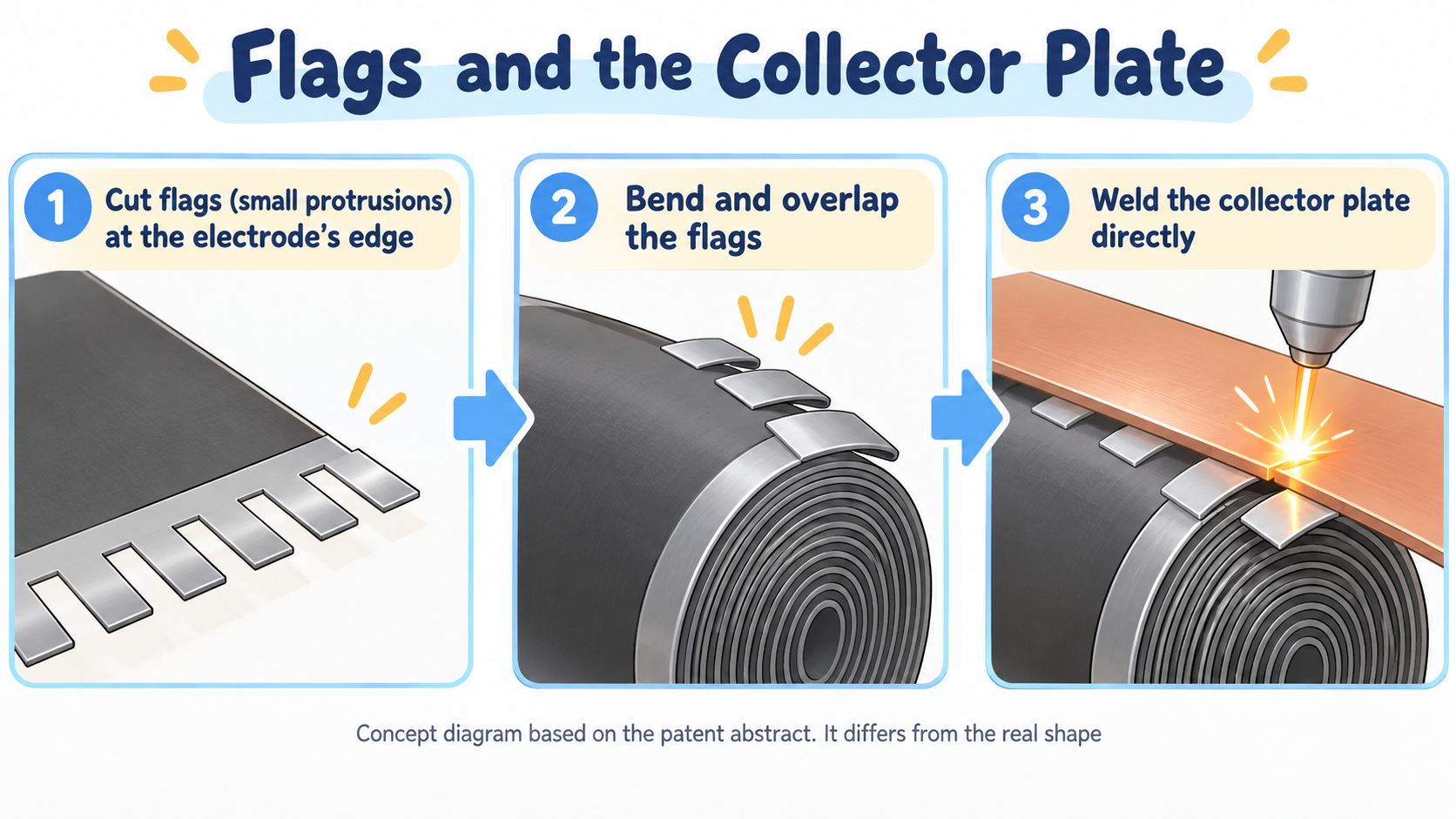
The abstract of Tesla's U.S. patent application publication US20230402722A1 (published December 14, 2023) explains it like this.
- A tabless structure has no tabs connecting the roll to the can.
- Flags (flag-like protrusions) are cut, bent and interleaved at the electrode's edge. They become connection points to the upper and lower collector plates.
- The collector plates are welded directly to the flags.
So the whole edge of the roll touches a collector plate. Because current does not gather at one tab but flows out spread around the whole edge, the current's paths seem to be shorter and more spread out.
Tesla's patents: has one been granted?
We checked Tesla's main tabless patents on Google Patents.
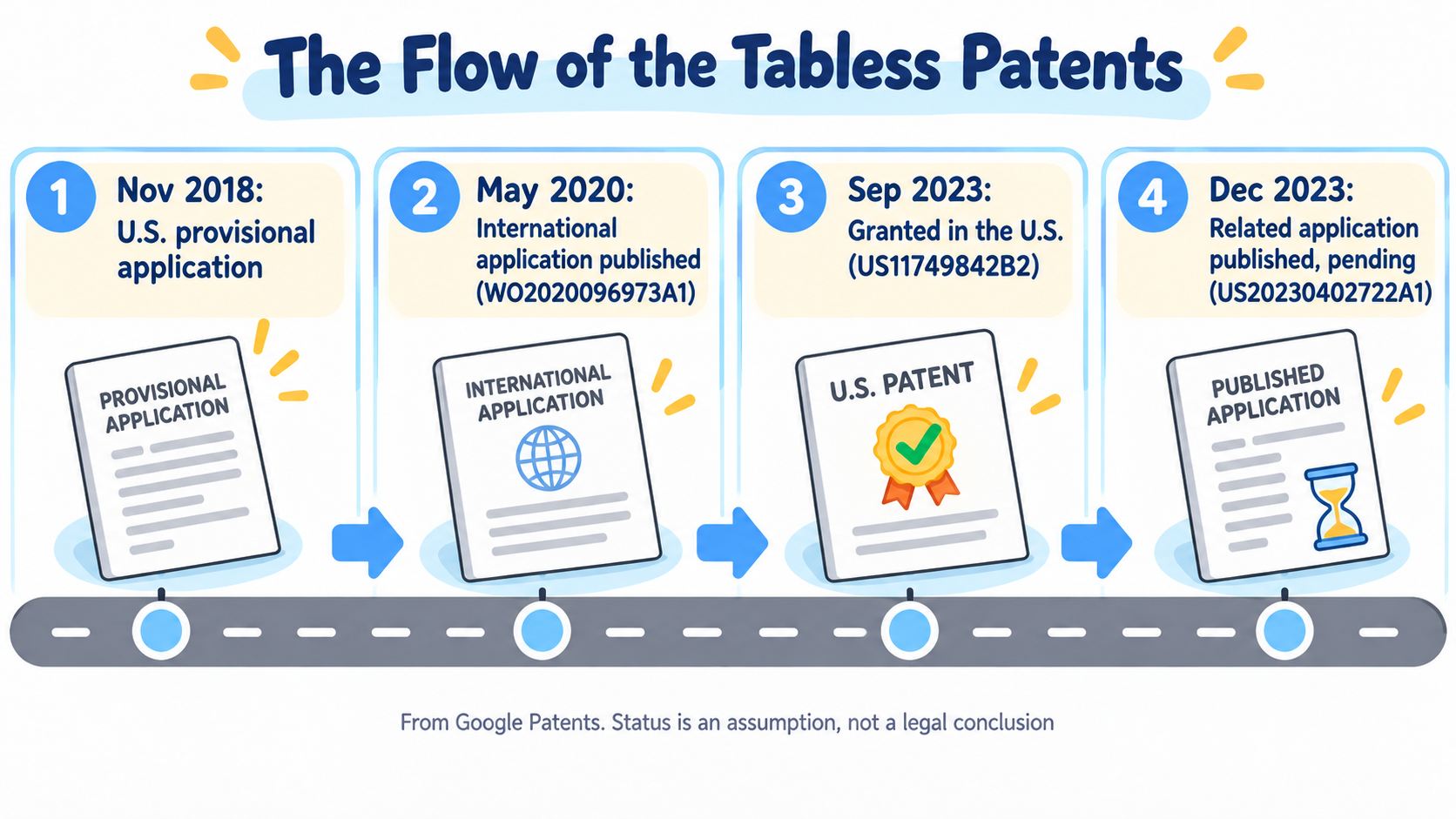
| Number | Title | Published / granted | Status (Google Patents) |
|---|---|---|---|
| US11749842B2 | Cell with a tabless electrode | Granted September 5, 2023 | Active |
| WO2020096973A1 | A cell with a tabless electrode | Published May 14, 2020 (international application) | "Ceased" (a general display for international applications, which are eventually continued in each country) |
| US20230402722A1 | Battery cell with a tabless electrode | Published December 14, 2023 | Pending |
- The applicant of all of them is Tesla, Inc. The inventors of WO2020096973A1 include Kunio Tsuruta (three inventors in all). The priority date is November 5, 2018 (a U.S. provisional application).
- The "Ceased" display for WO2020096973A1 is the usual treatment of an international (PCT) application. US11749842B2, in the same family, was granted in the U.S.
- Google Patents notes that the status display is an assumption, not a legal conclusion.
Tesla's claims, and what we could not confirm
About Battery Day in September 2020, a report (Electrek, September 22, 2020) calls the 4680 cell the "first tabless cylindrical cell design" and says it is Tesla's answer to the heat problem of big cells.
But we could not confirm the following in this article.
- The original text of the official Battery Day materials (slides).
- Measured values for how much internal resistance and heat actually fell with tabless. We could not find published measurement data from universities or research institutes.
- Whether other manufacturers have adopted tabless.
From the patent's wording we can read the idea that "spreading the current's exit from one point to the whole edge lowers resistance." But we could not confirm how large the effect is in real batteries. We cannot say "tabless is therefore safe" or "tabless therefore charges faster."
FAQ
What is tabless?
A structure that removes the metal strip (tab) that carries current out of a battery's electrode, and connects the whole edge of the electrode directly to a collector plate.
What gets better with tabless?
Tesla's patent explains that removing the negative tab lowers the electrical resistance from the negative electrode to the can. We could not confirm numerical effects in real cells in this article.
Has the tabless patent been granted?
U.S. patent US11749842B2 was granted on September 5, 2023 (shown as active on Google Patents). The related application US20230402722A1 is pending.
Is tabless technology unique to Tesla?
We could not confirm it in this article. We could not confirm other companies' adoption from official announcements.
Summary
- Tabless means removing the tab and taking current from the whole edge of the electrode. The flags at the electrode's edge are welded directly to collector plates (abstract of patent application US20230402722A1).
- Tesla's patent says removing the negative tab lowers the "ohmic resistance from the negative electrode to the can" (WO2020096973A1).
- U.S. patent US11749842B2 was granted on September 5, 2023. A related application is pending.
- Measured internal resistance and heat in real cells, adoption by others, and the original text of the Battery Day materials are unconfirmed.
Next: we will look, in order, at what is inside a battery pack, which protects the cells (coming soon).
Sources (checked 2026-10-14)
- U.S. Patent US11749842B2, "Cell with a tabless electrode" (Tesla, Inc., September 5, 2023): https://patents.google.com/patent/US11749842B2/en
- International application WO2020096973A1, "A cell with a tabless electrode" (Tesla Inc., published May 14, 2020): https://patents.google.com/patent/WO2020096973A1/en
- U.S. Patent Application Publication US20230402722A1, "Battery cell with a tabless electrode" (Tesla Inc., published December 14, 2023): https://patents.google.com/patent/US20230402722A1/en
- Electrek (September 22, 2020, Fred Lambert), "Tesla unveils new 4680 battery cell: bigger, 6x power, and 5x energy": https://electrek.co/2020/09/22/tesla-4680-battery-cell-bigger-power-energy/
This article is for learning about science and technology, and is not investment advice. Facts and the author's interpretation are kept separate. Figures are AI-generated illustrations.