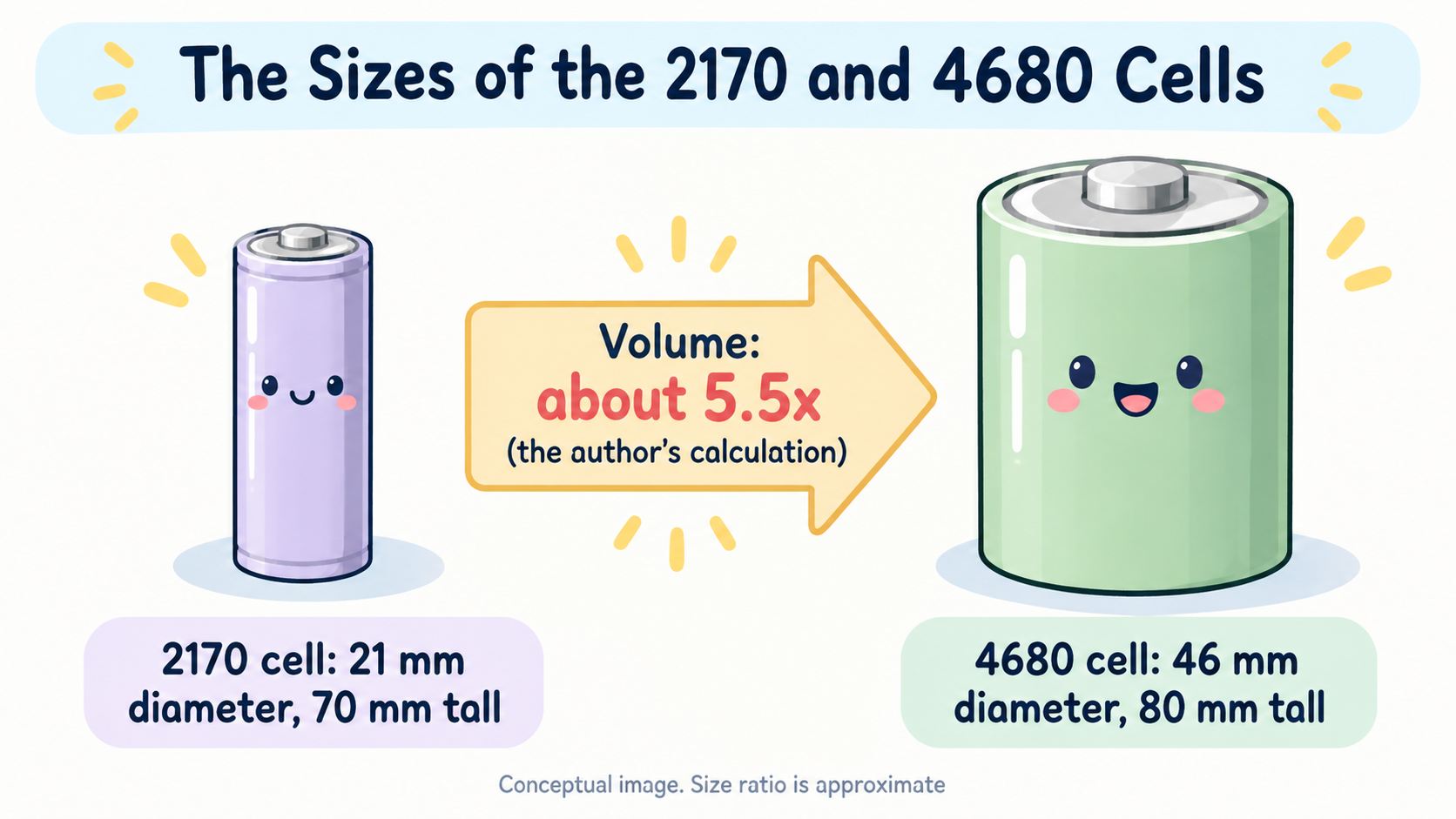
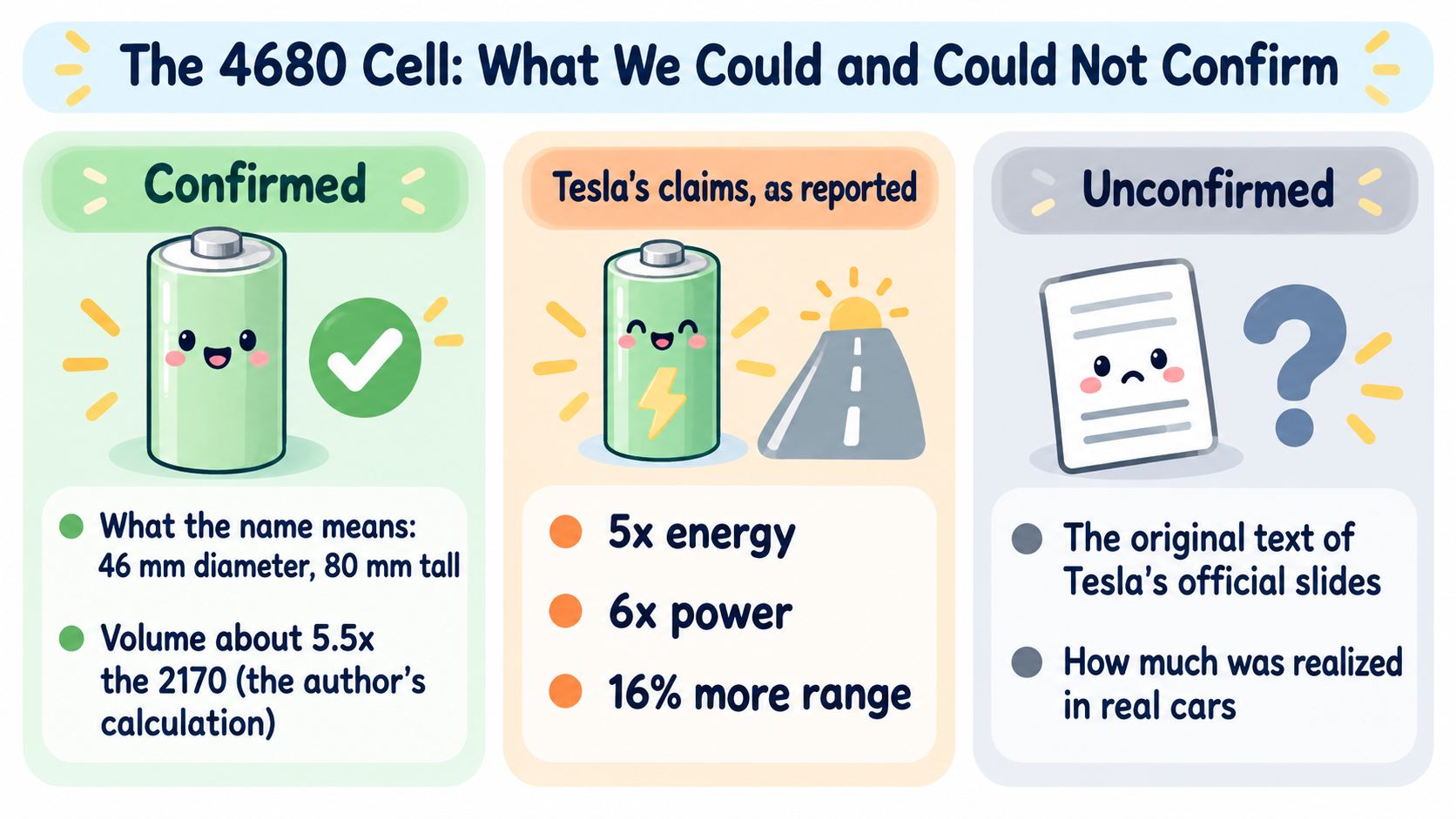
The 4680 cell is a cylindrical battery 46 mm in diameter and 80 mm tall; the numbers in the name are its size. Compared with the older 2170 cell (21 mm by 70 mm), its volume is about 5.5 times larger (the author's calculation). Press reports say Tesla claimed at its 2020 Battery Day that it would bring 5x the energy, 6x the power and 16% more range, but we could not confirm the original Tesla slides.
What is the 4680 cell? In Part 1, in Why are batteries expensive?, we saw that a battery's price is built up from its materials. One path Elon Musk chose to make batteries cheaper, in larger numbers, was making the cell itself bigger. That is the 4680 cell.
The conclusion: the 4680 is a big cylindrical cell, 46 mm wide and 80 mm tall
The name 4680 means 46 mm in diameter and 80 mm tall. The 2170 cell Tesla used until then reads, from its name, as 21 mm in diameter and 70 mm tall.
Comparing the sizes (the volume of a cylinder is the area of the base circle times the height; this is the author's calculation):
| 2170 cell | 4680 cell | Ratio | |
|---|---|---|---|
| Diameter | 21 mm | 46 mm | about 2.2x |
| Height | 70 mm | 80 mm | about 1.1x |
| Base area | about 346 mm² | about 1,662 mm² | about 4.8x |
| Volume | about 24.2 cm³ | about 132.9 cm³ | about 5.5x |
(Base area = π × (diameter ÷ 2)², volume = area × height. A battery's inside is not empty space, so the ratio of real capacity is not necessarily the same as the ratio of volume.)
Why make it bigger? Tesla's claims
At Battery Day on September 22, 2020, Tesla unveiled the 4680 cell. According to a report (Electrek, September 22, 2020, by Fred Lambert), Tesla's claims were as follows.
| Item | Tesla's claim (as reported) |
|---|---|
| Energy per cell | 5x |
| Power | 6x |
| Range | 16% more, from the change in cell form alone |
| Cost (per kWh) | 14% lower (at the cell-form level only) |
The same report also says that Tesla did not claim an improvement in energy density (the energy stored per unit of volume). So it can be read this way: one cell becomes bigger, so the energy per cell is 5x; it is not that the battery's performance becomes 5x at the same size (this is a reading of the report and the author's interpretation).
The numbers above are not something I confirmed directly in the original text of Tesla's Battery Day materials (the slides). I could not reach an official page, so this is Tesla's claims as introduced through a press report (Electrek). We keep it separate from "what we could confirm."
What does bigger give you? (a general explanation)
Each battery cell needs its own case, terminals and protection parts. If cells are bigger, the same capacity needs fewer cells, so fewer parts and assembly steps are thought to be needed (this is a general explanation, not a figure Tesla officially showed).
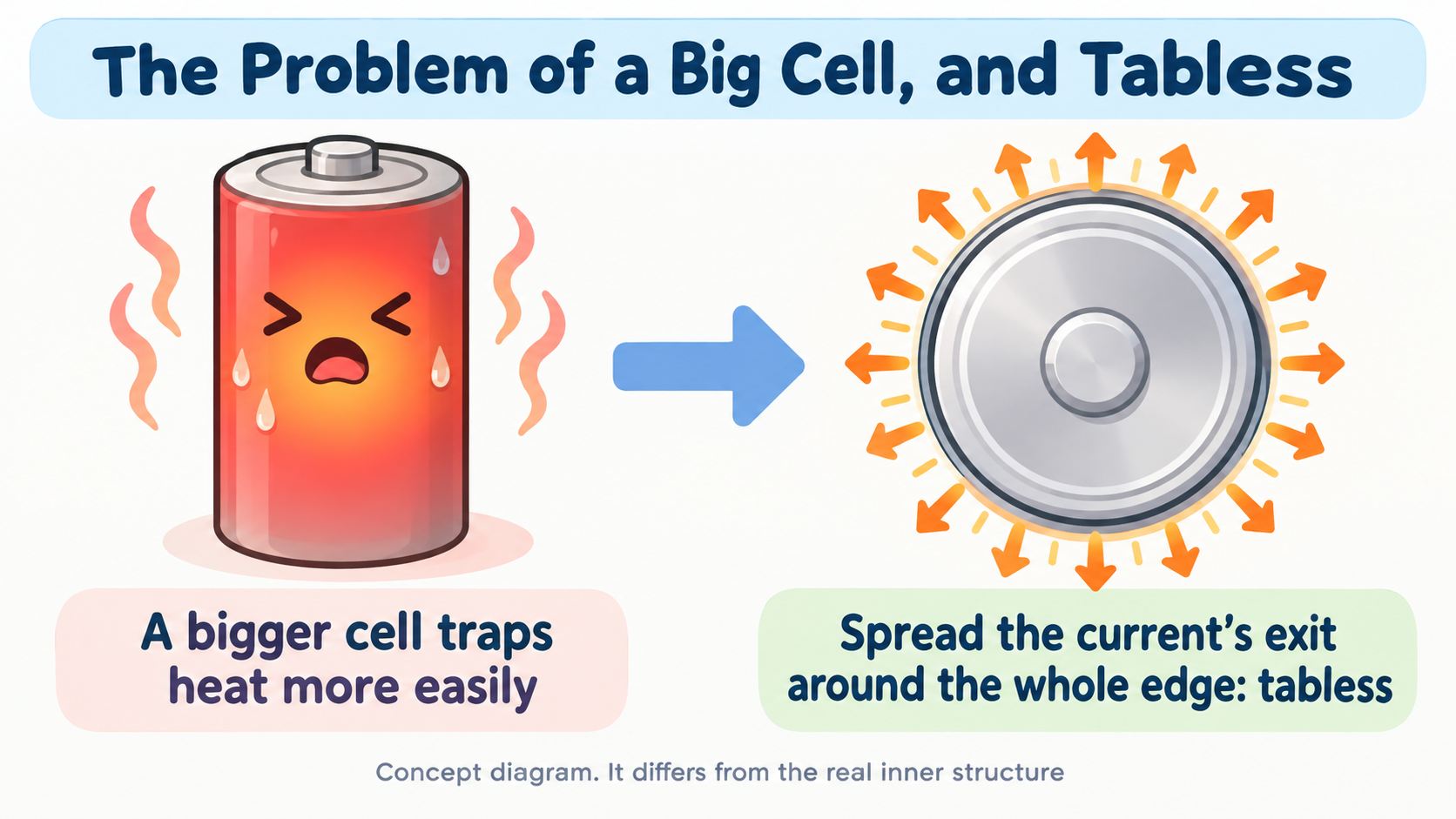
But big cells have a problem too: heat is easily trapped. Tesla paired it with a structure that removes the current's entry and exit points (tabs), called tabless. We explain it in the next article.
→ Next: What is the "tabless" design of Tesla's 4680 cell?
Is it actually used in cars?
How many Tesla cars use 4680 cells today, and in which models, is something we could not confirm from Tesla's official materials for this article. Press reports said that in 2024, earnings-call remarks covered the production of 4680 cells for the Cybertruck. But that came through reports, not official documents we confirmed, so we do not write about it in detail.
"Make the battery bigger and cut the parts" resembles Episode 6's idea of "making the body from one large part." Both look like doubting the approach of combining many small parts. This is my way of seeing it, not Tesla's own explanation.
FAQ
What does "4680" mean?
46 mm in diameter and 80 mm in height. 2170 means 21 mm in diameter and 70 mm in height.
How many times the capacity of a 2170 cell is a 4680 cell?
Its volume is about 5.5 times (the author's calculation). Tesla reportedly said the energy per cell would be 5x. Actual capacity changes with the battery's contents and design, so it is not necessarily the same as the volume ratio.
Who makes the 4680 cell?
We could not confirm it in this article. Tesla announced it at Battery Day, but we could not confirm the actual manufacturing situation (in-house production or purchase from others).
Did the 4680 cell raise range by 16%?
"A 16% range gain from the change in cell form alone" is reported as Tesla's 2020 claim. We could not confirm in this article whether real cars achieved that number.
Summary
- The 4680 cell is a cylindrical battery 46 mm in diameter and 80 mm tall. Compared with the older 2170 cell (21 mm by 70 mm), its volume is about 5.5 times (the author's calculation).
- At Battery Day in 2020, Tesla reportedly claimed 5x energy, 6x power, 16% more range and 14% lower cost (at the cell-form level) (Electrek). Tesla did not claim better energy density.
- Big cells trap heat more easily. The countermeasure is the tabless structure (next article).
- The original text of Tesla's official slides and how much was realized in real cars are unconfirmed.
Next: we will go through "tabless," the mechanism that solves the 4680 cell's heat problem, in order.
Sources (checked 2026-10-14)
- Electrek (September 22, 2020, Fred Lambert), "Tesla unveils new 4680 battery cell: bigger, 6x power, and 5x energy": https://electrek.co/2020/09/22/tesla-4680-battery-cell-bigger-power-energy/
This article is for learning about science and technology, and is not investment advice. Facts and the author's interpretation are kept separate. Figures are AI-generated illustrations.