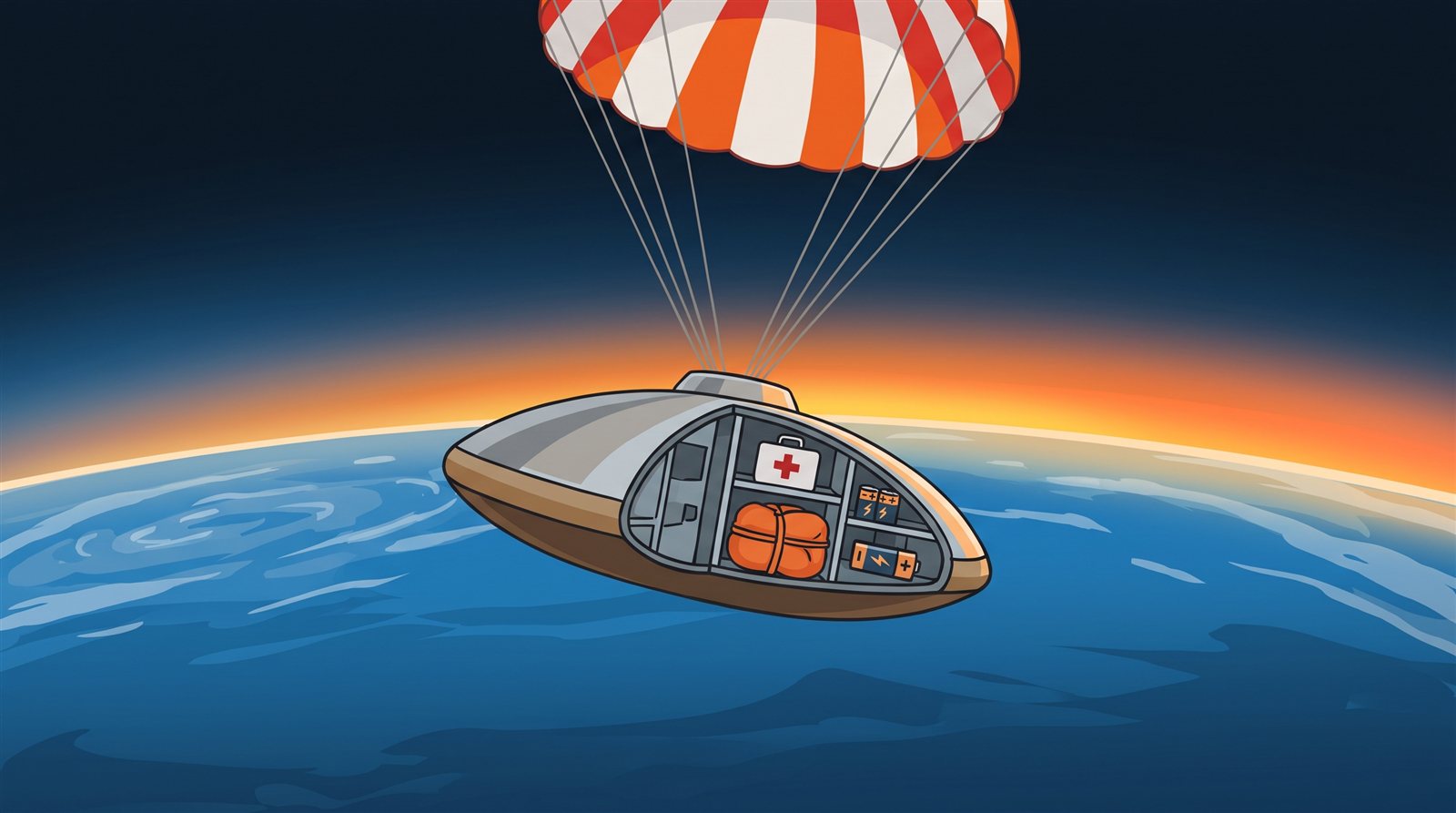
The Air Force Research Laboratory (AFRL) flew its "agile cargo pods" inside SpaceX's Starfall return capsule on a rideshare launched from Cape Canaveral on October 20, 2026. The pods held a satellite-communications tracker, batteries, a seawater desalinator and emergency medical gear, and recorded temperature, shock and vibration during launch and reentry. The pods were reported recovered after splashing down in the Pacific.
Summary in 3 lines
- On a rideshare launched from Cape Canaveral Space Force Station on October 20, 2026, AFRL flew cargo pods inside SpaceX's "Starfall" return capsule as a "Rocket Cargo" test.
- The pods carried a SATCOM tracker, batteries, a reverse-osmosis desalinator, survival gear and emergency medical equipment, and logged temperature, shock and vibration through launch and reentry.
- Rocket Cargo studies whether rockets can deliver supplies anywhere in the world quickly. This test checks the first step: whether cargo survives the round trip.
Background: what does "shipping by rocket" mean?
Rockets usually leave satellites in space. Rocket Cargo is different: launch from point A on the ground, travel through space, and set cargo down at point B. This is called point-to-point delivery, using space as the route instead of the sky.
A quick calculation shows why it is fast. Earth's circumference is about 40,000 km, so the far side is about 20,000 km away. Low-orbit speed is about 7.8 km/s. 20,000 km ÷ 7.8 km/s is about 2,560 seconds, or about 43 minutes. A jet at about 900 km/h needs 20,000 ÷ 900, about 22 hours. These are rough figures, but they differ by more than ten times.
Speed has a price. The cargo passes through three harsh environments that an ordinary freight flight never sees.
First, vibration. During launch, engine combustion and turbulent air shake the vehicle hard and fast. That can loosen solder joints and screws in electronics.
Second, temperature. Coming back, the capsule slows from about 7.8 km/s. That energy is about 30 million joules per kilogram, mostly turned into heat (worked out in the earlier article). The heat shield protects the outside, but how hot the cargo gets inside has to be measured.
Third, shock. When parachutes open and when the capsule hits the water, short, strong forces act on everything. They are measured in g (multiples of gravity). At 5 g, a 1 kg battery is pressed down for an instant as if it weighed 5 kg.
So the first question for Rocket Cargo is not "does it arrive fast?" but "does the cargo arrive usable?" This test measured exactly that.
What happened
According to AFRL's release (dated October 20, 2026, posted on DVIDS October 21), AFRL tested Rocket Cargo point-to-point delivery on a commercial rideshare launched from Cape Canaveral Space Force Station on October 20. That launch was the Falcon 9 rideshare "Bandwagon-5," which carried the second Starfall demonstration.
The test, per AFRL:
| Item | Details |
|---|---|
| Capsule | SpaceX Starfall, instrumented for temperature, shock and vibration |
| Container | AFRL "agile cargo pods" |
| Contents | SATCOM-enabled tracker, batteries, reverse-osmosis desalinator, survival gear, emergency medical equipment |
| Inside each pod | Representative equipment and environmental sensors |
| Extra check | Fit check of a UNI-PAC III life raft inside the capsule for future tests |
Air & Space Forces Magazine (October 26) reported that AFRL said in an October 26 social media post that the pods were recovered after splashing down in the Pacific. AFRL did not disclose how many pods flew or how much equipment they held.
Adam Remaly, director of the AFRL Technology Transition Office, called the launch a "critical achievement" for point-to-point rapid global mobility.
Why it matters
Return capsules have so far carried a narrow set of items, such as research results from space stations. What is new here is that a military research lab put the things it actually wants to deliver into a capsule and measured the environment on a real flight.
The choice of contents is telling. The tracker and batteries test whether electronics survive; the desalinator and medical kit stand in for supplies that must work immediately for survivors or disaster zones. The life-raft fit check points to a next step: delivering rafts to people stranded at sea.
Background: the Rocket Cargo program
AFRL started Rocket Cargo in 2021. In June 2021 the Department of the Air Force named it the fourth "Vanguard" program, with the U.S. Space Force as lead service. The aim is to find out whether large commercial liquid-propellant rockets can deliver materiel anywhere on the globe on tactical timelines.
AFRL says the key difference from other options is capacity of tens of tons per launch. Uses it lists include supplying sites without runways or roads, rescue, disaster relief, and response to chemical, biological, radiological and nuclear (CBRN) hazards.
How it works: why test on Starfall
Starfall is SpaceX's uncrewed return capsule. Reporting based on the FAA's May 2026 environmental assessment gives a diameter of about 3.1 m, height of about 0.75 m, mass of about 2,100 kg and about 1,000 kg of payload capacity. The flat disk shape catches a lot of air to slow down.
Rocket Cargo's end goal is to move tens of tons on a large rocket like Starship. Testing on such a big vehicle right away would be costly and risky. Putting a small capsule on a rideshare that is flying anyway collects "does the cargo survive?" data cheaply.
| Stage | What it checks |
|---|---|
| This test (Starfall) | Whether cargo survives launch, reentry and splashdown |
| Next candidate (per AFRL) | Real items such as a life raft |
| Program goal | Tens of tons per launch on large rockets |
Timeline
- June 2021: The Department of the Air Force names Rocket Cargo its fourth Vanguard.
- 2022: SpaceX wins the first Rocket Cargo contract (reported as five years, $102 million). Blue Origin, Sierra Space, Rocket Lab and others later join.
- May 2026: The FAA finds no significant environmental impact for two Starfall reentries into the Pacific.
- June 23, 2026: The first Starfall demo launches and splashes down in the Pacific.
- October 20, 2026: Second demo on Bandwagon-5, carrying AFRL cargo pods.
- October 26, 2026: AFRL reportedly announces the pods' recovery in the Pacific.
AFRL says it is now working with SpaceX, Blue Origin, Rocket Lab, Sierra Space, Anduril, Inversion Space and Outpost Space.
How to explain it to a friend
- Rocket Cargo is "delivery through space." The far side of Earth is, on paper, under an hour away.
- The first hurdle is not speed but whether the cargo survives: vibration (launch), heat (reentry) and shock (parachutes and splashdown).
- This test measured all three on a small capsule before trying large rockets.
My take
Starfall has been described as a capsule for bringing products made in space back to Earth. This test also used it for the opposite job: sending things from the ground through space. Testing two markets with one vehicle is, I think, an advantage of flying rideshares almost monthly.
A question to continue
If a vehicle is to carry tens of tons, how would something as large as Starship land safely at a site with no runway?
Read next
- SpaceX's Starfall return capsule flies its second demo (how cargo comes back from space)
- The day a rocket landed standing up
- Are rockets really expensive?
Sources
- AFRL, "AFRL Demonstrates Rocket Cargo Delivery with SpaceX Starfall Reentry Capsule" (October 20, 2026) → https://www.afrl.af.mil/News/Article-Display/Article/4629122/afrl-demonstrates-rocket-cargo-delivery-with-spacex-starfall-reentry-capsule/
- DVIDS (same release, October 21, 2026) → https://www.dvidshub.net/news/577476/afrl-demonstrates-rocket-cargo-delivery-with-spacex-starfall-reentry-capsule
- Air & Space Forces Magazine (October 26, 2026) → https://www.airandspaceforces.com/afrl-rocket-cargo-spacex-demonstration/
*Verification status (2026-10-29): The test and its contents are confirmed in AFRL's release. The pods' recovery in the Pacific and the 2022 contract value are based on Air & Space Forces Magazine's reporting. Measured values (temperature, shock, vibration) have not been published.
Thank you for reading. Was this article useful to you?
Thank you. If you like, tell us what you thought in a line or two.
Optional. No name or email needed.
Received. We will use your words to make better articles.