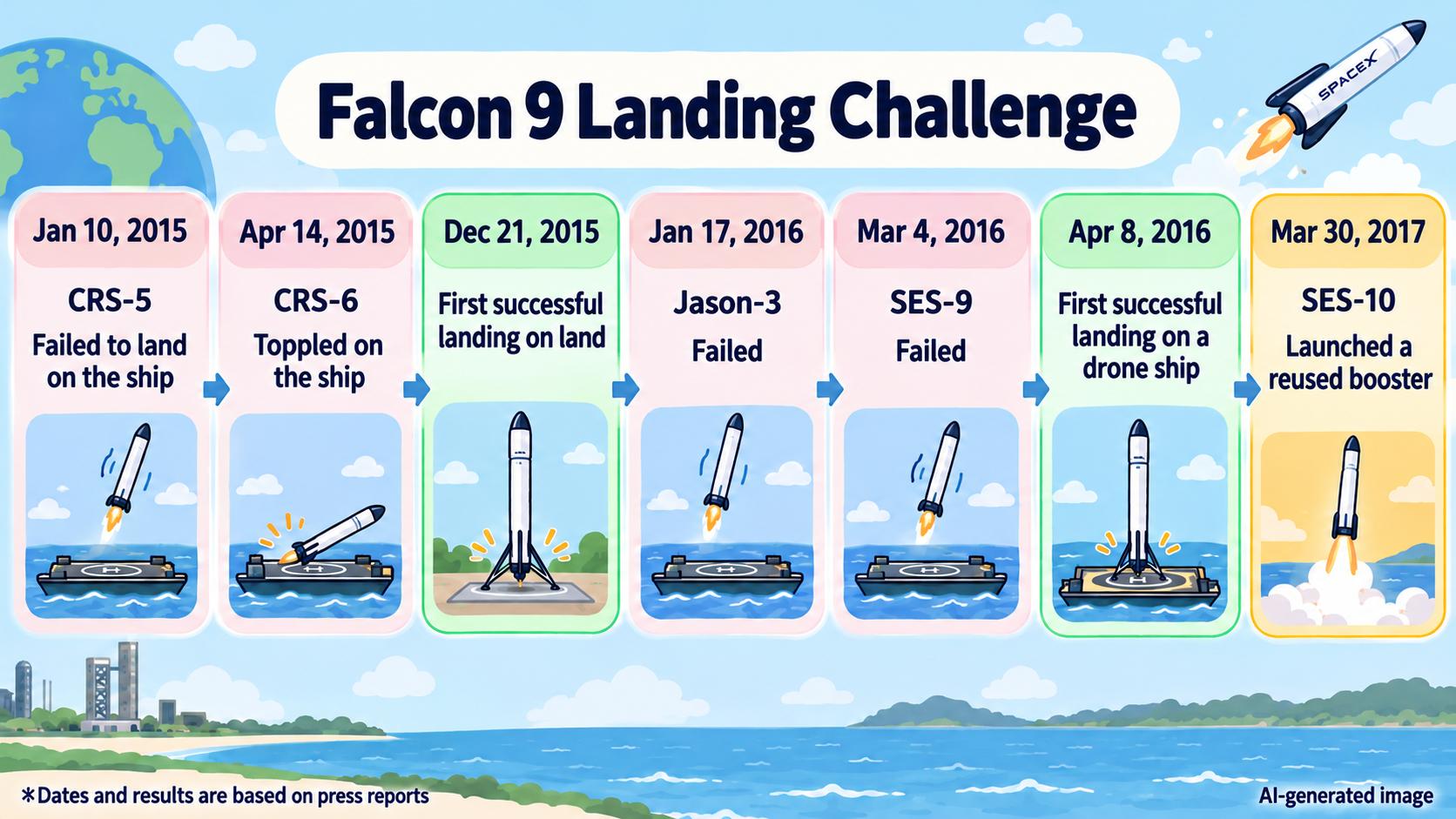
From January 2015 to March 2016, SpaceX failed four times to land a Falcon 9 first stage on a ship at sea. Even so, on December 21, 2015, it landed one on the ground for the first time. On April 8, 2016, it landed on a drone ship, and on March 30, 2017, it launched that same booster again.
A rocket that has gone up toward the sky finishes its job, and comes back down to the ground, standing on its tail.
It is a familiar sight in videos today, but until the early 2010s, the first stage of a rocket was thrown away as a matter of course. As we saw in the previous article, SpaceX reached orbit with Falcon 9 and delivered Dragon to the space station. What Musk took on next was flying a launched rocket again.
This article follows the landing failures and successes of 2015 to 2017, in order.
Why bring a rocket back down?
In Episode 3, we saw Musk say that a rocket's raw materials are only a small part of its price (his own explanation, not confirmed by third parties). He talked about the meaning of reuse along the same lines.
On March 30, 2017, right after the landing of a reused booster, Musk is reported to have said the following in effect (Scientific American).
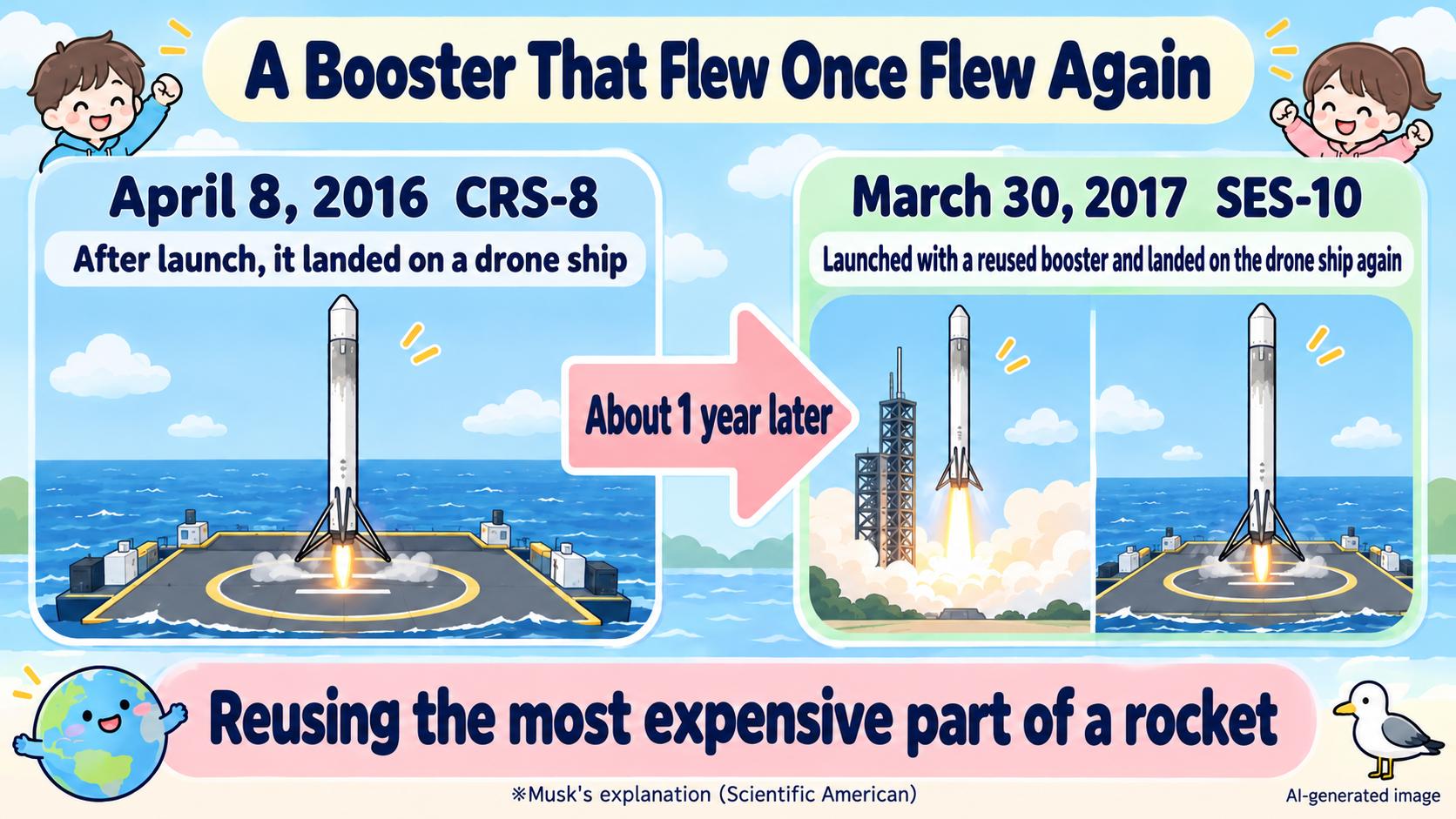
Reuse means you can fly an orbit-class booster, the most expensive part of the rocket, over and over.
Throwing it away is like discarding the aircraft after every single flight. If you can reuse the most expensive part, the price of a launch should go down. That is why he took on landing.
Setting the first stage down on a "ship"
Let me explain the "first stage" here. A rocket is divided into two parts (stages). The lower first stage burns through its fuel in the first few minutes of the launch and is cut away. Usually it just falls into the sea.
SpaceX thought of having this first stage turn itself around, relight its engines, and descend slowly, upside-down, onto the ground or a ship at sea. To land on the ground, the stage only needs to return near the launch site. But on launches carrying heavy satellites, there is little fuel to spare, and it cannot get that far. So SpaceX chose an unmanned ship floating on the ocean (a drone ship) as the landing place.
January 10, 2015, CRS-5 — the first try on a "ship"
The first attempt came on January 10, 2015, on a launch sending Dragon to the International Space Station (CRS-5). The first stage aimed for a drone ship floating in the Atlantic.
It failed. In a later article, CBS News wrote that this first attempt "crashed onto the barge because of a hydraulic system failure." Musk himself is reported to have explained that the hydraulic fluid for the grid fins (small lattice-shaped wings that steer the stage during descent) ran short just before landing (from a Space.com headline; I could not confirm the body text).
April 14, 2015, CRS-6 — it stood, and then it fell
The second came on April 14, 2015. Before launch, Musk put the chance of success at about 50% (Spaceflight Now).
This time the first stage reached the drone ship. But it touched down with sideways motion still left, and is reported to have wavered, toppled and exploded. The same article says it came closer to success than the earlier attempts at sea.
On the cause, Musk posted the following on April 18.
The hard landing was confirmed to be caused by the throttle valve, which adjusts engine power, responding more slowly than expected. The next attempt is in two months.
(Original: "slower than expected throttle valve response," quoted by Spaceflight Now.)
December 21, 2015 — standing on the ground for the first time
Then, December 21, 2015.
The launch, from Cape Canaveral Air Force Station in Florida, carried 11 communications satellites for ORBCOMM. After sending the satellites on their way, the first stage landed vertically on four deployed legs at "Landing Zone 1," near the launch site (CBS News). It is a place that used to be a launch complex for Atlas intercontinental ballistic missiles.
Musk is reported to have said that everything he had seen in the mission so far looked perfect, and that they could not have asked for a better mission. The booster is also said to have come down almost dead center on the pad.
The first stage of a rocket that had gone to space (and sent satellites into orbit) came down to the ground and stood. It was the day the "possibility" of landing first became real.
January and March 2016 — landing on a ship fails again
But landing on a "ship" was not so easy.
January 17, 2016 (Jason-3). The weather satellite Jason-3 was launched from Vandenberg Air Force Base on the U.S. West Coast. The first stage came down on a ship about 200 miles west of San Diego, but one leg broke and it toppled (Associated Press). Musk tweeted, in effect, that the touchdown speed was fine, but a leg lock did not latch, so it fell over after landing.
March 4, 2016 (SES-9). On a launch carrying a satellite to a very high orbit, there was little fuel to spare and the stage came back fast. The first stage landed hard on the ship and failed. It was the fourth failure at landing on a ship (Fortune). Musk posted, in effect, that he did not expect this one to work (the reentry was very hot), but the next flight had a good chance.
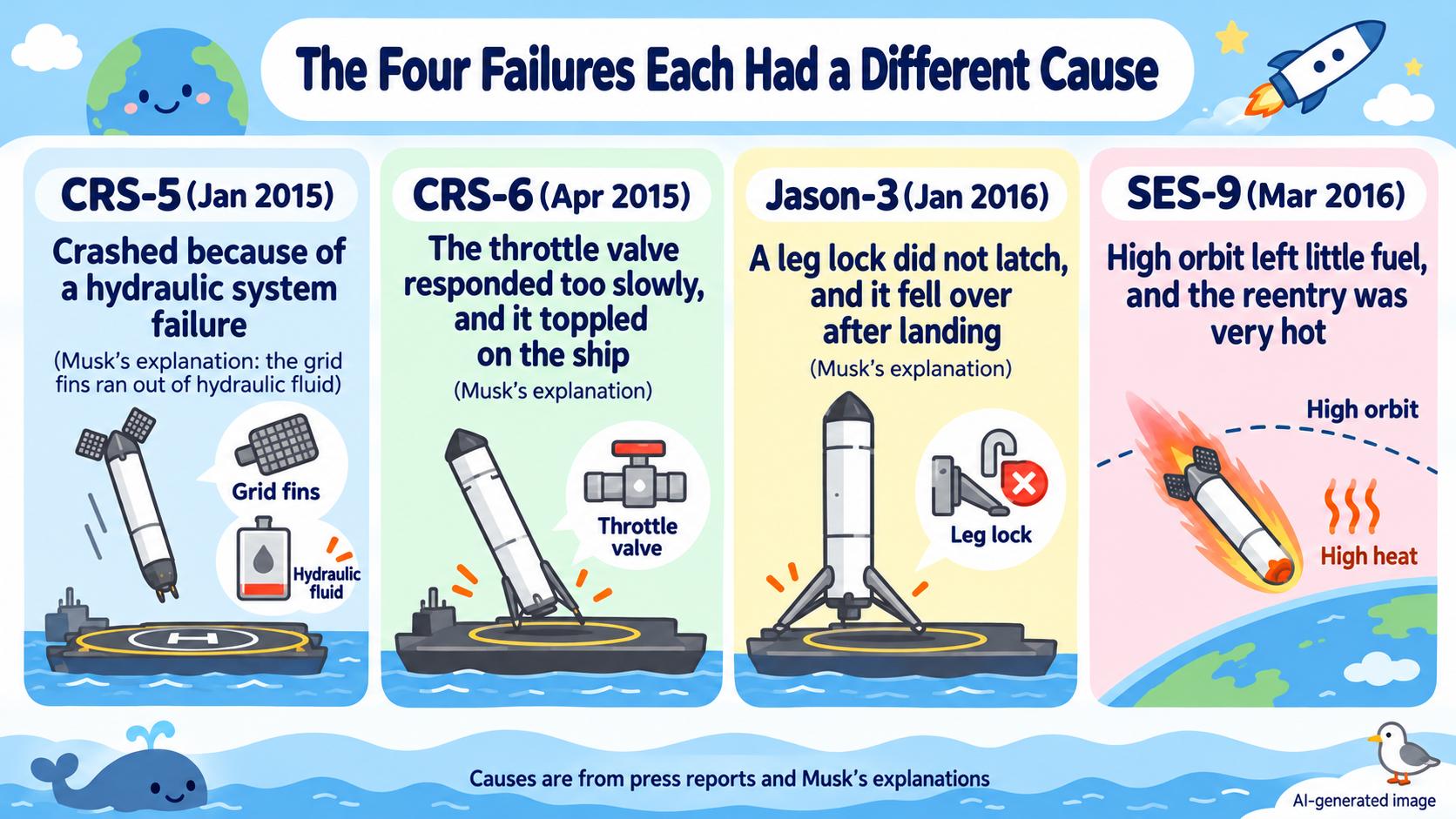
That the cause differs every time is very similar to Falcon 1 in Episode 4. It looks like an approach of "not repeating the same failure, and removing causes one by one." But I have not confirmed what SpaceX actually improved inside the company.
April 8, 2016 — upright on a ship at sea
Then the fifth attempt, on April 8, 2016.
From Cape Canaveral in Florida, a launch sending Dragon to the space station (CRS-8). About ten minutes later, the first stage came down straight onto the drone ship "Of Course I Still Love You," about 200 miles off the coast in the Atlantic (Universe Today).
The same article calls it "history's first upright landing of the spent first stage of a rocket on a barge at sea."
March 30, 2017 — the same rocket flew again
The last scene.
In August 2016, the satellite company SES announced it would launch the satellite SES-10 using a booster that had already flown once (CBS News). And on March 30, 2017, SES-10 was launched from Pad 39A at the Kennedy Space Center in Florida. The booster was the very one that had landed on the drone ship in April 2016 on CRS-8 (Scientific American).
The first stage again landed softly on the drone ship "Of Course I Still Love You." In addition, the payload fairing, the cover around the satellite, is reported to have been set down gently in the Atlantic using thrusters and a parachute.
Right after the landing, Musk said it was an amazing day for the space industry. He also said, in effect, that "you can fly and refly an orbit-class booster, the most expensive part of the rocket," and that "ultimately, this is going to be a huge revolution in spaceflight" (Scientific American). By then, SpaceX had landed a first stage nine times (six on drone ships, three on land).
What waits next
Landing was no longer an "experiment." The rocket flies again, and comes down again.
On the electric-car side, a completely different kind of difficulty was waiting for Tesla: not a single luxury car, but building an enormous number of cars at an affordable price.
FAQ
Was SpaceX the first in the world to land a rocket?
What this article confirmed is SpaceX's record: a Falcon 9 first stage, after sending satellites to orbit, landed vertically on the ground and on ships. The strict definition of "first in the world" (for example, whether it is limited to orbital-class rockets) is not confirmed here.
Why land on a ship, not on the ground?
On launches carrying heavy satellites or going to high orbits, the first stage has little fuel left to return near the launch site, it is thought (reports on SES-9 cite the small fuel margin as part of the background to the failure).
How much did reuse lower the price of a launch?
It is not confirmed in this article. Musk says the most expensive part of the rocket can be reused, but the sources of this article do not give a specific rate of price reduction.
Summary
- January 10, 2015 (CRS-5): the first try at a drone ship. Reported to have crashed because of a hydraulic system failure.
- April 14, 2015 (CRS-6): toppled on the ship. Musk explained the cause as a slow throttle valve response.
- December 21, 2015: first landing on the ground, at Landing Zone 1 at Cape Canaveral (11 ORBCOMM satellites).
- January 17 and March 4, 2016 (Jason-3, SES-9): more failures on ships (leg lock, fuel shortage from a high orbit).
- April 8, 2016 (CRS-8): first landing on a drone ship.
- March 30, 2017 (SES-10): first launch with a reused booster. It landed on a ship again.
Next: As rockets approached an age of reuse, the electric-car maker Tesla was entering a far harder period, the one called "production hell."
Sources (checked 2026-10-12)
- CBS News, "SpaceX pulls off dramatic Falcon 9 launch and landing" (the first landing on the ground, December 21, 2015; also mentions the CRS-5 and CRS-6 failures): https://www.cbsnews.com/news/spacex-pulls-off-dramatic-falcon-9-launch-landing/
- Space.com, "SpaceX's Elon Musk Says Rocket Landing Test Ran Out of Hydraulic Fluid" (CRS-5; only the headline was confirmed, the body could not be retrieved): https://www.space.com/28236-spacex-rocket-landing-hydraulic-fluid.html
- Spaceflight Now, "Throttle valve blamed for Falcon 9's unsuccessful landing" (April 21, 2015, CRS-6): https://spaceflightnow.com/2015/04/21/throttle-valve-blamed-for-falcon-9s-unsuccessful-landing/
- Associated Press (via Military Times), "Support leg breaks as SpaceX rocket lands on ocean barge" (January 17, 2016, Jason-3): https://www.militarytimes.com/news/your-military/2016/01/17/support-leg-breaks-as-spacex-rocket-lands-on-ocean-barge/
- Fortune (March 4, 2016, SES-9): https://fortune.com/2016/03/04/spacex-rocket-landing-ship
- Universe Today, "SpaceX Falcon 9 Recovered 1st Stage Arrives Back in Port After Historic Upright Landing at Sea" (April 2016, CRS-8): https://www.universetoday.com/articles/spacex-falcon-9-recovered-1st-stage-arrives-back-in-port-after-upright-landing-at-sea
- CBS News, "Satellite operator SES buys used rocket from SpaceX" (August 30, 2016): https://www.cbsnews.com/news/satellite-operator-ses-buys-used-rocket-from-spacex/
- Scientific American, "Used SpaceX Rocket Launches Satellite, Then Lands in Historic 1st Reflight" (March 30, 2017, SES-10): https://www.scientificamerican.com/article/used-spacex-rocket-launches-satellite-then-lands-in-historic-1st-reflight/
This article is for learning about science, technology and corporate history, and is not investment advice. Facts and the author's interpretation are kept separate. Figures are AI-generated illustrations.