Depending on how you count, a Space Shuttle launch cost roughly $0.76 billion to $1.5 billion, and NASA's SLS is estimated at about $4.1 billion. Falcon 9's standard price was $67 million in 2022 and $74 million in 2026. Musk has said a rocket's structural materials are under 2% of its total cost and fuel about 0.3%. But numbers with different conditions cannot be compared directly.
"Rockets are expensive." You hear it often. But how expensive are they? And what is the money spent on?
This article applies the "add up the materials" way of thinking from Episode 2 (the price of batteries) to rockets. First we line up numbers with clear sources, and then we check Musk's famous "materials are 2%" claim.
"Expensive" compared with what?
Before the numbers, one caution. A rocket's "price" is all over the place, in these ways.
- The price (what the customer pays) and the cost (what it takes the maker) are different things.
- The price changes with the weight carried and the orbit it goes to.
- The value of the dollar changes by year.
- Whether you include development costs changes the number a lot.
So the numbers below are for looking at side by side, not for saying "this is so many times that."
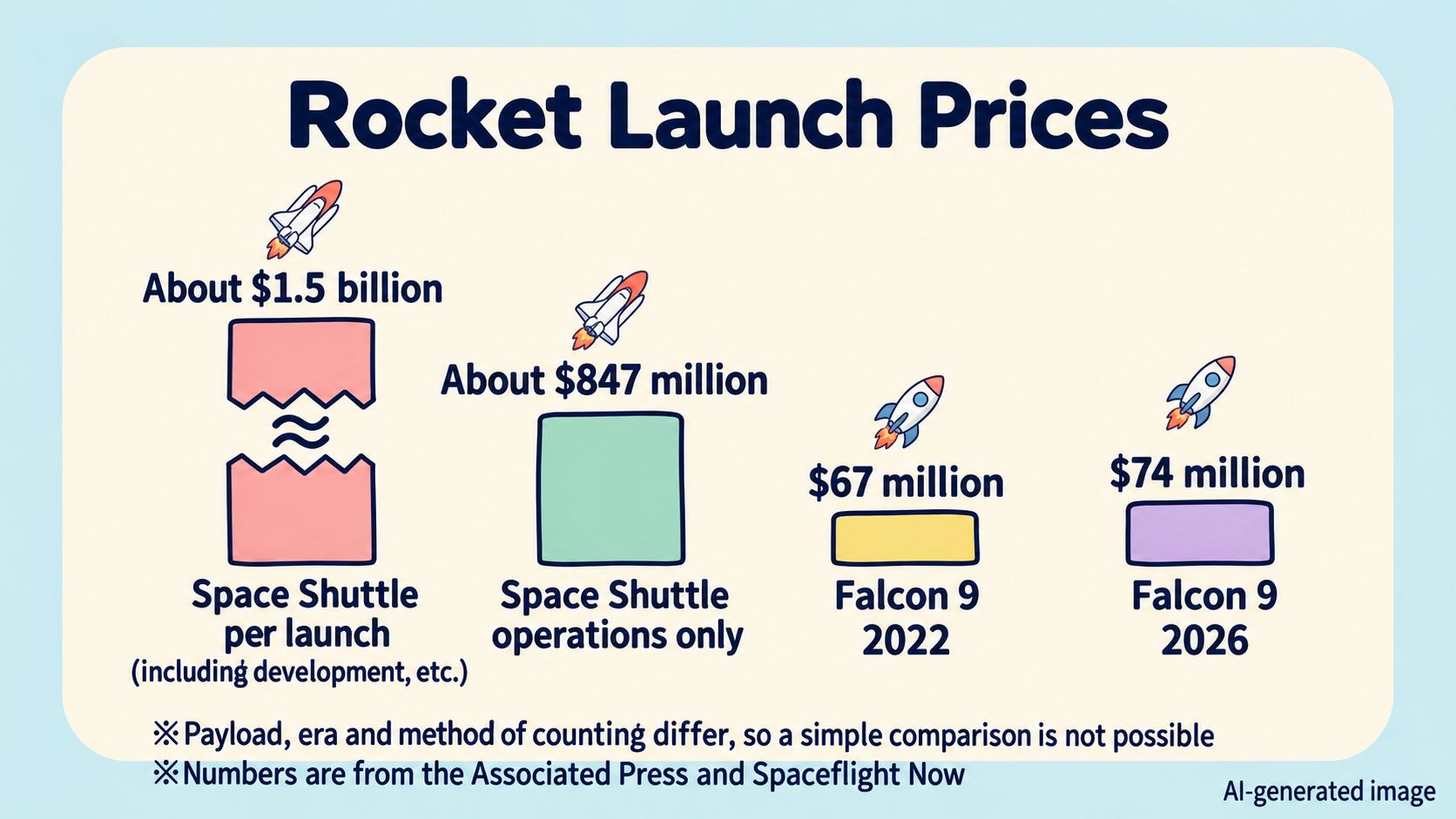
The Space Shuttle: about $1.5 billion per launch
According to the Associated Press (2011), the Space Shuttle program spent $196 billion over about 40 years and flew 135 times.
- Divided including the costs of design, construction and upgrades, that is about $1.5 billion per launch.
- The operating-only average, excluding early costs and upgrades, is about $847 million.
(The article does not state the base year for the dollars.)
A 2014 report by NASA's Office of Inspector General (OIG) also touches on the Shuttle's cost per flight. A 2000 law capped the Shuttle's cost per launch at $380 million. But a 2001 finding by the U.S. Government Accountability Office (GAO) put the actual figure closer to about $759 million. Even for the same Shuttle, depending on "what you count," the number swings widely: about $0.76 billion, about $0.85 billion, about $1.5 billion.
The Shuttle reused some of its parts, but each flight is thought to have needed major refurbishment. However, the breakdown is not confirmed in this article's sources.
NASA's current rocket, SLS: about $4.1 billion per launch
For the SLS, the big rocket NASA uses in its Artemis program to the Moon, NASA's OIG estimates the following in a November 2021 report.
- The cost of flying one SLS/Orion system, through at least Artemis IV, is about $4.1 billion per launch (at a pace of roughly one mission a year).
- The breakdown: the SLS rocket itself (single-use) about $2.2 billion, the Orion spacecraft about $1 billion, the service module supplied by Europe about $300 million, and ground systems about $568 million per year.
The SLS discards its rocket after every flight.
Falcon 9: a list price of around $70 million
SpaceX's official "Capabilities and Services" page lists Falcon 9's standard payment plan price. For up to 5.5 metric tons to geostationary transfer orbit, Spaceflight Now reports the following (February 24, 2026).
| Year | Standard price (US$) |
|---|---|
| 2022 | $67 million |
| 2025 | $70 million |
| 2026 | $74 million |
The same article also says the 2022 page mentioned the possibility of future price increases due to inflation. In other words, Falcon 9's price has been creeping up in recent years.
The same article also reports, citing Ars Technica, that SpaceX's internal cost of flying a reusable Falcon 9 is about $15 million. This is not an official SpaceX figure; it is a press report.
The Shuttle's roughly $1.5 billion (including development, etc.) and Falcon 9's roughly $70 million (a standard price) differ in the weight carried, the era and the way of counting. Even so, you can see a gap of more than one order of magnitude.
Musk's words: "materials are under 2% of the cost"
Here is Musk's famous remark. At a conference (All Things Digital), SpaceNews reports, Musk said the following.
Fuel is about 0.3% of a rocket's total cost. The materials that make the structure are at most 2%. A Falcon 9 costs about $60 million. "People were doing something silly in how they put those materials together."
(Part of the original: "Clearly people were doing something silly in how they put those materials together.")
In other words, Musk's claim is "the reason it is expensive lies not in the materials but in how it is made." This is the same as the "materials are about 2%" story introduced in the Episode 1 article, "What is first-principles thinking?"
But a caution is needed here.
- This number is Musk's own explanation. We could not confirm third-party verification in this article's sources.
- We could not confirm the date of this conference. We could also read the article only to the extent of the quotation that appeared in search results.
NASA's estimate: a tenth of the development cost?
There is one more number from public materials. In a 2010 report, NASA estimated, with its cost model (NAFCOM), what Falcon 9 would have cost if NASA had developed it in the traditional way.
- The traditional approach: $4.0 billion.
- A more commercial-style approach: $1.7 billion.
- SpaceX's published actual development cost: about $300 million for Falcon 9 and about $90 million for Falcon 1, about $390 million in total. NASA writes that it verified these costs.
(These numbers are introduced in a 2017 paper by NASA's Edgar Zapata, which quotes the 2010 report.)
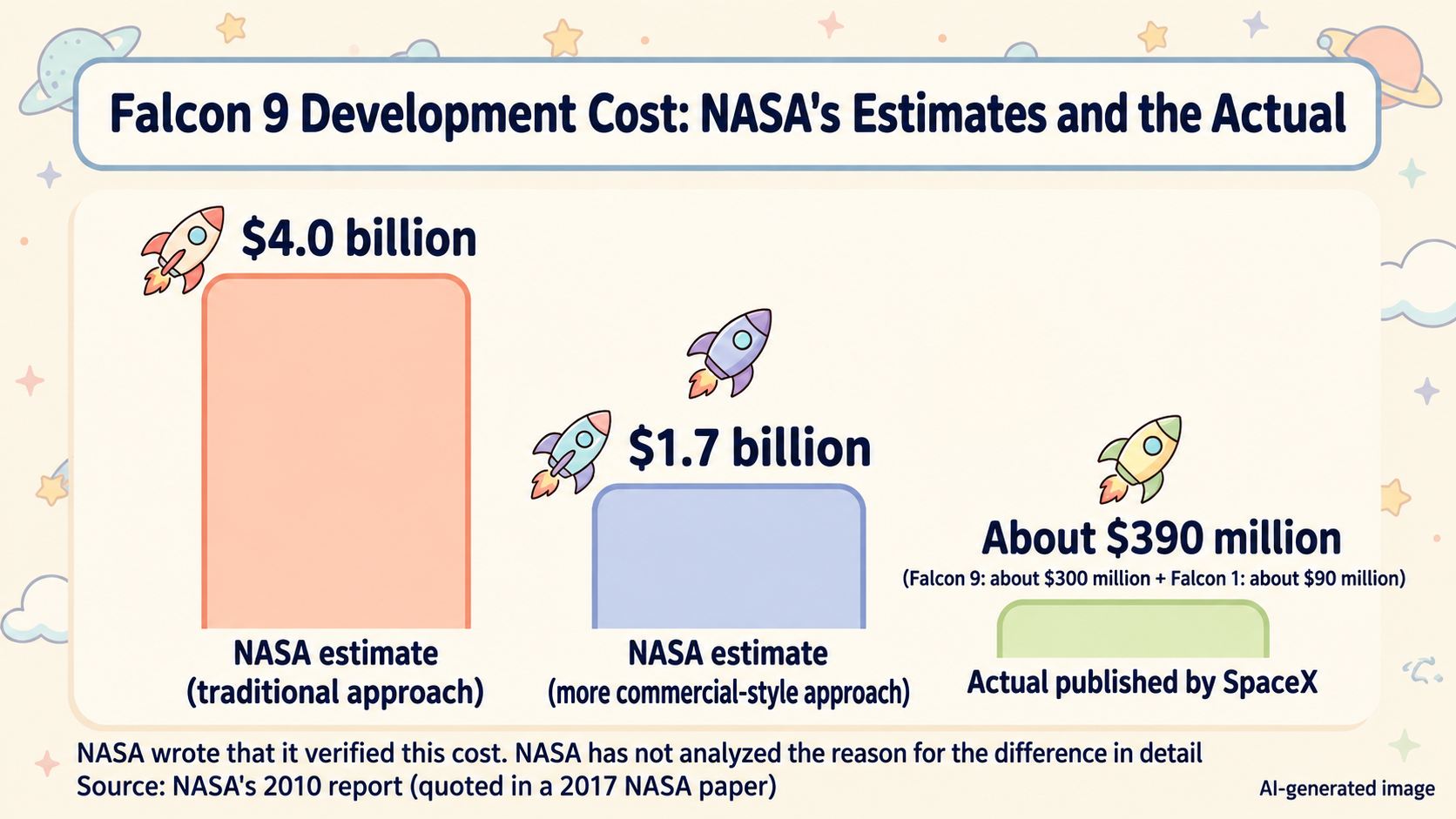
NASA also writes that it could not analyze in detail why the actual cost was so much lower. It says, in effect, that fewer NASA processes, less oversight and less overhead, features of the public-private partnership, may be the reason, and that other factors are possible.
Breaking it down from first principles
Let's organize the story so far with the three steps of first principles (write down what you take for granted → break it down to the root → build it back up).
- Write down what you take for granted: a rocket belongs to nations and big companies, is expensive, and is thrown away after one use.
- Break it down to the root: what is the price made of? In Musk's explanation, materials are under 2% and fuel is 0.3%. The remaining roughly 98% is not materials.
- Build it back up: the rest lies in how it is made, people, facilities, testing, operations, and throwing it away. If so, changing those should make it cheaper.
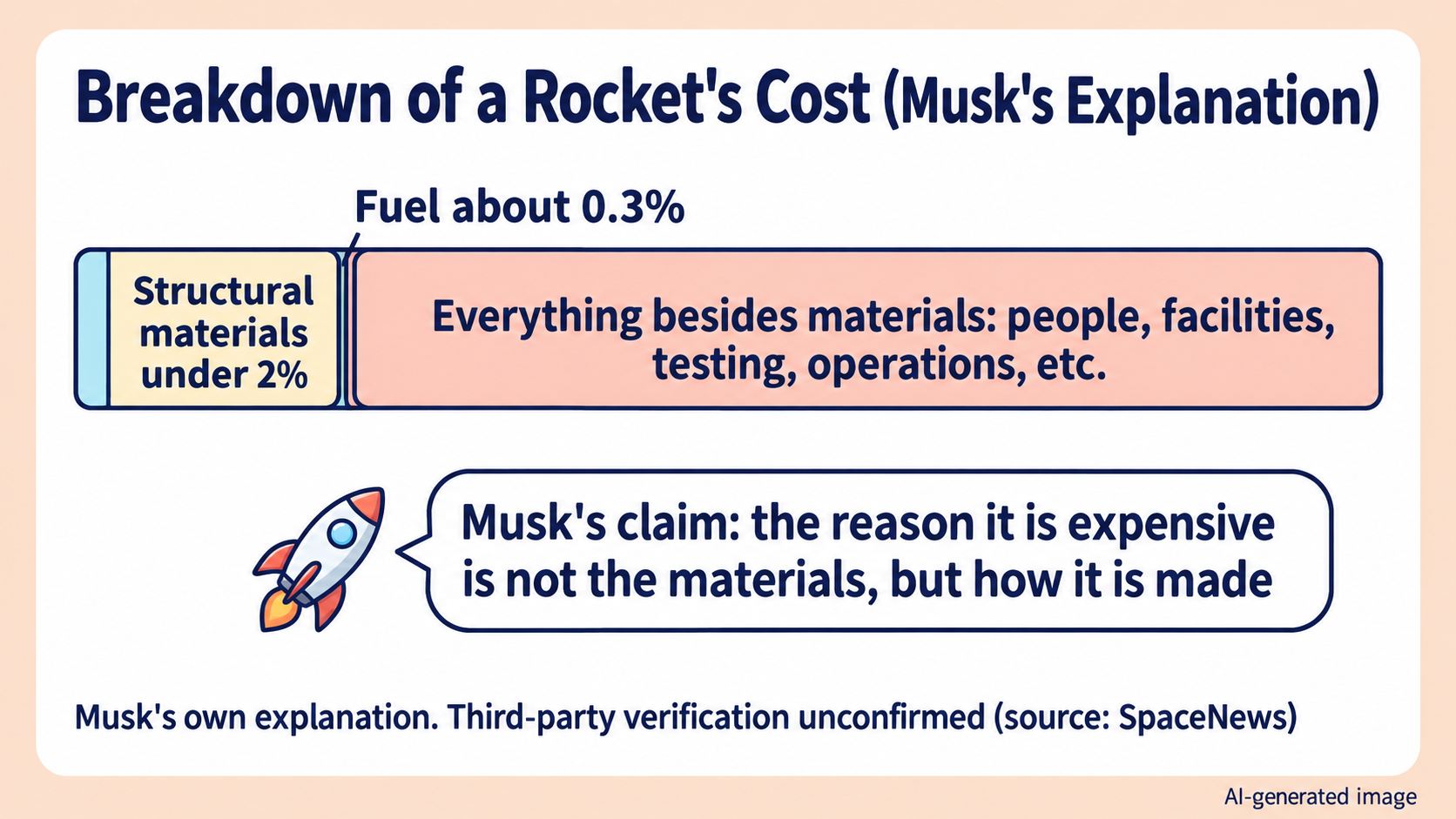
"Materials are 2%" is, like the "adding up materials" of batteries, a starting point. This time we could not confirm a source that splits the remaining roughly 98% (labor, manufacturing, operations, insurance, launch sites and so on) with reliable numbers. So "the reason it is expensive is how it is made" makes sense as a question, but cannot yet be called a proven conclusion. In future articles we will dig a bit further into that remainder.
FAQ
So, is a rocket expensive?
It depends on conditions. The Shuttle was reported at about $1.5 billion per launch (including development, etc.). Falcon 9's standard price is around $70 million. But the weight carried, the era and the way of counting differ, so a simple ratio cannot be stated.
Is "materials are 2%" a correct number?
It is Musk's own explanation, and we could not confirm third-party verification in this article's sources. It is the same as the first-principles caution: "adding up materials is a starting point, not the answer."
How much cheaper does reuse make Falcon 9?
We could not confirm it in this article. There is a press report that the internal cost of a reused vehicle is about $15 million, but it is not an official SpaceX figure.
Summary
- Space Shuttle: about $1.5 billion per launch (including development, etc.). Operations only: about $847 million (AP, 2011). About $759 million in GAO's 2001 finding (NASA OIG, 2014).
- SLS (Artemis): about $4.1 billion per launch (NASA OIG, 2021. SLS itself about $2.2 billion, Orion about $1 billion, service module about $300 million, ground systems about $570 million).
- Falcon 9's standard price: $67 million in 2022, $70 million in 2025, $74 million in 2026 (Spaceflight Now).
- Musk's explanation: materials under 2%, fuel about 0.3% (SpaceNews. His own explanation; third-party verification unconfirmed).
- NASA's estimate: Falcon 9's development cost $4.0 billion by the traditional approach, actual about $390 million. NASA has not analyzed the reason in detail.
- When comparing prices, watch for differences in weight, orbit, year and way of counting.
Next: we move the same way of thinking from rockets to "cars": "Taking a car apart from first principles" (coming soon).
Sources (checked 2026-10-13)
- NASA Office of Inspector General, "Extending the Operational Life of the International Space Station Until 2024" (IG-14-031, September 18, 2014; mentions the Shuttle's cost cap and GAO's finding): https://oig.nasa.gov/docs/IG-14-031.pdf
- NASA Office of Inspector General, "NASA's Management of the Artemis Missions" (IG-22-003, November 15, 2021; about $4.1 billion per SLS/Orion launch): https://oig.nasa.gov/docs/IG-22-003.pdf
- Associated Press (via NBC News), "Shuttle cost: More than AIG bailout, less than war" (2011): https://www.nbcnews.com/news/amp/wbna43631772
- Spaceflight Now (February 24, 2026; Falcon 9's price and the internal cost of a reused vehicle): https://spaceflightnow.com/2026/02/24/live-coverage-spacex-to-launch-29-starlink-satellites-on-falcon-9-rocket-from-cape-canaveral-8/
- SpaceNews (Musk's remarks at the All Things Digital conference; date unconfirmed): https://spacenews.com/?p=13131
- Edgar Zapata (NASA Kennedy Space Center), "An Assessment of Cost Improvements in the NASA COTS/CRS Program and Implications for Future NASA Missions" (2017, AIAA; quotes NASA's 2010 "Commercial Market Assessment for Crew and Cargo Systems"): https://ntrs.nasa.gov/api/citations/20170008895/downloads/20170008895.pdf
This article is for learning about science, technology and corporate history, and is not investment advice. Facts and the author's interpretation are kept separate. Figures are AI-generated illustrations.