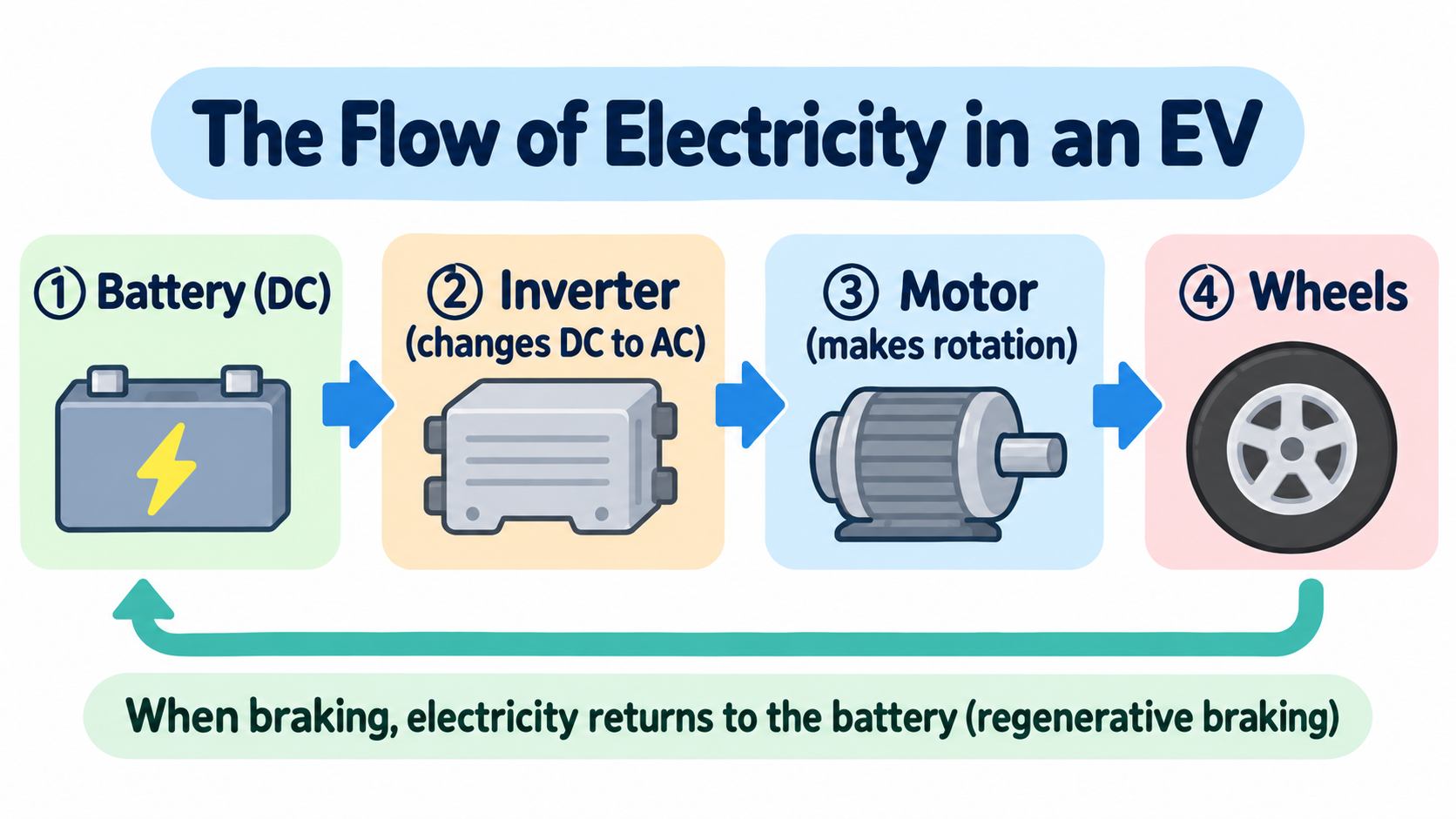
An EV stores direct-current electricity in a battery, an inverter changes it into alternating current, and the motor uses it to make rotation. When braking, the flow reverses: the motor becomes a generator and returns electricity to the battery (regenerative braking).
Last time we saw the biggest difference between an EV and a gasoline car. This time we follow the heart of the EV, the flow of electricity, in order.
The conclusion: battery → inverter → motor
The flow of electricity in an EV can be told with three parts.
- Battery: stores electricity.
- Inverter: changes the battery's electricity into a form the motor can use.
- Motor: uses electricity to make rotation.
When braking, the direction reverses. The motor becomes a generator and sends electricity back to the battery.
1. The battery: where electricity is stored
An EV's battery is a lithium-ion battery. Here is how it works, according to the University of Washington's Clean Energy Institute.
- Inside are a negative electrode (anode) and a positive electrode (cathode), with an electrolyte between them. A separator keeps the electrodes from touching, but lithium ions can pass through it.
- The negative electrode is usually graphite. Lithium is stored in the gaps between its layers of carbon.
- The positive electrode can be made of several materials, such as lithium cobalt oxide, lithium manganese oxide or lithium iron phosphate.
- During discharge (when electricity is used), lithium at the negative electrode gives up electrons and becomes ions. The ions travel through the electrolyte to the positive electrode, and the electrons travel there through the outside circuit. That flow of electrons is the electric current.
The same page says that lithium's small, light atoms let such batteries reach high voltage and store a lot of charge for their weight (it cites up to 3.6 V per cell and up to 330 Wh/kg. These are general figures for such batteries, not Tesla's numbers).
The Model 3's batteries
Here is what can be confirmed in Tesla's manual (Singapore edition).
| Item | Content |
|---|---|
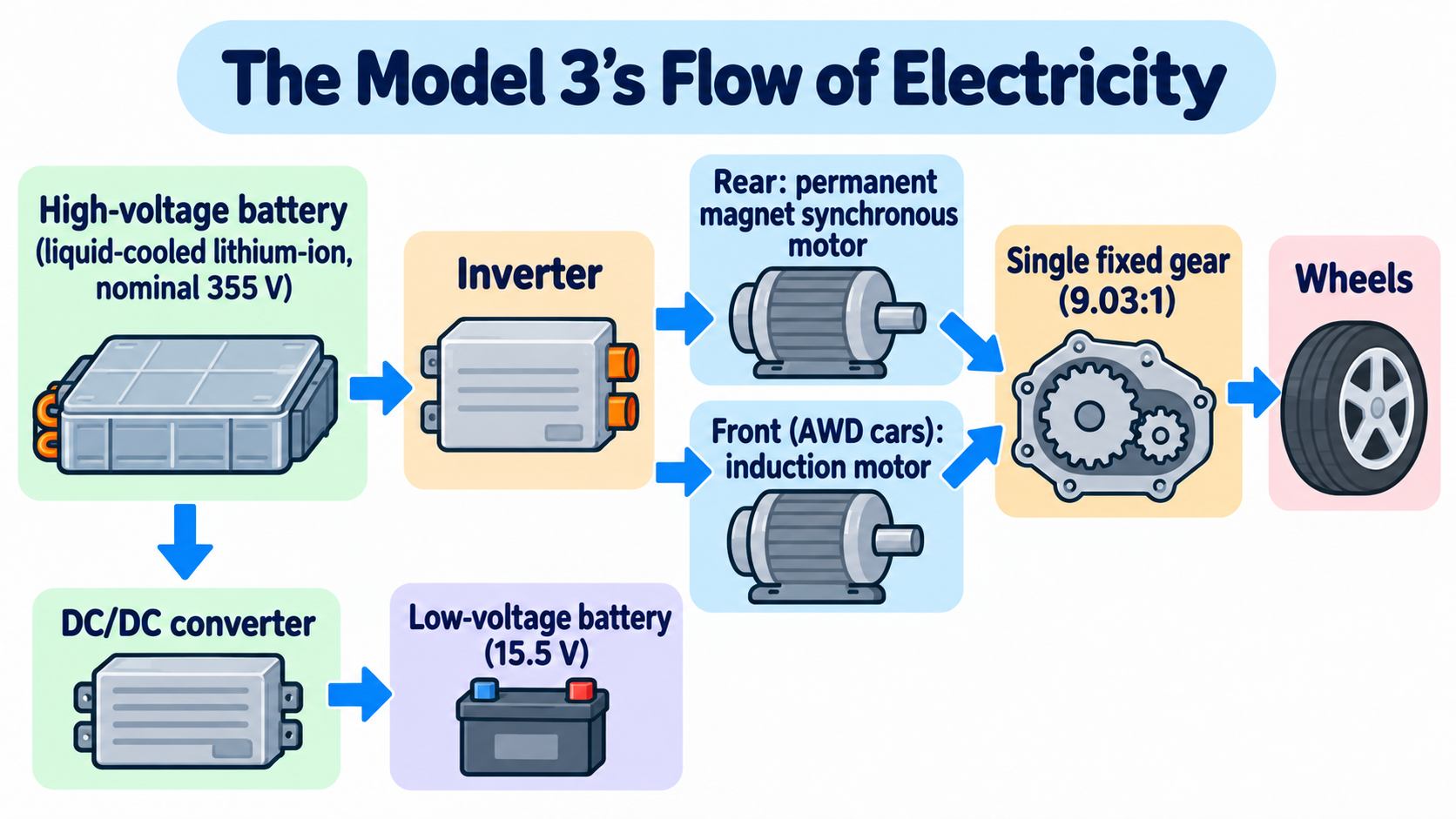
| High-voltage battery | Liquid-cooled lithium ion, nominal 355 V DC |
| Low-voltage battery | 15.5 V, 6.9 Ah |
The high-voltage battery is the one for driving. The low-voltage battery is for small loads such as lights and the screen.
The device that makes low-voltage electricity from high-voltage electricity is called a DC/DC converter. The U.S. DOE's AFDC describes it as converting the traction battery's high-voltage DC into power for accessories.
2. The inverter: changing direct current into alternating current
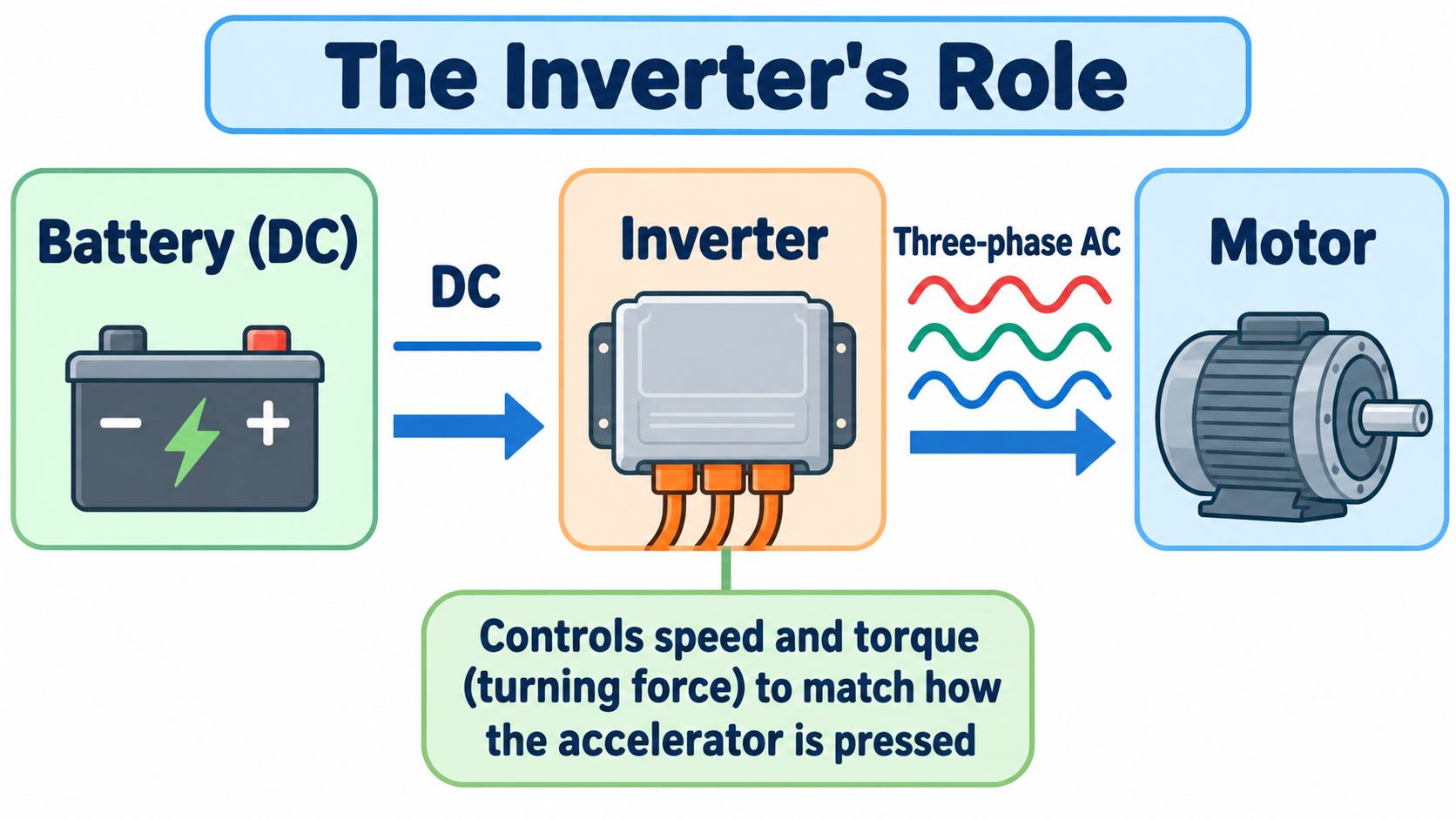
The electricity a battery gives out is direct current (DC), which always flows in the same direction.
Most EV motors, on the other hand, run on alternating current (AC), which keeps switching direction.
The inverter bridges the two. Bosch Semiconductors' glossary describes a traction inverter as a power-electronics system that converts the battery's DC voltage into three-phase AC to drive the motor.
The DOE's AFDC says the power electronics controller manages the motor's speed and the torque (turning force) it produces.
In other words, the inverter turns how far you press the accelerator into how electricity is delivered.
When braking, it runs in reverse
Bosch writes that the inverter enables regenerative braking by reversing the power flow. When slowing down, the motor becomes a generator, and the inverter turns the AC it makes back into DC and returns it to the battery.
An aside: silicon carbide (SiC)
Some inverters use silicon carbide (SiC) semiconductors. Bosch explains that SiC power semiconductors can work at higher switching frequencies and higher temperatures than ordinary silicon (this is about Bosch's products).
There are reports that the Model 3's inverter uses SiC (a 2018 teardown report on an STMicroelectronics SiC module was publicized). But Tesla's official manual does not say so. In this article we stay at "there are reports" and do not state it as fact.
3. The motor: turning electricity into rotation
A motor makes rotation from electricity. Tesla's Model 3 manual confirms these two types.
| Position | Motor type |
|---|---|
| Rear | AC permanent magnet synchronous motor (liquid-cooled) |
| Front (AWD cars) | AC induction motor (liquid-cooled) |
- Permanent magnet synchronous motor: strong magnets are built into the rotating part.
- Induction motor: the rotating part has no magnets. A rotating magnetic field made from the outside induces electricity in it, and it turns.
Why is the Model 3's rear motor a permanent-magnet type? Electrek reports that Tesla's principal motor designer, Konstantinos Laskaris, said the following at a trade show in Chicago in 2018 (the article does not give the date of the talk).
Permanent magnet machines have the benefit of pre-excitation from the magnets. The permanent magnet machine better solved Tesla's "cost minimization function." It is a tradeoff between motor cost, range and battery cost.
So the explanation is that it was chosen as a balance of cost and range. But the article itself says the Model 3's exact motor design is unclear. And we have not checked the latest Model 3 or Model Y configurations in this article.
Putting it all together
Here are the main EV parts the AFDC lists, by role.
| Part | Role |
|---|---|
| Traction battery pack | Stores the electricity the motor uses |
| Onboard charger | Converts AC coming from the charge port into DC for the battery |
| Power electronics controller | Manages the motor's speed and torque |
| Electric traction motor | Uses battery power to drive the wheels |
| DC/DC converter | Converts high-voltage DC into power for accessories |
| Thermal system | Keeps the motor and power electronics at a proper temperature |
(We will look at the thermal system in more detail later in Part 2.)
In a gasoline car, "burn, then turn" (heat) was the center. In an EV, the center seems to be "moving electricity while changing its form." The inverter is the part that changes the form, and its quality seems likely to affect how the car drives and how much energy is wasted. But we have not confirmed how much it matters.
FAQ
Why is an EV's battery "direct current"?
Because a battery works by a chemical reaction that always pushes electrons in the same direction (the discharge mechanism explained by UW). For motors that need AC, an inverter converts it.
Which is better, a permanent magnet motor or an induction motor?
It cannot be said in general. In Mr. Laskaris's explanation it is decided by a tradeoff among motor cost, range and battery cost. Even the Model 3 uses both: permanent magnet at the rear and induction at the front (AWD cars).
Does the inverter use SiC (silicon carbide)?
There are reports, but we could not confirm it in Tesla's official materials. This article does not state it as fact.
What about battery life and how far it can go?
We have not confirmed these in this article. We will cover them in another article.
Summary
- The flow of electricity in an EV is battery → inverter → motor → wheels. When braking, it reverses and electricity returns to the battery.
- The battery is lithium-ion. On discharge, lithium ions move from the negative to the positive electrode, and electrons flow through the outside circuit (UW).
- Model 3: the high-voltage battery is liquid-cooled, nominal 355 V. The low-voltage battery is 15.5 V, 6.9 Ah (Tesla's manual).
- The inverter changes the battery's DC into three-phase AC. It manages the motor's speed and torque, and in regeneration it reverses the flow (Bosch, AFDC).
- The Model 3's motors: rear = permanent magnet synchronous, front (AWD) = induction (manual). The designer said the rear's permanent magnet was chosen as a balance of cost and range (Electrek, 2018).
- On SiC: there are reports, but it is unconfirmed in Tesla's official materials.
Next: we will follow how the rotation the motor makes reaches the tires, the "flow of force" (coming soon).
Sources (checked 2026-10-13)
- University of Washington, Clean Energy Institute, "Lithium-Ion Battery": https://www.cei.washington.edu/research/energy-storage/lithium-ion-battery/
- Bosch Semiconductors, "Traction inverter" (glossary): https://www.bosch-semiconductors.com/glossary/traction-inverter/
- U.S. Department of Energy, Alternative Fuels Data Center, "How Do All-Electric Cars Work?": https://afdc.energy.gov/vehicles/how-do-all-electric-cars-work
- Tesla, "Model 3 Owner's Manual: Subsystems" (Singapore edition): https://www.tesla.com/ownersmanual/model3/en_sg/GUID-E414862C-CFA1-4A0B-9548-BE21C32CAA58.html
- Electrek (February 27, 2018; an article on a talk by Tesla's motor designer): https://electrek.co/2018/02/27/tesla-model-3-motor-designer-permanent-magnet-motor/
This article is for learning about science and technology, and is not investment advice. Facts and the author's interpretation are kept separate. Figures are AI-generated illustrations.