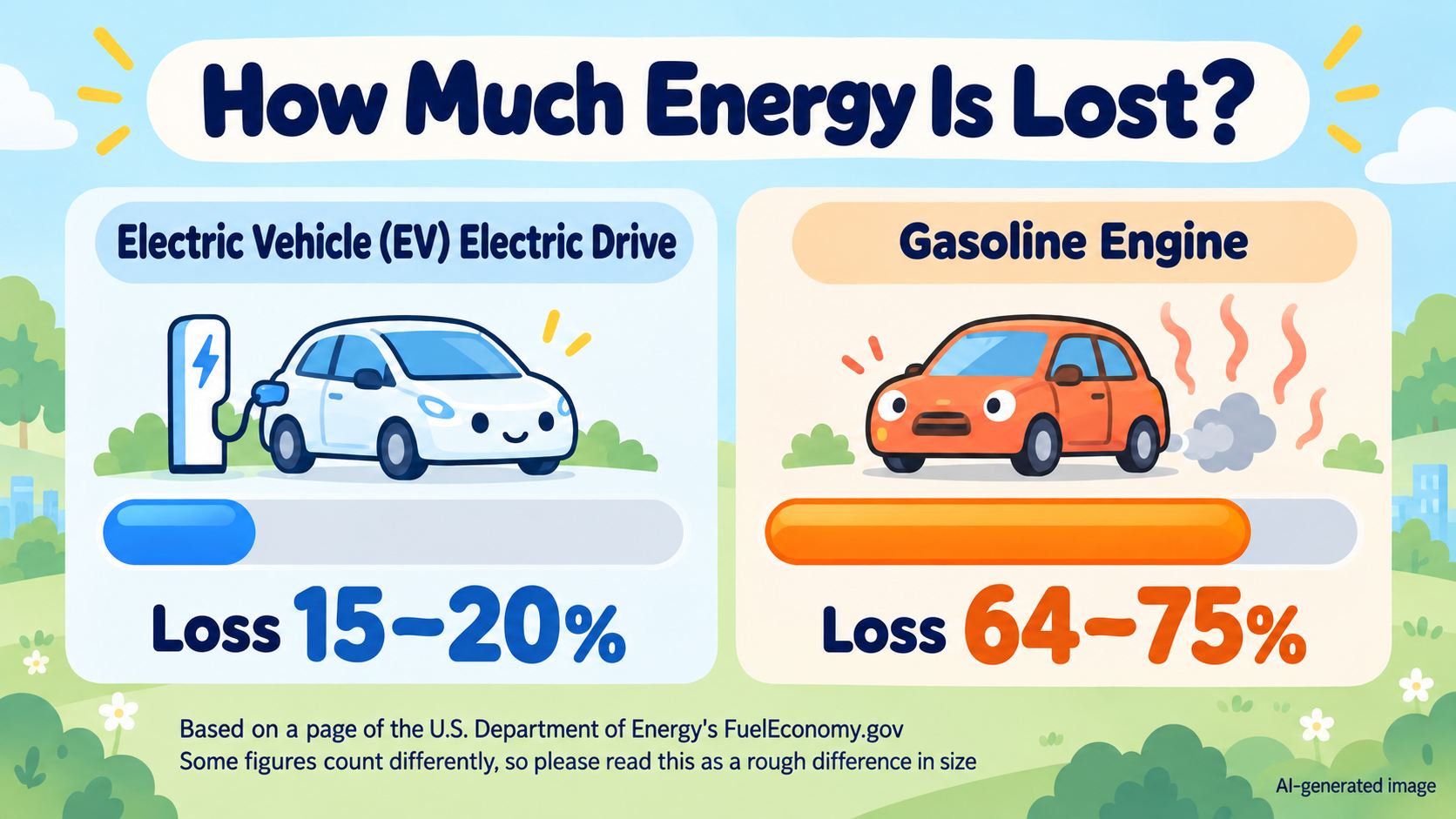
The biggest difference between an EV and a gasoline car is that a gasoline car has a step in which it burns fuel to make heat and uses that heat to make motion, while an EV does not. According to a U.S. Department of Energy page, the energy lost in the drive system is 15–20% for an EV and 64–75% for a gasoline engine.
From here on is Part 2. In Part 0 we learned the history, and in Part 1 the way of thinking. In Part 2 we look at the inside of Tesla's electric cars, in order, through four flows: electricity, force, heat and information.
First, the question that is the foundation of everything: how is an electric car different from a gasoline car?
The conclusion: is there a step that turns heat into motion, or not?
A gasoline car burns gasoline and uses the heat to make power. It is a long road: burn → the force of the explosion moves a piston → turn that into rotation → change the speed with gears → pass it on to the tires.
An electric vehicle (EV) turns a motor directly with electricity from the battery. There is no burning step.
This "is there a step that turns heat into motion, or not?" is the root of almost every difference, in efficiency, in parts and in maintenance.
How much energy is wasted?
FuelEconomy.gov, run by the U.S. Department of Energy (DOE) and the Environmental Protection Agency (EPA), has an explanation of EV efficiency.
- The share of energy that reaches the wheels of an EV is 60–66% in "stop-and-go" city driving and 71–73% on the highway.
- The energy lost in the drive system is 15–20% for an EV's electric drive system. For a gasoline engine, it is 64–75%.
In other words, in a gasoline car more than half of the fuel's energy is thrown away as heat.
One caution, though. On the same page, the text and the diagram disagree slightly on the city figure (the diagram says 54–62%). Also, "the share that reaches the wheels" and "the share lost" do not necessarily cover the same range of counting. So please read these as a rough difference in size.
Comparing the road the power takes
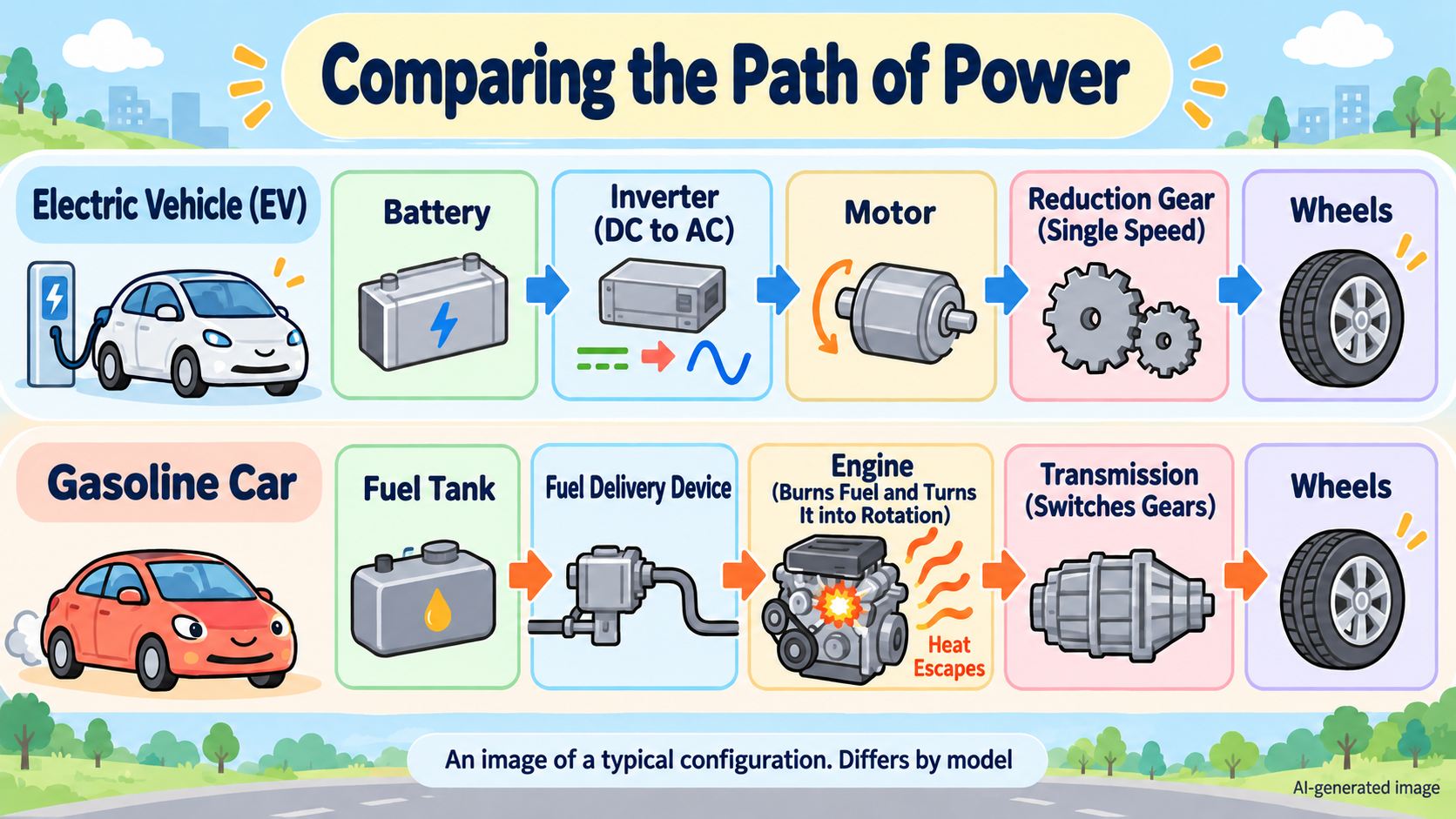
- EV: battery → inverter (a device that changes the battery's direct current into alternating current for the motor) → motor → reduction gear → wheels.
- Gasoline car: fuel tank → a device that sends fuel → engine (burns fuel and turns it into rotation) → transmission (switches gears to suit the speed) → wheels. Ignition, intake, exhaust, lubrication and cooling equipment are also needed.
An EV has no engine, so it does not need a device to inject fuel, a device to make sparks, or a device to treat exhaust gas.
On the number of parts, an article by S&P Global Mobility (Michael Robinet, May 1, 2023) says: "There are thousands of moving parts in the internal-combustion powertrain; battery electric vehicles have only a couple dozen." But this compares the moving parts of the powertrain, not the number of parts in the whole vehicle.
In the case of Tesla's Model 3
Here is what can be confirmed in the official Tesla Model 3 Owner's Manual (the Singapore edition's "Subsystems").
| Item | Content |
|---|---|
| Rear motor | AC permanent magnet synchronous motor, liquid-cooled, with variable frequency drive |
| Front motor (AWD cars) | AC induction motor, liquid-cooled, with variable frequency drive |
| Transmission | Single speed fixed gear |
| Gearbox ratio | 9.03:1 |
| High-voltage battery | Liquid-cooled lithium ion, nominal 355 V DC |
| Brakes | In addition to a 4-wheel ABS and more, a regenerative braking system operated by the accelerator pedal |
A gasoline car switches among many gears to run from low speed to high speed. The Model 3 has just one gear. A motor can produce force even at low rotation, so it does not need many gear steps (this reason is a general explanation, not a statement of this table's source).
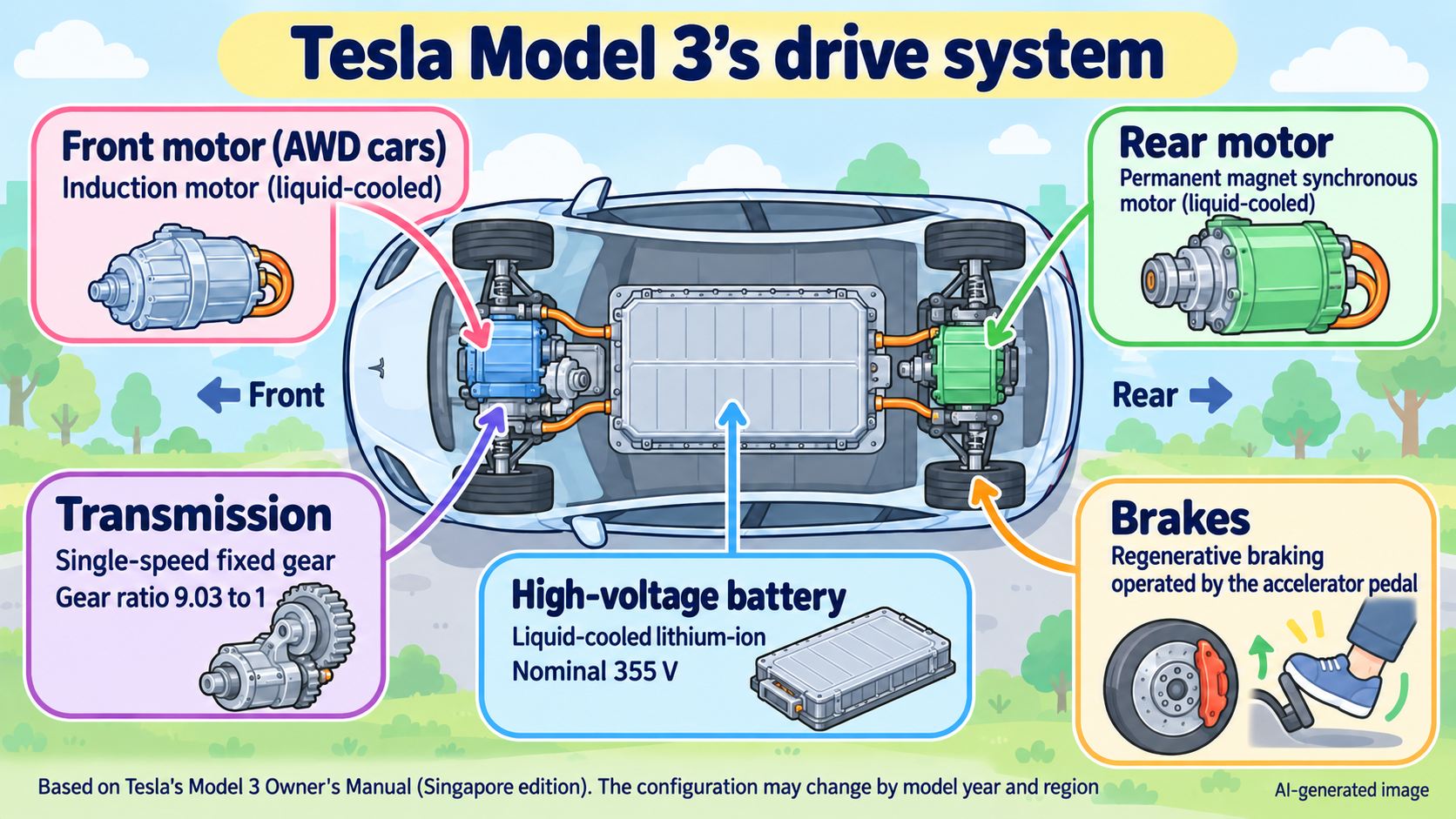
Note that Tesla sometimes changes the motor configuration by model year, trim and region. What is written here is the content of the manual we checked (the Singapore edition).
Regenerative braking: generating power while braking
EVs have one big feature that gasoline cars do not: regenerative braking.
FuelEconomy.gov explains it this way. When you apply the brakes, the vehicle's inertia turns the motor-generator, which makes electricity and stores it in the battery. That electricity is later used to power the wheels.
An ordinary friction brake throws away the car's kinetic energy as heat. An EV's regenerative braking takes part of that back as electricity. The same page also says that if you count this recovered energy, efficiency can exceed 94% in the city (though this disagrees with the numbers in the same page's diagram).
"A gasoline car throws away more than half the energy as heat" and "an EV even takes back part of the heat of braking." These two seem to be the center of the EV's efficiency advantage. But on any single drive of a real car, the numbers change greatly with conditions.
FAQ
How many times more efficient is an EV than a gasoline car?
We cannot say "how many times." The DOE page gives the share lost (15–20% for an EV's electric drive, 64–75% for a gasoline engine) and the share of an EV's energy that reaches the wheels (60–73%). We could not confirm a gasoline car's "share that reaches the wheels" in the same form from this page.
An EV has what fraction of the parts of a gasoline car?
We could not confirm a public source that compared the number of parts of the whole vehicle under the same conditions. There is a statement in an S&P Global Mobility article, "thousands versus a couple dozen" in the powertrain's moving parts (about the drive system only).
Does an EV need no maintenance at all?
Engine-oil changes and spark plugs are unnecessary because there is no engine. But the replacement interval of the battery coolant and so on depends on the model, and we could not confirm it in this article. We cannot say "no maintenance is needed."
Summary
- The biggest difference between an EV and a gasoline car is whether there is a step that burns fuel and makes power from heat.
- U.S. Department of Energy page: loss in the drive system is 15–20% for an EV's electric drive and 64–75% for a gasoline engine. An EV's share reaching the wheels is 60–66% in the city and 71–73% on the highway (the text and the diagram disagree on the numbers).
- Moving parts of the powertrain: thousands in an internal-combustion engine, a couple dozen in a BEV (S&P Global Mobility, 2023. Not the number of parts in the whole vehicle).
- The Model 3: a single fixed gear (9.03:1), a permanent magnet synchronous motor at the rear, a liquid-cooled battery (nominal 355 V) (Tesla's manual).
- Regenerative braking: when slowing down, the motor becomes a generator and returns electricity to the battery.
Next: we will follow, in order, the flow of electricity at the heart of an EV, "battery → inverter → motor" (coming soon).
Sources (checked 2026-10-13)
- FuelEconomy.gov (U.S. Department of Energy and Environmental Protection Agency), "All-Electric Vehicles": https://www.fueleconomy.gov/feg/atv-ev.shtml
- S&P Global Mobility (Michael Robinet, May 1, 2023), "As the industry goes electric, expect a shakeout among internal-combustion suppliers": https://www.mobilityglobal.com/en-us/automotive-insights/blog/fuel-for-thought-as-the-industry-goes-electric-expect-shakeout
- Tesla, "Model 3 Owner's Manual: Subsystems" (Singapore edition): https://www.tesla.com/ownersmanual/model3/en_sg/GUID-E414862C-CFA1-4A0B-9548-BE21C32CAA58.html
This article is for learning about science and technology, and is not investment advice. Facts and the author's interpretation are kept separate. Figures are AI-generated illustrations.