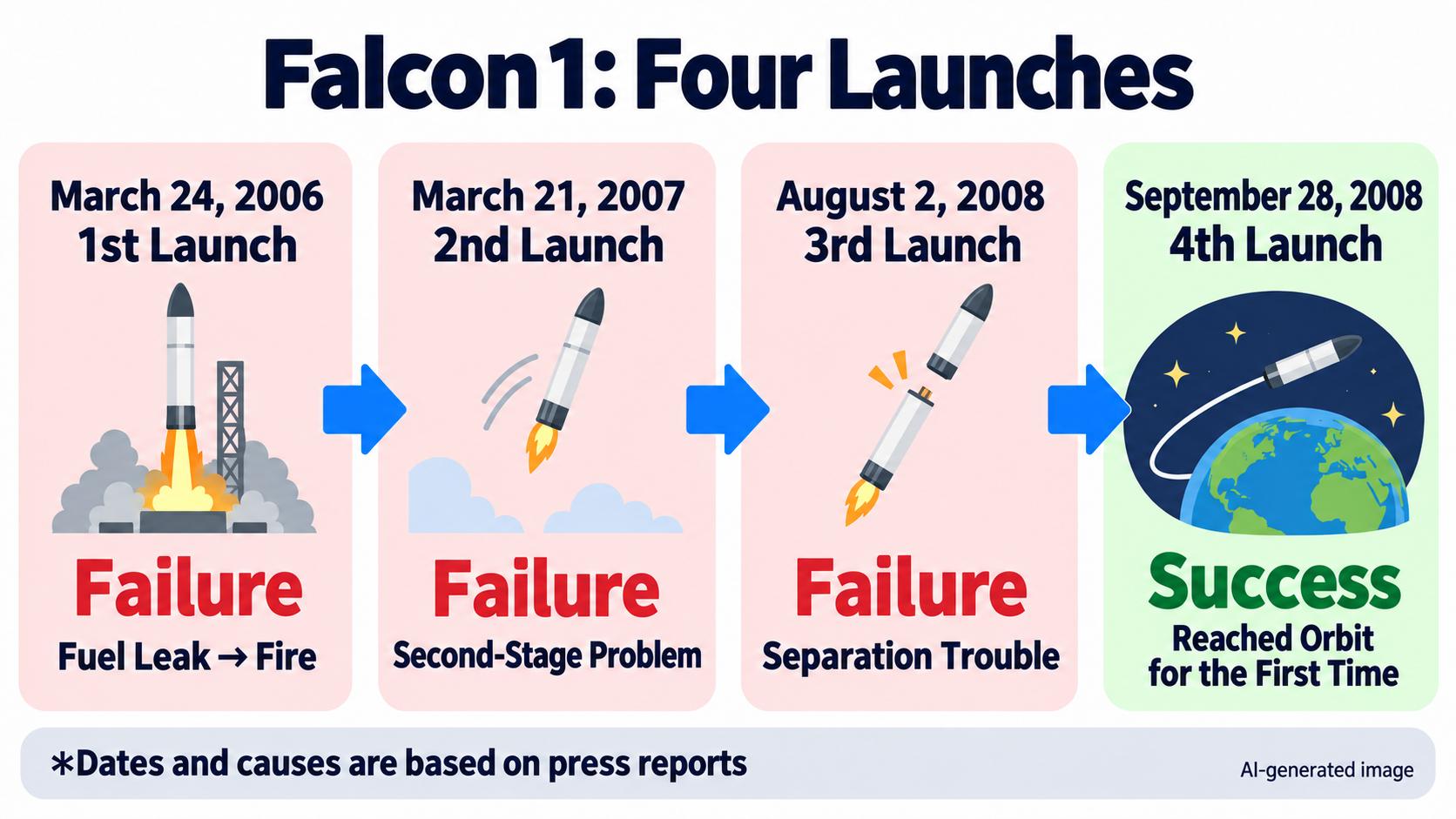
SpaceX's small rocket Falcon 1 failed to reach orbit three times in a row, in March 2006, March 2007 and August 2008. Then, on September 28, 2008, its fourth launch reached Earth orbit for the first time. The three failures are reported to have had different causes.
Fail one rocket launch, and the company takes a heavy blow. Fail twice, and trust begins to waver. Fail three times, and ordinarily that is the end.
SpaceX failed three times. And on the fourth, it succeeded.
This article traces those two and a half years (2006–2008) in order. You will get a real sense of how "hard" the enormous challenge of rockets is.
The stage: a small island in the Pacific
The launch site was Omelek Island, in the Kwajalein Atoll of the Marshall Islands (according to press reports). A small island in the middle of the Pacific. From here, Falcon 1 rose toward the sky four times.
"Falcon 1" is the first rocket SpaceX built: a two-stage, liquid-fuel rocket. "Two-stage" here means the rocket body is divided into a first stage and a second stage; the lower stage is dropped once its fuel is used up, and the upper stage climbs higher still.
Launch 1: March 24, 2006 — a fire right after liftoff
The first launch was on March 24, 2006.
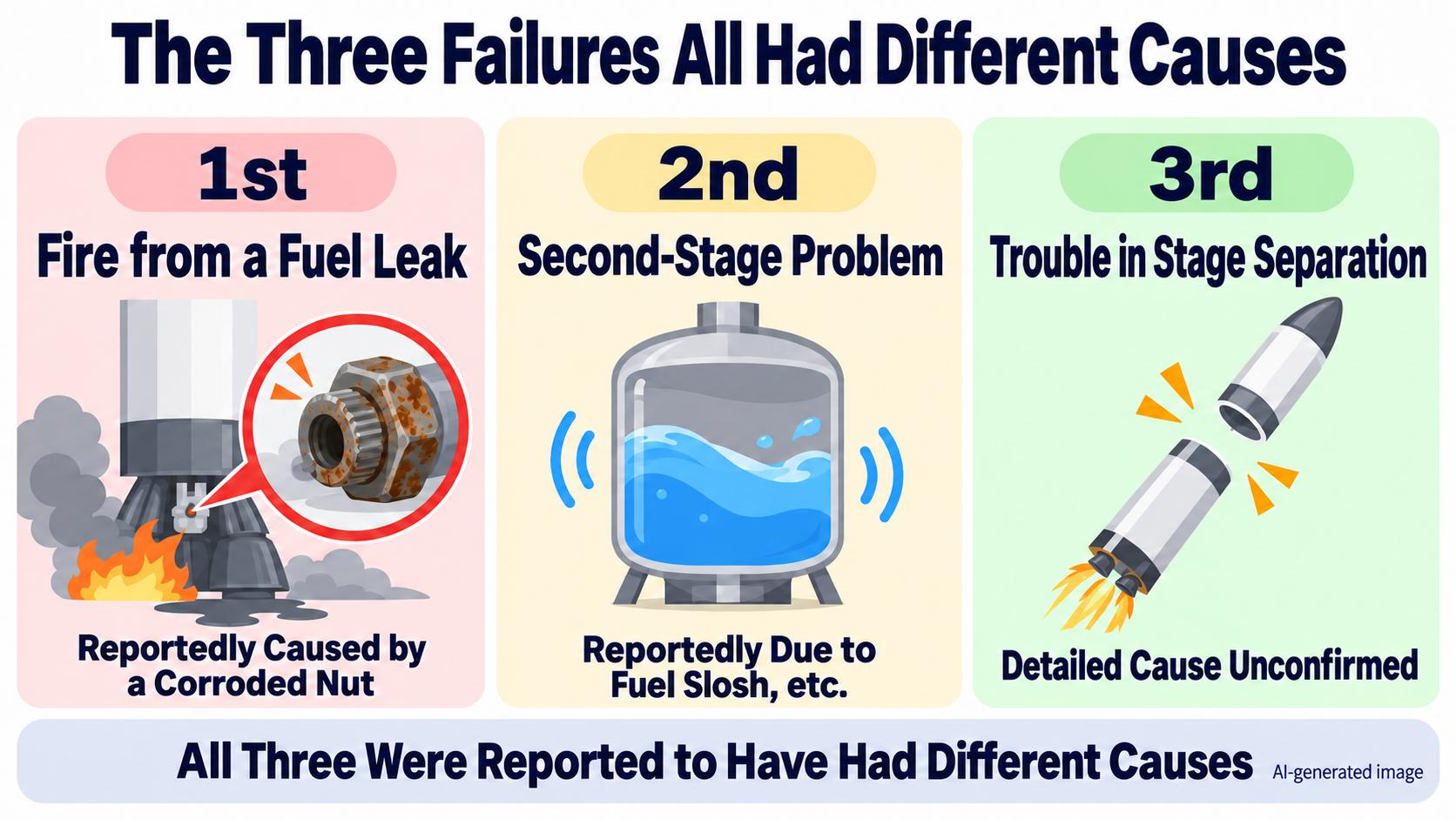
Right after liftoff, fuel leaked from the fuel system. A fire broke out and the flight ended in failure. The cause is reported to have been a corroded nut.
A fault in a small part loses the whole rocket. The fearsomeness of rocketry appeared at the very first step.
Launch 2: March 21, 2007 — one step short of space
The second was on March 21, 2007.
This time it went farther than the first. But a problem occurred during the second stage's flight, and it failed to reach orbit. The cause is reported to involve fuel "sloshing" and the like, and the second-stage engine shut down.
"Fuel sloshing" may not ring a bell. The fuel in a rocket is a large mass of liquid. When the rocket moves, that liquid also sloshes inside the tank. The sloshing can disturb the flow of fuel to the engine. It was a completely different kind of problem from the first.
Launch 3: August 2, 2008 — the stages that were meant to part
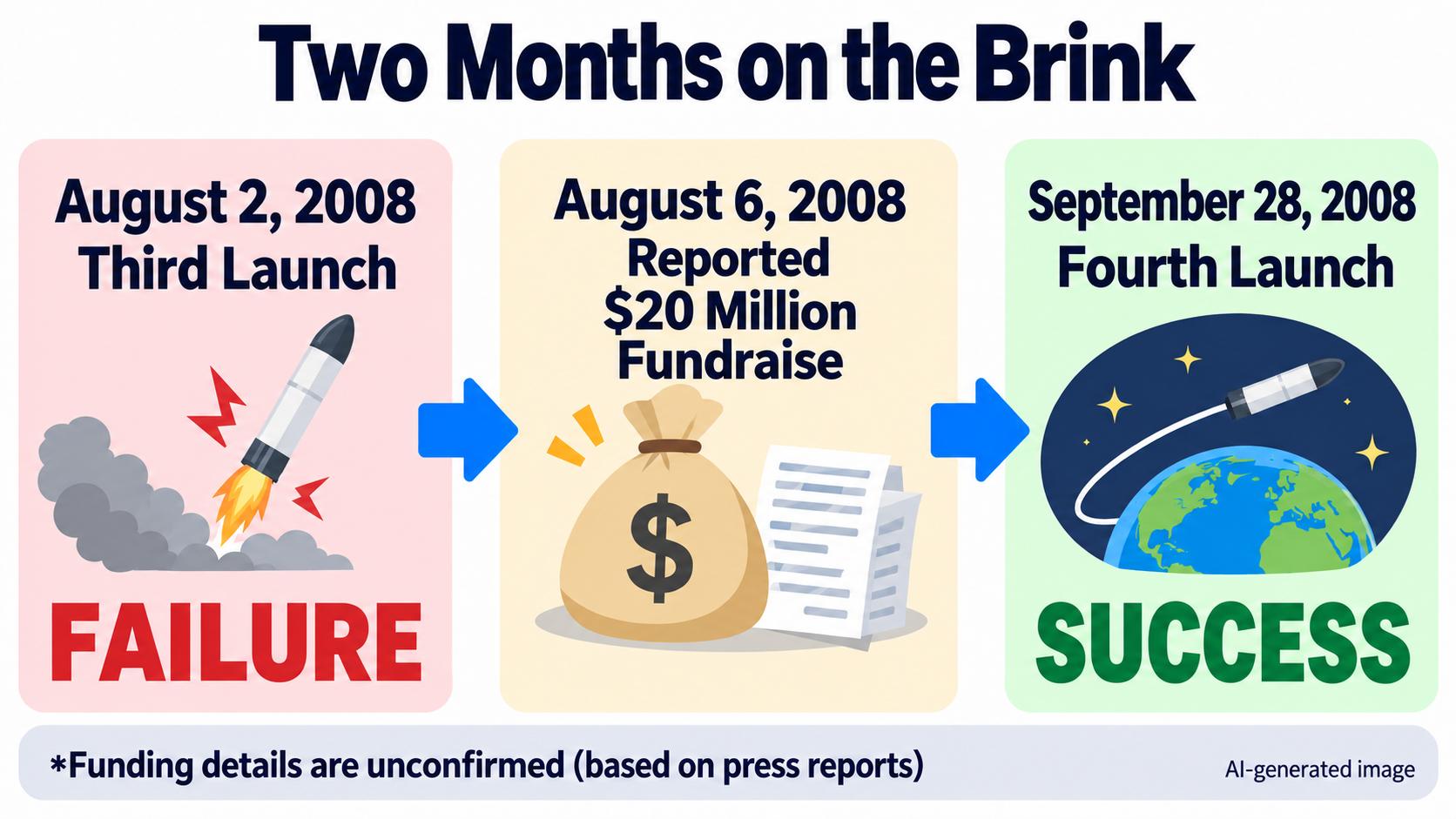
The third was on August 2, 2008.
About two minutes and twenty seconds into the flight, a problem occurred when the first and second stages separated. The two stages are reported to have collided (the detailed technical cause of the separation problem has not been confirmed).
That makes three failures in a row. The first was a fuel leak, the second the second stage, the third stage separation. All three failed in different places, for different reasons.
A few days on the brink
Just four days after the third failure, on August 6, 2008, SpaceX is reported to have raised $20 million from the venture capital firm Founders Fund.
This funding is thought to have been an important piece in getting SpaceX through the brink. But the detailed meaning of this money (the funding situation until then, and its relation to the cost of the fourth launch) has not been confirmed.
And Musk is reported to have declared his intent to attempt a fourth launch even after the failure.
Launch 4: September 28, 2008 — reaching orbit
Then, on September 28, 2008: the fourth launch.
Falcon 1 reached Earth orbit for the first time. After three failures, this was the moment a liquid-fuel rocket developed by a private company reached orbit.
Musk is reported to have commented happily on the precision of the orbital insertion. It is also said that his comment included the English phrase for "the fourth time is the charm" ("Fourth time's a charm").
What did the failures teach?
It seems important that the three failures had different causes. It allows the view that they did not repeat the same failure and removed the causes one by one. The approach is to improve from failures, on the premise that "a rocket cannot be built without ever failing." But this is not a confirmation of how SpaceX actually worked inside; it is the author's interpretation from the outside.
The next article is about this very year, 2008. Behind SpaceX's fourth-launch success, another company was actually nearly collapsing at the same time.
FAQ
What kind of rocket was Falcon 1?
It was the first rocket SpaceX developed: a two-stage, liquid-fuel rocket. It is a different rocket from the later "Falcon 9."
Is the cause of the third failure clearly known?
It is reported that a problem occurred at stage separation. But we could not confirm the detailed technical cause in this article.
Where did the money for the fourth launch come from?
It is reported that $20 million was raised from Founders Fund on August 6, 2008. But its relation to the cost of the fourth launch has not been confirmed.
Summary
- Falcon 1 failed three times in a row: March 24, 2006; March 21, 2007; and August 2, 2008.
- The three causes are reported to have been different (fuel leak, a second-stage problem, stage separation).
- Four days after the third failure, a $20 million fundraising from Founders Fund was reported.
- On September 28, 2008, the fourth launch reached Earth orbit for the first time.
Next: In 2008, the same year SpaceX succeeded, another company was nearly collapsing.
Sources (checked 2026-10-11)
- Space.com, "SpaceX Falcon 1 Falters (Again)" (reports on launches 1 to 3): https://www.space.com/5693-spacex-falcon-1-falters-time.html
- Gizmodo, "SpaceX Falcon 1 finally gets into orbit, makes history" (the fourth-launch success, September 2008): https://gizmodo.com/spacex-falcon-1-finally-gets-into-orbit-makes-history-5056064
- New Atlas, "SpaceX successfully launches Falcon 1 into orbit" (the fourth-launch success): https://newatlas.com/spacex-successfully-launches-falcon-1-into-orbit/10098/
- VentureBeat, "Private rocket company SpaceX gets $20M from the Founders Fund" (August 6, 2008): https://venturebeat.com/business/private-rocket-company-spacex-gets-20m-from-the-founders-fund
This article is for learning about science, technology and corporate history, and is not investment advice. Facts and the author's interpretation are kept separate. Figures are AI-generated illustrations.