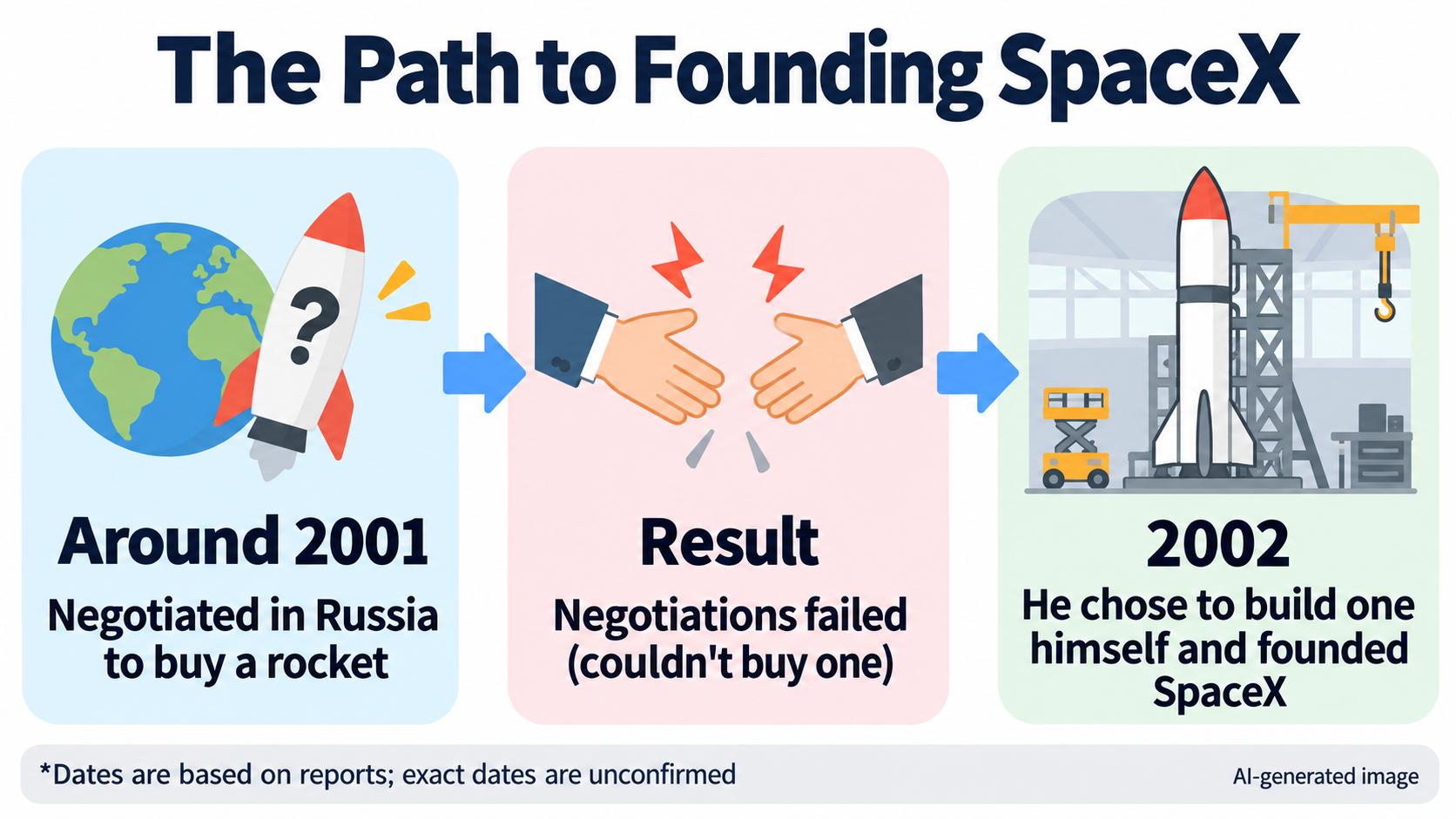
Around 2001, Elon Musk went to Russia to buy a rocket. The negotiations did not succeed, and he is said to have chosen the path of "if I can't buy one, I'll build it myself," founding SpaceX in 2002.
"I'm going to buy a rocket." Most people never say those words in their entire lives.
But Elon Musk really tried to do it. The destination was Russia. The goal was to get a rocket and send it toward Mars. The failure of that trip became the starting point of SpaceX, the company that would later shake the world's space industry.
This article looks at that entrance, in order. What we can confirm as fact and what is only "said to be" are written apart, clearly.
What did he want to send to Mars?
The story starts with "Mars."
Musk is said to have had a plan to send plants and small animals to Mars (from a 2022 business-media article based on accounts from people involved). The aim was to show a place where life could live beyond Earth, and so turn people's attention to space development. The rocket was the "vehicle" for that.
But there is a big wall here: where do you buy a rocket?
Around 2001, to Russia
At that time, rockets were built by nations and a very small number of large organizations. They were not something an individual could buy in a shop. So Musk went to Russia, hoping to get a rocket handed over cheaply.
The talks are reported to have taken place around 2001 (the exact dates are unconfirmed). The result: no deal. The two sides are said to have failed to agree on terms.
There is an anecdote that he was treated insultingly by the Russian side at the negotiating table. It rests on later accounts, and the details could not be confirmed. We should avoid asserting that "SpaceX was born because of that incident." What press reports do confirm are two points: the talks failed, and he then chose the path of building one himself.
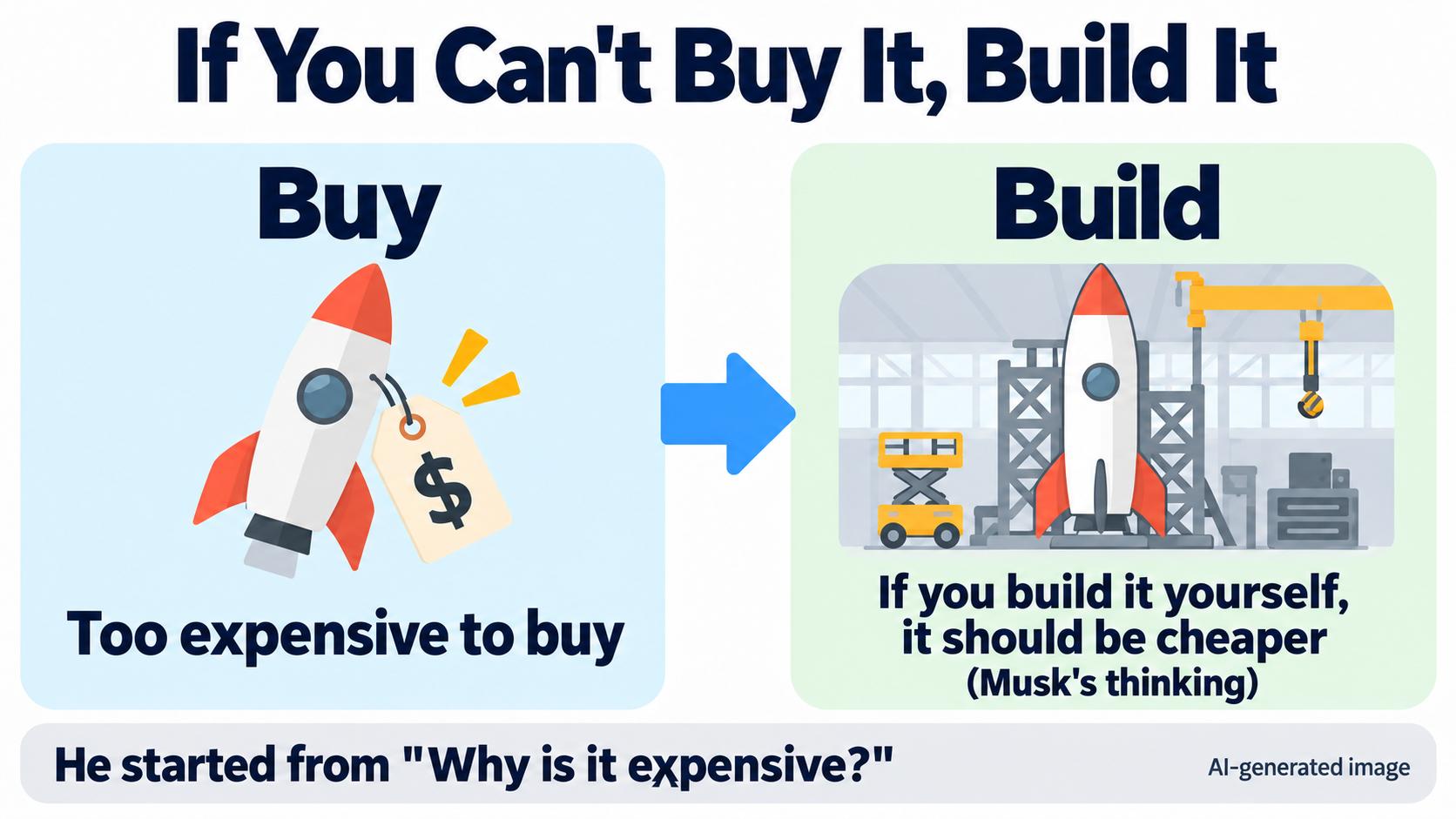
If you can't buy it, build it
Here, an ordinary person would give up. If you can't buy a rocket, the dream of Mars should end there.
But Musk asked a different question: "Why is a rocket so expensive in the first place?"
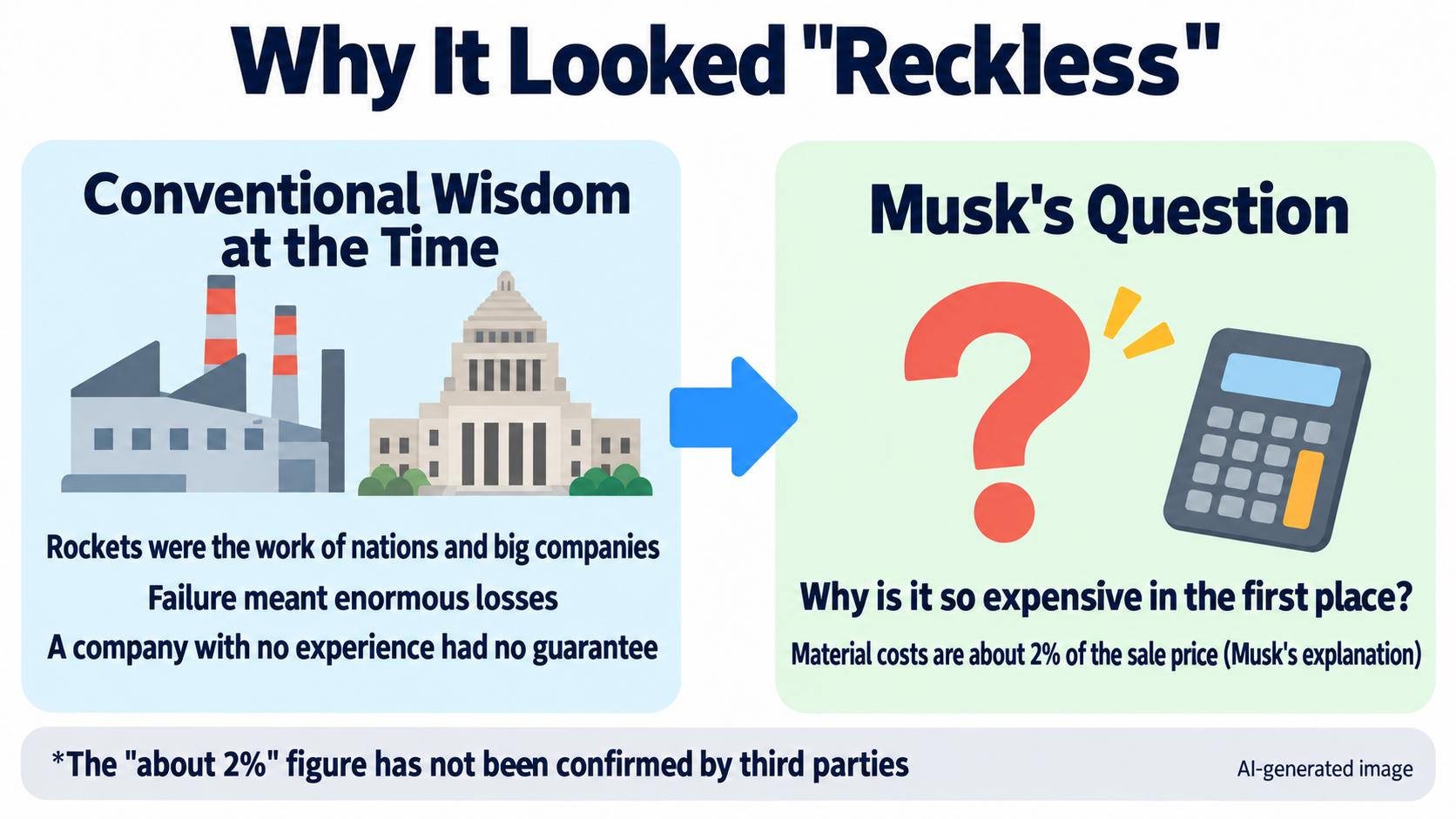
This is exactly the "first-principles thinking" introduced in the earlier article (What is first-principles thinking?). Musk later said that the raw materials of a rocket are only about 2% of its selling price. In other words, the idea is that "the reason it is expensive lies not in the materials but in how it is made." But this "about 2%" is Musk's own explanation, and we could not confirm it with third-party materials.
If you can't buy it, build it. And build it much more cheaply. From here the story begins to move.
2002: SpaceX is founded
In 2002, Musk founded Space Exploration Technologies (known as SpaceX), in El Segundo, California. The founding month is said to be June 2002, but the date itself could not be confirmed.
At the founding, Musk put in his own money. A person with no experience building rockets started a rocket company with his own funds.
Why it looked "reckless"
So why did this look "reckless" to those around him? The reasons are simple.
- Rockets were thought of as the work of nations and large organizations.
- If you fail, a huge amount of money is lost in an instant.
- There is no guarantee at all that a company that has never built one will succeed.
Musk's challenge went against all of this "common sense." And big failures really did lie ahead. The next article covers SpaceX, which failed three launches in a row, and the miracle that came out of that brink.
FAQ
Is it true that he was spat on in Russia?
It is an anecdote based on later accounts and could not be confirmed. In this article, only the point that "the talks failed" is treated as fact.
When was SpaceX founded?
It is said to be June 2002, but the exact date could not be confirmed. The date a company is incorporated can differ from the date it actually began operating.
Is it correct that rocket materials are about 2% of the selling price?
It is presented as Musk's own explanation. We could not confirm a figure with the same premise in third-party materials.
Summary
- Around 2001, Musk is reported to have gone to Russia to buy a rocket. The talks failed.
- He chose the path of "if you can't buy it, build it" and founded SpaceX in 2002 (date unconfirmed).
- The question "why is a rocket expensive?" connects to first-principles thinking (the "about 2%" is Musk's explanation and unverified).
Next: What happened after SpaceX was founded? Three failed launches in a row, and the miracle of the fourth.
Sources (checked 2026-10-11)
- Business Insider, "Russian officials inspired Elon Musk to start SpaceX by spitting on his shoes, a new book says" (June 2022): https://www.businessinsider.com/russian-inspired-spacex-by-spitting-on-elon-musk-shoes-book-2022-6 (background on the Russia talks and the Mars plan; details of the anecdote are from later accounts)
- Musk's remarks on rocket raw-material costs: see the sources of What is first-principles thinking?.
This article is for learning about science, technology and corporate history, and is not investment advice. Facts and the author's interpretation are kept separate. Figures are AI-generated illustrations.