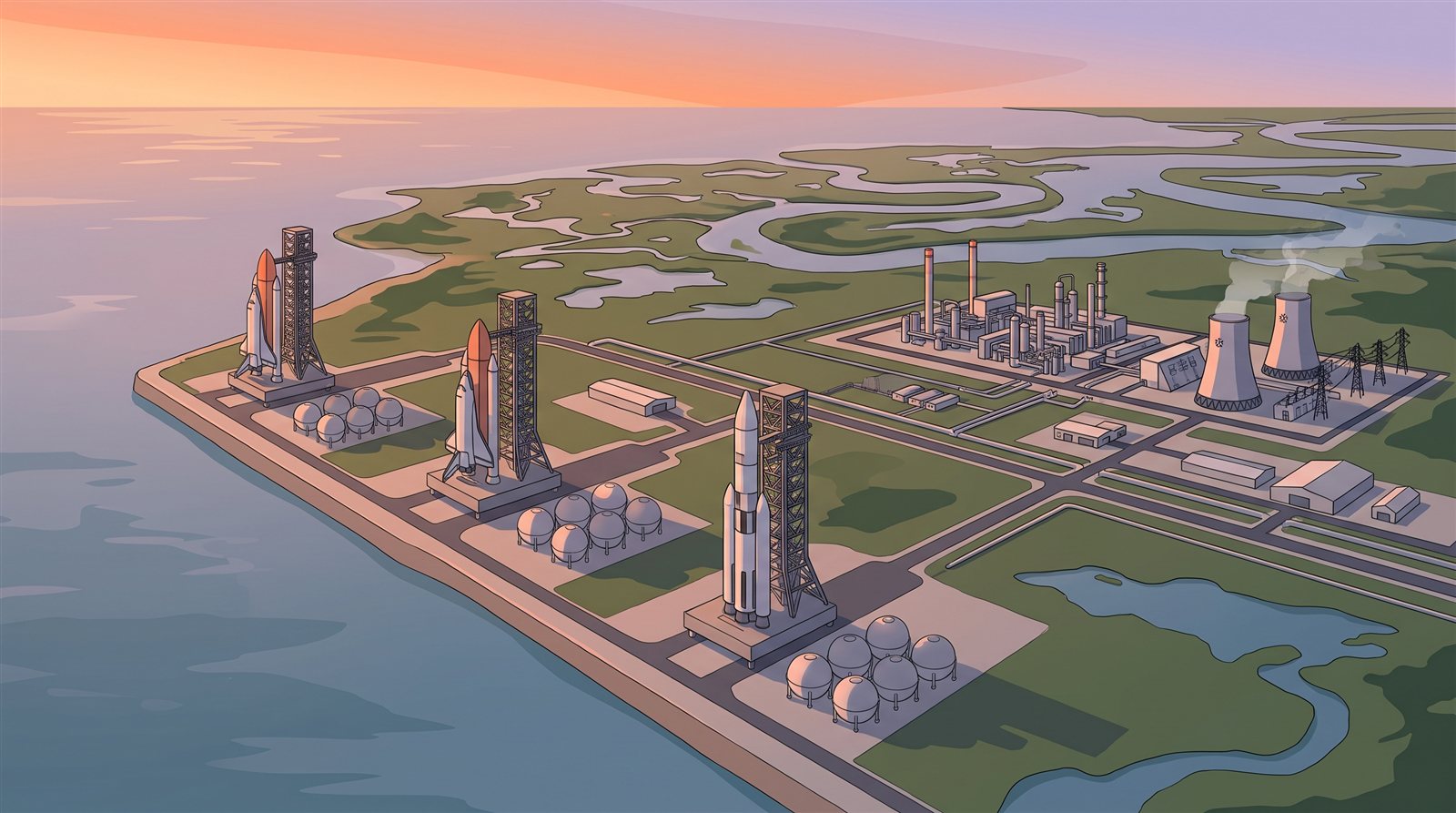
In its third-quarter release filed with the U.S. Securities and Exchange Commission on October 20, 2026, SpaceX described Starbase Louisiana as its next-generation spaceport, designed to support thousands of Starship flights a year, with the first launch targeted for 2029. According to Louisiana Economic Development (August 25, 2026), the site is at Pecan Island in Vermilion Parish. At full buildout it will have five launch complexes with two pads each (ten in total), propellant farms, a propellant production facility, power generation, vehicle processing and employee housing. Construction is expected to begin in 2027.
3-line summary
- In its third-quarter release on October 20, 2026, SpaceX described Starbase Louisiana as a next-generation spaceport "designed to support thousands of Starship flights a year," with the first launch targeted for 2029.
- The state's announcement (August 25, 2026) says that at full buildout there will be five launch complexes × two pads = ten pads, each complex with a propellant farm, plus a propellant production facility and power generation on site.
- The state cites abundant natural gas (for power and fuel), expansive acreage, and a Gulf Coast location that supports a wide range of launch trajectories.
Background: launch sites, propellant and launch direction
A launch site is a rocket's airport. Planes take off from runways, refuel and get serviced at airports. Rockets likewise fly from a cluster of pads, propellant tanks and buildings for assembly and inspection. The differences are that a rocket pad takes intense flame and vibration on every launch, and the amount of propellant is in a different league. SpaceX already operates launch sites at Starbase in Texas, in Florida, and at Vandenberg in California, and the state calls Louisiana SpaceX's "fourth and largest" launch site.
Propellant is a rocket's fuel plus its oxygen. A car engine burns gasoline with oxygen from the air. Space has no air, so a rocket carries its own oxygen. Fuel and oxidizer together are called propellant. Starship uses liquid methane and liquid oxygen (SpaceX). Methane is the main component of natural gas. Liquid oxygen is usually made by chilling air and separating out the oxygen.
One Starship launch uses about 5,250 tonnes of propellant. SpaceX's official figures are 3,650 t for the Super Heavy booster and 1,600 t for the Starship upper stage (Starship basics). A 25-meter swimming pool holds about 400 t of water, so that is roughly 13 pools. At 1,000 flights a year, it would be about 5.25 million tonnes (my own calculation). Trucking or shipping that much in from far away for every launch is not realistic, which is why making propellant on site makes sense.
Launch direction depends on where the site is. Rockets drop empty stages and parts as they climb, so they normally launch over the sea rather than over populated land. Florida launches east over the Atlantic; Vandenberg launches south over the Pacific. Which directions you can fly determines which orbits you can reach.
What happened
On October 20, 2026, SpaceX published its third-quarter (July–September) results and filed them with the SEC. Among the Space segment highlights is this line:
Announced the planned development of Starbase, Louisiana, our next-generation spaceport, designed to support thousands of Starship flights a year, with the first launch targeted for 2029. (SpaceX)
The plan itself was announced by Louisiana Economic Development on August 25, 2026. Here is what the announcement and project page say:
| Item | State announcement / project page |
|---|---|
| Location | Pecan Island, Vermilion Parish, Louisiana |
| Status | SpaceX's fourth and largest launch site |
| Launch complexes | Five at full buildout, each with two pads and a propellant farm (ten pads in total) |
| Other facilities | Propellant production facility, power generation, vehicle processing, housing for employees and families |
| Capacity | Designed to support thousands of launches annually |
| Schedule | Construction to begin in 2027 ("by the end of 2027" on the project page); first launch as soon as 2029 |
| Jobs | 3,000 direct jobs over 10 years (state estimate) |
| Investment | $100 billion |
| Reviews | All applicable environmental, wetlands, natural resource and launch-related reviews |
In a statement for the announcement, Musk said the goal is to make "going to space as routine as flying on an airplane" and that "Starbase, Louisiana will unlock that future." At the October 20 presentation, Musk reportedly said the internal goal is a 2028 launch but 2029 is more likely.
Why it matters
The number of pads caps the number of flights. Just as an airport can't handle more flights than its runways allow, a rocket fleet's launch rate is limited by the number of pads and how quickly each pad can be reused. Ten pads used once a day each would give about 3,650 launches a year (my own calculation). "Thousands a year" implies turning pads around on something close to a daily cycle. Today, a pad usually needs several days or more of inspection and repair after a launch.
Flying Starship "like an airplane" requires designing in the fuel plant. As calculated above, each Starship flight uses about 5,250 t of propellant. A crewed Moon landing needs multiple refueling flights in low Earth orbit; a NASA meeting reportedly heard an estimate of about 22, while Musk answered "6 to 8" (refueling flights for the Moon). Either way, frequent launches are assumed. On-site propellant production and power generation are the foundation for that cadence.
Background: why Louisiana?
The state gives three reasons:
- Abundant natural gas: Louisiana is a major natural gas producer. Natural gas fuels power plants and is the source of the methane Starship burns, so power and fuel can come from nearby.
- Expansive acreage: Pads must be spaced apart in case of an explosion. Ten pads plus plants and housing need a lot of land.
- Gulf Coast location: With open water to the south, the state says the site supports a wide range of launch trajectories.
My own view: Starbase in Texas is hemmed in by the sea, a town and roads, leaving limited room to grow. Louisiana faces the same Gulf of Mexico, which may also make it easier to move large vehicles built in Texas by sea (the announcement does not say this).
How it works: what is in one launch complex?
Here are the facilities from the state's announcement, by role:
| Facility | Role | Everyday analogy |
|---|---|---|
| Launch pads (two per complex) | Stand the vehicle up and launch it; Super Heavy is designed to be caught by the tower's arms | Runway |
| Propellant farm (each complex) | Store methane and oxygen before launch | Airport fuel tanks |
| Propellant production facility | Make methane and liquid oxygen | Refinery |
| Power generation | Supply electricity to the plant and pads | Private power plant |
| Vehicle processing | Inspect returned vehicles for the next flight | Maintenance hangar |
| Housing | Employees and families live nearby | Company town |
Why two pads per complex? While one pad is being inspected after a launch, the other can be prepared for the next one. Two runways mean less downtime than alternating on one. Catching Super Heavy with tower arms and returning it straight to the pad (Flight 15's dual catch) is part of the same "fly again quickly" idea.
Timeline
- August 25, 2026: Louisiana Economic Development announced SpaceX's launch site: five complexes (ten pads), construction in 2027, first launch as soon as 2029.
- October 20, 2026: SpaceX's third-quarter release (filed with the SEC) described Starbase Louisiana as a next-generation spaceport for thousands of flights a year, with the first launch targeted for 2029.
- Next: According to the project page, the project will go through environmental, wetlands, natural resource and launch-related reviews. The state says unavoidable wetlands impacts must be fully mitigated by the company.
Takeaways for reading the news
- Pads × turnaround = launch ceiling: Ten pads at one launch a day is about 3,650 a year. That puts "thousands a year" in scale.
- Remember the propellant: About 5,250 t per Starship flight. The more flights, the more "where do we make the fuel?" drives site selection.
- Common misconception: "Announced" is not "built." As of October 2026, construction is scheduled to start in 2027, and the reviews are still ahead.
A question to follow
What does one launch do to a pad? Learning how the ground and tower that take the flame of 33 engines could be ready again within a day shows what makes "thousands a year" so hard.
Read next
- What Is Starship? The Two-Stage Design with Super Heavy, Size, Engines and Reuse, Checked on SpaceX's Official Page
- How many refueling launches does Starship need to reach the Moon? Reading the gap between "about 22" and "6 to 8"
- Starship Flight 15 aims for a "dual catch" of booster and ship. How a tower catches a rocket
Sources
- SpaceX third-quarter release (October 20, 2026, SEC filing, Exhibit 99.1) → https://www.sec.gov/Archives/edgar/data/1181412/000162828026066482/spaceexplorationtechnologi.htm
- Louisiana Economic Development, "SpaceX Launches New Era of Commercial Spaceflight with $100 Billion Louisiana Campus" (August 25, 2026) → https://www.opportunitylouisiana.gov/news/spacex-launches-new-era-of-commercial-spaceflight-with-100-billion-louisiana-campus
- Louisiana Economic Development, Starbase Louisiana project page → https://opportunitylouisiana.gov/spacex
- New Space Economy (report on the October 20 presentation, October 21, 2026) → https://newspaceeconomy.ca/2026/10/21/could-spacex-launch-starship-from-louisiana-in-2028-instead-of-2029/
*Location, facilities, schedule and reviews were checked against Louisiana Economic Development's announcement and project page; "thousands of flights a year" and "2029" against SpaceX's SEC filing (as of 2026-10-24). Status: Musk's remark at the October 20 presentation that the internal goal is 2028 is based on press reports and has not been confirmed in an official written source.
Thank you for reading. Was this article useful to you?
Thank you. If you like, tell us what you thought in a line or two.
Optional. No name or email needed.
Received. We will use your words to make better articles.