According to SpaceX's official page, Starship combines the Starship spacecraft (upper stage) and the Super Heavy booster (first stage) into a system designed to be fully reusable. It is 124 m tall and 9 m in diameter, and is designed to carry more than 100 metric tonnes to orbit in a fully reusable configuration (a design goal, not a record). Super Heavy has 33 Raptor engines and is designed to be caught by the launch tower.
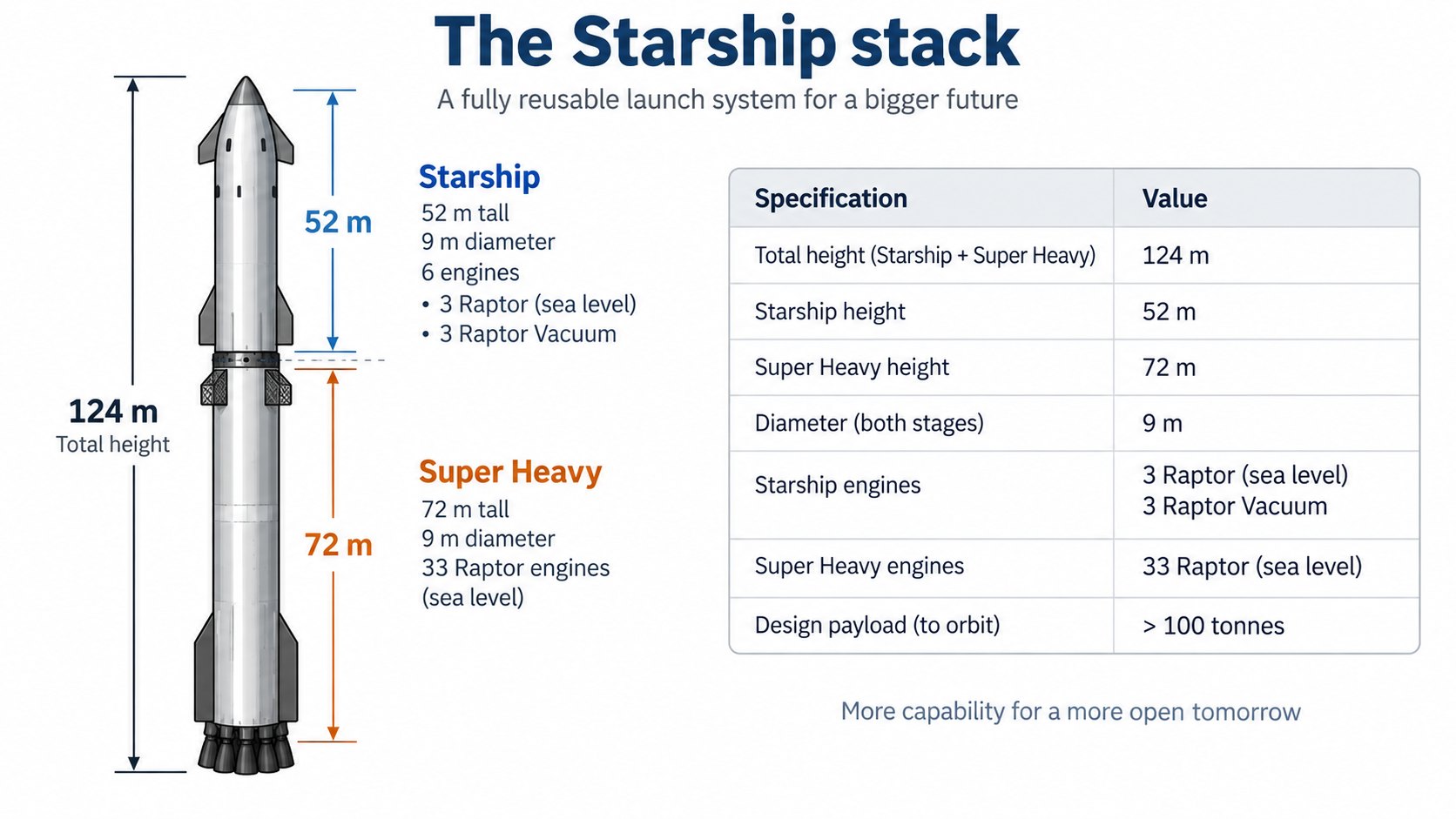
Starship is much larger than Falcon 9. We summarize what SpaceX's official Starship page confirms (checked 2026-10-16). The figures here are design figures, not flight records.
The conclusion: both stages are designed to be reused
The page says (summary):
- Starship (the spacecraft) and Super Heavy (the rocket), together called Starship, are a fully reusable transportation system designed to carry crew and cargo to Earth orbit, the Moon, Mars and beyond.
- "The world's most powerful launch vehicle ever developed", designed to carry more than 100 metric tonnes to orbit in a fully reusable configuration.
| Item | Figure on the official page (design) |
|---|---|
| Whole system height | 124 m (407 ft) |
| Diameter | 9 m (29.5 ft) |
| Payload | 100+ t |
Starship (the upper stage)
| Item | Figure |
|---|---|
| Height | 52 m (171 ft) |
| Diameter | 9 m |
| Propellant capacity | 1,600 t |
| Thrust | 1,614 tf (3.5 Mlbf) |
| Payload | 100+ t |
| Engines | 6 (three Raptor, three Raptor Vacuum) |
[A note for beginners]
tf (tonne-force) is the force with which Earth pulls one tonne (1 tf ≈ 9.8 kN; a general conversion). Propellant is the fuel and oxidizer a rocket burns. Raptor Vacuum is built for use in the vacuum of space.
Super Heavy (the first-stage booster)
| Item | Figure |
|---|---|
| Height | 72 m (236 ft) |
| Diameter | 9 m |
| Propellant capacity | 3,650 t |
| Thrust | 8,240 tf (18.1 Mlbf) |
| Engines | 33 Raptor (13 maneuverable in the center, 20 around the perimeter) |
| Propellants | sub-cooled liquid methane (CH4) and liquid oxygen (LOX) |
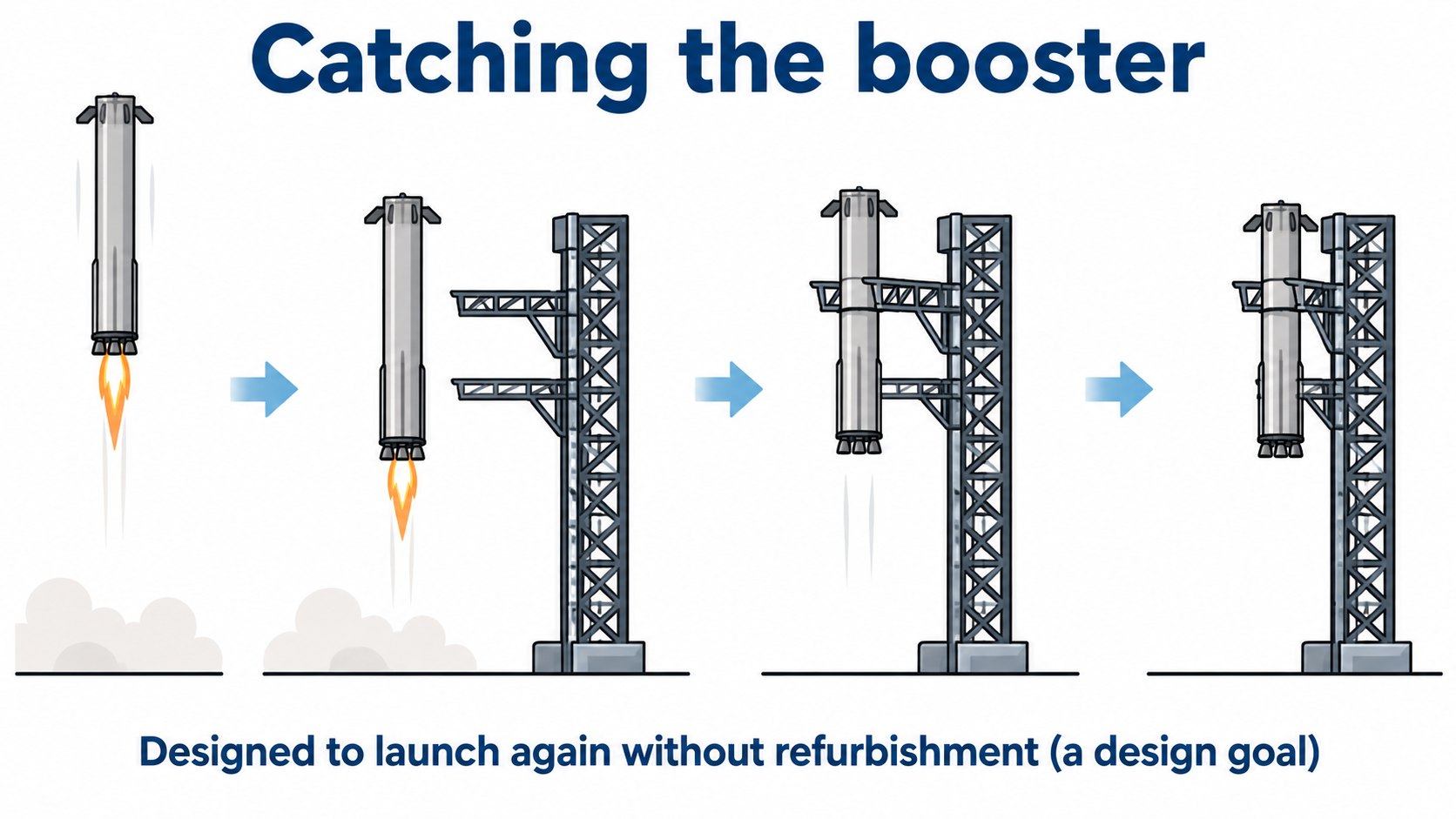
Super Heavy is designed to return to the launch site, be caught by the launch tower and be rapidly reused.
Reuse and on-orbit refilling
- Full and rapid reusability: Starship and Super Heavy are designed to return to the launch site and be caught, then launch again without refurbishment.
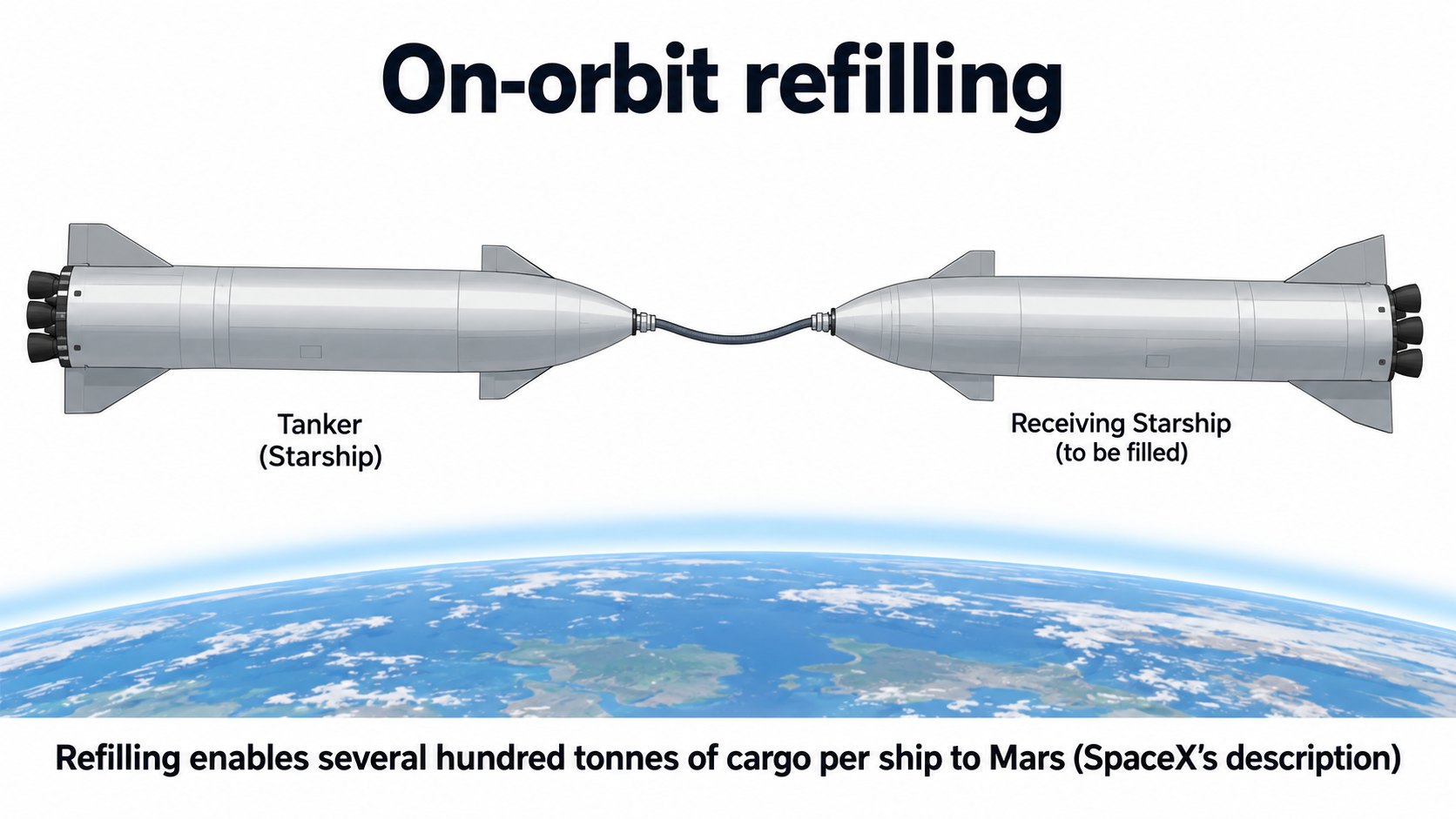
- On-orbit refilling: tanker vehicles (essentially Starship minus the windows) refill the spacecraft in low Earth orbit. The page says this enables several hundred tonnes of cargo per ship to Mars, and that with high tanker reuse the primary cost is just oxygen and methane, which is "extremely low".
FAQ
How many stages does Starship have?
Two: Super Heavy as the first stage and the Starship spacecraft as the upper stage (official page).
How big is it?
The whole system is 124 m tall and 9 m in diameter (design figures, official page).
How does it differ from Falcon 9?
Starship is designed to reuse both stages, caught by the tower. The Falcon 9 page describes it as reusable and mentions fairing recovery, but does not say anything about reusing the second stage.
How many engines?
Super Heavy has 33 Raptor engines; the Starship upper stage has six (three Raptor, three Raptor Vacuum).
Summary
- Starship is a fully reusable system of Super Heavy (first stage) and Starship (upper stage): 124 m tall, 9 m in diameter.
- Design payload over 100 t. Engines: 33 on Super Heavy, 6 on Starship.
- It is designed around catching by the tower and on-orbit refilling.
Sources (checked 2026-10-16)
- SpaceX, "Starship": https://www.spacex.com/vehicles/starship
- SpaceX, "Falcon 9": https://www.spacex.com/vehicles/falcon-9
This article is for learning about science and technology and is not investment advice. Facts and the author's reading are kept separate. The figures are AI-generated illustrations.
Thank you for reading. Was this article useful to you?
Thank you. If you like, tell us what you thought in a line or two.
Optional. No name or email needed.
Received. We will use your words to make better articles.