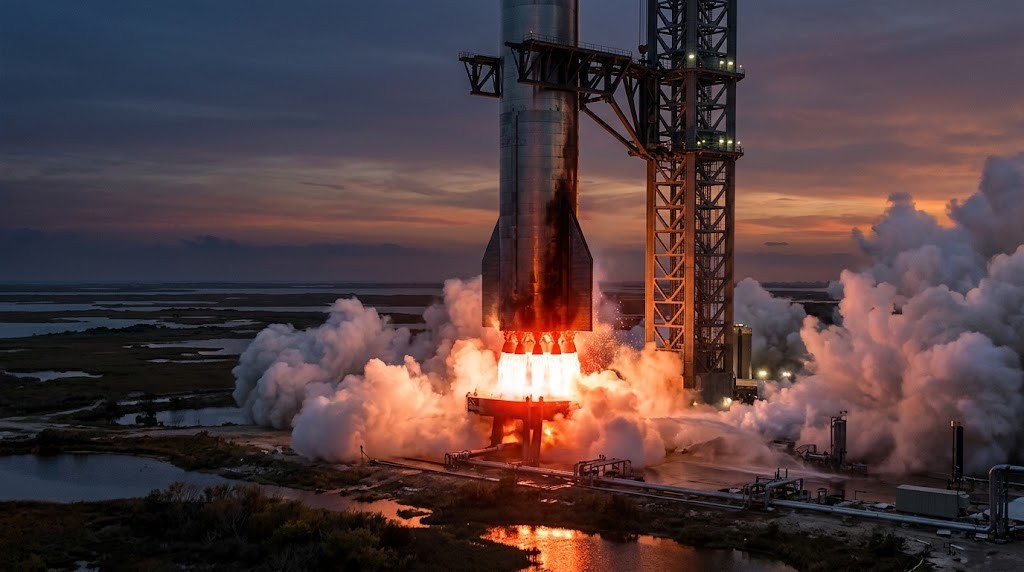
On October 25, 2026 (U.S. time), SpaceX announced on its official X account a "full duration 33-engine static fire" of the Super Heavy booster, preparing for Starship Flight 15. A static fire holds the rocket on the pad while all engines burn, so engineers can check the engines and ground systems without flying.
Summary in three lines
- On October 25, 2026 (U.S. time), SpaceX said on its official X account that it had performed a full-duration static fire of the Super Heavy first stage with all 33 engines, preparing for Starship Flight 15 (two videos attached).
- A static fire holds the rocket on the ground while every engine burns. It checks whether the engines and the pad equipment work as they will on launch day, without flying.
- Flight 15 plans to catch both the booster and the Ship with the launch tower. Specialist media had described this static fire as a major pre-launch milestone.
Background: what is a static fire?
Before a rocket flies, it is sometimes asked to give full power while staying on the ground. That is a static fire. "Static" means not moving. The base of the rocket is firmly held to the pad while the engines ignite and burn.
It is like putting a car on a stand at inspection and revving the engine to look for faults. Finding a problem while stationary is safer and easier to fix than discovering it after takeoff.
There are three main things to check.
- Do all the engines light? Super Heavy carries 33 engines. If even one fails to start or shuts down early, it can affect the real flight.
- Does the propellant keep flowing steadily? The pipes and pumps that feed large amounts of liquid methane (fuel) and liquid oxygen (oxidizer) to the engines must work correctly for the whole burn.
- Does the pad equipment work too? Fueling systems, hold-down systems and the water systems used during a burn all have to follow the same procedure as on launch day.
What happened
On October 25, 2026 (U.S. time; early morning of the 26th in Japan), SpaceX posted on its official X account: "Full duration 33-engine static fire for the Super Heavy booster preparing for Flight 15." Two videos are attached.
The key phrase is "full duration." SpaceX is indicating that the 33-engine static fire took place and ran for its planned length.
What is Super Heavy?
According to SpaceX's official page, Super Heavy is the first stage (booster) of Starship. Key figures:
| Item | SpaceX official page |
|---|---|
| Height | 72 m (236 ft) |
| Diameter | 9 m (29.5 ft) |
| Engines | 33 Raptor engines (sub-cooled liquid methane and liquid oxygen) |
| Thrust | 8,240 tf (18.1 million lbf) |
| Propellant capacity | 3,650 t (8 million lb) |
A thrust of 8,240 tf is how hard the rocket pushes on the ground. With all 33 engines running, it can lift roughly 8,000 tonnes of weight. SpaceX describes the full Starship system (booster plus Ship) as the most powerful launch vehicle ever developed.
A static fire burns all 33 at once. Confirming that they can all burn together for the planned length is a main purpose of the test.
What makes Flight 15 special
Flight 15 is Starship's 15th flight. On October 20, 2026 (U.S. time), SpaceX said it plans to catch both the booster and the Ship with the arms of the launch tower on this flight. A booster catch has succeeded before; a Ship catch has never been tried (details here).
In an October 18 article, NASASpaceflight said Flight 15 is targeting November, with a current No Earlier Than date of November 8. It said that keeping that date requires both the booster and the Ship to complete a major pre-launch milestone, a static fire. It also reported that the Flight 15 booster is Booster 22, that it was believed to have all its engines installed, and that it was awaiting its static fire at Pad 2. This post shows that the booster-side milestone has now taken place.
For the Ship (Ship 42), the same article reported that its engines had been removed and that it was undergoing other testing. A Ship static fire is not part of this post.
Why it matters
A static fire confirms on the ground that the flight vehicle behaves as it will on launch day. In a plan where the booster is caught by the tower, the 33 engines are used not only on the way up but also on the way back, since the final landing relies on engine thrust to line up within tens of centimeters. That makes it especially important that every engine lights and shuts down as intended.
Tips for reading the news
- A static fire is not a launch: The rocket stays on the pad. Even if a headline mentions flames or a plume, it did not fly.
- "Completed" and "launch date confirmed" are different things: After a static fire, the launch date can still move with approvals, weather and the readiness of other vehicles. Wait for SpaceX's announcement.
- Booster and Ship are tested separately: For Flight 15, each is expected to have its own static fire. This announcement concerns the booster.
Timeline
- October 13, 2024 (Flight 5): Super Heavy was caught by the tower for the first time.
- September 28, 2026 (Flight 14): Starship reportedly reached orbit.
- October 18, 2026: NASASpaceflight reported Flight 15 was targeting November, with the booster awaiting its static fire.
- October 20, 2026: The plan to catch both the booster and the Ship was presented for Flight 15.
- October 25, 2026 (U.S. time): SpaceX announced on X the full-duration 33-engine static fire of Super Heavy.
A question to follow up
What preparation remains between the booster's static fire and launch? Following the Ship's static fire, the launch approval and the final checks of the tower arms in turn will give clues about when Flight 15 can fly.
Read next
- Starship Flight 15 will try to catch both the booster and the Ship
- What Is Starship? The Two-Stage Design with Super Heavy, Size, Engines and Reuse
- Falcon 9 vs. Starship
Sources
- SpaceX on X (@SpaceX, post of October 25, 2026) → https://x.com/SpaceX/status/2114444137067844004
- SpaceX, "Starship" official page (Super Heavy height, engines, thrust) → https://www.spacex.com/vehicles/starship
- NASASpaceflight, "SpaceX working through Starship Flight 15 and 16 milestones" (October 18, 2026) → https://www.nasaspaceflight.com/2026/10/spacex-flight-15-16-milestones/
Note: The static fire itself (33 engines, full duration, preparing for Flight 15) was checked in SpaceX's official X post (as of October 26, 2026). Vehicle figures come from SpaceX's official page; Booster 22, the November 8 target and the Ship's status are based on NASASpaceflight's reporting.
Thank you for reading. Was this article useful to you?
Thank you. If you like, tell us what you thought in a line or two.
Optional. No name or email needed.
Received. We will use your words to make better articles.