On SpaceX's official pages, Falcon 9 is 70 m tall and 3.7 m in diameter; the whole Starship system is 124 m tall and 9 m in diameter. Falcon 9 lists 22,800 kg to low Earth orbit, while Starship is designed to carry 100+ tonnes in a fully reusable configuration. The reuse approach also differs: Starship is designed to return to the launch site and be caught by the tower. But Starship's figures are design figures, not results.
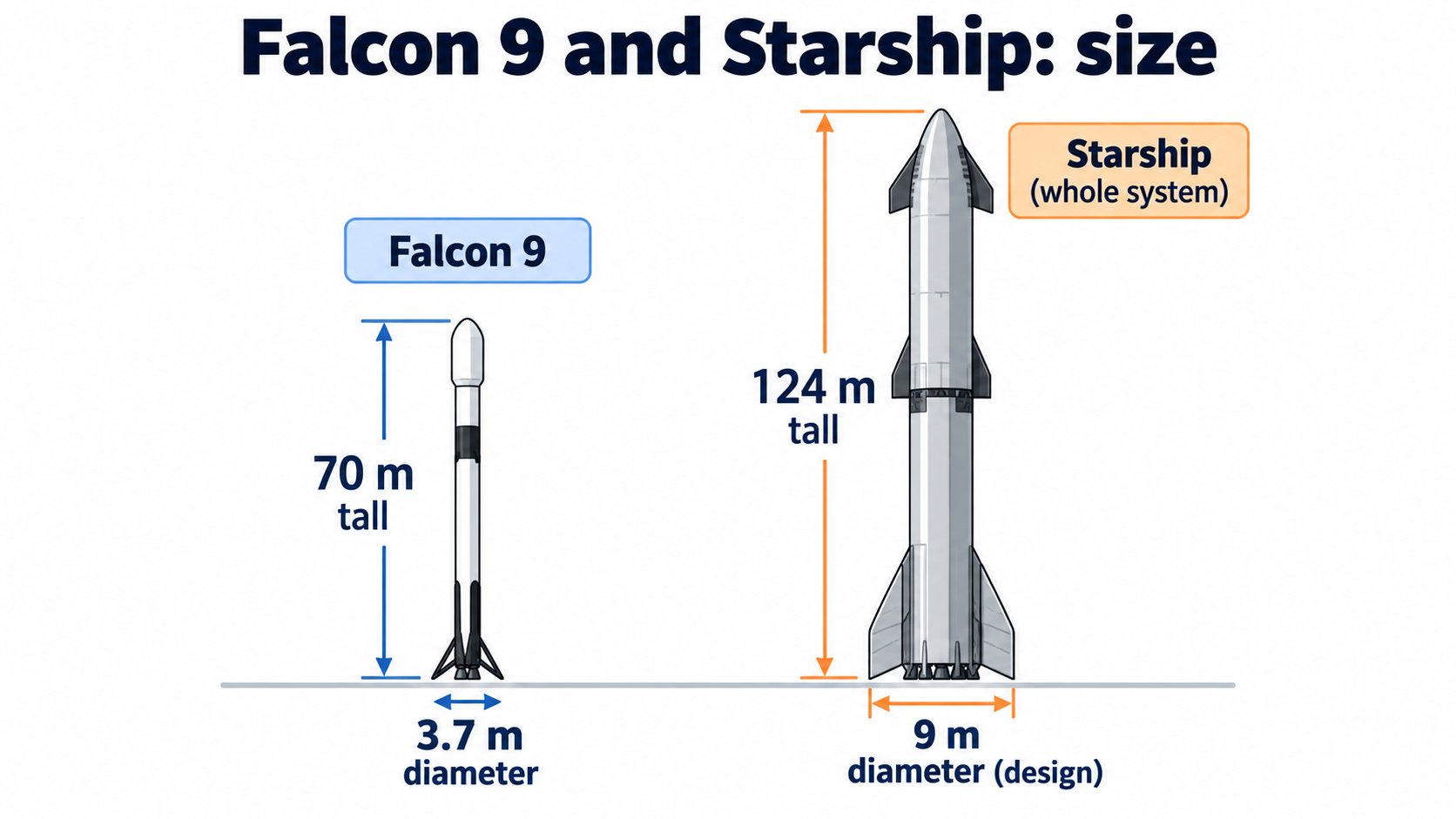
We put the figures from the Falcon 9 and Starship articles side by side (SpaceX official pages, checked 2026-10-16).
The conclusion: every figure is very different
| Item | Falcon 9 | Starship (whole system) |
|---|---|---|
| Stages | 2 | 2 (Super Heavy + Starship) |
| Height | 70 m | 124 m |
| Diameter | 3.7 m | 9 m |
| First-stage engines | 9 Merlin | 33 Raptor (Super Heavy) |
| Second-stage engines | 1 Merlin Vacuum | 6 (3 Raptor, 3 Raptor Vacuum) |
| Propellants | kerosene (RP-1) + liquid oxygen | methane + liquid oxygen |
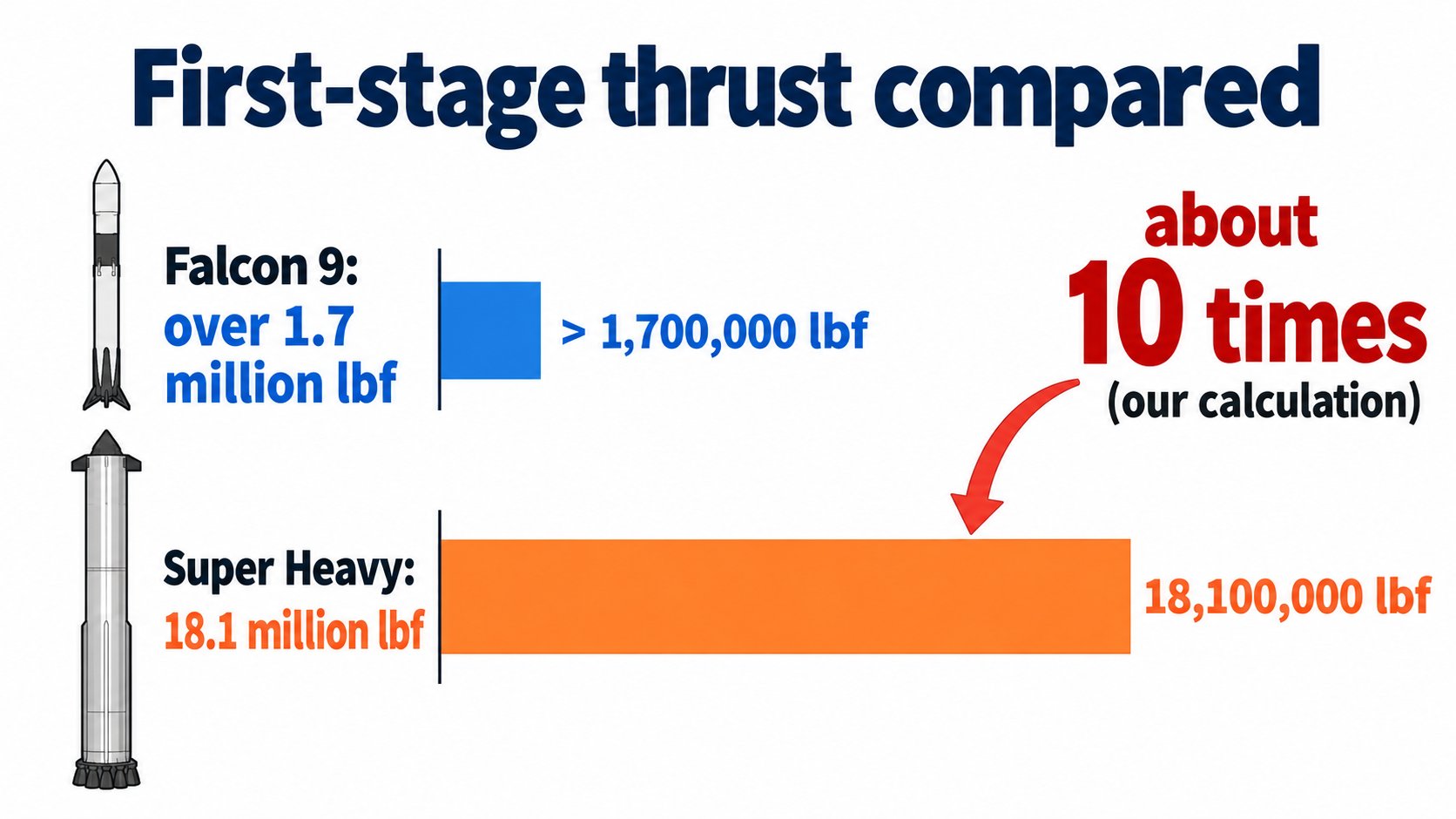
| First-stage thrust | over 1.7 million lbf at sea level | 8,240 tf (18.1 Mlbf) |
| Payload to low Earth orbit | 22,800 kg | 100+ t (fully reusable configuration, design) |
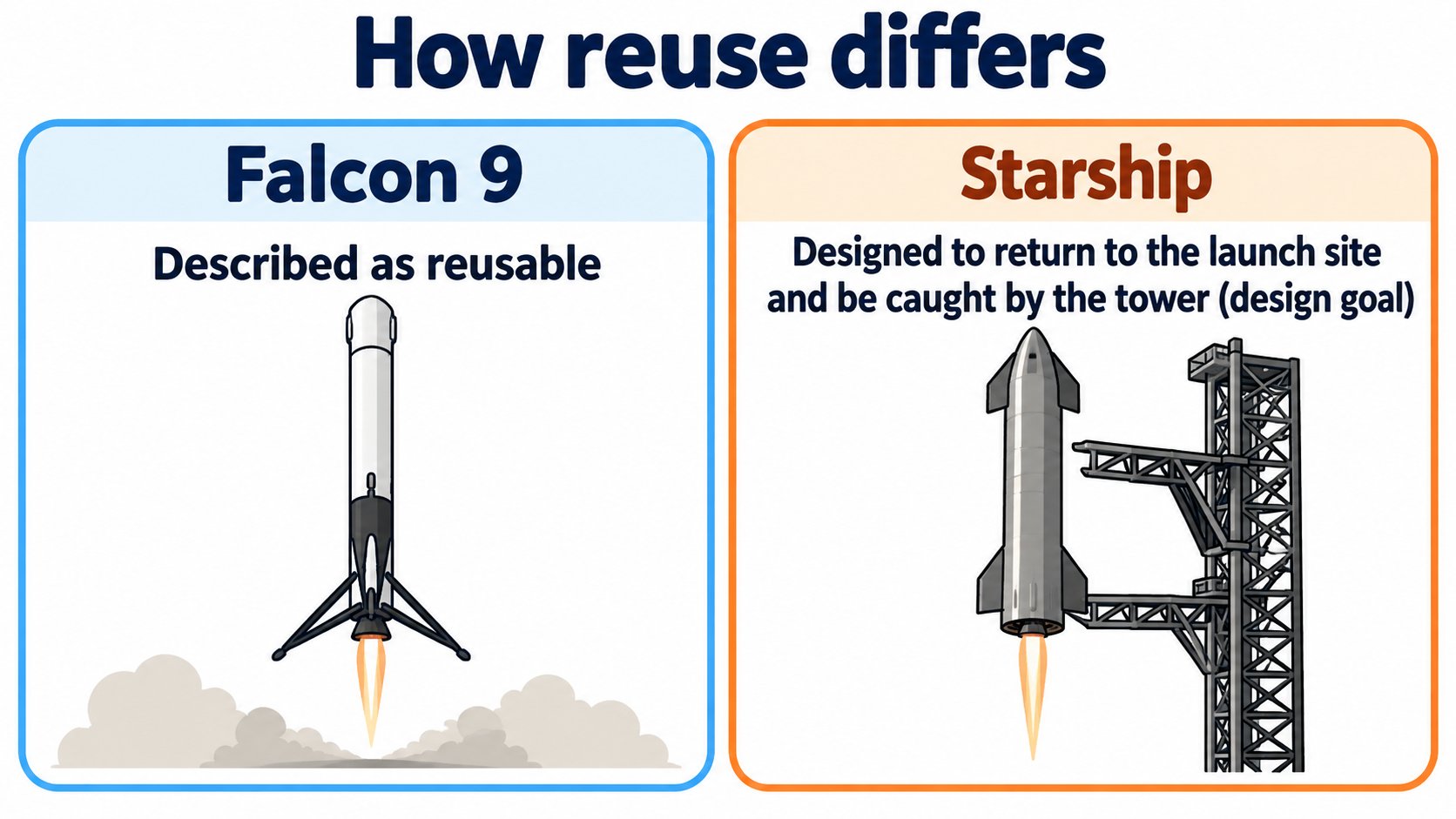
| Reuse | described as reusable (fairing also recovered) | both stages designed to return and be caught by the tower |
[A note for beginners]
tf (tonne-force) and lbf (pound-force) are units of force. 1 tf ≈ 9.8 kN and 1 lbf ≈ 4.45 N (general conversions).
What the numbers show (our calculation)
- Height: 124 ÷ 70 ≈ 1.8 times. Diameter: 9 ÷ 3.7 ≈ 2.4 times.
- First-stage thrust: Falcon 9 over 1.7 million lbf (about 7.6 MN); Super Heavy 18.1 million lbf (about 80 MN). The ratio is about 10 times.
- Payload: 100+ t ÷ 22.8 t ≈ 4.4 times or more.
How reuse differs
- Falcon 9: SpaceX describes it as the world's first reusable orbital-class rocket. The idea is that flying the most expensive part again lowers cost. SpaceX also aims to recover and reuse the fairing.
- Starship: Starship and Super Heavy are designed to return to the launch site, be caught, and launch again without refurbishment. On-orbit refilling is also planned.
FAQ
Which is bigger, Falcon 9 or Starship?
Starship: 124 m tall and 9 m in diameter as a whole system (design). Falcon 9 is 70 m tall and 3.7 m in diameter.
How does reuse differ?
Falcon 9 is described as reusable. Starship is designed so both stages return to the launch site and are caught by the tower.
Has Starship already flown?
The official page text is a design description. This article did not check actual flight results.
Summary
- Falcon 9: 70 m tall, 3.7 m diameter; Starship (whole): 124 m, 9 m (design).
- First-stage engines: 9 vs. 33. Propellants: kerosene vs. methane.
- Payload: 22,800 kg vs. 100+ t (design).
Sources (checked 2026-10-16)
- SpaceX, "Falcon 9": https://www.spacex.com/vehicles/falcon-9
- SpaceX, "Starship": https://www.spacex.com/vehicles/starship
This article is for learning about science and technology and is not investment advice. Facts and the author's reading are kept separate. The figures are AI-generated illustrations.
Thank you for reading. Was this article useful to you?
Thank you. If you like, tell us what you thought in a line or two.
Optional. No name or email needed.
Received. We will use your words to make better articles.