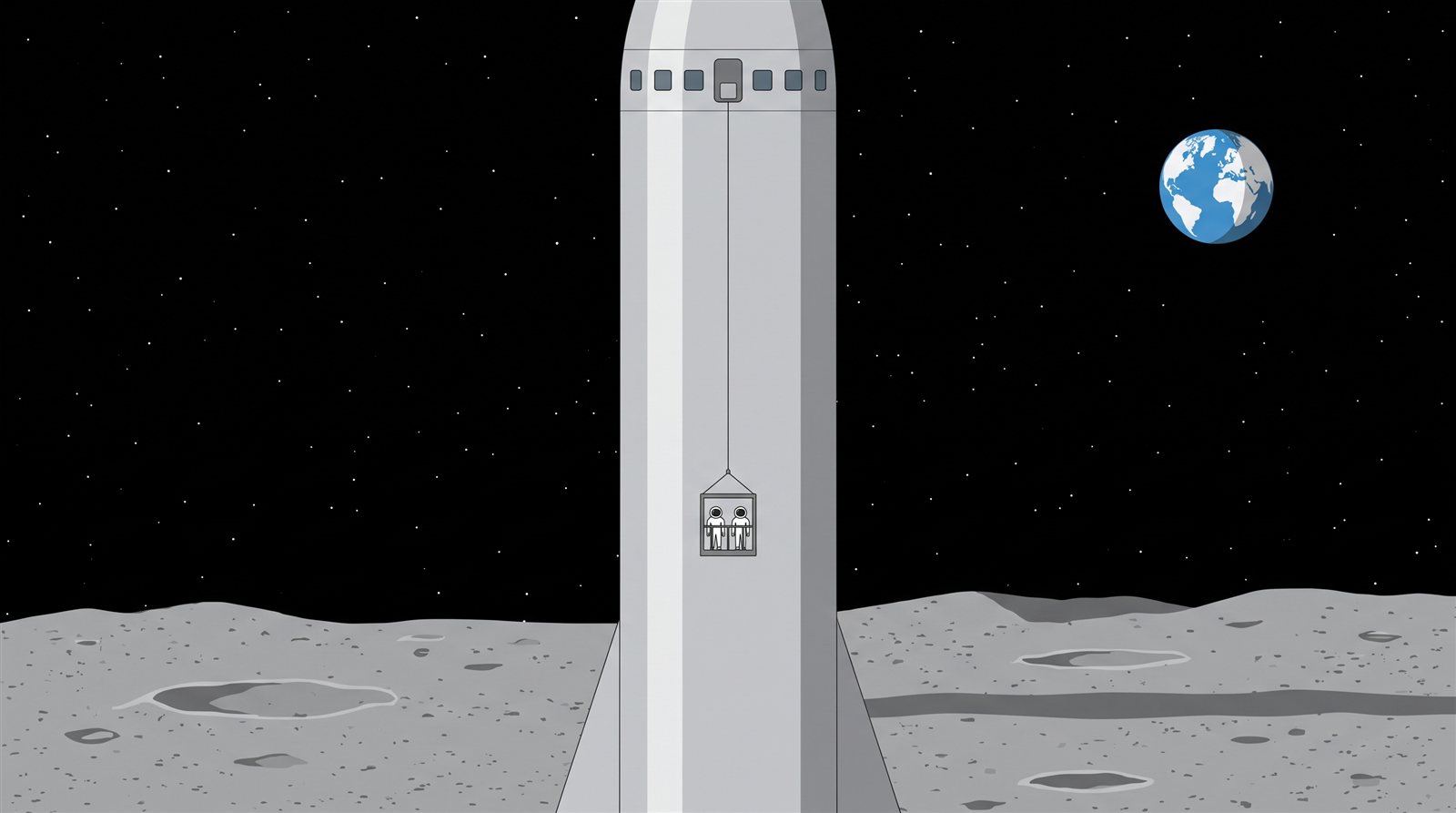
According to a paper presented by NASA's HLS program at the International Astronautical Congress (IAC) in October 2026, the Starship HLS crew compartment sits at the top of the vehicle, has a pressurized habitable volume of more than 600 cubic meters and is designed with two airlocks. A simple pulley system will lower two crew members to the surface in an elevator basket. SpaceX is fabricating a full-scale, flight-like crew cabin called "Cabin One" at Starbase, Texas, to test systems such as life support and to train astronauts.
3-line summary
- According to a NASA paper (October 2026), the Starship HLS crew compartment sits at the top of the vehicle, has a pressurized habitable volume of more than 600 cubic meters, and has two airlocks.
- A simple pulley system will lower two crew members to the lunar surface in an elevator basket.
- At Starbase, SpaceX is building a full-scale, flight-like cabin called "Cabin One" to test systems such as life support and to train astronauts.
Background: what does a spacecraft cabin actually do?
"Pressurized" means the room is filled with air and kept near sea-level pressure. Space is almost a vacuum, with no air pushing on anything. Without surrounding pressure, people cannot breathe and their body fluids start to boil, so they cannot survive. A spacecraft cabin is therefore a strong shell filled with air, built like a balloon to withstand the air pushing outward from inside. The size of this "room with air, where people can work in normal clothes" is what news reports call pressurized volume. The bigger the volume, the larger the total force on the walls, so a big cabin is a design challenge in itself.
Life support (ECLSS) is the cabin's "air and temperature crew." In a sealed room, people use up oxygen, breathe out carbon dioxide and moisture, and warm the room with their bodies and equipment. On Earth you would open a window, but in space there is no air outside. So machines work nonstop to add oxygen, remove carbon dioxide, remove moisture, hold the temperature and keep the pressure steady. This is the Environmental Control and Life Support System, or ECLSS. Whether a cabin is just an empty room or a place people can live depends on it.
An airlock is a small room with two doors that lets you go outside without losing air. If you simply opened the cabin door, the air would rush out. So a small room sits between the cabin and the outside. A suited astronaut enters it, closes the cabin-side door, pumps out only the small room's air, and then opens the outer door. Coming back, the order is reversed. Only the small room's air is lost, so the cabin's air is protected. With two airlocks, if one cannot be used, crew can still go in and out through the other.
Let's get a feel for the size. 600 cubic meters is, for example, a space 10 m long, 10 m wide and 6 m high. A 25 m school pool (25 m × 10 m × 1.2 m deep) holds 300 cubic meters, so it is about two pools' worth. The Apollo lunar module's crew compartment was 6.65 cubic meters (NASA), so 600 ÷ 6.65 ≈ 90: roughly 90 times larger.
What happened
Leaders of NASA's Human Landing System (HLS) program, which manages the Moon landers, published a paper reviewing the past year's progress for the International Astronautical Congress (IAC), held October 5–9, 2026, in Antalya, Türkiye. The paper describes the Starship HLS crew cabin as follows.
| Item | What the paper says |
|---|---|
| Location | At the top of the vehicle |
| Size | Pressurized habitable volume of more than 600 cubic meters |
| Hatches | Designed with two airlocks |
| Getting to the surface | A simple pulley system lowers two crew members in an elevator basket |
| Test cabin | SpaceX is fabricating a full-scale, flight-like cabin, "Cabin One," at Starbase |
Cabin One will include flight-like avionics and power systems, crew operations mechanisms, ECLSS, crew communication systems, a dedicated thermal control system and more. The paper says Cabin One will help SpaceX and NASA test and mature systems and will serve as the platform for human-in-the-loop training. Detailed news coverage of the cabin based on this paper appeared from around October 23, 2026.
Why it matters
First, testing of the "room people live in" begins in earnest on the ground. Rockets and landings can be tested with uncrewed vehicles. But cabin air, temperature, communications and ease of operation can only be checked with people inside. A flight-like cabin on the ground lets crews go in again and again before anyone flies.
Second, cabin size changes how people live on the Moon. The Apollo lunar module was barely big enough for two people for a few days. NASA's Artemis IV plan has two astronauts staying near the lunar south pole for about a week. The longer the stay, the more room is needed to sleep, eat, change into spacesuits and store tools.
How it works: a big cabin, and why an elevator
Starship is a very tall spacecraft designed to carry large numbers of people and large amounts of cargo. Because the cabin is at the very top, it sits many stories above the lunar surface. Climbing down a ladder as on Apollo is not practical, so an "elevator" basket is raised and lowered by pulleys. According to the paper, two crew members ride it down.
| Compared with | Pressurized volume | Source |
|---|---|---|
| Apollo lunar module (crew compartment) | 6.65 cubic meters | NASA |
| Starship HLS (crew cabin) | More than 600 cubic meters | NASA IAC paper |
| International Space Station (ISS) | 1,005 cubic meters (habitable: 388 cubic meters) | NASA |
Each spacecraft defines volume slightly differently, so treat the table as a rough size guide. Even so, one lander with more than half the ISS's pressurized volume is a different league from any previous Moon lander.
My own view: a big cabin is not only about comfort. It also leaves room for two airlocks and for storing spacesuits and tools, which makes work easier and adds safety margin. In exchange, life support has more air to manage, which is why ground testing in Cabin One matters.
How we got here
- April 2021: NASA selected SpaceX's Starship HLS as the Artemis lunar lander.
- To date: According to the NASA paper, both SpaceX and Blue Origin have used lander crew compartment mockups in the Neutral Buoyancy Lab, a large pool at NASA Johnson, to test suited ingress and egress, clearances and other human factors.
- May 22, 2026: Flight testing of Starship version 3 began. Flight 13 on July 24 relit a single Raptor engine in space.
- 2027 (planned): Artemis III is a docking test in Earth orbit between the Orion spacecraft and test articles from both lander providers. SpaceX will outfit a standard Starship version 3 with a docking assembly on its nose. According to the paper, this test article will not include ECLSS, and the crew will not enter Starship during Artemis III.
- 2028 (planned): The first crewed landing is targeted for Artemis IV (early 2028), and a second for Artemis V (late 2028). NASA will announce the lander provider for each mission later.
Takeaways for reading the news
- Read "volume" together with its definition: "Pressurized volume" and "habitable volume" can differ a lot. Even for the ISS, pressurized volume is 1,005 cubic meters and habitable volume is 388.
- Separate "mockup," "test cabin" and "flight vehicle": Pool mockups check ingress and egress, Cabin One is for ground tests and training with real systems, and only the flight vehicle goes to space. Checking which one a photo or video shows tells you how far development has come.
- A common misunderstanding: Artemis III in 2027 does not land on the Moon. It is a docking test in Earth orbit, and the crew does not enter Starship.
A question to follow up
A lunar day lasts about a month on Earth; the surface gets hotter than 100°C by day and far colder than −100°C at night. What does it take to keep a cabin of more than 600 cubic meters at a livable temperature through those swings?
Read next
- What Is Starship? The Two-Stage Design with Super Heavy, Size, Engines and Reuse
- How many refueling launches does Starship need to reach the Moon? Reading the gap between "about 22" and "6 to 8"
- What Is SpaceX's Dragon Spacecraft? Crew Capacity, Size and the Launch Escape System (compare with the SpaceX spacecraft that carries people today)
Sources
- NASA, "NASA's Human Landing System: Demonstrating the Capability to Land Artemis Astronauts on the Moon by 2028" (IAC-26-B3.1, October 2026) → https://ntrs.nasa.gov/api/citations/20260008717/downloads/HLS%20IAC%202026%20FINAL.pdf
- NASA, "International Space Station Facts and Figures" → https://www.nasa.gov/international-space-station/space-station-facts-and-figures/
- NASA NSSDCA, "Apollo 11 Lunar Module / EASEP" → https://nssdc.gsfc.nasa.gov/nmc/spacecraft/display.action?id=1969-059C
- NASA, "Artemis IV" → https://www.nasa.gov/mission/artemis-iv/
Note: Cabin size, airlocks, the elevator, Cabin One and the Artemis schedule were checked in the NASA paper; ISS and Apollo volumes in NASA materials (as of October 24, 2026).
Thank you for reading. Was this article useful to you?
Thank you. If you like, tell us what you thought in a line or two.
Optional. No name or email needed.
Received. We will use your words to make better articles.