In its Q3 2026 Update (October 21, 2026), Tesla said it continued construction of the Austin Fab, where it plans to start commissioning equipment in 2027. Its AI training compute in Texas includes Cortex 1 (over 105 MW) and Cortex 2 (over 120 MW), both in production, and Tesla plans to reach 400 MW by the end of the year to support autonomy software for both vehicles and humanoid robots.
Summary in three lines
- In its Q3 2026 Update (October 21, 2026), Tesla said construction continues on the "Austin Fab" in Austin, Texas, and that it plans to start commissioning equipment in 2027.
- Its AI training compute in Texas includes "Cortex 1" (over 105 MW) and "Cortex 2" (over 120 MW), both in production. Tesla plans to reach 400 MW by the end of the year.
- The compute supports autonomy software for both vehicles and the Optimus humanoid robot. Tesla is moving to own both the facilities that *train* AI and a factory that *makes the chips* that run it.
Background knowledge: MW, training vs. inference, and chip fabs
A megawatt (MW) measures power: how fast energy is used. 1 MW is 1,000 kW. A household microwave uses roughly 1 kW, so 400 MW is like running 400,000 microwaves at the same time, nonstop. MW is a *rate*, not an amount. Battery capacity uses MWh (megawatt-hours), which multiplies that rate by time. Data centers are often sized by power because the more computers inside, the more power they draw, and power is a common yardstick even when companies count chips and performance differently.
AI has two phases: training and inference. Training means showing a model huge amounts of data, such as driving video, and gradually adjusting its internal numbers (parameters) until it makes good decisions. It runs for weeks in large data centers. Inference means using the trained model to decide, for example, "turn here" from the camera image in front of the car. That happens in an instant on a small chip inside the car or robot. Think of training as years of school, and inference as answering on exam day. The 400 MW is the "school"; the Austin Fab is about making the "brains" (chips) used on exam day.
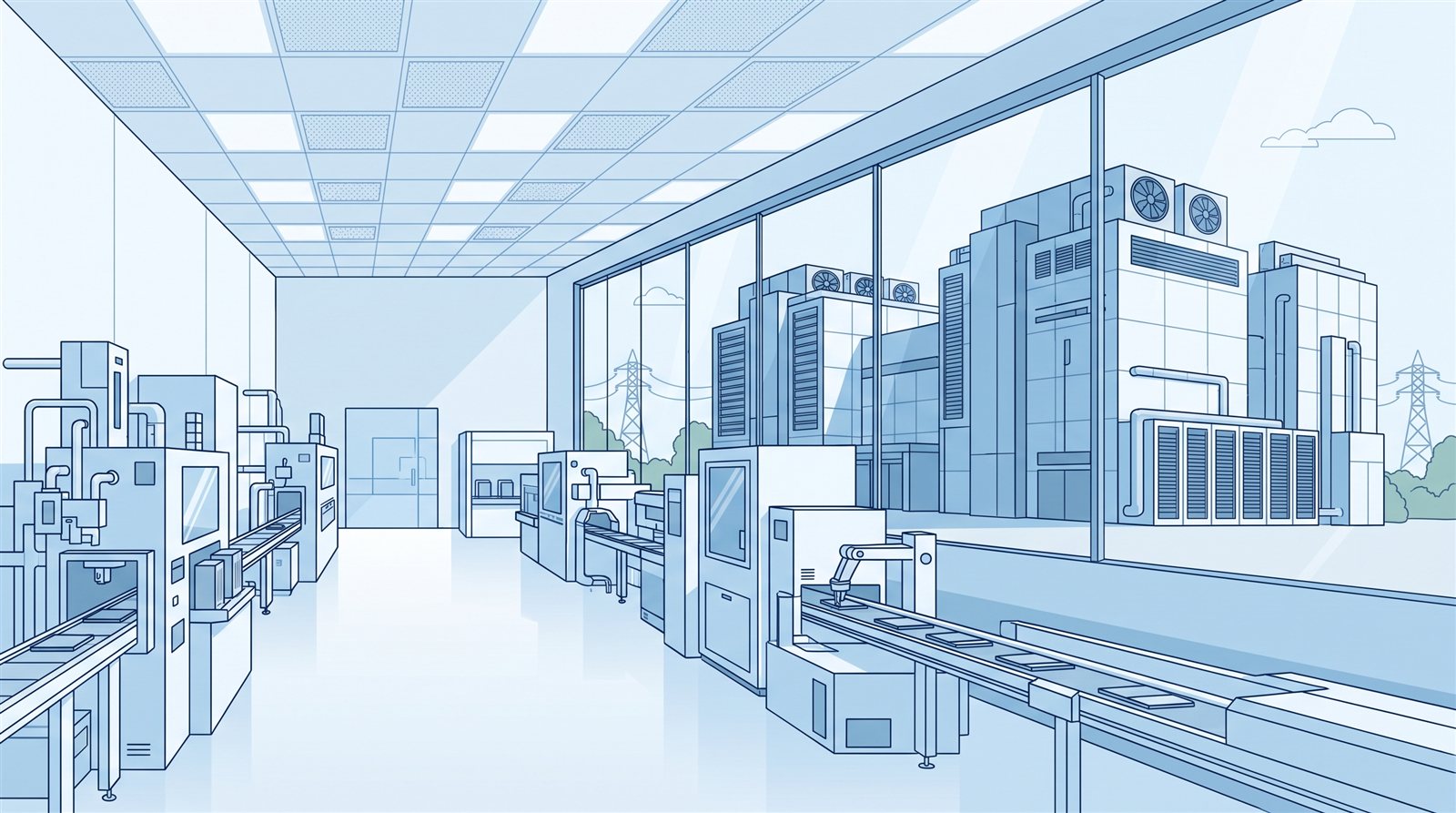
A semiconductor fab is a chip factory. Chips are made by printing circuit patterns onto a silicon disk (a wafer) with light, etching, and layering materials, repeated hundreds of times. Circuit lines are thousands of times thinner than a human hair, so a single speck of dust can ruin a chip. That is why fabs use "clean rooms" with extremely little dust, filled with large, precise tools.
What happened
On October 21, 2026, Tesla released its Q3 2026 Update. The "Supporting Infrastructure" page says:
| Item | Location | Size | Status (as written) |
|---|---|---|---|
| AI training compute, Cortex 1 | Texas | >105 MW | Production |
| AI training compute, Cortex 2 | Texas | >120 MW | Production |
| Year-end target | — | 400 MW total | Plan |
| Austin Fab | Austin, Texas | — | Under construction; equipment commissioning planned to start in 2027 |
Source: Tesla, Q3 2026 Update (October 21, 2026).
The document says the 400 MW of compute supports the development of both vehicle and humanoid robot autonomy software.
Why it matters
The two clusters in production add up to more than 105 + 120 = 225 MW. Reaching 400 MW by year-end means adding roughly 175 MW in about three months, nearly doubling Tesla's training capacity in a short time.
The second point is the Austin Fab. Tesla has designed its own in-car AI chips while relying on outside chipmakers to manufacture them. Owning a fab makes it easier to decide how many chips to make and when. As more products need AI chips, such as Optimus and robotaxis, a steady chip supply can set the ceiling on how many of those products can be built.
Background: why own both the "school" and the "brain factory"?
Tesla's driver assistance judges its surroundings using cameras only (see Tesla Vision). Making that camera-based AI smarter takes training on huge amounts of video, which takes compute. In October 2026, Tesla also said it had started building Optimus on high-volume lines (the Optimus article), adding robot AI to the training workload. The bigger the "school," the more "brains" are needed to run what it produces. Owning both lets a company design software and chips together and plan volumes more easily.
How it works: the stages before a fab produces chips
A finished building does not mean chips start coming out. Roughly, a fab goes through these stages:
| Stage | What happens |
|---|---|
| 1. Construction | Build the building, clean rooms, and power, water, and gas systems |
| 2. Tool move-in | Bring in and install manufacturing tools one by one |
| 3. Commissioning | Run the tools, test them, and tune them until they hit the required precision |
| 4. Trial production | Run real wafers and eliminate causes of defects |
| 5. Volume production | Increase output once the share of good chips (yield) rises |
The "2027" in Tesla's document refers to the start of stage 3, commissioning, not the start of volume chip production. Because hundreds of steps all have to work correctly together, it normally takes time to go from commissioning to stable volume production.
Timeline
- March 2026: Elon Musk said Tesla, SpaceX, and xAI would kick off a chip project called "Terafab" in Texas, according to reports (Bloomberg Law, Boston Globe).
- October 21, 2026: In its Q3 2026 Update, Tesla said construction continues on the Austin Fab, with equipment commissioning planned to start in 2027, and set a 400 MW year-end target for AI training compute.
Useful takeaways
- MW is a rate; MWh is an amount. Data centers are usually sized in MW; batteries in MWh.
- Training facilities and inference chips are different things. Training happens in big data centers; inference happens on small chips in cars and robots.
- "Commissioning" is not "volume production." For fab news, check which stage is being described: construction, commissioning, trial, or volume.
A question for next time
How many working chips can you get from a single silicon wafer? The answer depends on chip size and a number called "yield."
Read next
- What Is Tesla Vision? How Many Cameras Does a Tesla Have? Checked Against the Official Owner's Manual
- Tesla FSD vs Autopilot: The Three Levels of Driver Assistance, Sorted Out From Official Descriptions
- Tesla starts building its Optimus humanoid robot in Fremont. What separates a prototype from a product?
Sources
- Tesla, Q3 2026 Update (October 21, 2026; Supporting Infrastructure page) → https://assets-ir.tesla.com/tesla-contents/IR/TSLA-Q3-2026-Update.pdf
- Bloomberg Law, "Musk Says Tesla, SpaceX, xAI Chip Project to Kick Off in Texas" (March 2026) → https://news.bloomberglaw.com/capital-markets/elon-musk-says-tesla-xai-spacex-terafab-to-start-in-austin
- Boston Globe, "Musk Tesla SpaceX xAI chip project to kick off in Texas" (March 22, 2026) → https://www.bostonglobe.com/2026/03/22/nation/musk-tesla-spacex-xai-chip-project-to-kick-off-in-texas/
*The Austin Fab plan and compute figures were confirmed in Tesla's official document (as of 2026-10-22). The Terafab announcement is based on news reports.*
Thank you for reading. Was this article useful to you?
Thank you. If you like, tell us what you thought in a line or two.
Optional. No name or email needed.
Received. We will use your words to make better articles.