In its Q3 2026 Update (October 21, 2026), Tesla said Megafactory Texas began production, with a planned capacity of 50 GWh per year. Together with California (40 GWh) and Shanghai (20 GWh), Tesla's installed Megapack capacity is 110 GWh per year. Tesla also shipped the first Megapacks comprised solely of its own LFP (lithium iron phosphate) cells made in Nevada. Storage deployments were 13.7 GWh in Q3, and Tesla reported its highest-ever order rate and backlog for energy storage.
Summary in three lines
- In its Q3 2026 Update on October 21, 2026, Tesla said Megafactory Texas, its third Megapack factory, began production, with a planned capacity of 50 GWh per year.
- Tesla shipped the first Megapacks built solely with its own LFP cells, made at its Nevada factory. Tesla is starting to make the battery cells inside the packs itself.
- Storage deployments in Q3 (July to September) were 13.7 GWh, up 10% year over year. Tesla said its energy storage business had its highest-ever order rate and backlog, driven in part by data center demand.
Background knowledge: GWh vs. GW, cells vs. packs, and LFP
A GWh (gigawatt-hour) is a unit of energy, an amount. One GWh is one million kWh. A household uses very roughly 10 kWh of electricity a day, so 1 GWh is about one day's electricity for 100,000 homes. Q3's 13.7 GWh is 13.7 times that. Do not confuse GWh with GW (gigawatt). GW is power, a rate of flow; GWh is that rate multiplied by hours, an amount. Think of GW as how hard water flows from a tap, and GWh as how much water sits in the tank. A battery is about how much it can store, so it is measured in GWh.
A factory "capacity of 50 GWh" means equipment that can make up to 50 GWh worth of batteries in a year. Tesla itself notes that installed capacity is not the same as the current production rate. A new factory ramps up gradually, so it does not make 50 GWh worth of batteries from day one.
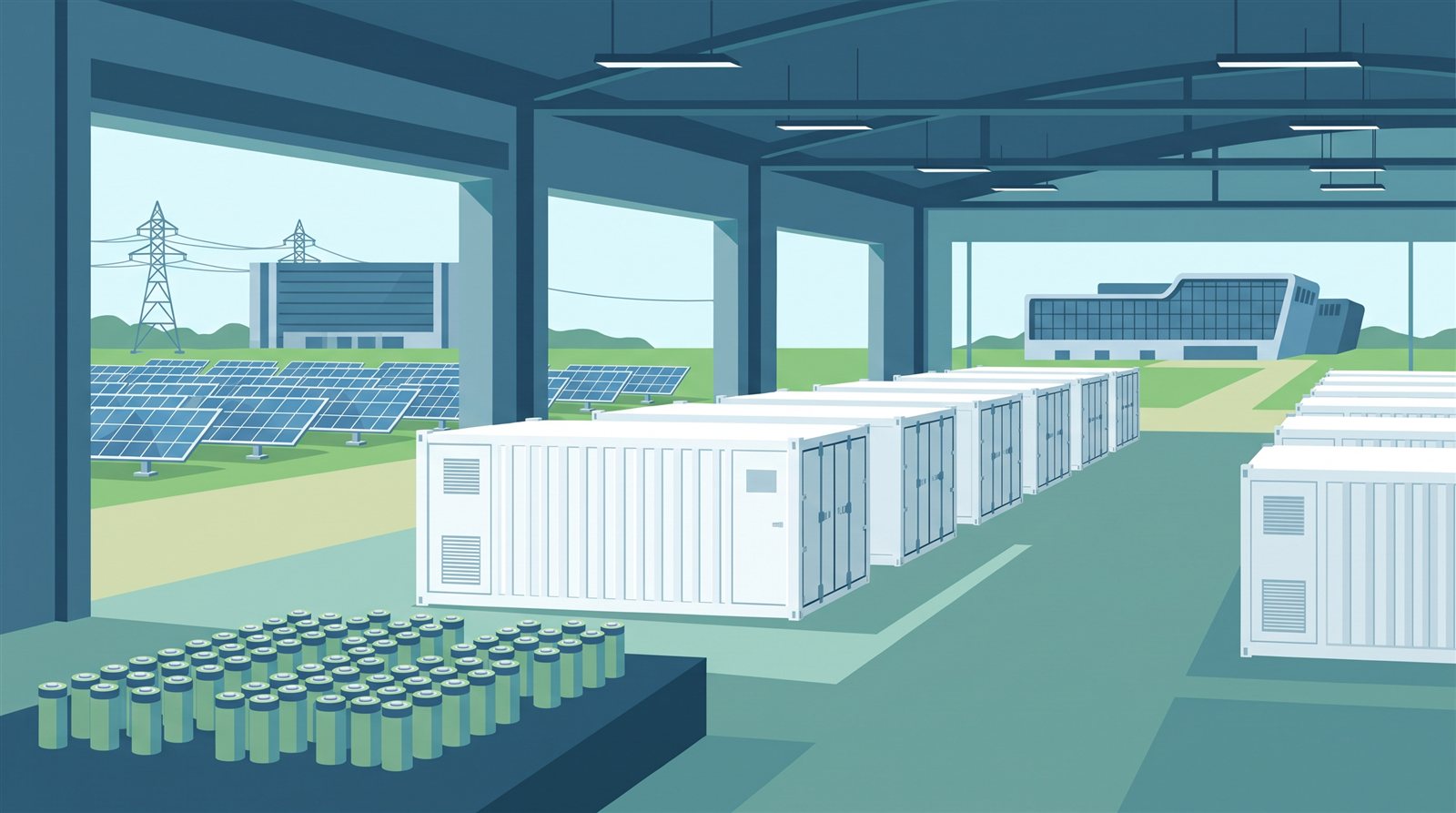
A battery has two layers: cells and packs. A cell is the smallest unit that stores electricity, a single part like a household battery. A pack is many cells arranged together with wiring, cooling and control electronics in an enclosure. Megapack is a pack the size of a large shipping container, installed in rows next to substations, power plants or data centers. Until now, Tesla assembled packs itself but bought many of the cells from outside battery makers.
LFP (lithium iron phosphate) is one family of lithium-ion battery chemistry. A battery's character is largely set by its positive electrode material. LFP uses iron and phosphate, so it stores less energy per kilogram than nickel- and cobalt-based NMC. In exchange, its materials are easier to obtain, it tolerates heat well, and it lasts through thousands of charge and discharge cycles. See our article on LFP vs. NMC for details.
What happened
Tesla published its Q3 2026 Update on October 21, 2026. The energy storage points are:
| Item | What the document says |
|---|---|
| Megafactory Texas | Began Megapack production; planned capacity 50 GWh per year |
| Tesla's own LFP cells | Shipped the first Megapacks comprised solely of LFP cells from Nevada |
| Q3 deployments | 13.7 GWh (up 10% from 12.5 GWh a year earlier) |
| Orders | Highest-ever order rate and backlog |
Installed energy storage capacity, as listed in the document:
| Location | Product | Annual capacity | Status |
|---|---|---|---|
| California | Megapack | 40 GWh | Production |
| Shanghai | Megapack | 20 GWh | Production |
| Texas | Megapack | 50 GWh | Production |
| Nevada | Powerwall | >6 GWh | Production |
Battery cell factories appear in a separate table:
| Location | Type | Annual capacity | Status |
|---|---|---|---|
| Nevada | LFP cells | 7 GWh | Early ramp |
| Texas | 4680 cells | >40 GWh | Production |
Source: Tesla, Q3 2026 Update (October 21, 2026).
Why it matters
Megapack capacity is now 40 + 20 + 50 = 110 GWh per year. Texas alone is nearly as large as the previous two sites combined (60 GWh).
Adding up the last four quarters of deployments gives 14.2 + 8.8 + 13.5 + 13.7 = about 50 GWh. Installed capacity of 110 GWh is more than twice the past year's deployments. With a record backlog, Tesla is building factories ahead of the demand it expects.
The other point is cells. Nevada's LFP cell line is 7 GWh per year and still in early ramp, a small share of the 110 GWh of Megapack capacity. Still, building Megapacks entirely from its own cells opens a path to supplying the batteries inside without buying them. Tesla calls this progress on "LFP supply domestication in the U.S."
Background: why grid batteries are in demand now
Tesla writes that "energy storage is the fastest way to add power to the existing grid and is critical to data center uptime."
In my view, the reason is speed of construction. New power plants and transmission lines take years from planning to completion. Batteries are built in a factory, shipped and set in place, so they can be installed in a comparatively short time. Charging when power is plentiful and discharging when it is scarce has an effect similar to adding usable power, without new plants or lines.
AI data centers draw a lot of power around the clock. Tesla says Megapack can supply large data center loads, buffer rapidly changing demand and help with grid-interconnection compliance. Tesla itself plans to reach 400 MW of AI training compute by year-end (our article on the Austin Fab and AI compute), so it is also on the side of fast-growing power demand.
How it works: why grid batteries use LFP
Electric cars and stationary batteries need different things from a battery.
| Point | Electric car | Stationary battery (Megapack) |
|---|---|---|
| Weight and size | Lighter and smaller means more range | Sits on the ground, so weight matters less |
| Charge cycles | About once a day | Every day for many years |
| Safety | Important | Very important, with hundreds of units side by side |
| Price | Important | Price per kWh is critical at this scale |
For stationary storage, light weight matters less, while long life, safety and low cost matter more. Those are exactly LFP's strengths, which is why Megapack uses LFP. LFP avoids expensive nickel and cobalt, but making the cells still takes dedicated factories and know-how. Making its own cells lets Tesla depend less on outside suppliers and set its own production volume and timing.
Timeline
Tesla's quarterly storage deployments (from its quarterly updates):
| Quarter | Deployed |
|---|---|
| Q3 2025 | 12.5 GWh |
| Q4 2025 | 14.2 GWh |
| Q1 2026 | 8.8 GWh |
| Q2 2026 | 13.5 GWh |
| Q3 2026 | 13.7 GWh |
Source: Tesla, Q3 2026 Update, Operational Summary.
- October 8, 2026: A Taiwanese energy company was reported to have agreed to buy about 1 GWh of Megapack 2XL units (our article).
- October 21, 2026: Tesla's Q3 2026 Update announced the start of production at Megafactory Texas and the first Megapacks built solely with its own LFP cells.
Quarterly deployments go up and down rather than rising in a straight line. Large battery projects are big individually, so delivery timing moves the numbers. Add up a full year rather than judging one quarter.
Useful takeaways
- GW is a rate, GWh is an amount: Batteries are sized in GWh; power plants and data centers in GW or MW. 1 GWh is roughly a day's electricity for 100,000 homes.
- Capacity is not output: "Capacity of X GWh" is a ceiling. Read it separately from what was actually built or deployed (13.7 GWh this quarter).
- Cells and packs are different stories: A factory that assembles Megapacks and a factory that makes cells are separate. Check which one a headline is about.
A question for next time
Both are lithium-ion batteries, so why does LFP survive thousands of charge and discharge cycles so well? The answer lies in the crystal shape of its positive electrode material.
Read next
- LFP vs NMC Batteries: Differences and How to Choose
- Taiwan's Apollo Power reportedly orders 260 Tesla Megapack 2XL units (about 1 GWh)
- Tesla is building its own chip fab in Austin, with equipment commissioning set for 2027
Sources
- Tesla, Q3 2026 Update (October 21, 2026; Highlights, Operational Summary, Manufacturing & Hardware and Supporting Infrastructure pages) → https://assets-ir.tesla.com/tesla-contents/IR/TSLA-Q3-2026-Update.pdf
Note: Figures were checked against Tesla's official document (as of October 23, 2026).
Thank you for reading. Was this article useful to you?
Thank you. If you like, tell us what you thought in a line or two.
Optional. No name or email needed.
Received. We will use your words to make better articles.