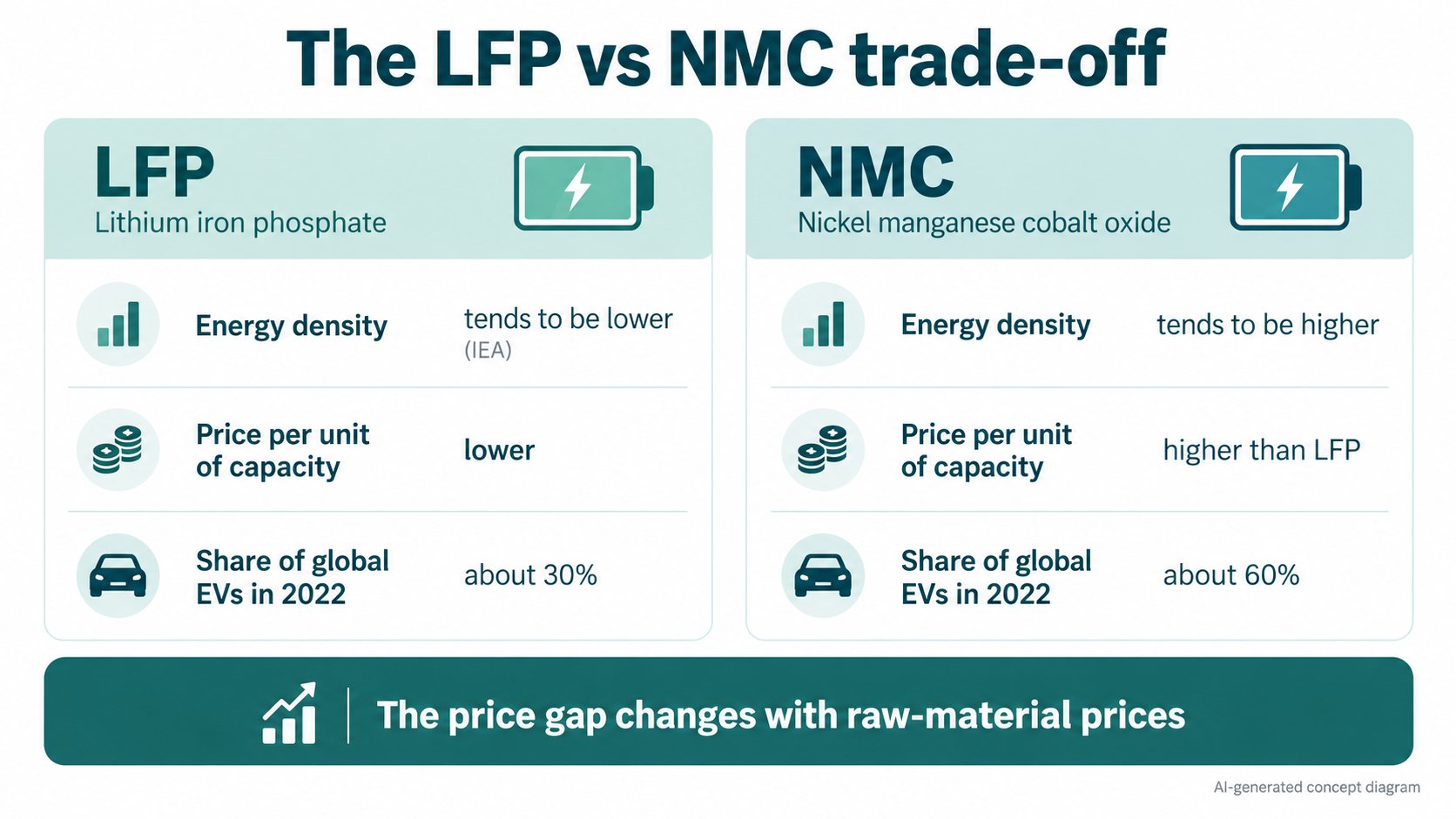
LFP uses iron and phosphorus in the cathode (the battery's positive-side material); NMC uses nickel, manganese and cobalt. According to the International Energy Agency (IEA), LFP's energy density (energy stored per weight or volume) tends to be lower than NMC's, but LFP is less expensive per unit of capacity. In 2022, NMC held about 60% of the global EV market and LFP about 30%. Tesla's official page says different batteries need different charging routines and tells owners to check the recommended charge limit on the car's touchscreen.
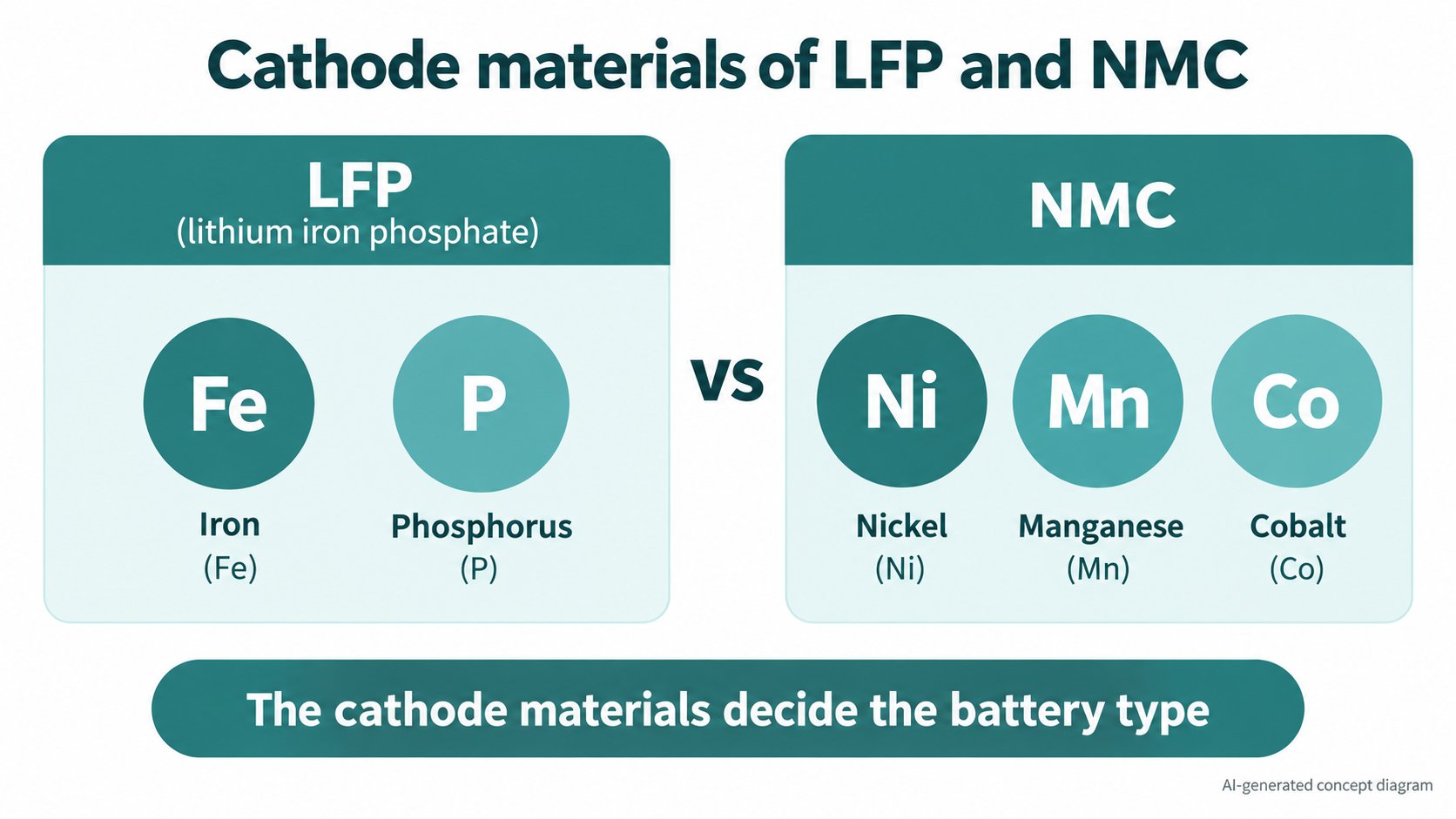
In Part 1, Why are batteries expensive?, we saw that a battery's price is built up from its materials. The choice of materials decides the battery's "type". In this article we compare the two main types used in EVs: LFP and NMC.
The conclusion: LFP is "said to be cheap and durable", NMC "stores more", but the numbers depend on conditions
LFP stands for Lithium Iron Phosphate. NMC stands for Nickel, Manganese and Cobalt, the three metals used in its cathode.
The IEA's "Global EV Outlook 2023" says, in summary:
| Item | LFP | NMC |
|---|---|---|
| Main cathode materials | Iron, phosphorus | Nickel, manganese, cobalt |
| Energy density | Tends to be lower than NMC | Tends to be higher than LFP |
| Price per unit of capacity | Less expensive than NMC/NCA | Higher than LFP |
| Share of global EVs in 2022 | About 30% (highest in a decade) | About 60% (largest) |
[A note for beginners]
Energy density is "how much energy can be stored in the same weight (or size)". The higher it is, the longer the same-sized battery tends to drive (or the lighter and smaller the battery can be for the same distance).
Price: why is LFP cheaper?
The IEA report notes that LFP is less expensive than NMC and NCA, with LFP not using nickel or cobalt. But it also says that in 2022, LFP prices rose more, because lithium's price rose faster than nickel's and cobalt's: LFP prices rose by over 25%, NMC prices by under 15%. So "LFP is always cheaper" is not guaranteed; the gap depends on raw-material prices.
The IEA also explains that high nickel prices in 2022 pushed manufacturers toward chemistries less dependent on nickel, such as LFP, despite their lower energy density.
Tesla and LFP
According to the IEA report, Tesla accounted for about 15% of LFP battery demand for EVs in 2022. The share of Tesla's cars using LFP is reported to have risen from 20% in 2021 to 30% in 2022, and about 85% of Tesla's LFP cars were reported to be made in China.
[What we could not confirm in this article]
These are figures up to 2022. We did not confirm today's (2026) share of LFP cars at Tesla, or which models and trims use LFP. We did not check the battery type of each car in Tesla's official materials.
Charging habits: recommendations depend on the battery type
Tesla's official support page "Range Tips" says the following about battery longevity (summary):
- Different batteries require different charging routines. The car's touchscreen displays the recommended charge limit for your battery; you change it with the slider on the Charging screen.
- For vehicles with a recommended daily charge limit of 80%, keep it at 80% for daily use and raise it to 100% only when needed, such as before a long road trip.
- Avoid letting the vehicle sit near 0% or 100% for days or weeks.
- Charge as often as you can. Frequently letting the battery discharge to a low state before charging can strain it over time.
- Charge at home when possible and use Superchargers for road trips.
- If you leave the car unused for more than two weeks, leave it around 50% and plugged in if possible.
[What we could not confirm in this article]
This page does not say which battery type has which recommended limit. You often see "LFP can be charged to 100% every day" online, but we could not confirm that on the Tesla official page we read. The official guidance is to follow the recommended limit shown on your own car's screen.
For using the battery in cold weather, see also Battery preconditioning.
Cold, safety, lifetime: what is commonly said, and what we could not confirm
LFP is often said to be "weak in the cold", "less likely to burn" and "durable over many charge cycles". But in this research, the only points we could confirm with numbers from official or public-institution texts are those in the table above (materials, the energy-density tendency, price, shares).
- Cold performance: Tesla's Range Tips says cold weather shortens range, but gives no figure such as "LFP loses X% more than NMC".
- Resistance to fire: LFP is generally said to be thermally stable, but we did not confirm this from an original text.
- Lifetime (number of cycles): manufacturer and retailer sites give specific cycle counts, but they differed widely between sites. We could not confirm them from a public-institution text, so we do not give numbers here.
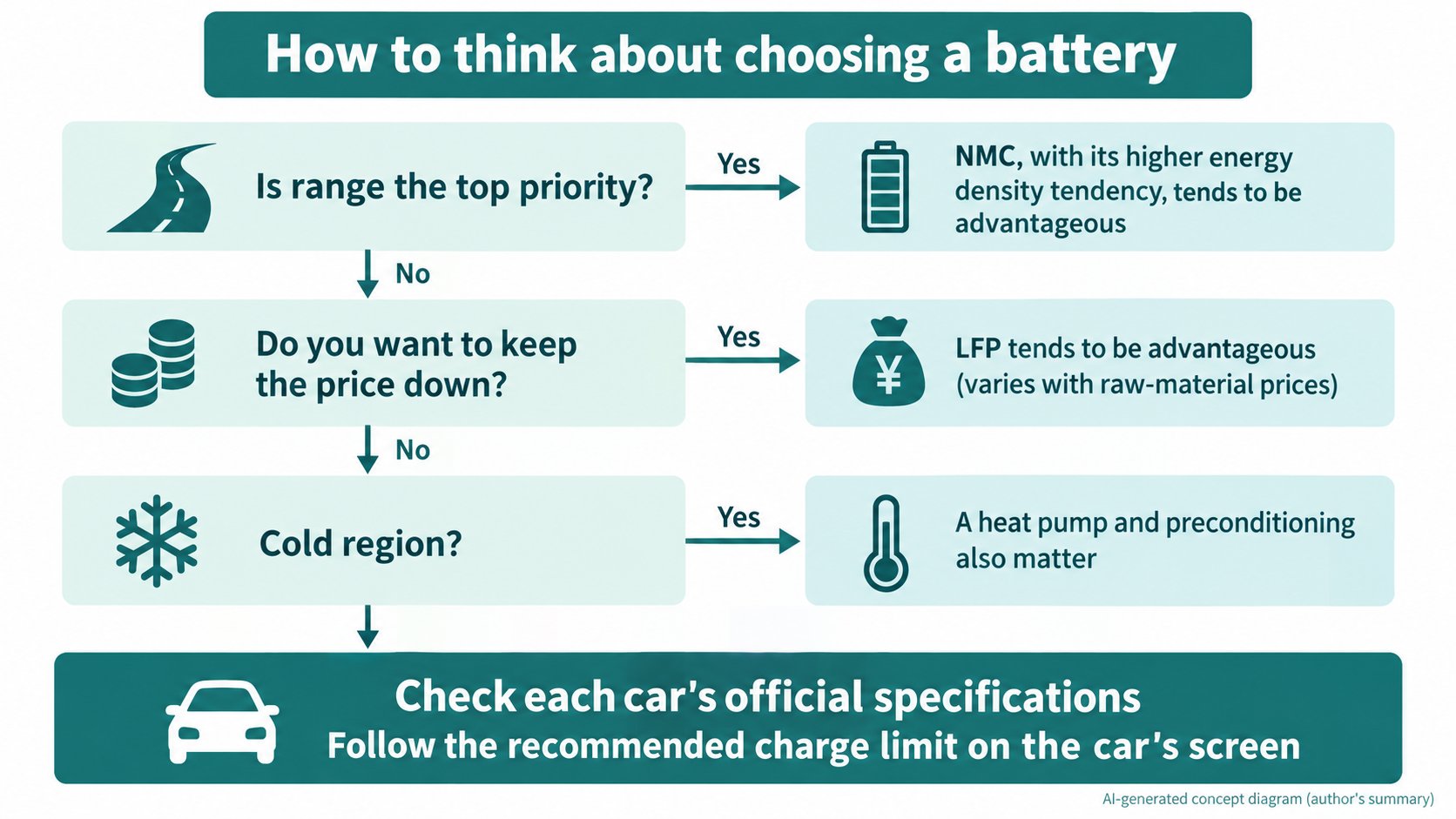
How to think about choosing (the author's summary)
[The author's summary, not a confirmed fact]
We found no Tesla page that says which of LFP or NMC to choose. So this is a way of thinking based on what we confirmed above.
>
- Range is the top priority (long distances, heavy loads) → NMC, with its higher-energy-density tendency, tends to be advantageous.
- Keeping the price down → LFP, said to be cheaper per unit of capacity, tends to be advantageous, though it varies with raw-material prices.
- Charging habits → whatever the battery type, follow the recommended charge limit on the car's screen.
- Cold regions → besides the battery type, whether the car has a heat pump and preconditioning also matters (Range Tips).
>
For the actual choice, compare the official specifications of each model and trim (battery type, range, warranty).
FAQ
What is the difference between LFP and NMC?
The cathode materials differ: LFP uses iron and phosphorus, NMC uses nickel, manganese and cobalt. According to the IEA, LFP's energy density tends to be lower than NMC's, and it is less expensive per unit of capacity.
Is a Tesla LFP or NMC?
Press reports say it differs by model, trim and where it is built. The IEA report says about 30% of Tesla's cars used LFP in 2022. We did not confirm the battery type per model today; check the official specifications of the car you own or want to buy.
Can LFP be charged to 100% every day?
Tesla's official page says "different batteries require different charging routines" and that the recommended limit appears on the car's screen. We could not confirm on the official page that LFP may be charged to 100% daily. Follow what your car's screen shows.
Does LFP lose a lot of range in the cold?
Tesla's official page says cold weather reduces range. We could not confirm how much more LFP loses than NMC.
Summary
- LFP uses iron and phosphorus, NMC uses nickel, manganese and cobalt in the cathode.
- According to the IEA, LFP tends to have lower energy density but is less expensive per unit of capacity. In 2022 worldwide, NMC had about 60% and LFP about 30%. The price gap changes with raw-material prices.
- Tesla's official page says the best charging routine differs by battery and tells owners to check the recommended charge limit on the car's screen.
- Figures for cold performance, fire resistance and lifetime were not confirmed from original official texts, so we do not give them. When choosing, check each car's official specifications.
Sources (checked 2026-10-16)
- IEA, "Global EV Outlook 2023", Trends in batteries (2022 data): https://www.iea.org/reports/global-ev-outlook-2023/trends-in-batteries
- Tesla Support, "Range Tips": https://www.tesla.com/support/range
This article is for learning about science and technology and is not investment advice. Facts and the author's reading are kept separate. The figures are AI-generated illustrations.
Thank you for reading. Was this article useful to you?
Thank you. If you like, tell us what you thought in a line or two.
Optional. No name or email needed.
Received. We will use your words to make better articles.