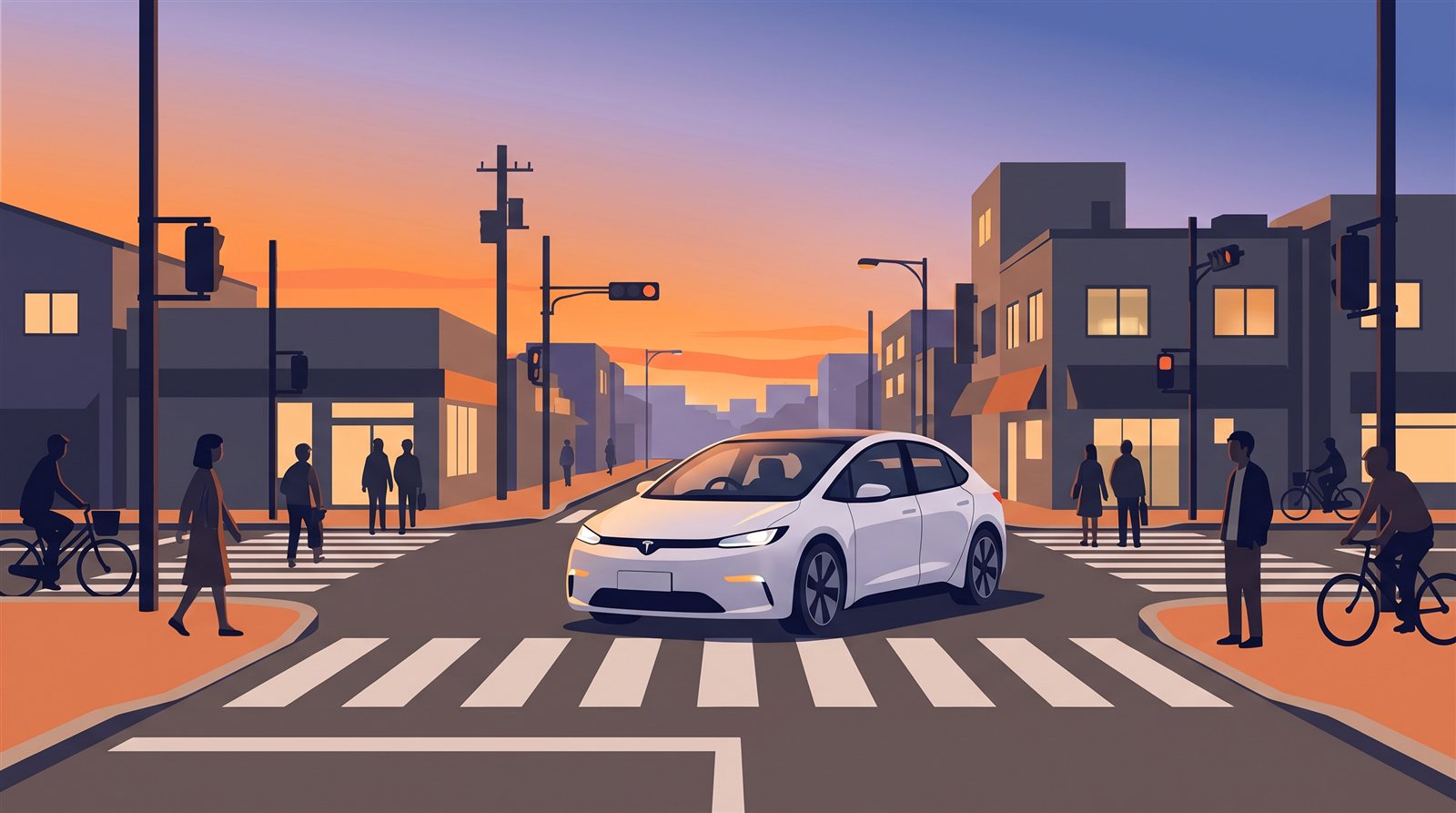
In October 2026, Tesla published a Robotaxi Safety Report (tesla.com/robotaxi/safety). From January 22 to October 18, 2026, its Robotaxi fleet drove 3.1 million miles (about 5 million km) with no safety monitor in the vehicle. Over that period there were zero people injured in collisions where the Robotaxi made first contact, zero Robotaxi airbag deployments, and zero pedestrians or cyclists hit. Tesla says human drivers would have had about 9.1 injury collisions over the same miles. It listed Las Vegas, Jacksonville, Phoenix and San Antonio as "Coming Soon."
Summary in 3 lines
- Tesla published a Robotaxi Safety Report. With no safety monitor in the vehicle, the fleet drove 3.1 million miles (about 5 million km) from January 22 to October 18, 2026.
- Over that period: zero people injured in collisions where the Robotaxi made first contact, zero Robotaxi airbag deployments, and zero pedestrians or cyclists hit. Tesla says human drivers would have had about 9.1 injury collisions over the same miles.
- Tesla listed Las Vegas, Jacksonville, Phoenix and San Antonio as "Coming Soon" (no launch dates).
Background knowledge: compare per mile, not by raw counts
You cannot judge safety by the number of crashes alone. Say company A's cars had 10 crashes in a year and company B's had 2. B looks safer, until you learn A drove 10 million km and B drove 100,000 km. Per 10,000 km, A had 0.01 crashes and B had 0.2, so B was 20 times more crash-prone. It is like a batting average: you compare hits per at-bat, not total hits. That is why autonomous driving safety is always stated as "how many events over how many miles."
One mile is about 1.6 km. The 3.1 million miles are about 5 million km, or roughly 125 trips around the Earth.
An "expected value" is how many times something should happen on average. Tesla's "about 9.1 for human drivers" is not a count of real crashes. It is a calculation: if human drivers drove the same roads for the same distance, about this many would happen on average. Roll a die 60 times and you expect ten 1s, but you might get 8 or 13.
When the expected value is small, zero is not unusual. This is the most important point. For random events like crashes, if 9.1 are expected, the chance of seeing zero is about 0.01% (roughly 1 in 10,000). If 0.52 are expected, the chance of zero is about 60%. (These are my own calculations, using the Poisson distribution and assuming crashes happen independently.) So a zero where many events were expected carries weight; a zero where less than one was expected is still hard to tell apart from luck.
What happened
Tesla published a "Robotaxi Safety Report" page on its website. The main figures (covering January 22 to October 18, 2026) are:
| Item | Figure on the page |
|---|---|
| Miles driven with no safety monitor | 3.1 million (as of Oct 18) |
| People injured in collisions where Robotaxi made first contact | 0 (humans: about 9.1 injury collisions) |
| Robotaxi airbag deployments | 0 (humans: about 4.1) |
| Pedestrians or cyclists hit | 0 (humans: about 0.52) |
| Miles after dark | 862K |
| Miles in rain | 113K (a minimum) |
| Miles in rush hour | 575K |
By city: Austin 2,118,015 miles, Dallas 608,130, Houston 225,964 (Texas), and Orlando 61,053, Tampa 53,117, Miami 46,262 (Florida). They add up to about 3.11 million miles, with Austin alone accounting for about two-thirds.
The top of the page also shows a live counter that estimates miles at the fleet's current pace. When I opened it on October 23, 2026, it read 3,449,924 miles. That is an estimate; the safety figures above run through October 18.
Why it matters
Tesla put its safety numbers in one place, with definitions and sources. The page has a Methodology section explaining which collisions are counted and how the human figures were built, plus a list of sources. As robotaxi services expand, riders and regulators want to know whether they are actually safe. Publishing the evidence in a checkable form is the heart of this news.
The next four cities are also new. So far, unsupervised miles came from six cities in Texas and Florida. Now Nevada (Las Vegas), Arizona (Phoenix), Florida (Jacksonville) and Texas (San Antonio) are listed as coming soon, without dates.
Background: which crashes are counted, and how
The crash count follows a US federal rule. The National Highway Traffic Safety Administration (NHTSA) requires companies to report crashes involving automated driving and driver-assistance systems under its Standing General Order (SGO). Tesla says the report includes every collision it reported under the SGO while Robotaxi was driving autonomously with no safety monitor in the vehicle, including when a remote operator was assisting or had taken control. The SGO covers crashes where the system was engaged at any time in the 30 seconds before the crash, including many with only minor property damage.
Miles and crashes with a safety monitor on board are excluded. Tesla's Robotaxis first ran with a safety monitor in the vehicle. NHTSA's public data includes collisions from that period, but Tesla removed both those events and those miles "to focus on autonomous driving alone." That is why the count starts on January 22, 2026.
How it works: breaking down the human comparison
The human figures come from Texas police crash records (TxDOT CRIS, 2024). Here is how the comparison lines up:
| Point | Robotaxi | Human benchmark |
|---|---|---|
| Miles | 2.95 million in Austin, Dallas and Houston (95% of the total) | Passenger vehicles driving the same miles on the same cities' surface streets |
| Injury counting | Only collisions where Robotaxi made first contact | All collisions, whichever vehicle made first contact |
| Unreported crashes | Reports to NHTSA (including minor ones) | Adds the roughly 32% of injury crashes never reported to police, from a research estimate |
| Data year | 2026 | 2024 |
Tesla itself flags the "first contact" difference. Police reports do not record which vehicle hit first, so the human side counts every crash, including ones where the driver was hit. The Robotaxi side counts only crashes where the Robotaxi hit first. The page gives real examples: an SUV, struck by another vehicle, was pushed into a Robotaxi waiting at a stop sign, and an occupant of the other vehicle went to the hospital; nobody in the Robotaxi or the SUV was hurt, and it was not counted as an injury. A rider who claimed injury after the Robotaxi drove over a pothole was also not counted, after an investigation found no injury.
Airbag deployments are the easier comparison. Whether your own airbag deployed is clear regardless of who hit whom, and the human benchmark also counts a vehicle's own airbag deploying. Against about 4.1 expected, the Robotaxis had zero.
Let's compute the human crash interval. If there are 9.1 injury collisions over 2.95 million miles, that is about one per 320,000 miles (about 520,000 km). For airbag deployments, about one per 720,000 miles. Human driving is safer than many people think, which is exactly why showing that a self-driving system beats humans takes millions of miles of data.
Timeline
- January 22, 2026: The start of the report's "no safety monitor" count. Tesla says most earlier collisions in NHTSA's data happened with a safety monitor on board.
- October 21, 2026: In its Q3 update, Tesla announced the Cybercab's launch in Austin and about 2 million cumulative unsupervised miles as of the end of September. See our Cybercab article.
- October 2026: The Safety Report page went up: 3.1 million miles as of October 18, and four cities "coming soon."
Useful takeaways for reading the news
- Read "zero" together with the expected value: Zero where humans would have about 9.1 means a lot; zero where humans would have about 0.52 (pedestrians and cyclists) is still hard to tell from luck.
- Make sure the definitions match: "Only crashes where we hit first" and "all crashes" are not the same yardstick.
- Human crashes are rarer than you think: Even for humans, injury crashes happen about once every 320,000 miles. Proving autonomous safety takes long distances.
A question for next time
In situations where a human driver might crash, what does a Robotaxi see, and how does it decide? The answer lies in cameras that see 360 degrees around the car, and how their images are processed.
Read next
- Tesla's Cybercab, a robotaxi with no steering wheel, is now carrying riders in Austin. What changes when you remove the wheel?
- What Is Tesla Vision? How Many Cameras Does a Tesla Have? Checked Against the Official Owner's Manual
- Tesla FSD vs Autopilot: The Three Levels of Driver Assistance, Sorted Out From Official Descriptions
Sources
- Tesla, "Robotaxi Safety Report" (data from January 22 to October 18, 2026, including the Methodology and Sources sections) → https://www.tesla.com/robotaxi/safety
- NHTSA, "Standing General Order on Crash Reporting" → https://www.nhtsa.gov/laws-regulations/standing-general-order-crash-reporting
- Not a Tesla App, "Tesla names next Robotaxi cities, shares miles driven, safety data" (October 21, 2026) → https://notateslaapp.com/news/4860/tesla-names-next-robotaxi-cities-shares-miles-driven-safety-data
*Figures were checked against Tesla's official page (as of 2026-10-23). The probability calculations are my own.
Thank you for reading. Was this article useful to you?
Thank you. If you like, tell us what you thought in a line or two.
Optional. No name or email needed.
Received. We will use your words to make better articles.