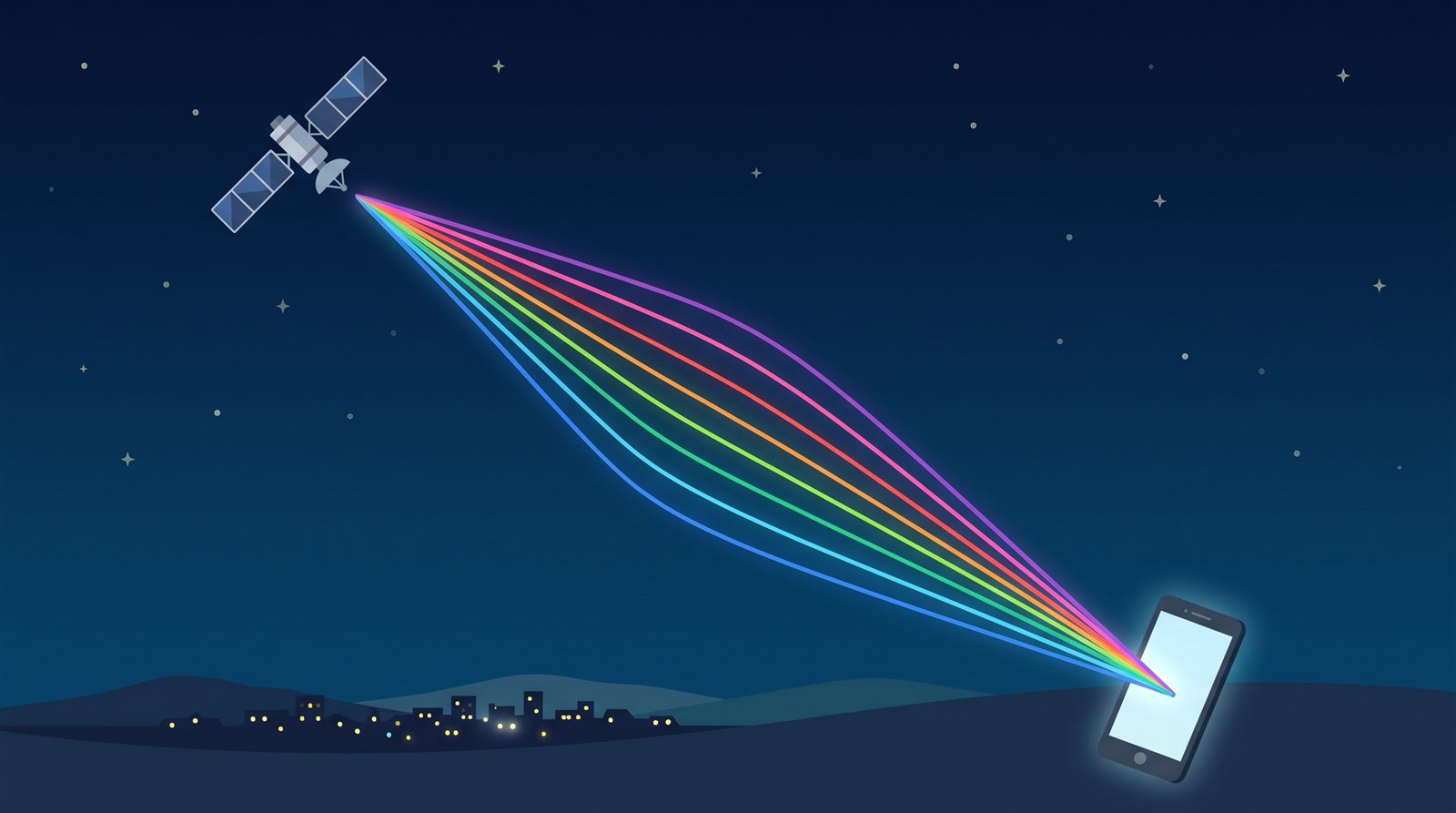
In a draft Notice of Proposed Rulemaking released on October 8, 2026 (GN Docket Nos. 26-281 and 23-65), the FCC proposed expanding Supplemental Coverage from Space (SCS), in which satellites use carriers' licensed spectrum to reach ordinary phones, from today's five bands (344 MHz) to 13 bands by adding 482 MHz. At its October 29 open meeting the Commission reportedly adopted the proposal unanimously and opened it for comment. These are proposed rules, not final ones.
3-line summary
- The FCC has proposed growing the spectrum available for SCS, the framework for satellites that connect directly to ordinary phones, from five bands to 13, adding 482 MHz (the draft was released on October 8, 2026).
- At its October 29 open meeting, the Commission reportedly adopted the proposal unanimously and opened a comment period. This is not a final decision; it starts the process of gathering views.
- The other pillar: drop today's strict rule that a satellite operator must lease from every carrier holding the same spectrum across a huge area, and instead allow license areas sized to where service is actually offered.
Background: where and how wide, low versus high bands, FDD and TDD
Frequency (the "where") is how many times a radio wave oscillates per second, measured in hertz (Hz). 1 MHz is a million times a second; 1 GHz is a billion. Just as turning a radio dial changes stations, different frequencies let separate conversations share the same air. To avoid interference, governments decide who may use which frequencies through licenses. In the United States, that is the FCC's job.
Bandwidth (the "how wide") is the size of a frequency range. "1850–1920 MHz" is 1920 − 1850 = 70 MHz wide. Think of frequency as where a road is, and bandwidth as how many lanes it has. More lanes carry more cars (data) at once. The "482 MHz" in this story is a total width, not a single frequency.
Low and high bands have different strengths. Waves around 600–900 MHz are long, travel far, and pass through walls and foliage relatively well, but the available width is narrow, so they carry less data. Higher bands like 2.5 GHz and 3.5 GHz offer wide channels and speed, but they fade faster with distance and obstacles. Because satellites sit hundreds of kilometers up, low bands have long been seen as the natural fit. This proposal stands out because it reaches into high bands too.
FDD and TDD are two ways to separate uplink (phone to tower or satellite) from downlink (tower or satellite to phone). FDD uses two different frequencies, like separate lanes in each direction. TDD uses one frequency and takes turns over time, like a single lane controlled by a traffic light. With TDD, uplink and downlink share the same spectrum, so a satellite in the band has to avoid disturbing both ground base stations and phones. The FCC draft notes that in TDD bands, SCS licensees must protect both terrestrial base stations and receivers across the entire band.
The interference yardstick, power flux density, measures how much signal power arrives per square meter of ground, per MHz. Today's SCS rules cap the total out-of-band emissions at −120 dBW/m²/MHz. The decibel-watt scale changes by 10 for every factor of 10, so −120 dBW is one trillionth of a watt (10⁻¹² W). The point is to keep satellite leakage tiny enough not to disrupt terrestrial users next door.
What happened
On October 8, 2026, the FCC released a draft Notice of Proposed Rulemaking and a fact sheet titled "Unleashing Licensed Spectrum for Direct-to-Device," slated for the October 29 open meeting.
According to Broadband Breakfast (October 29, 2026), the Commission voted unanimously at that meeting to seek comment on the proposal. Under the draft, comments are due 60 days after publication in the Federal Register, and replies 90 days after.
Main points (from the October 8 fact sheet and draft):
| Item | Current rules (adopted March 2024) | Proposal |
|---|---|---|
| SCS bands | 5 bands (344 MHz total) | 13 bands (482 MHz added) |
| License area | Large "geographically independent areas" (GIAs) such as the contiguous U.S. | Custom-sized areas covering only where service is offered |
| Relationship with carriers | A lease with every co-channel licensee in the GIA | A coexistence agreement, or certification that the satellite operator holds the terrestrial licenses itself |
| Interference rules | Limits on signal strength at license boundaries, among others | A revised boundary limit, with the option of privately negotiated alternatives |
| Phones | SCS devices are licensed by rule | Extend that to devices in the new bands |
| Service quality | No specific requirements | Seek comment on D2D performance requirements |
The eight new bands and how 482 MHz adds up
The draft proposes rewriting footnote NG33A of the U.S. Table of Frequency Allocations. The five existing bands (600 MHz, 700 MHz, 800 MHz cellular, PCS, and AWS H Block) stay, and eight are added:
| New band | Frequencies | Width |
|---|---|---|
| 800 MHz ESMR | 817–824 MHz, 862–869 MHz | 7+7 = 14 MHz |
| 900 MHz | 896–901 MHz, 935–940 MHz | 5+5 = 10 MHz |
| 1.4 GHz (two pieces) | 1390–1395 MHz, 1432–1435 MHz | 5+3 = 8 MHz |
| 1670–1675 MHz | 1670–1675 MHz | 5 MHz |
| AWS (uplink side) | 1695–1780 MHz | 85 MHz |
| AWS (downlink side) | 2110–2180 MHz | 70 MHz |
| 2.5 GHz | 2500–2690 MHz | 190 MHz |
| 3.45 GHz | 3450–3550 MHz | 100 MHz |
| Total | 482 MHz |
14 + 10 + 8 + 5 + 85 + 70 + 190 + 100 = 482 MHz, matching the FCC's figure. Added to today's 344 MHz, that makes 826 MHz, about 2.4 times as much. That is what the FCC means by "more than double."
Of the 482 MHz, the 2.5 GHz (190 MHz) and 3.45 GHz (100 MHz) bands make up 290 MHz, about 60%. AT&T, Verizon, and T-Mobile reportedly asked, just before the vote, that those two bands be removed. Both are TDD bands, the kind described above as harder to share. Broadband Breakfast reports that staff adjusted how the item seeks comment on TDD bands.
Why it matters
First, the road for satellite-to-ordinary-phone service gets much wider. Speed between satellites and phones depends heavily on bandwidth. Much of today's 344 MHz is low-band. Adding 482 MHz, including high bands, opens room for more than texting and calls. In my view, though, high bands do not travel as well, so satellites would need larger antennas and tightly focused beams to make use of them.
Second, the "lease with everyone" rule would go. Today, SCS requires leases with every co-channel licensee across a GIA. According to the draft, every one of the four SCS authorizations granted since 2024 relied on waivers of parts of the rules. The FCC is effectively acknowledging that no one has been able to operate under the rules as written, and proposing to fix the rules instead.
Third, the relationship between satellite operators and carriers could change. The draft notes that SpaceX was approved in 2026 to acquire EchoStar's AWS-4 and 2 GHz MSS licenses, and that on October 6 SpaceX's new direct-to-device constellation was authorized with conditions. If satellite operators can hold spectrum and need only coexistence agreements with carriers, they could become competitors as well as partners.
How we got here
| Date | Event |
|---|---|
| March 2023 | FCC proposes an SCS framework |
| March 2024 | First SCS rules adopted (5 bands, leases with all licensees, −120 dBW/m²/MHz limit) |
| 2024 onward | Four SCS authorizations, including SpaceX with T-Mobile, each with waivers |
| March 2025 | SpaceX satellites allowed a higher out-of-band emission limit by waiver |
| May 12, 2026 | Transfer of EchoStar's 2 GHz and other licenses to SpaceX approved |
| October 6, 2026 | SpaceX's new D2D constellation authorized with conditions |
| October 8, 2026 | Draft of this proposal released |
| October 21, 2026 | SpaceX subsidiary approved to take over three 1695–1710 MHz licenses |
| October 29, 2026 | Proposal adopted unanimously at the open meeting (reported) |
How it works: why each band gets its own review
Adding spectrum means different neighbors in each band. The draft notes that Anterix and Lynk Global tested direct-to-device service in the 900 MHz band under an experimental license, and asks what was learned. The 800 MHz ESMR band sits next to police and fire radio, and its layout varies by region. Just below the 600 MHz band (608–614 MHz) is a radio astronomy band used to listen to faint signals from space.
A satellite shines its signal over a wide area from above, so leakage into neighboring bands affects far more ground than a single tower would. That is why the FCC is asking, band by band, whether each one should be used and under what conditions.
Points to share with a friend
- "482 MHz" is a total width. It is the sum of eight bands' widths, not one frequency. More width means more data.
- The vote was on a proposal. The October 29 vote opens a comment period. The 13 bands become usable only after final rules are adopted.
- Low bands reach far; high bands carry a lot. Bringing 2.5 GHz and 3.45 GHz into satellite-to-phone service is a bid for speed.
- TDD is harder to share. Because uplink and downlink take turns on the same frequency, carriers' caution has a technical basis.
A question for next time
If a ground tower and a satellite overhead use the same frequency in the same area, which one does your phone hear? What tricks let a satellite borrow a carrier's spectrum without colliding with the ground network?
Read next
- The FCC approves more "phone-to-satellite" spectrum for SpaceX. Why the uplink matters (about 1695–1710 MHz, which is part of this proposal too)
- Starlink's phone-to-satellite service goes nationwide in Brazil. Why an ordinary phone can connect where there is no signal
- What Is Falcon 9? Size, Engines, Payload and How Reuse Works (the rocket that carries Starlink satellites)
Sources
- FCC, "FCC FACT SHEET: Unleashing Licensed Spectrum for Direct-to-Device / Single Network Future: Supplemental Coverage from Space" and draft NPRM (FCC-CIRC2610-02; GN Docket Nos. 26-281, 23-65; October 8, 2026) → https://docs.fcc.gov/public/attachments/DOC-425711A1.pdf
- Broadband Breakfast, "FCC Clears Slate of Spectrum Items, Including Proposal to Expand Direct-to-Device" (October 29, 2026) → https://broadbandbreakfast.com/fcc-clears-slate-of-spectrum-items-including-proposal-to-expand-direct-to-device/
- TeslaNorth, "FCC Moves to Unlock 482 MHz More Spectrum, a Win for Starlink Mobile" (October 29, 2026) → https://teslanorth.com/2026/10/29/fcc-d2d-vote-starlink-mobile/
- KeepTrack, "Carriers Seek 290 MHz Cut Before FCC D2D Vote" (October 29, 2026) → https://keeptrack.space/x-report/spacex-brief-2026-10-29
*Status (as of 2026-10-30): The proposal's contents, bands and frequencies, current rule conditions, and past authorizations and waivers were confirmed in the FCC's October 8 draft. The unanimous October 29 vote and staff's adjustment of the TDD language are based on press reports; the adopted document (with an FCC number) and the full set of changes from the draft have not been confirmed in an official release. The carriers' request to drop 290 MHz is also based on press reports.*
Thank you for reading. Was this article useful to you?
Thank you. If you like, tell us what you thought in a line or two.
Optional. No name or email needed.
Received. We will use your words to make better articles.