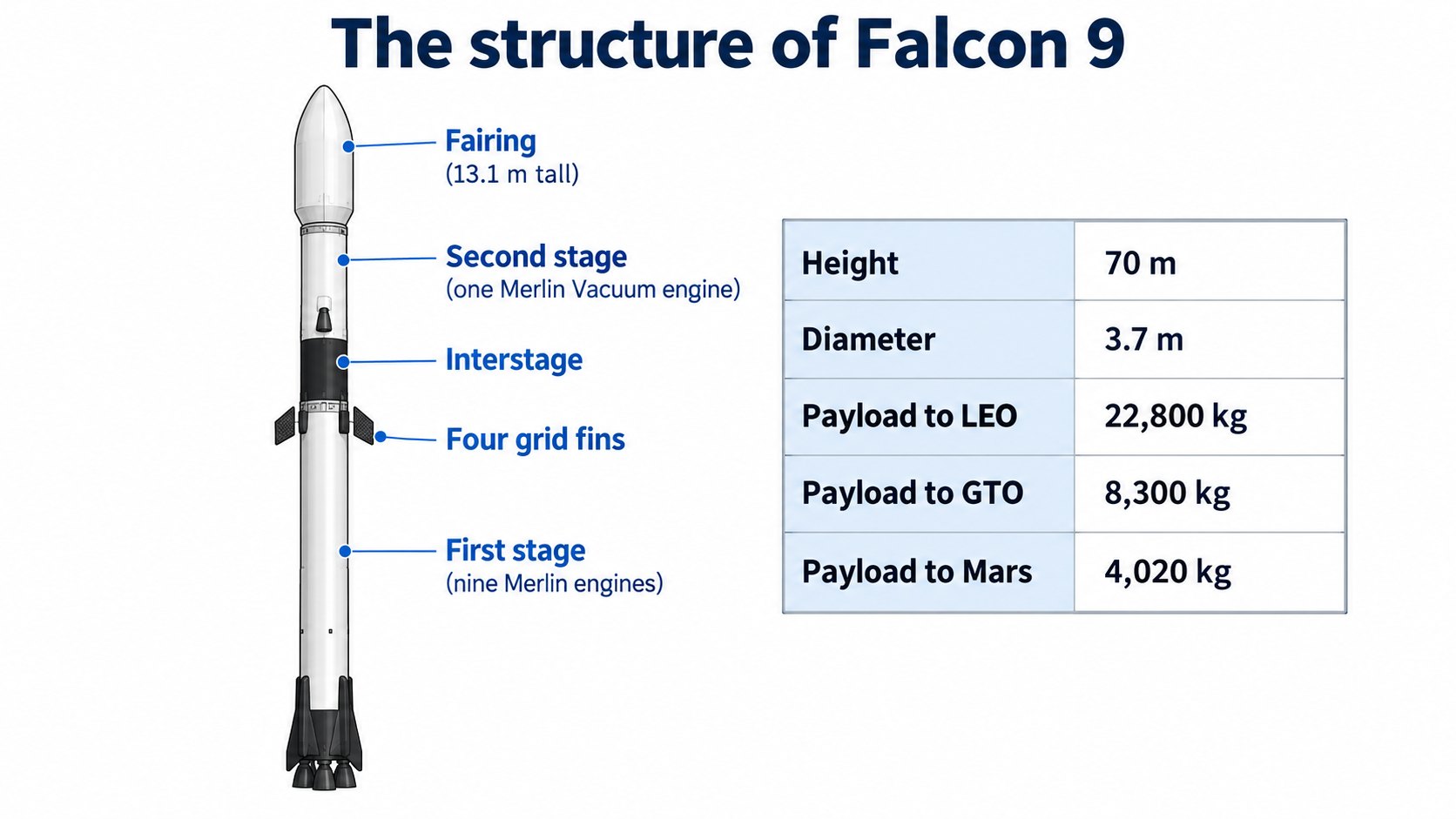
According to SpaceX's official page, Falcon 9 is a two-stage reusable rocket 70 m tall and 3.7 m in diameter, with a mass of 549,054 kg. The first stage has nine Merlin engines producing more than 1.7 million pounds of thrust at sea level (about 7.6 meganewtons, our conversion). Payload is 22,800 kg to low Earth orbit, 8,300 kg to geostationary transfer orbit and 4,020 kg to Mars. SpaceX calls it the world's first orbital class reusable rocket.
Is a rocket really expensive? looked at Falcon 9's price. Here we check what the rocket looks like and what it can do, on SpaceX's official Falcon 9 page (checked 2026-10-16).
The conclusion: two stages, and the first stage comes back
The page says (summary):
- Falcon 9 is a reusable, two-stage rocket designed and manufactured by SpaceX to transport people and payloads into Earth orbit and beyond.
- It is "the world's first orbital class reusable rocket". Reuse lets SpaceX refly the most expensive parts, which drives down the cost of space access.
[A note for beginners]
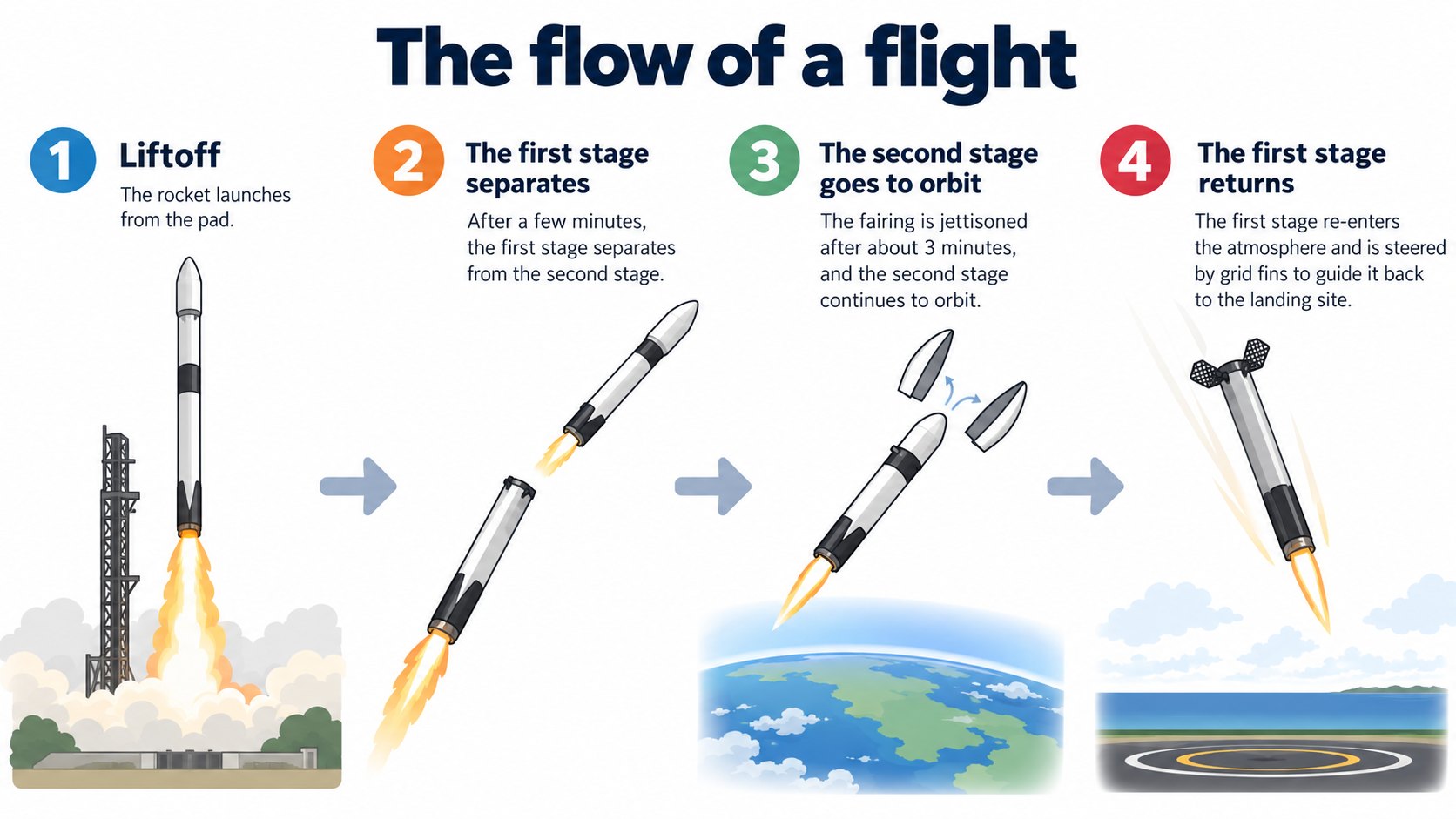
A stage is a part of a rocket that can be dropped. The lower (first) stage burns first and is released when used up; the upper (second) stage then carries the payload to orbit. (General explanation.)
Size and payload
| Item | Figure on the official page |
|---|---|
| Height | 70 m (229.6 ft) |
| Diameter | 3.7 m (12 ft) |
| Mass | 549,054 kg (1,207,920 lbs) |
| Payload to LEO | 22,800 kg (50,265 lbs) |
| Payload to GTO | 8,300 kg (18,300 lbs) |
| Payload to Mars | 4,020 kg (8,860 lbs) |
First stage: nine Merlin engines
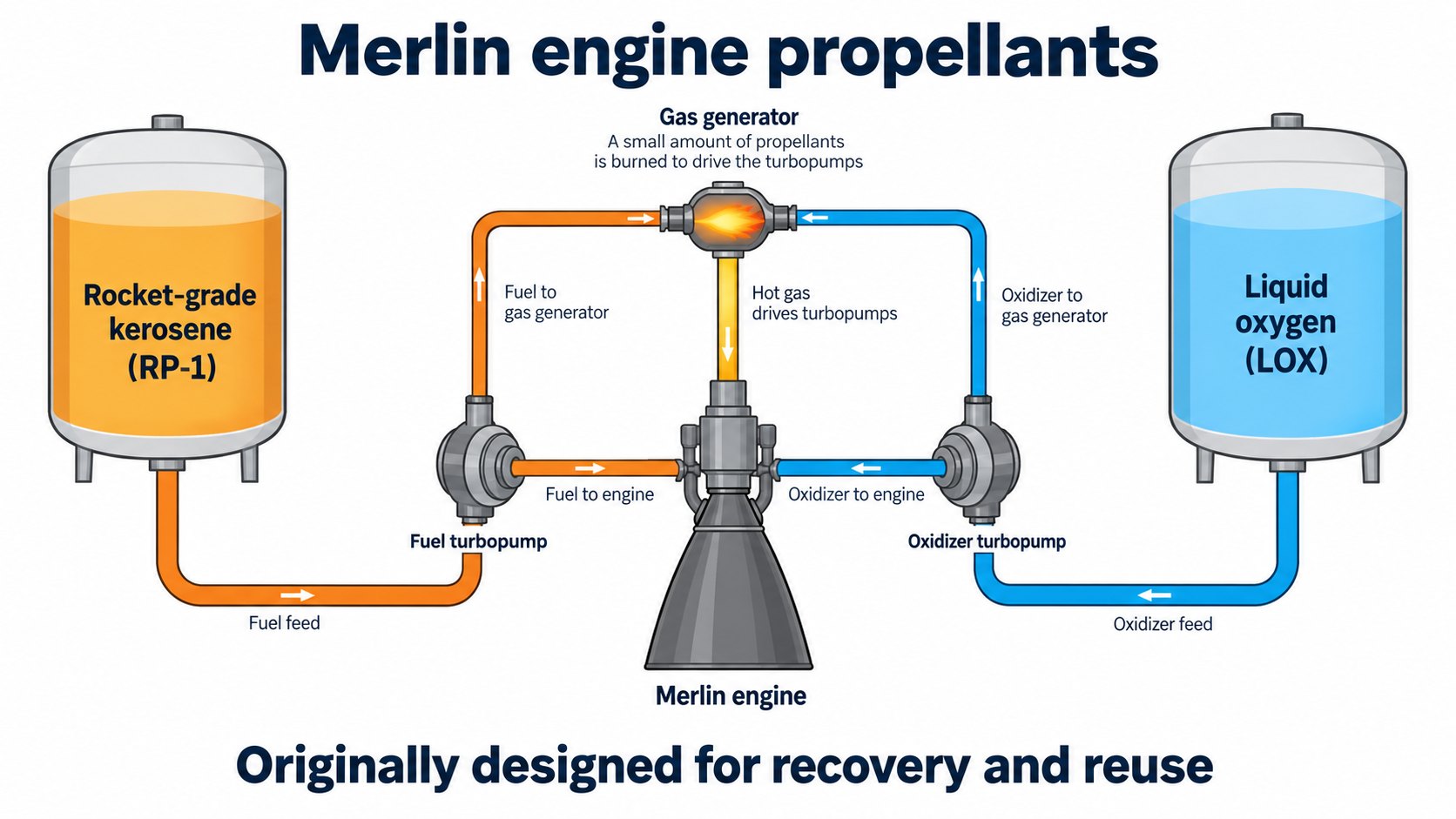
- Nine Merlin engines and aluminum-lithium alloy tanks holding liquid oxygen and rocket-grade kerosene (RP-1).
- More than 1.7 million pounds of thrust at sea level. The page lists 845 kN (190,000 lbf) per Merlin; nine give about 7.6 meganewtons (our calculation, consistent with the page).
- Four grid fins at the base of the interstage orient the rocket during reentry by moving the center of pressure.
Interstage, second stage, fairing
- Interstage: a composite structure joining the stages; it houses pneumatic pushers that separate them.
- Second stage: one Merlin Vacuum engine, burn time 397 s, thrust 981 kN (220,500 lbf). It ignites a few seconds after separation and can be restarted multiple times, placing multiple payloads in different orbits.
- Fairing: carbon composite, 13.1 m tall and 5.2 m in diameter, jettisoned about 3 minutes into flight; SpaceX continues to recover fairings for reuse.
The Merlin engine
SpaceX describes Merlin as a family of engines developed for Falcon 1, Falcon 9 and Falcon Heavy. They burn RP-1 and liquid oxygen in a gas-generator power cycle and were "originally designed for recovery and reuse". For a comparison with the next-generation Raptor, see Merlin vs. Raptor(coming soon).
FAQ
How big is Falcon 9?
On SpaceX's page: 70 m tall, 3.7 m in diameter, 549,054 kg.
How much can it carry?
22,800 kg to low Earth orbit, 8,300 kg to geostationary transfer orbit and 4,020 kg to Mars (SpaceX).
What does "reusable" mean?
Per SpaceX, the most expensive parts of the rocket are flown again. Fairings are also recovered for reuse.
How many engines?
Nine Merlin engines on the first stage and one Merlin Vacuum engine on the second.
Summary
- Falcon 9 is a two-stage reusable rocket, 70 m tall and 3.7 m in diameter.
- First stage: nine Merlin engines, over 1.7 million lbf at sea level. Second stage: one Merlin Vacuum.
- Payload: LEO 22,800 kg, GTO 8,300 kg, Mars 4,020 kg.
Sources (checked 2026-10-16)
- SpaceX, "Falcon 9": https://www.spacex.com/vehicles/falcon-9
This article is for learning about science and technology and is not investment advice. Facts and the author's reading are kept separate. The figures are AI-generated illustrations.
Thank you for reading. Was this article useful to you?
Thank you. If you like, tell us what you thought in a line or two.
Optional. No name or email needed.
Received. We will use your words to make better articles.