In an order adopted on October 21, 2026 (DA 26-1129), the FCC's Wireless Telecommunications Bureau approved the transfer of control of three unpaired AWS-3 licenses (1695–1710 MHz) from a Tristar subsidiary to Starlink Spectrum Holdings, a wholly owned SpaceX subsidiary. The licenses cover 62 counties in eight states, about 4% of the U.S. population. The band is uplink only and will be used for SpaceX's direct-to-device (D2D) network.
3-line summary
- On October 21, 2026, the FCC approved a SpaceX subsidiary taking over three spectrum licenses (1695–1710 MHz, 15 MHz wide) held by a Tristar subsidiary (order DA 26-1129).
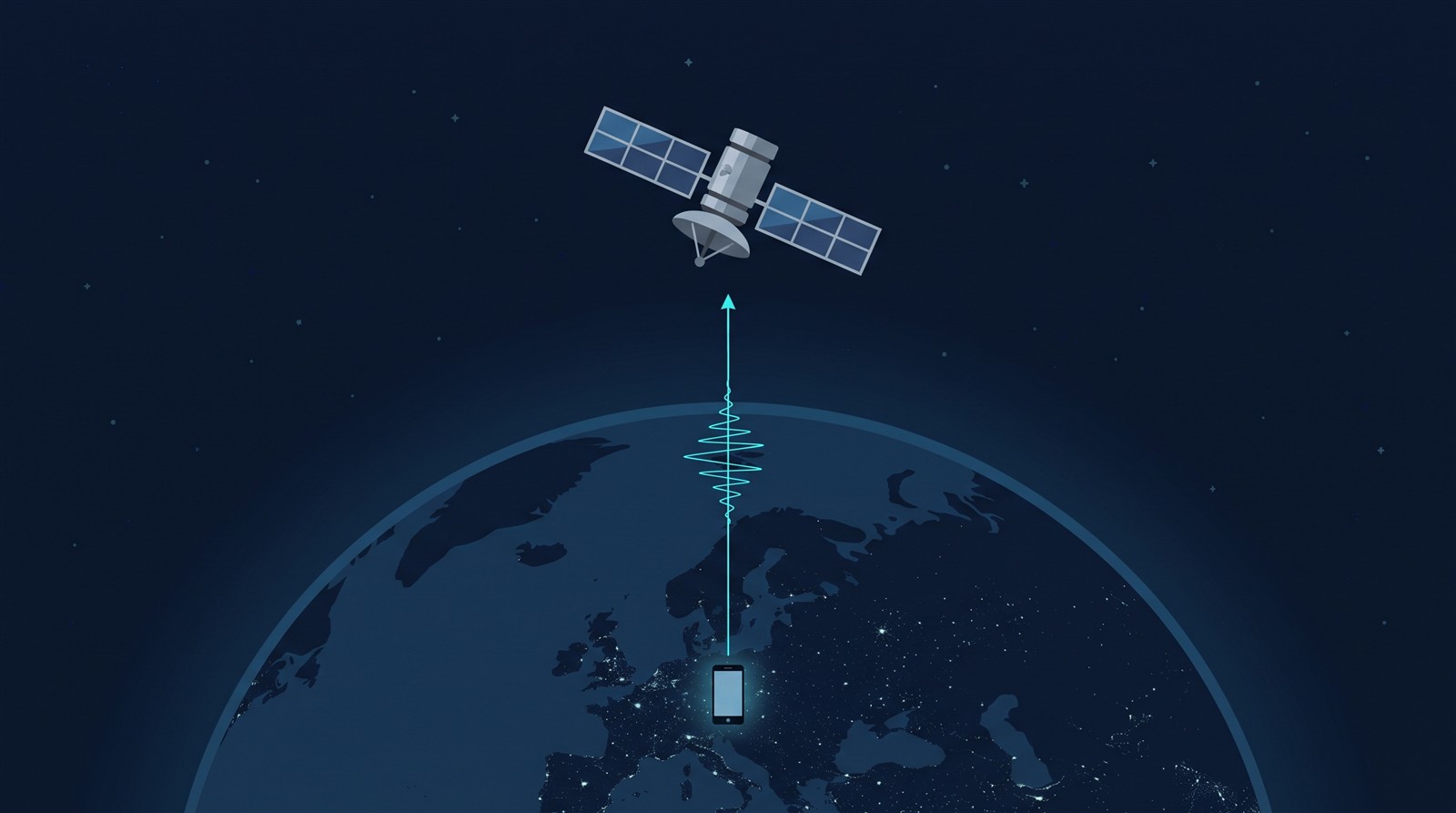
- The band is uplink only: it carries signals from phones to satellites, as part of SpaceX's direct-to-device (D2D) service.
- The requirement to build ground towers was waived. In its place, the FCC set satellite uplink-speed milestones at two, four, and nine years.
Background: frequency, bandwidth, uplink and downlink
Frequency is how many times a radio wave oscillates per second, measured in hertz (Hz). One megahertz (MHz) is one million times per second, so this band, at 1695–1710 MHz, oscillates about 1.7 billion times per second. Just as turning a radio dial switches stations, different frequencies let separate conversations share the same space. That is why governments assign frequencies by license. In the United States, that job belongs to the FCC.
Bandwidth is how wide a slice of frequencies you can use. From 1695 to 1710 is 15 MHz wide. Think of frequency as where a road is, and bandwidth as how many lanes it has. More lanes carry more cars (data) at once. Roughly, speed equals width times how much you can pack into each megahertz. With a technique that sends 100 kilobits per second per MHz, using all 15 MHz gives 15 × 100 kbps = 1,500 kbps, or about 1.5 Mbps.
Downlink is the direction from a tower or satellite to your phone (watching a video). Uplink is from your phone to the tower or satellite (sending a photo, or your voice on a call).
Between satellites and phones, the uplink is the hard part. A satellite can use a large antenna and solar power to beam a strong signal down. A phone runs on a small battery, and its signal is far weaker. According to the FCC's October 6 approval, these satellites fly at about 326–335 km, roughly the distance from Tokyo to Nagoya, but straight up, reached by a palm-sized device. Adding uplink-only spectrum widens the narrowest road in the system.
What happened
On October 21, 2026, the FCC's Wireless Telecommunications Bureau issued a Memorandum Opinion and Order (DA 26-1129, WT Docket No. 26-187).
| Item | Detail (from the FCC order) |
|---|---|
| Seller | TLG Unpaired Holdings, a subsidiary of Tristar License Group (Mississippi) |
| Buyer | Starlink Spectrum Holdings, a wholly owned SpaceX subsidiary |
| Spectrum | Unpaired AWS-3, 1695–1710 MHz (uplink only) |
| Licenses | Three (three Economic Areas) |
| Coverage | 62 counties in eight states, about 4% of the U.S. population |
| Application | Filed June 11, 2026; amended in July |
| Opposition | No petitions to deny |
| Effective | Upon adoption |
The FCC says the licenses will be used for SpaceX's next-generation direct-to-device (D2D) network.
Why it matters
First, more uplink spectrum. As explained above, the uplink is the narrowest road between phones and satellites. On October 6, the FCC conditionally approved SpaceX's next-generation D2D constellation of up to 15,000 satellites, which already included unpaired AWS-3 uplink spectrum. These licenses fill in areas of that same band SpaceX did not yet hold. The order records the applicants' point that the deal helps build a contiguous AWS-3 footprint.
Second, rules adapted for satellites. These licenses came with a duty to build ground towers covering set areas. Accepting the applicants' argument that satellites and towers cannot serve the same location at the same time on the same spectrum, the FCC waived the terrestrial buildout duty and replaced it with satellite targets. A license designed for ground carriers was reshaped for space-based service.
How it works: the FCC's uplink-speed milestones
The milestones count from November 30, 2027, at two, four, and nine years. They are written as kilobits per second per megahertz.
| Milestone | Uplink speed (even for the slowest 5% of users) | Service availability | Spectral efficiency per beam |
|---|---|---|---|
| 2 years | At least 100 kbps/MHz | 70% | 100 kbps/MHz |
| 4 years | At least 200 kbps/MHz | 80% | (not set) |
| 9 years | At least 300 kbps/MHz | 90% | 200 kbps/MHz |
The speed targets must be met over 90% of each license area.
The "slowest 5%" (5th percentile) wording matters. An average can be pulled up by users in ideal conditions. A 5th-percentile target requires reasonable speed even for people under partly blocked skies or at busy times.
Penalties are set too. Missing the two-year target moves the final deadline from nine years to eight. Missing the four-year target moves it two more years earlier (six years if both are missed). Missing the final target ends the license in that area automatically, and SpaceX cannot regain it.
My own estimate: applying 300 kbps/MHz to this 15 MHz gives 300 × 15 = 4,500 kbps, about 4.5 Mbps, if a single user had the full width. That is plenty for messages and voice calls, and enough to make sending photos practical.
Timeline
- June 11, 2026: The SpaceX subsidiary and Tristar applied to the FCC.
- July 5, 2026: The licenses' expiration date. Renewal applications filed in time kept them in effect.
- July 17, 2026: The FCC accepted the application for filing (DA 26-747). Petitions to deny were due August 17.
- October 6, 2026: The FCC granted in part and deferred in part SpaceX's next-generation D2D constellation of up to 15,000 satellites (DA 26-1078).
- October 21, 2026: The FCC approved this license transfer (DA 26-1129).
Useful takeaways for reading the news
- When you see "MHz," ask: location or width? "1695–1710 MHz" is the location; "15 MHz" is the width. Width is what drives speed.
- Uplink and downlink are separate problems. With satellites, weak phone signals make the uplink harder. Uplink-only spectrum targets that weakness.
- Approval is permission, not a launch date. This order allows the license transfer. The speed milestones count from November 30, 2027.
A question for next time
How does a satellite 330 km up pick out the faint signal from a phone's tiny antenna? The answer lies in the satellite's large antenna and in "beams" that focus radio energy onto a small spot.
Read next
- What Is Falcon 9? Size, Engines, Payload and How Reuse Works (the rocket that carries Starlink satellites)
- What Is Starship? The Two-Stage Design with Super Heavy, Size, Engines and Reuse
- How Much Does a Rocket Launch Cost? The Cost Breakdown Starting From Materials
Sources
- FCC, Memorandum Opinion and Order, DA 26-1129 (WT Docket No. 26-187; adopted and released October 21, 2026) → https://docs.fcc.gov/public/attachments/DA-26-1129A1.pdf
- FCC, Public Notice, DA 26-747 (July 17, 2026; application accepted for filing) → https://docs.fcc.gov/public/attachments/DA-26-747A1.pdf
- FCC, Order and Authorization, DA 26-1078 (October 6, 2026; SpaceX D2D constellation) → https://docs.fcc.gov/public/attachments/DA-26-1078A1.pdf
- TeslaNorth, "The FCC Just Handed SpaceX More Spectrum for Starlink Mobile" (October 21, 2026) → https://teslanorth.com/2026/10/21/the-fcc-just-handed-spacex-more-spectrum-for-starlink-mobile/
*The approval, conditions, and dates were confirmed in official FCC documents (as of 2026-10-22).*
Thank you for reading. Was this article useful to you?
Thank you. If you like, tell us what you thought in a line or two.
Optional. No name or email needed.
Received. We will use your words to make better articles.