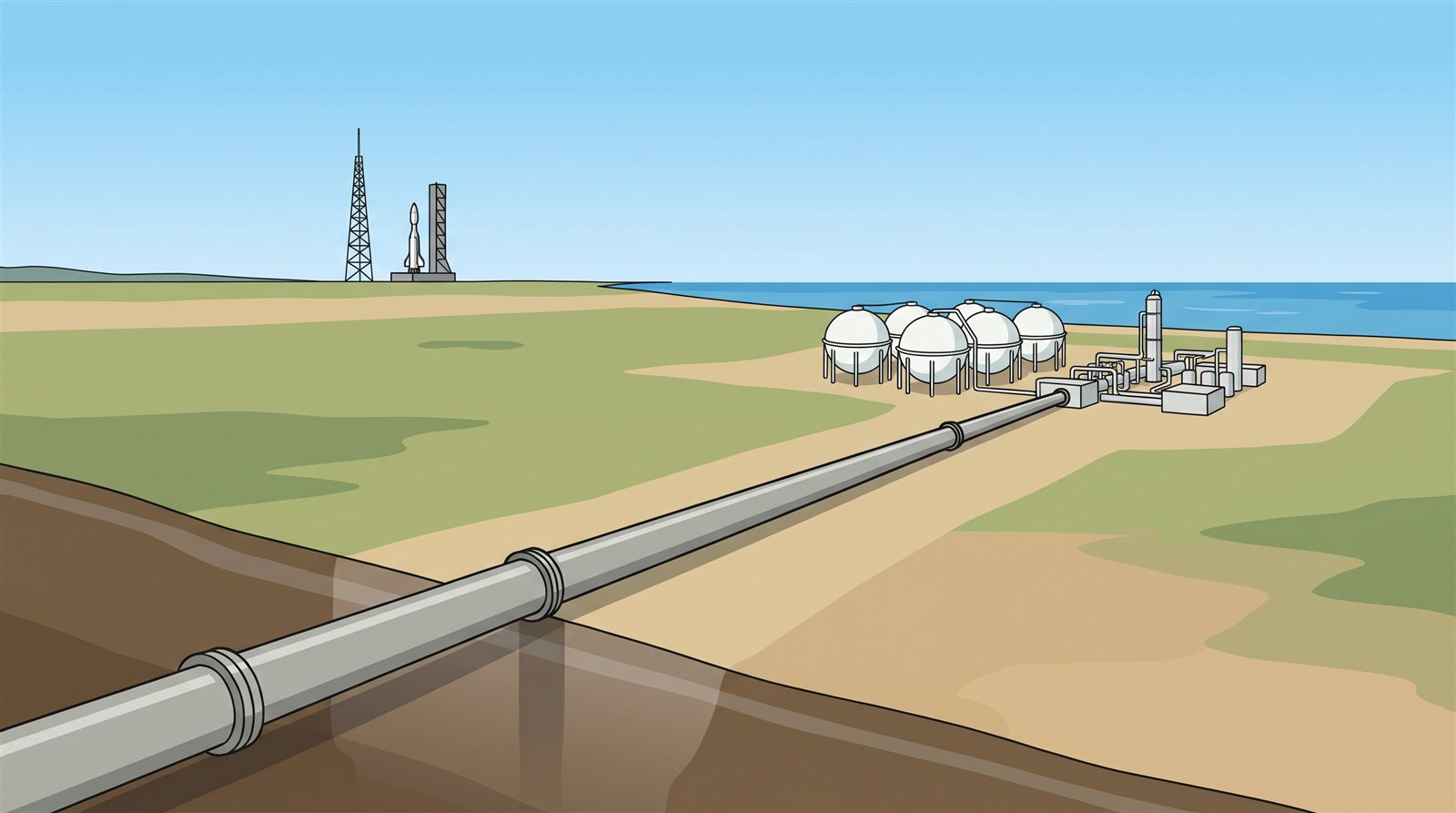
SpaceX subsidiary Coastal Connect Services has asked the Florida Public Service Commission to approve the tariff (rates and terms of service) for a 32.4-mile (about 52 km), 16-inch (about 41 cm) natural gas pipeline in Brevard County, home of Cape Canaveral, Reuters and others reported around October 5, 2026. The line would take gas from the existing Florida Gas Transmission interstate pipeline and deliver it directly to SpaceX facilities. The filing reportedly says current truck-based supply and existing local pipelines cannot meet SpaceX's growing needs at Cape Canaveral.
Summary in three lines
- SpaceX subsidiary Coastal Connect Services is reported to have asked Florida's Public Service Commission to approve the rates and terms for a 32.4-mile (about 52 km), 16-inch (about 41 cm) natural gas pipeline in Brevard County.
- The goal is to deliver large amounts of natural gas, the raw material for Starship's liquid methane fuel, by pipe instead of by truck. The filing reportedly says trucks and local pipelines cannot keep up with growing demand.
- According to reports, commission staff recommended approval and the commission approved it at its October 6 meeting. The target in-service date is reported as August 2027.
Background knowledge: natural gas, methane and LNG
Natural gas is a "burnable gas" taken from underground, and most of it is methane. Methane, one carbon atom with four hydrogen atoms, is the simplest hydrocarbon. It is also the main component of household city gas. Raw natural gas also contains small amounts of ethane, water and carbon dioxide.
Starship burns liquid methane and liquid oxygen. According to SpaceX's official page, Starship's propellant is liquid methane and liquid oxygen. One launch uses about 5,250 tonnes: 3,650 tonnes in the Super Heavy booster and 1,600 tonnes in the ship (Starship basics).
Methane is roughly one fifth of that. In chemistry, burning one methane molecule (mass 16) completely takes two oxygen molecules (mass 64). By mass, that is 1 part methane to 4 parts oxygen. Real engines usually run a little off this ratio, but as a rough guide, one fifth of 5,250 tonnes is about 1,000 tonnes of methane per launch (my own calculation).
LNG is natural gas cooled into a liquid. At about minus 162°C, natural gas becomes liquid and shrinks to about 1/600 of its volume. Because the gas is hard to move, it is liquefied for transport by truck or ship. SpaceX is reported to truck LNG into its Florida sites today.
Keeping a liquid that cold is hard. Liquid methane slowly warms and turns back into gas (boil-off). Every truck trip and every transfer between tanks loses a little. The more you need, the more trips and handling you add.
What happened
According to Reuters and others (around October 5, 2026), SpaceX subsidiary Coastal Connect Services asked the Florida Public Service Commission to approve the tariff (the document setting rates and terms of service) for a natural gas pipeline. The reported details:
| Item | Reported details |
|---|---|
| Applicant | Coastal Connect Services (a SpaceX subsidiary) |
| Location | Brevard County, Florida (home of Cape Canaveral) |
| Length and size | 32.4 miles (about 52 km), 16-inch diameter, steel |
| Gas source | The existing Florida Gas Transmission interstate pipeline |
| Delivery points | SpaceX facilities; Tesla North reports the Starship pads at LC-39A (Kennedy Space Center) and SLC-37 (Cape Canaveral Space Force Station) |
| Reason | Current truck-based supply and local pipelines cannot meet SpaceX's growing needs at Cape Canaveral |
| Schedule | Target in-service date of August 2027 |
| Review | Staff recommended approval; reported approved at the October 6 meeting |
Tesla North (October 8) reports that the filing describes current supply as "hundreds of truckloads of LNG per launch." It also reports that Florida City Gas, the local utility serving the Cape Canaveral area, sought to intervene in August, arguing its existing investment could be stranded.
Why it matters
More launches require a different way of delivering fuel. As calculated above, one Starship launch needs about 1,000 tonnes of methane. Sent through a pipe as gas, it can flow steadily day and night without waiting for trucks. Think of water: trucking is "carrying buckets," and a pipeline is "turning on a tap." Buckets are fine for a few launches a year. For dozens or hundreds, only a tap keeps up.
It points to fuel plants built at the launch site. What arrives by pipeline is gaseous natural gas. According to reports, SpaceX must treat it and chill it into liquid methane, which means owning purification and liquefaction equipment near the pads. For its planned Louisiana launch site, the state's announcement also lists a propellant production facility and power generation on site (Starbase Louisiana). Both point the same way: from "buying and hauling fuel" to "piping in the raw material and making it."
Background: why a state commission reviews it
Pipelines are treated as public infrastructure, like roads and power lines. In the United States, gas pipelines that cross state lines are overseen by the Federal Energy Regulatory Commission (FERC). Pipelines entirely within one state are overseen by that state's commission. This line stays inside Florida, so the Florida Public Service Commission reviews it.
What is reviewed is the "rates and terms." The commission was asked to approve a tariff: who gets gas, on what terms and at what price. According to Tesla North, the tariff bars service to existing utility customers and to sites within one mile of a utility's gas facilities, a condition meant to avoid taking customers from the local utility.
My own view: there is a business lesson here. SpaceX chose to own the pipe rather than buy from a gas company. Owning it lets SpaceX control volume and timing, in exchange for taking on construction, operation and regulatory review. It is the same idea as Tesla making its own battery materials: control the inputs that matter most.
Technology: how gas becomes rocket fuel
| Step | What happens | Analogy |
|---|---|---|
| 1. Interstate pipeline | Sends gaseous natural gas from gas fields to Florida | The water main |
| 2. This pipeline (about 52 km) | Branches off the main and carries gas to SpaceX facilities | The service line to a house |
| 3. Treatment | Removes water, carbon dioxide and more to purify the methane | A water filter |
| 4. Liquefaction | Chills it to about minus 162°C into liquid methane | An ice maker |
| 5. Pad tanks | Stores it as liquid until launch | A freezer |
A wider pipe carries much more. A pipe's cross-section grows with the square of its diameter, so a 16-inch pipe has about 1.8 times the cross-section of a 12-inch pipe (my own calculation). According to Tesla North, Coastal Connect says the local utility's 12-inch line to Kennedy Space Center lacks the needed capacity and is more than a mile from both pads.
Timeline
- August 2026: Florida City Gas reportedly sought to intervene.
- September 2026: Coastal Connect reportedly filed additional documents with the commission.
- Around October 5, 2026: Reuters and others reported the pipeline plan.
- October 6, 2026: Tesla North reports the commission approved it as staff recommended.
- Next: According to Tesla North, after the written order is issued there is a 21-day protest window, and the docket closes if there is no protest. The target in-service date is reported as August 2027.
Useful points for reading the news
- Methane is about one fifth of the propellant, because burning it takes four times its mass in oxygen. Think roughly 1,000 tonnes of methane per Starship launch.
- Pipeline regulation depends on whether it crosses state lines: FERC if it does, the state commission if it doesn't.
- Common misconception: "approved" does not mean "built." What was approved is the rates and terms; construction and operation come later.
The next question
Methane can now arrive by pipe. But where, and how, is the much larger amount of liquid oxygen made? Learning how oxygen is separated from air shows that a launch site is really a large chemical plant.
Read next
- What is "Starbase Louisiana," SpaceX's fourth launch site?
- What Is Starship? The Two-Stage Design with Super Heavy, Size, Engines and Reuse
- Merlin vs. Raptor: Comparing SpaceX's Rocket Engines by Fuel, Cycle and Thrust
Sources
- Insurance Journal (Reuters), "SpaceX Seeks Approval for Florida Gas Pipeline" (October 7, 2026) → https://www.insurancejournal.com/news/southeast/2026/10/07/888153.htm
- Interesting Engineering (October 5, 2026) → https://interestingengineering.com/space/spacex-florida-starship-gas-pipeline
- Tesla North (October 8, 2026) → https://teslanorth.com/2026/10/08/spacex-florida-natural-gas-pipeline-starship/
- Florida Public Service Commission, Docket 20260094-GU → https://www.floridapsc.com/clerks-office-dockets-level2?DocketNo=20260094
- SpaceX official (Starship) → https://www.spacex.com/vehicles/starship/
*The pipeline's length, size, gas source and applicant agree across Reuters, Interesting Engineering and Tesla North (as of 2026-10-25). Status: there is no official SpaceX announcement, and the plan's details are based on press reports. The October 6 approval, the delivery points (LC-39A and SLC-37), the August 2027 target and "hundreds of truckloads" come from Tesla North's report.
Thank you for reading. Was this article useful to you?
Thank you. If you like, tell us what you thought in a line or two.
Optional. No name or email needed.
Received. We will use your words to make better articles.