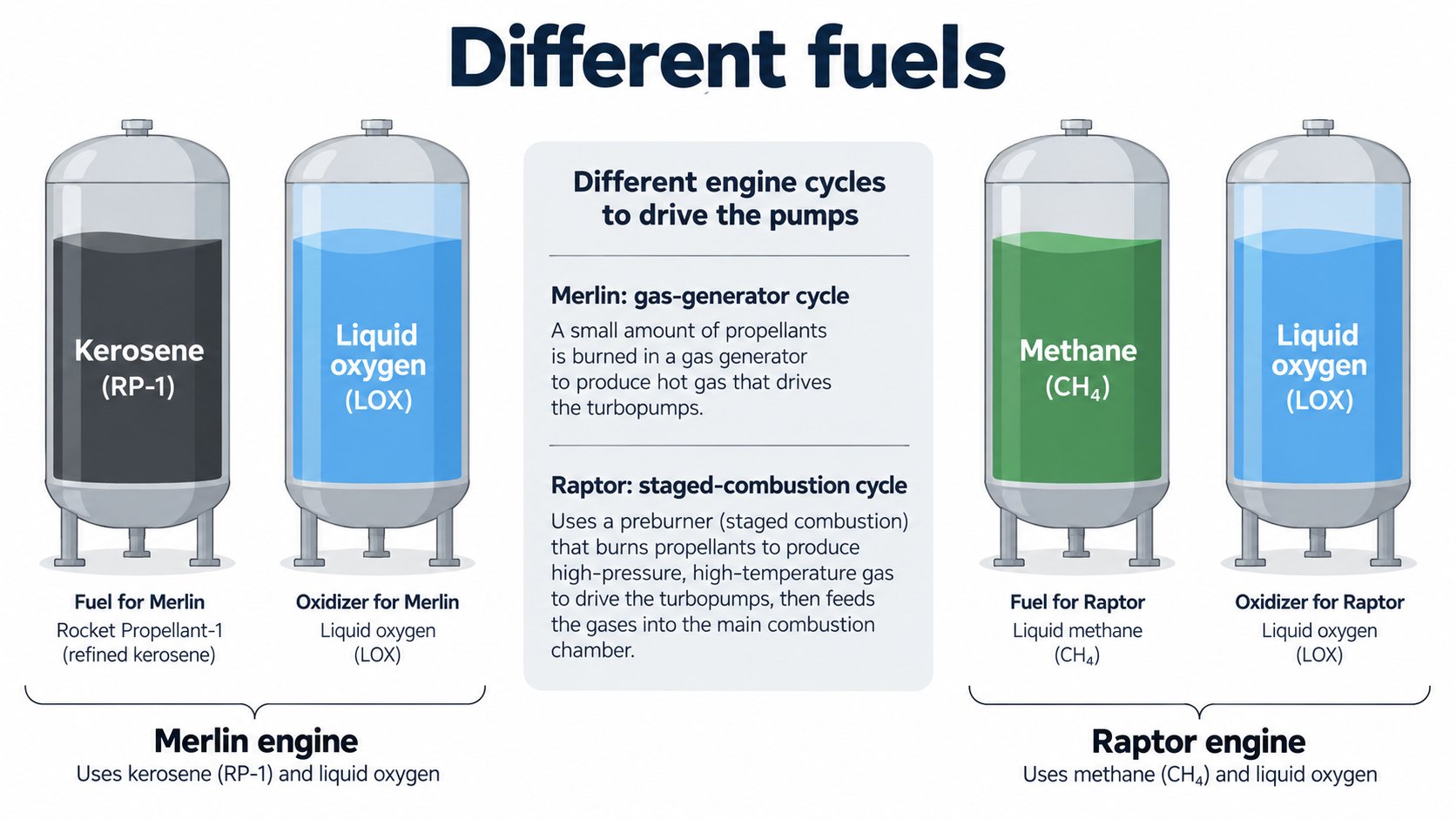
According to SpaceX's official pages, Merlin burns rocket-grade kerosene (RP-1) and liquid oxygen in a gas-generator cycle; Raptor is a reusable methane-oxygen staged-combustion engine. The pages list Merlin thrust as 845 kN (190,000 lbf) and Raptor thrust as 250 tf (551 klbf). The Starship page says Raptor has twice the thrust of Merlin, but calculating from the two figures gives about 2.9 times. The pages do not explain the difference.
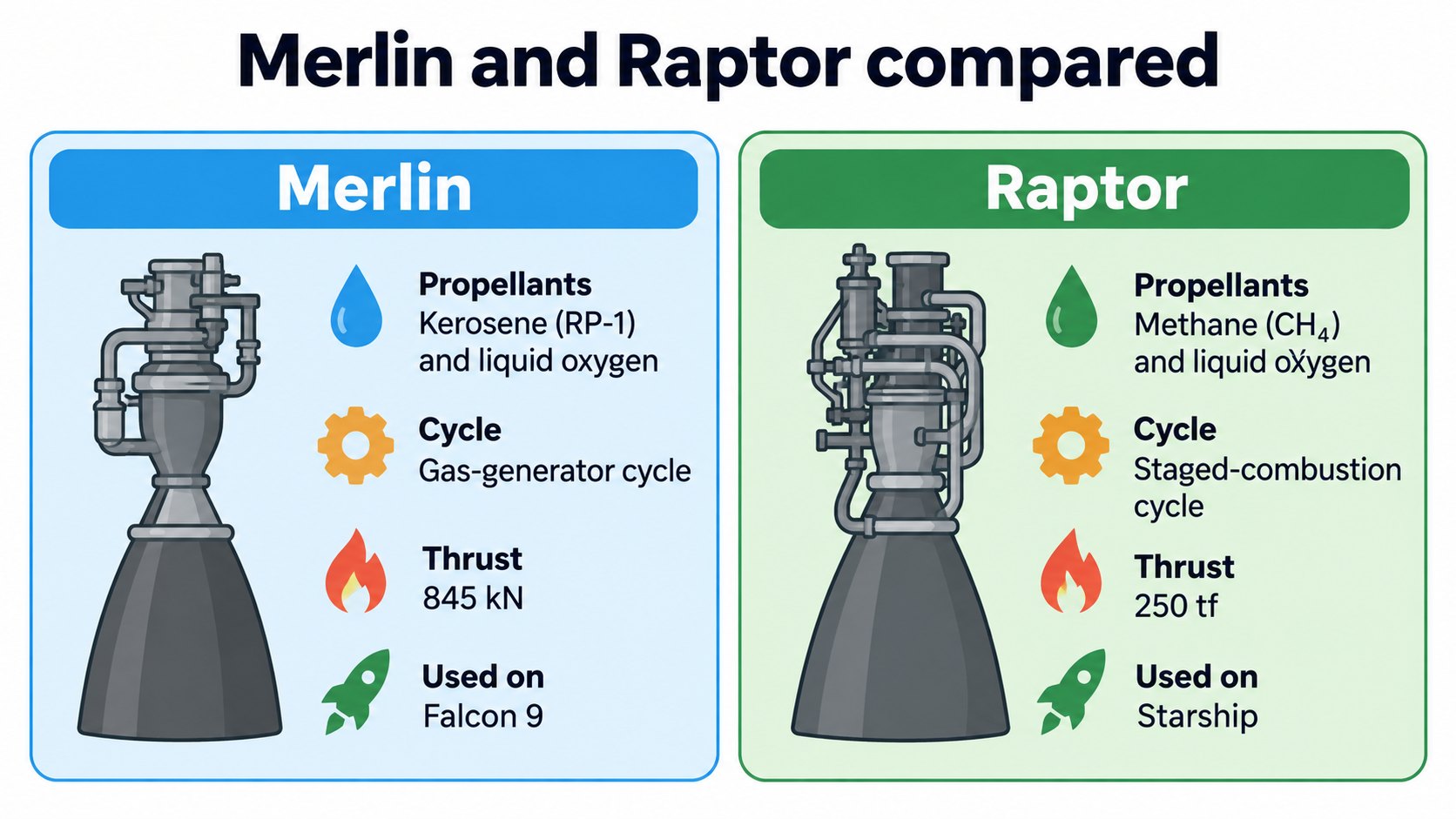
We looked at Falcon 9 and Starship. Here we compare their engines, Merlin and Raptor, using the figures on SpaceX's official Falcon 9 and Starship pages (checked 2026-10-16).
The conclusion: different fuel, different cycle
| Item | Merlin (Falcon 9 page) | Raptor (Starship page) |
|---|---|---|
| Used on | Falcon 1, Falcon 9, Falcon Heavy | Starship (upper stage and Super Heavy) |
| Propellants | rocket-grade kerosene (RP-1) and liquid oxygen | methane and oxygen (Super Heavy: sub-cooled liquid methane and LOX) |
| Cycle | gas-generator | staged-combustion |
| Thrust | 845 kN (190,000 lbf) | 250 tf (551 klbf) |
| Size | (not on the page) | 1.3 m diameter, 2.9 m height |
| Reuse | "originally designed for recovery and reuse" | a "reusable" engine |
| Vacuum version | Merlin Vacuum (second stage, 981 kN) | Raptor Vacuum (RVac) |
[A note for beginners]
Gas-generator and staged-combustion cycles differ in how the pumps that feed fuel are driven inside the engine. (General explanation; the pages do not explain the difference.) kN and tf are both units of force: 1 tf ≈ 9.8 kN (a general conversion).
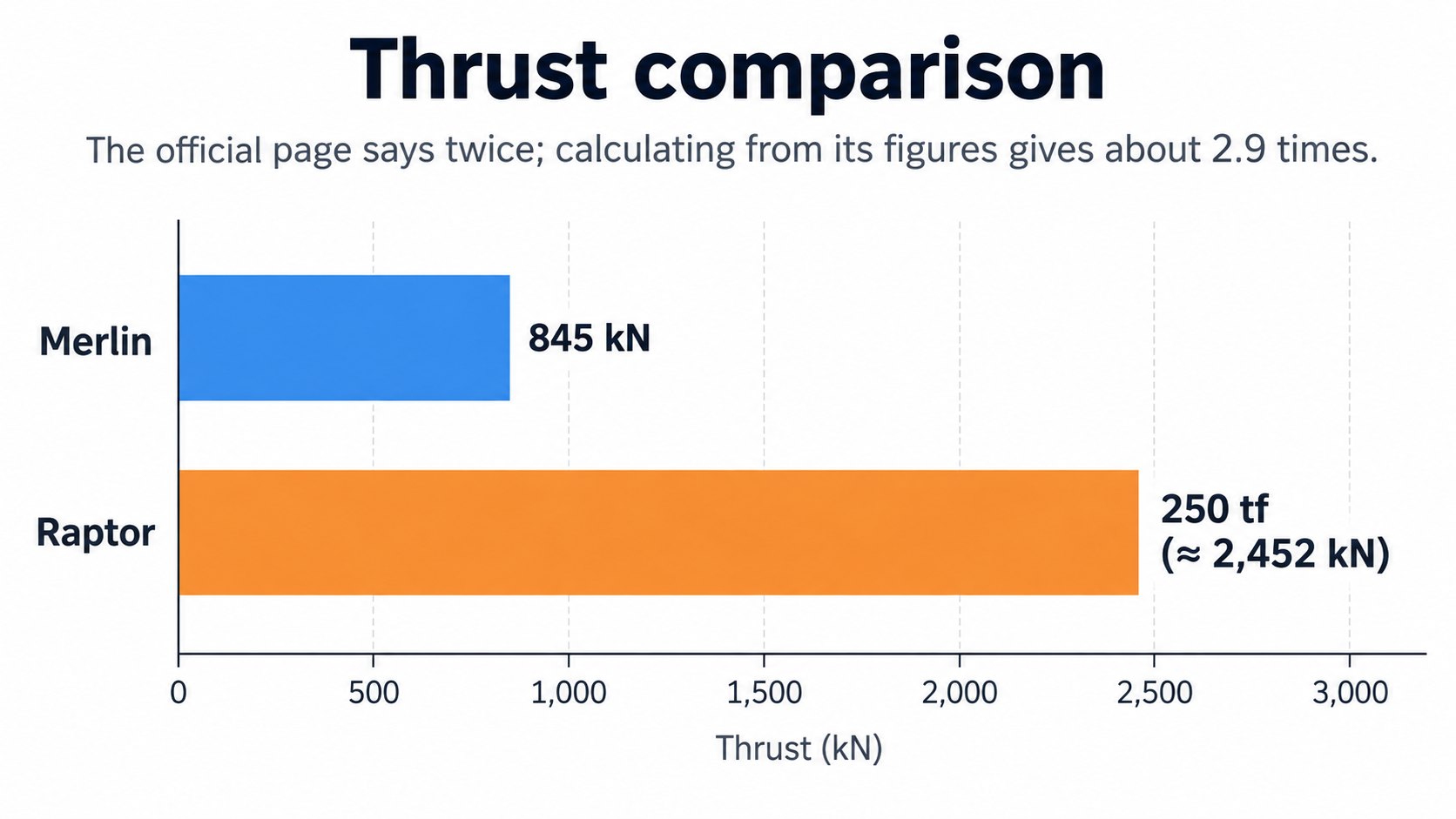
How many times Merlin is Raptor?
The Starship page says Raptor has "twice the thrust of the Falcon 9 Merlin engine". But calculating from the pages' figures:
- Merlin: 845 kN
- Raptor: 250 tf ≈ 2,452 kN (250 × 9.8066, our calculation)
- Ratio: 2,452 ÷ 845 ≈ 2.9
The pages do not explain the gap between "twice" and about 2.9.
[The author's reading, not a confirmed fact]
Thrust differs between sea level and vacuum, and it is unclear from the pages which condition each figure and the "twice" comparison refer to. (The Falcon 9 page's "over 1.7 million lbf at sea level" matches nine Merlins, so 845 kN is probably the sea-level value.) So we just record the gap.
Counting engines
- Falcon 9's first stage: nine Merlins (over 1.7 million lbf at sea level).
- Starship's upper stage: six (three Raptor, three Raptor Vacuum); Super Heavy: 33 Raptors (13 maneuverable in the center, 20 on the perimeter).
FAQ
What is the main difference between Merlin and Raptor?
The fuel: Merlin uses kerosene (RP-1) and liquid oxygen; Raptor uses methane and oxygen. The cycles also differ (gas-generator vs. staged-combustion).
Which is stronger?
By the pages' figures, Raptor. The page says twice; a calculation gives about 2.9 times.
Are both reusable?
SpaceX says Merlin was originally designed for recovery and reuse, and calls Raptor a reusable engine.
Summary
- Merlin: kerosene (RP-1) + liquid oxygen, gas-generator cycle, 845 kN.
- Raptor: methane + oxygen, staged-combustion cycle, 250 tf (about 2,452 kN).
Sources (checked 2026-10-16)
- SpaceX, "Falcon 9": https://www.spacex.com/vehicles/falcon-9
- SpaceX, "Starship": https://www.spacex.com/vehicles/starship
- SpaceX, "Falcon Heavy": https://www.spacex.com/vehicles/falcon-heavy
This article is for learning about science and technology and is not investment advice. Facts and the author's reading are kept separate. The figures are AI-generated illustrations.
Thank you for reading. Was this article useful to you?
Thank you. If you like, tell us what you thought in a line or two.
Optional. No name or email needed.
Received. We will use your words to make better articles.