In a Federal Register notice published October 14, 2026 (document 2026-20963, docket FAA-2026-12808), the FAA announced it will prepare a Programmatic Environmental Impact Statement on SpaceX's proposal to increase Starship-Super Heavy launches and landings at the Boca Chica Launch Site at Starbase, Texas. SpaceX is currently authorized for 25 launches and 50 landings a year. The review covers Phase 1 at 100 launches and 200 landings a year, and Phase 2 at up to 456 launches and 912 landings a year. Public comments are open until November 30, 2026, with scoping meetings on November 17–19.
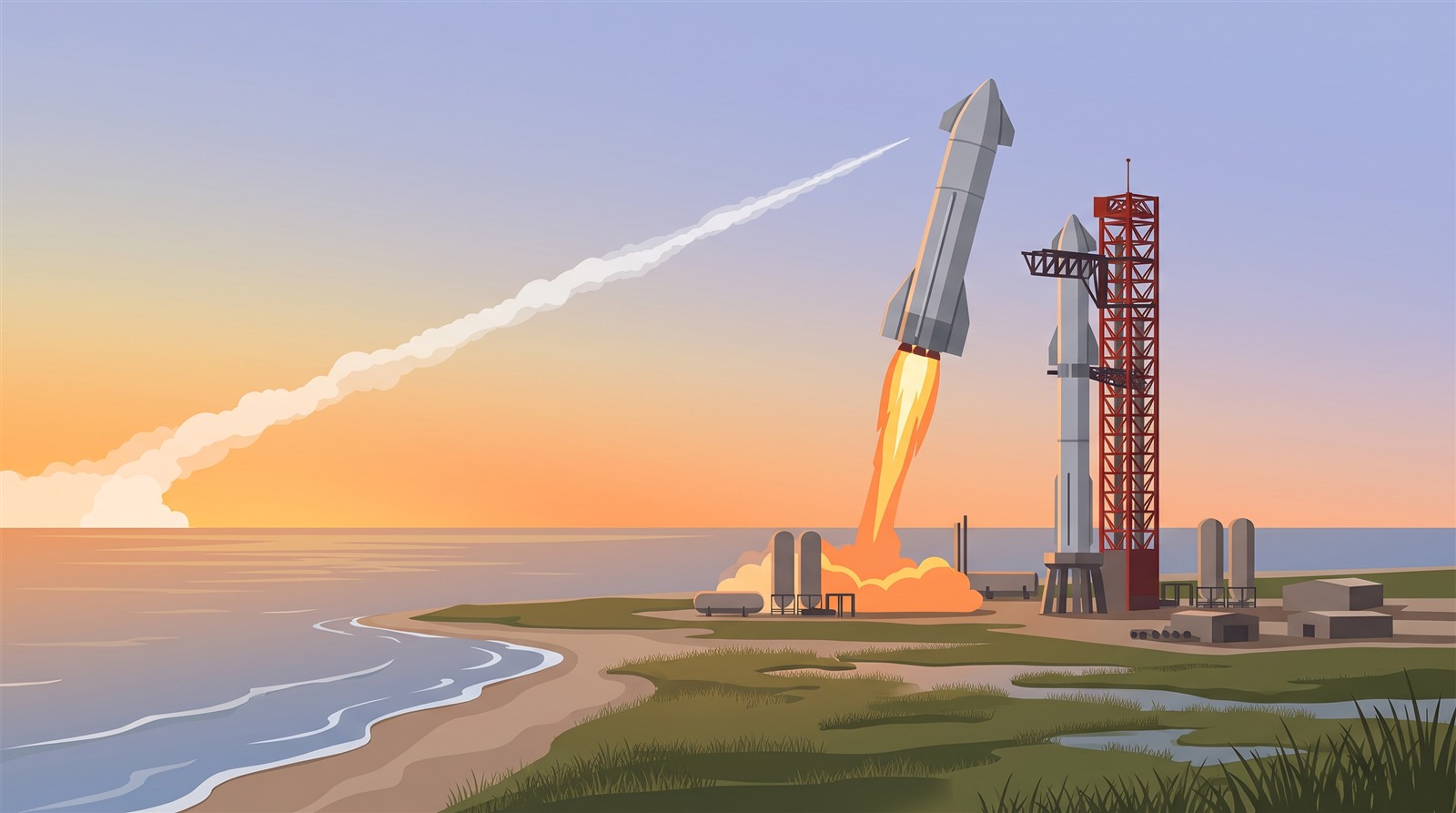
Three-line summary
- In a Federal Register notice published October 14, 2026, the FAA said it will prepare a Programmatic Environmental Impact Statement (PEIS) on SpaceX's plan to raise Starship launches from Starbase, Texas from 25 a year to as many as 456.
- The review has two phases: Phase 1, 100 launches and 200 landings a year (any day or time), and Phase 2, up to 456 launches and 912 landings a year (Monday to Friday only, any time of day).
- Public comments are open until November 30, 2026, with in-person meetings in Texas on November 17 and 19 and a virtual meeting on November 18. This is the start of a review, not an approval.
Background knowledge: environmental review, launch licenses and "landing counts"
Launching a rocket requires a government license. In the U.S., commercial launches and reentries need an FAA license, which spells out where a vehicle may fly from, in which directions, and how often. Starship's current authority at Starbase comes from a 2025 review: 25 launches and 50 landings a year (25 Starship, 25 Super Heavy), or roughly one launch every two weeks. Flying more means modifying the license, and that first requires an environmental review.
An environmental review studies and publishes a project's effects before the government acts. The National Environmental Policy Act (NEPA) requires federal agencies to look at noise, air, wildlife, water, cultural sites and local communities before issuing approvals. Smaller projects can use a shorter Environmental Assessment (EA); projects that may have larger effects get a more detailed Environmental Impact Statement (EIS). The "P" in PEIS means "programmatic": it examines a multi-year program of increasing flights as a whole rather than one launch at a time.
The steps run: notice, scoping, draft, comments, final, decision. This notice (a Notice of Intent) opens "scoping," a period for the public, governments and experts to say what the study should cover. The FAA will later release a Draft PEIS for another round of comments. The notice says only that the draft will come "at a later date."
Landings are double the launches because both stages come back. Starship has two stages: the Super Heavy booster and the Starship spacecraft (Starship basics). Both are designed to return and be caught by the tower, so each launch means two landings: 456 × 2 = 912, and 100 × 2 = 200.
What happened
According to the notice (filed October 13, published October 14, 2026), the FAA will prepare a PEIS on SpaceX's proposal to increase Starship-Super Heavy launches and landings at Boca Chica and to expand Starship landing and expenditure locations. Future license modifications or renewals, and the temporary airspace closures tied to the flights, are within the scope.
| Item | Current (2025 review) | Phase 1 | Phase 2 (maximum) |
|---|---|---|---|
| Launches | 25/year | 100/year | 456/year |
| Landings | 50/year | 200/year | 912/year |
| Days and times | — | Any day or time | Monday–Friday only, any time |
| Rough weekly rate (our calculation) | ~0.5 | ~2 | ~8.8 |
Source: FAA Federal Register notice (October 14, 2026). Weekly rates are annual figures divided by 52.
The notice describes Phase 2 as "a mature program launching more than 100 times annually" to be implemented "within several years," and says the 912 landings are the maximum that could occur at Starbase regardless of where the vehicle launched.
Why it matters
It prepares the rules for Starship's move from testing to routine flight. The notice calls Starbase SpaceX's primary research, development and flight-test site. Counting only weekdays (about 261 a year), 456 launches is about 1.75 a day (our calculation), closer to a scheduled service than a test campaign.
Flight rates are capped by licenses as much as by hardware. However fast rockets are built, a company cannot exceed its licensed cadence. When reading a launch target, look separately at how fast vehicles are built, how many pads exist, and what the license allows.
Background: why more flights now
Reusable rockets only get cheap when they fly often. Starship burns about 5,250 tonnes of propellant per launch (Starship basics). If both stages are reused, the cost per flight is mainly propellant and turnaround; the notice says both stages are "designed to require minimal post-flight refurbishment."
Going to the Moon needs many refueling launches. NASA's lunar lander version of Starship must take on propellant in Earth orbit from other Starships before heading to the Moon (refueling flights), so frequent launches are part of the plan.
How it works: launch directions and the way home
Directions are given as azimuths, with north at 0°, east at 90°, south at 180° and west at 270°.
| Item | Azimuth | What it means (our reading) |
|---|---|---|
| Launch | 40°–115° | Northeast to east-southeast, over the Gulf |
| Super Heavy return | Within the launch range | Back along the direction it went up |
| Starship return | 155°–185° and 240°–340° | Approaching from the south, or from the west/northwest |
Why launch east? Earth spins west to east, so launching east borrows that speed and saves propellant. Starbase sits on the western edge of the Gulf, with open water to the east.
Why does Starship return from the west? A spacecraft coming back from orbit approaches from a different direction than it left. The 240°–340° range may cross land on the way in; in our view, this will be an important point for noise and airspace studies.
What if a stage cannot return? Super Heavy would land at the site, soft-land in the Gulf, or be expended in flight. Starship would land at the site, soft-land in the Gulf or the open ocean, or be expended in the open ocean. For analysis, the FAA assumes half of operations by day (7 a.m.–10 p.m.) and half by night.
What will be studied
The PEIS will cover air quality, plants and wildlife, coastal resources, farmland, hazardous materials and waste, historic and cultural resources, land use, energy, noise, socioeconomics and children's health and safety, visual effects, and water resources. The FAA is also consulting the U.S. Fish and Wildlife Service and the National Marine Fisheries Service on endangered species, and starting historic-preservation consultation. The only alternative studied is No Action (staying at 25 a year), because Starbase already has the needed infrastructure.
Timeline
- 2025: The FAA completed a tiered EA authorizing up to 25 launches a year at Starbase (cited in the notice).
- October 14, 2026: This notice is published and scoping begins.
- Next: Accommodation requests by November 2; English and Spanish presentations online by November 10; meetings on November 17 (Brownsville), 18 (virtual) and 19 (Port Isabel); comments due November 30; then a draft PEIS.
Useful takeaways
- "Review started" is not "approved." No 456-launch authority exists yet.
- For fully reusable rockets, landings ≈ launches × 2.
- Convert annual rates to weekly or daily ones: 25/year = every two weeks; 100/year = twice a week; 456/year = about 1.75 per weekday.
- Common mistake: a company's long-term goal (such as "10,000 launches") and the FAA's reviewed maximum for one site are different numbers.
A question to continue with
To fly 1.75 times per weekday, how quickly must a pad be ready for the next launch? Learning how the pad and the catch tower recover after 33 engines fire shows the real challenge behind 456 launches a year.
Read next
- What is Starship? Two stages, size, engines and reuse, checked against SpaceX's official page
- What is "Starbase Louisiana," SpaceX's fourth launch site?
- How many refueling launches does Starship need to reach the Moon?
Sources
- FAA, Notice of Intent to Prepare a PEIS… Boca Chica Launch Site at Starbase, Texas (Federal Register document 2026-20963, published October 14, 2026) → https://www.federalregister.gov/d/2026-20963
- Public inspection copy (PDF) → https://public-inspection.federalregister.gov/2026-20963.pdf
- FAA Starship environmental review page → https://www.faa.gov/space/stakeholder_engagement/spacex_starship
- Space.com, "SpaceX wants to launch Starship more than 450 times per year from South Texas" → https://space.com/space-exploration/launches-spacecraft/spacex-wants-to-launch-starship-more-than-450-times-per-year-from-south-texas
*Figures, phases, directions and dates were checked against the FAA notice (as of 2026-10-29). Status: the notice does not give a completion date for the review or a specific year for Phase 2.
Thank you for reading. Was this article useful to you?
Thank you. If you like, tell us what you thought in a line or two.
Optional. No name or email needed.
Received. We will use your words to make better articles.