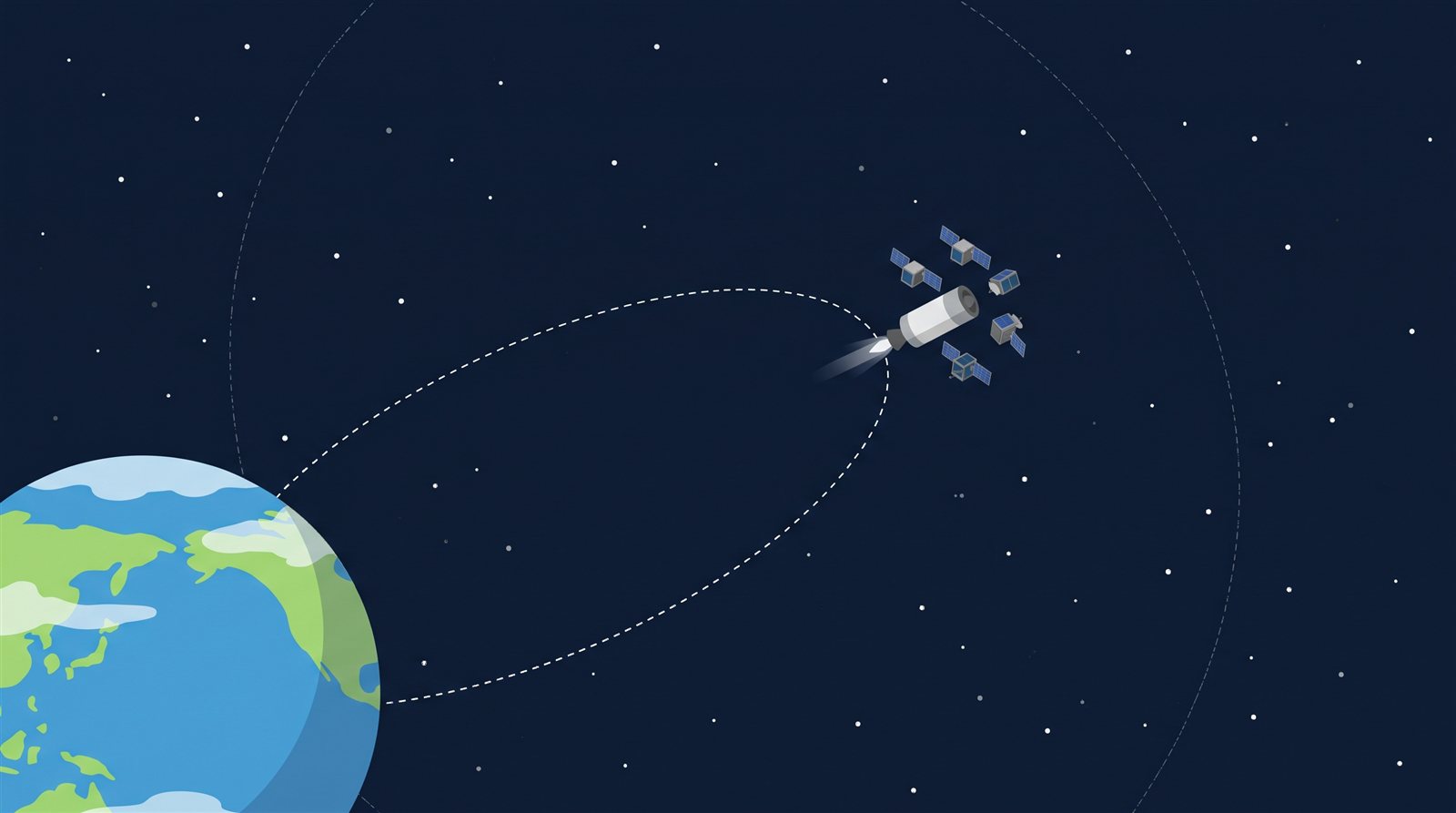
In an October 26, 2026 press release (Business Wire), Astranis said it amended a contract signed with SpaceX in late 2024 so that its 2028 Falcon 9 launch becomes a dedicated mission using all of the rocket's payload capacity. It will carry the six "Block 4" MicroGEO satellites (numbers 11 to 16), and Impulse Space's Helios upper stage will place them directly into geostationary orbit. That brings the Astranis fleet to 16 satellites.
3-line summary
- On October 26, 2026, satellite maker Astranis announced that its Falcon 9 launch planned for 2028 is now a dedicated mission carrying only its own satellites: six small geostationary satellites, numbers 11 to 16.
- Impulse Space's Helios upper stage will deliver them directly to geostationary orbit. Impulse's official page lists the trip from low Earth orbit to GEO as "less than 1 day."
- The previous batch, launched in December 2024, took about six months to reach GEO. That gap is the main lesson of this news.
Background knowledge: GEO satellites and the long road there
Geostationary orbit (GEO) is a circular orbit about 35,786 km above the equator. At that height a satellite takes exactly as long to circle Earth as Earth takes to spin once (about 23 hours 56 minutes), so from the ground it seems to hang still at one point in the sky. It is like riding a merry-go-round: the horse next to you seems not to move. Because a ground antenna can stay pointed in one direction, GEO has long been used for TV broadcasting and internet service for ships, aircraft and remote islands.
Higher orbits take more energy to reach. The International Space Station flies about 400 km up, so GEO is roughly 90 times farther. A rocket first climbs to a low orbit, then accelerates again to reach higher.
Geostationary transfer orbit (GTO) is the ellipse in between. Its closest point is a few hundred kilometers up and its farthest point is at GEO height (about 36,000 km). Many rockets release satellites here. Even SpaceX's official Falcon 9 page lists payload as "8,300 kg to GTO," not to GEO. Turning that ellipse into a circle is the satellite's own job.
To round out the ellipse, you speed up again at the far point. By my own calculation, with a low point of 200 km, the speed at the far point of the ellipse is about 1.6 km/s, while a circular GEO orbit needs about 3.1 km/s. The satellite must add the difference, about 1.5 km/s, by itself (not counting any change to the orbit's tilt). That is about 17 times the speed of a bullet train, added in space.
How long that takes depends on the engine. A chemical engine, which burns propellant, is powerful and can finish the job in minutes. Electric propulsion, which accelerates gas with electricity, saves a great deal of propellant but pushes very gently, so it widens the orbit little by little over months. It is the difference between climbing a hill slowly in a small car and charging up it with a big engine.
What happened
| Item | Details |
|---|---|
| Announcement | Astranis press release (Business Wire, October 26, 2026) |
| Change | Amended a late-2024 SpaceX launch contract to secure all payload capacity (dedicated mission) |
| Rocket | SpaceX Falcon 9 |
| Timing | Planned for 2028 |
| Satellites | The six "Block 4" satellites (numbers 11 to 16), the entire Block 4 production run |
| Delivery | Impulse Space's Helios upper stage, direct insertion into GEO |
| Fleet total | 16, adding to the 10 satellites of Blocks 1 to 3 |
| Customers | Several initial customers signed, to be named later |
Astranis CEO John Gedmark said, "We've only just begun to ramp up production to meet the demand we are seeing."
Why it matters
The biggest point is how soon a satellite starts working. Of the four satellites launched on a dedicated Falcon 9 in December 2024, the two built for in-flight connectivity company Anuvu reached GEO in early July 2025 after a "six-month orbit raise" and entered service on August 7, according to reports. Impulse's Helios page lists LEO-to-GEO transfer as "less than 1 day." The half year between launch and earning revenue nearly disappears.
The second point is that satellites can be lighter and simpler. In my view, if a ride takes them all the way to GEO, the satellites no longer need to carry the propellant and time to add 1.5 km/s on their own, and that margin can go to communications equipment or to propellant that extends their working life.
Background: why a dedicated launch, and why small GEO satellites?
Traditional GEO satellites weigh several tonnes and usually take years to build. Astranis instead builds small GEO satellites, called MicroGEO, in batches of the same design (Blocks). If a whole batch flies on one rocket, the company does not have to fit its schedule around other customers. The press release says dedicated launches of multi-satellite blocks support its business model.
How it works: two ways to get to GEO
| Last time (December 2024) | This time (planned 2028) | |
|---|---|---|
| Rocket | Falcon 9 (dedicated) | Falcon 9 (dedicated) |
| Satellites | 4 | 6 |
| Final leg to GEO | Satellites raise their own orbits | Helios upper stage carries them |
| Time to reach GEO | About 6 months (the two Anuvu satellites) | Less than 1 day (Helios official page) |
Helios has one Deneb engine burning liquid oxygen and liquid methane, with 67 kN (15,000 lbf) of thrust, according to Impulse Space's official page. It can add 3 to 9 km/s of speed, depending on payload mass. Falcon 9 carries the satellites and Helios together to a low orbit, and Helios takes over from there, like a relay.
Timeline
- April 2022: Astranis announced a dedicated Falcon 9 contract for four satellites.
- December 2024: Those four (two for Anuvu, UtilitySat, and AGILA for the Philippines) launched on a dedicated Falcon 9.
- July–August 2025: The two Anuvu satellites reached GEO after about six months of orbit raising and entered service on August 7.
- October 26, 2026: Astranis switched its fourth launch to a dedicated mission for the six Block 4 satellites, with Helios delivering them directly to GEO. The Block 3 launch is planned for the first quarter of 2027.
Takeaways for reading space news
- "To GEO" and "to GTO" are different destinations: Most rocket payload numbers are for GTO. Who covers the remaining ~1.5 km/s changes the satellite's design and how soon it can start service.
- Electric propulsion is slow but fuel-efficient: Six months is not a failure; it is the result of a design that saves propellant. You are choosing between buying speed and buying fuel.
- Rockets sometimes hand off the final leg: Think of an upper stage like Helios as a connecting flight in space.
Read next
- How to Read a Rocket's "Payload" Number: LEO, GTO and Mars Figures Compared
- What Is Falcon 9? Size, Engines, Payload and How Reuse Works
- How Much Does a Rocket Launch Cost? Falcon 9, the Space Shuttle and SLS
A question to carry forward: GEO is a single ring above the equator. As satellites keep multiplying, who divides up the "parking spots" on that ring, and how?
Sources
- Astranis, "Astranis Upgrades Falcon 9 Launch Contract to Dedicated Mission for Entire Block 4 Production Run of Satellites" (Business Wire, October 26, 2026) → https://www.morningstar.com/news/business-wire/20261026609529/astranis-upgrades-falcon-9-launch-contract-to-dedicated-mission-for-entire-block-4-production-run-of-satellites
- Via Satellite, "Astranis Plans Dedicated Falcon 9 to Launch 6 MicroGEO Satellites" (October 26, 2026) → https://www.satellitetoday.com/launch/2026/10/26/astranis-plans-dedicated-falcon-9-to-launch-6-microgeo-satellites/
- Impulse Space, "Helios" (official page, checked October 27, 2026) → https://www.impulsespace.com/helios
- Via Satellite, "2 Astranis MicroGEO Satellites Enter Service for Anuvu" (August 7, 2025) → https://www.satellitetoday.com/connectivity/2025/08/07/2-astranis-microgeo-satellites-enter-service-for-anuvu/
- Astranis (Business Wire, April 5, 2022, first dedicated launch contract) → https://www.businesswire.com/news/home/20220405005129/en
Verification status
The switch to a dedicated launch, the six satellites, 2028, direct GEO insertion by Helios, and the 16-satellite total were confirmed in the Astranis press release and trade press coverage. Helios's propellant, thrust and transfer time come from Impulse Space's official page. The orbital speed figures are the author's own calculation. This article is for learning about science and technology and is not investment advice.
Thank you for reading. Was this article useful to you?
Thank you. If you like, tell us what you thought in a line or two.
Optional. No name or email needed.
Received. We will use your words to make better articles.