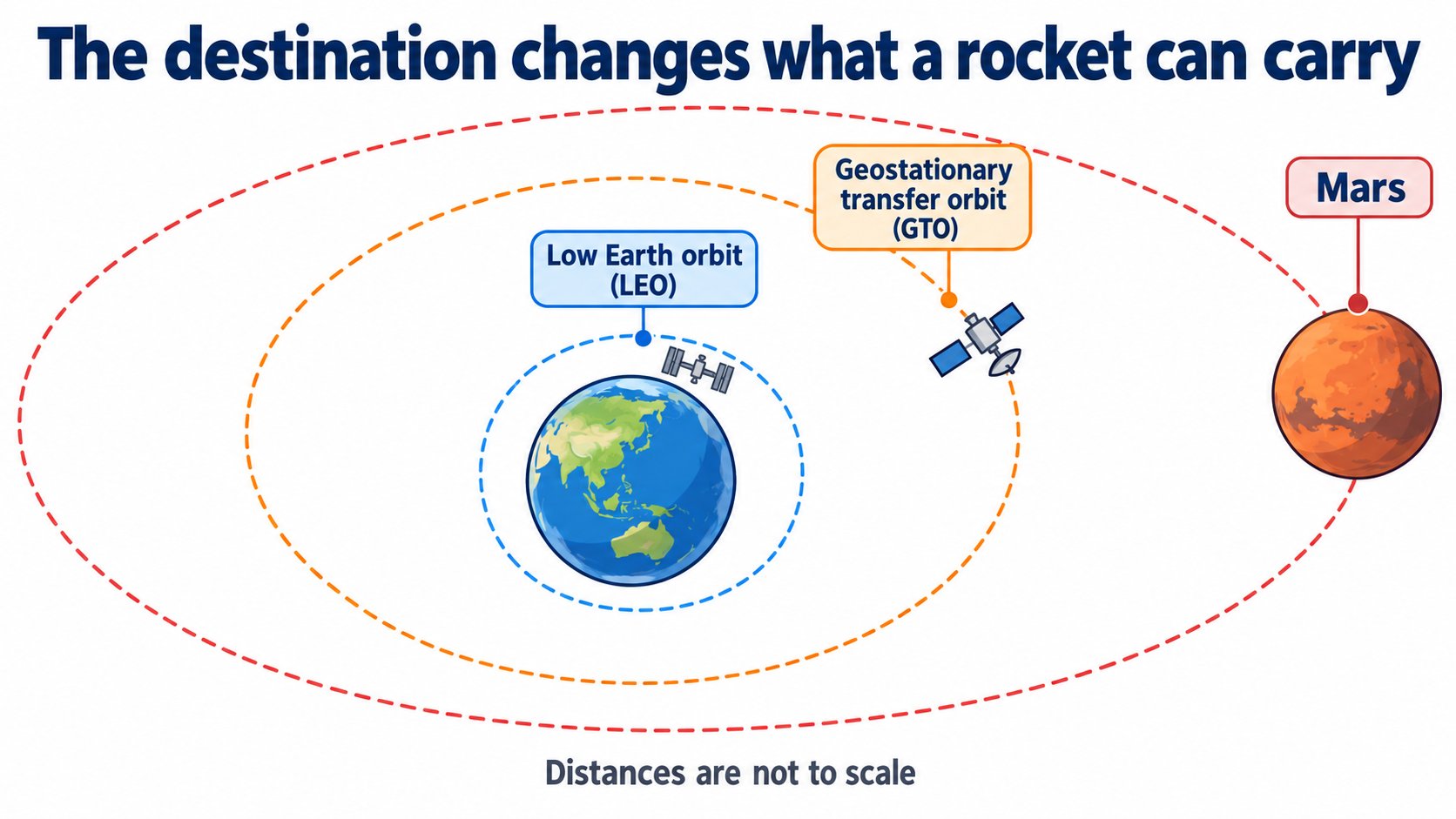
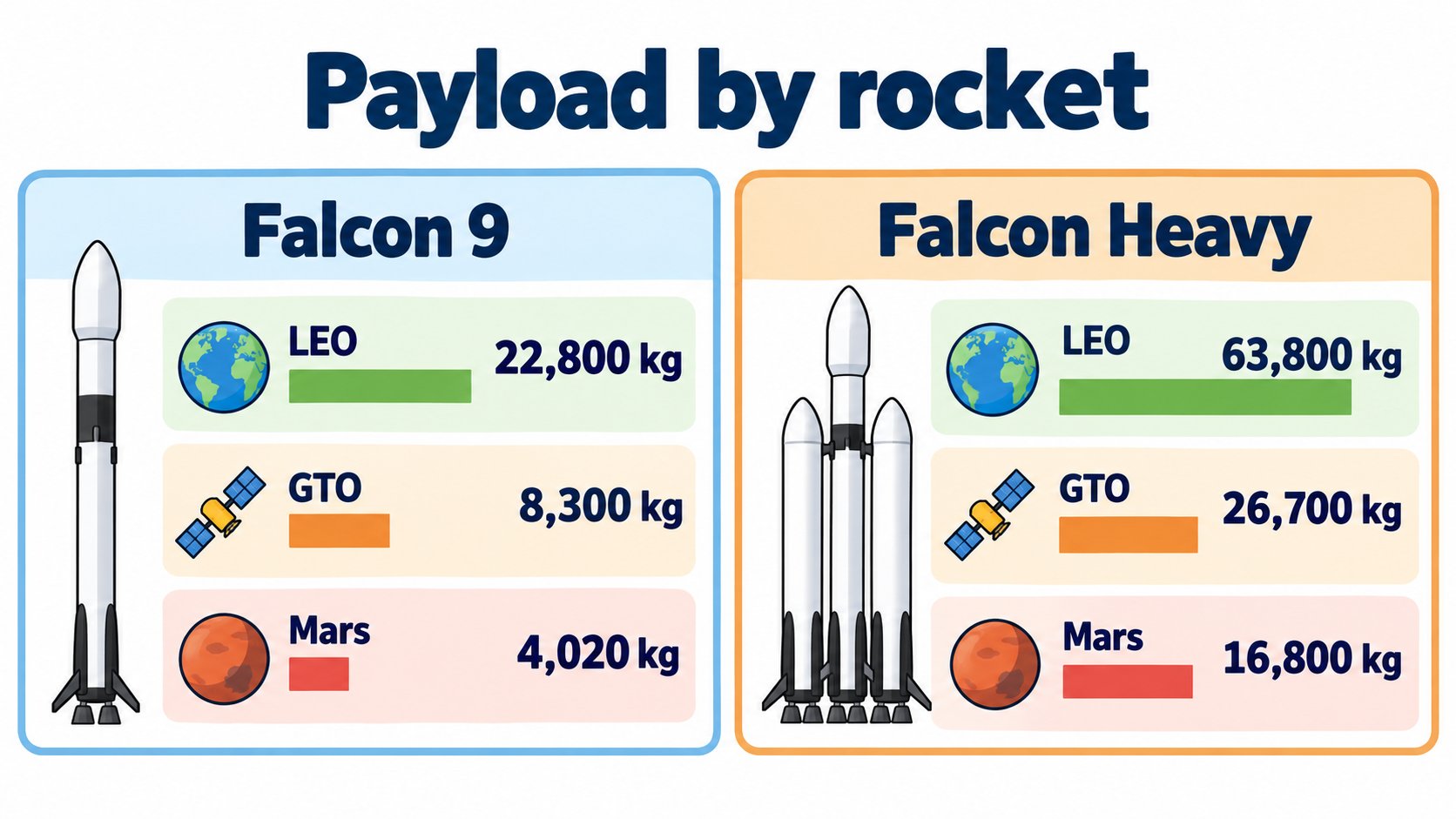
Payload is the mass a rocket can carry, and it changes with the destination orbit. On SpaceX's official pages, Falcon 9 lists 22,800 kg to low Earth orbit (LEO), 8,300 kg to geostationary transfer orbit (GTO) and 4,020 kg to Mars. The same rocket carries less to farther destinations. Falcon Heavy lists 63,800 kg to LEO, about 2.8 times Falcon 9 (our calculation).
The Falcon 9 and Falcon Heavy articles quote "kg to low Earth orbit". Here we explain how to read payload numbers, using SpaceX's official pages (checked 2026-10-16).
The conclusion: the same rocket, different numbers for different destinations
Payload is the mass of cargo (satellites, spacecraft) a rocket can deliver to a target orbit. For the same rocket, the farther the destination, the less it can carry.
[A note for beginners]
- Low Earth orbit (LEO) is an orbit close to Earth. The International Space Station is in this kind of orbit.
- Geostationary transfer orbit (GTO) is an intermediate orbit toward geostationary orbit, where a satellite appears to hang at one point in the sky. Communications satellites often use it.
- Mars payload is the mass that can be sent on a trajectory to Mars.
(General explanations; SpaceX's pages do not define these terms.)
The figures on the official pages
| Rocket | Low Earth orbit (LEO) | Geostationary transfer orbit (GTO) | Mars |
|---|---|---|---|
| Falcon 9 | 22,800 kg | 8,300 kg | 4,020 kg |
| Falcon Heavy | 63,800 kg | 26,700 kg | 16,800 kg |
| Starship | 100+ t (design figure, fully reusable configuration) | (not listed) | (not listed) |
- Dragon is a spacecraft, not a rocket. The page lists "6,000 kg up" and "3,000 kg returned" (Dragon article).
What the numbers show (our calculation)
- For one rocket, the figure drops from LEO to GTO to Mars. For Falcon 9, GTO is about 36% of LEO (8,300 ÷ 22,800) and Mars about 18% (4,020 ÷ 22,800).
- Falcon Heavy carries about 2.8 to 4.2 times as much as Falcon 9 (LEO about 2.8, GTO about 3.2, Mars about 4.2).
[The author's reading, not a confirmed fact]
The generally accepted idea is that reaching farther requires more speed, so the cargo must be lighter. The official pages do not explain the reason.
Cautions when reading the figures
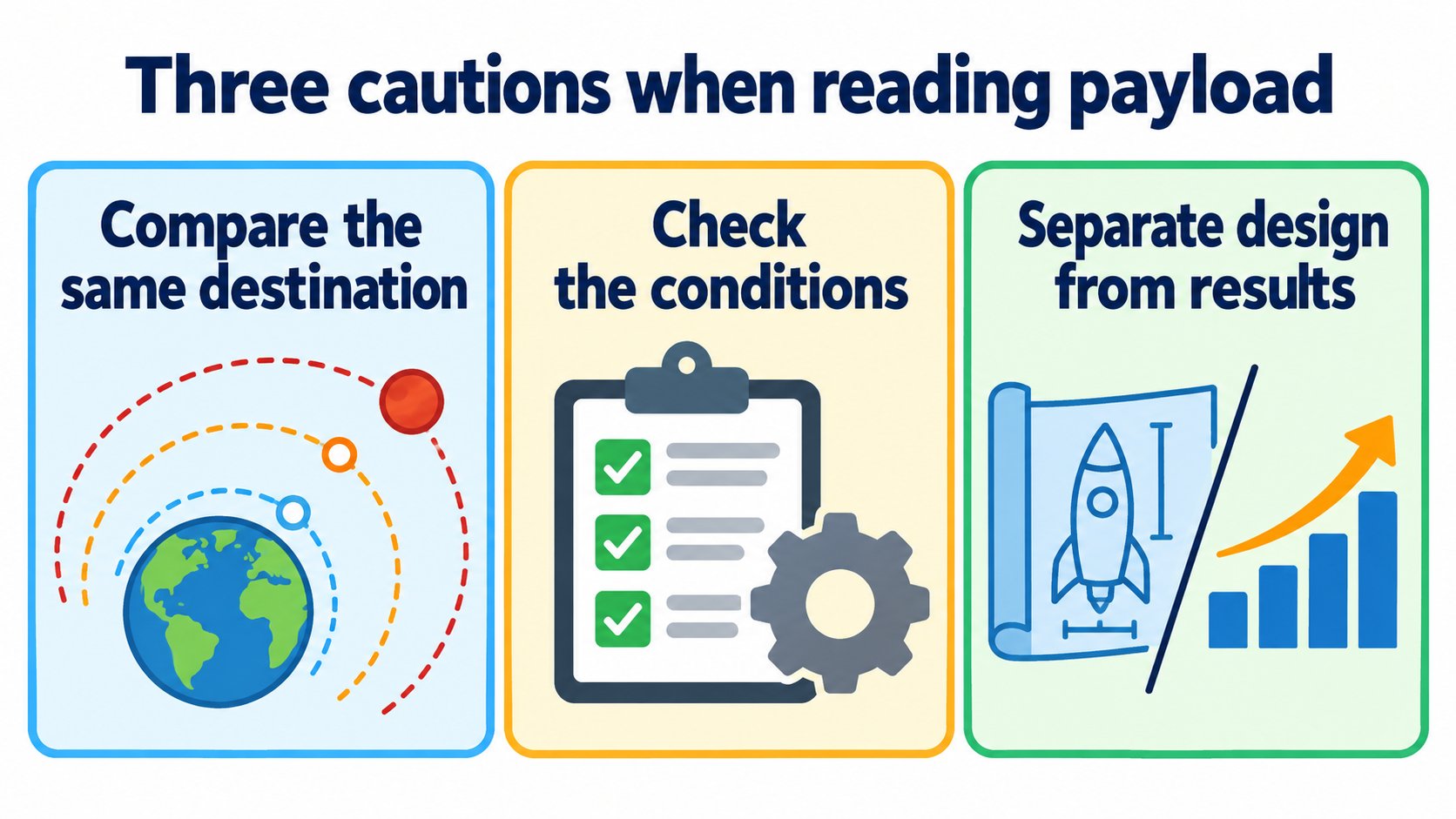
- The pages do not say whether the figures are the same for reuse and for expendable launches. We could not confirm the conditions.
- Starship's "100+ t" is a design figure (fully reusable configuration), not a record (Starship article).
- When comparing rockets, put the same destination side by side.
FAQ
What is payload?
The mass of cargo a rocket can deliver to a target orbit. It differs by destination.
What is the difference between LEO and GTO?
LEO is a low orbit close to Earth; GTO is a farther orbit on the way to geostationary orbit. For the same rocket, GTO payload is smaller (official figures).
How many times Falcon 9 is Falcon Heavy?
About 2.8 times to LEO, about 3.2 to GTO and about 4.2 to Mars (our calculation from the official figures).
Summary
- Payload is a separate number for each destination; farther means smaller.
- Falcon 9: LEO 22,800 / GTO 8,300 / Mars 4,020 kg. Falcon Heavy: 63,800 / 26,700 / 16,800 kg.
- Compare at the same destination. Starship's 100+ t is a design figure.
Sources (checked 2026-10-16)
- SpaceX, "Falcon 9": https://www.spacex.com/vehicles/falcon-9
- SpaceX, "Falcon Heavy": https://www.spacex.com/vehicles/falcon-heavy
- SpaceX, "Starship": https://www.spacex.com/vehicles/starship
- SpaceX, "Dragon": https://www.spacex.com/vehicles/dragon
This article is for learning about science and technology and is not investment advice. Facts and the author's reading are kept separate. The figures are AI-generated illustrations.
Thank you for reading. Was this article useful to you?
Thank you. If you like, tell us what you thought in a line or two.
Optional. No name or email needed.
Received. We will use your words to make better articles.