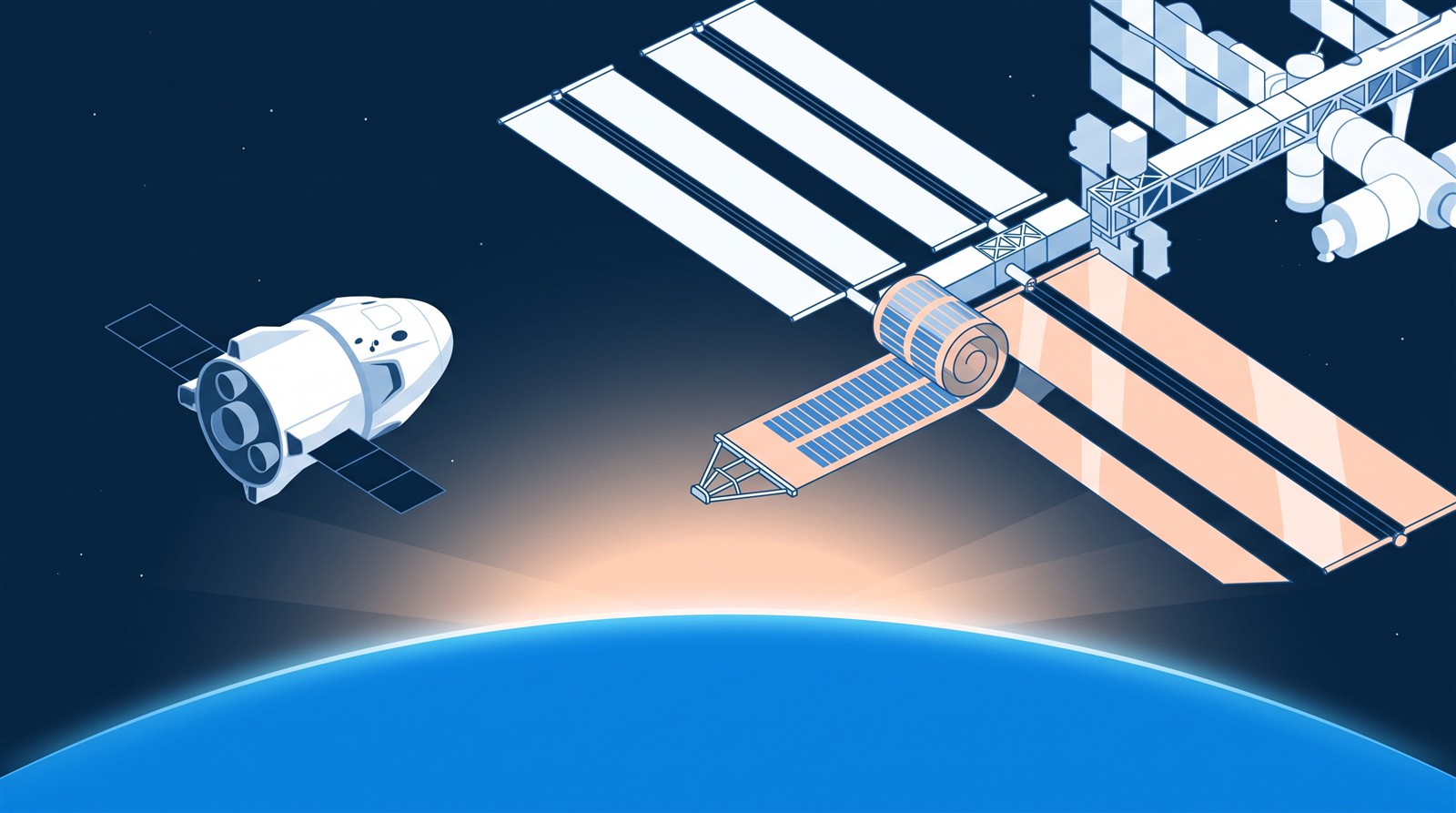
At 10:27 a.m. EDT on October 15, 2026, the CRS-35 cargo Dragon docked with the space-facing port of the ISS's Harmony module. The final pair of ROSA arrays is scheduled to be installed on spacewalks on October 29 and November 5.
In three lines
- On October 15, the CRS-35 cargo Dragon docked with the ISS automatically.
- The last two ROSA (roll-out solar array) wings will first be lifted out by the robotic arm, then installed on spacewalks scheduled for October 29 and November 5.
- Dragon is scheduled to stay until mid-November.
What happened
According to NASA, the CRS-35 cargo Dragon docked automatically with the space-facing port of the ISS's Harmony module at 10:27 a.m. EDT on October 15, about two days after its October 13 launch.
Astronaut Anil Menon then ran pressure and leak checks, opened the hatch and entered Dragon. Jessica Watkins, Luke Delaney and Joshua Kutryk (Canadian Space Agency) followed. As of October 16, five spacecraft were docked at the ISS: two Dragons (CRS-35 and the crewed Crew-13), a Soyuz, and two Progress ships.
How will ROSA be installed?
The last two ROSA wings ride in Dragon's "trunk", the unpressurized cargo section. NASA describes the steps:
- Ground engineers remotely command the Canadarm2 robotic arm to remove them from the trunk.
- They are parked temporarily on logistics platforms on the station's truss (its framework).
- Menon and Kutryk finish the installation on spacewalks scheduled for October 29 and November 5.
Once installed, they are expected to increase the station's power generation. ROSA is a solar array that is rolled up for launch and unrolled in space; the previous article explains how it works.
Much more in the cargo
Dragon carried more than 6,300 pounds (about 2.9 tonnes) of cargo. Besides ROSA, NASA lists materials for these studies:
- Hardware to make artificial retinas in microgravity (research aimed at treating eye disease)
- 3D heart tissue models for large-scale drug testing
- Materials to study how a new kind of glass forms in microgravity
- Brain organoids (clusters of brain cells) to look for treatment targets for Alzheimer's, Parkinson's and multiple sclerosis
The crew moved samples from portable freezers and incubators into the station's science freezers. Protein crystal growth and plant genetic response experiments were planned to start on Friday, October 16, and over the weekend.
Connecting it to what you are learning
"Pack it small, carry it light, unfold it on site" is the idea behind ROSA, and the cargo shows that a rocket is not only a way to carry things: it connects to the places where research happens. For the cost side of rockets, see the articles below.
Read next
Source
- NASA, "SpaceX Dragon Docks with Science Supplies and Roll-Out Solar Arrays" (October 15, 2026) → https://www.nasa.gov/blogs/spacestation/2026/10/15/spacex-dragon-docks-with-science-supplies-and-roll-out-solar-arrays/
- NASA, "Crew Unpacks Dragon and Begins Activating New Science Experiments" (October 16, 2026) → https://www.nasa.gov/blogs/spacestation/2026/10/16/crew-unpacks-dragon-and-begins-activating-new-science-experiments/
- Space.com, "Watch SpaceX deliver more than 6,000 pounds of cargo to the ISS today" (a pre-docking preview) → https://www.space.com/space-exploration/launches-spacecraft/spacex-crs-35-iss-cargo-mission-docking
Verification (2026-10-17): the docking time, the installation steps, the spacewalk dates (October 29 and November 5) and the cargo contents were confirmed only on NASA's two official blog posts (both written by the same agency). No non-NASA report of the completed docking was found. The stay is described as "until mid-November"; no exact departure date is given. The weight is converted from pounds. NASA's October 16 post says the launch was on "Wednesday", but October 13 was a Tuesday; this article uses dates only.
Thank you for reading. Was this article useful to you?
Thank you. If you like, tell us what you thought in a line or two.
Optional. No name or email needed.
Received. We will use your words to make better articles.