A single reduction gear (9.03:1 in the Model 3) slows the motor's rotation to about one-ninth and raises the turning force (torque) about nine times. A differential then lets the left and right tires turn at different speeds in a corner, and passes the force to the tires.
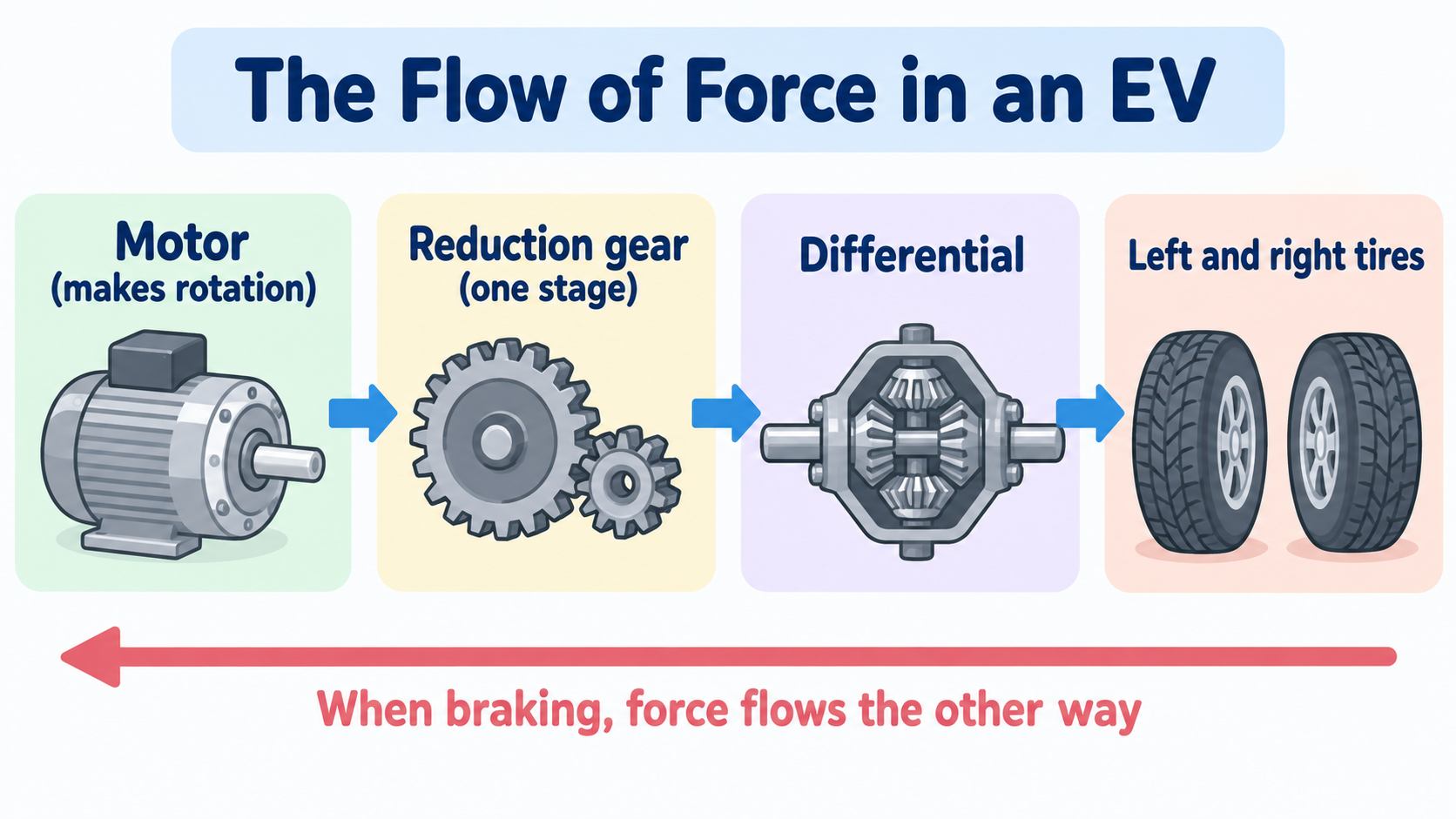
Last time we followed the flow of electricity from the battery to the motor. This time we follow the flow of force: how the rotation the motor makes reaches the tires.
The conclusion: motor → reduction gear → differential → tires
The flow of force can be told with three parts.
- Motor: makes rotation from electricity.
- Reduction gear: slows the rotation and increases the turning force.
- Differential: lets the left and right tires turn at different speeds.
The U.S. DOE's AFDC describes an EV's transmission as the part that transfers mechanical power from the electric traction motor to drive the wheels.
1. The reduction gear: slow the rotation, increase the force
Tesla's Model 3 manual (Singapore edition) says the following.
| Item | Content |
|---|---|
| Transmission | Single speed fixed gear |
| Gearbox ratio | 9.03:1 |
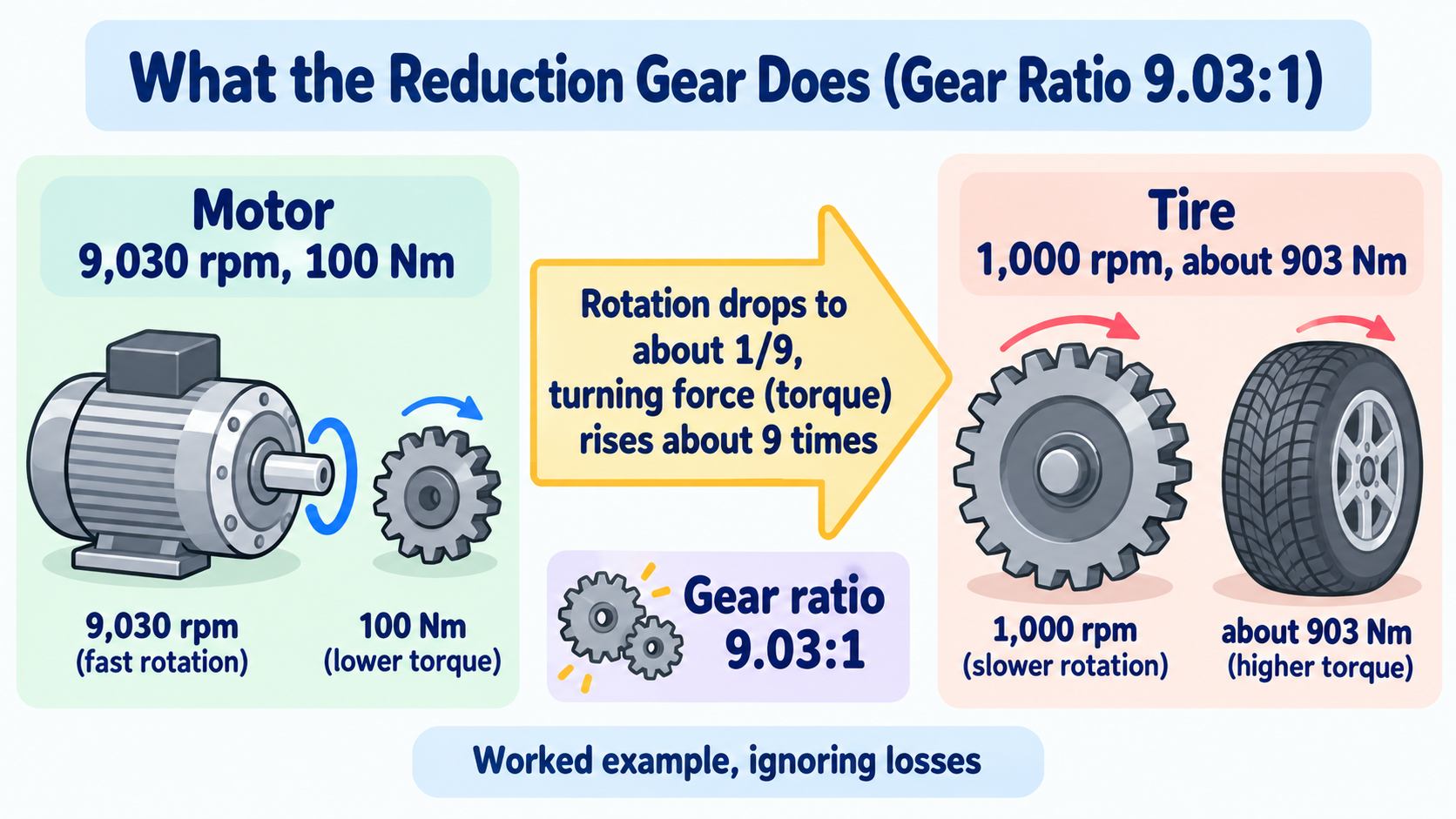
A ratio of 9.03:1 means that while the motor turns 9.03 times, the tire turns once.
How rotation and force change
The engineering magazine Gears Magazine explains it this way. The total gear ratio is the product of the ratios of every stage. And multiplying the power source's torque by the total gear ratio gives the torque at the wheels.
Torque is the "turning force." Ignoring losses, with gear ratio R, it goes like this (these formulas are general physics).
- Tire rotation = motor rotation ÷ R
- Tire torque = motor torque × R
A worked example (made up by the author; not figures of a real car):
| Motor | Tire (R = 9.03) | |
|---|---|---|
| Rotation | 9,030 rpm | 1,000 rpm |
| Torque | 100 Nm | about 903 Nm |
The rotation drops to about one-ninth, and in exchange the turning force becomes about nine times larger.
Why one gear is enough
A gasoline car switches among many gears, because an engine can produce force only over a narrow range of rotation speeds (a general explanation).
An EV's motor can produce force from a standstill. Using the Chevy Bolt EV (with one gear) as an example, Gears Magazine explains that the motor's torque stays about constant from a stop up to about 6,000 rpm, and then gradually falls. And because a single gear's ratio does not change, the wheel torque simply follows the motor torque.
So because the motor delivers force over a wide range, many gear steps are not needed (this is a general reason based on Gears Magazine's explanation, not figures for the Model 3).
On the other hand, because the ratio is fixed, the motor's rotation-speed limit sets the top speed. Some EVs, such as the Porsche Taycan, are said to use a two-speed transmission (we have not checked primary sources for this in this article).
2. The differential: let the left and right tires turn at different speeds in a corner
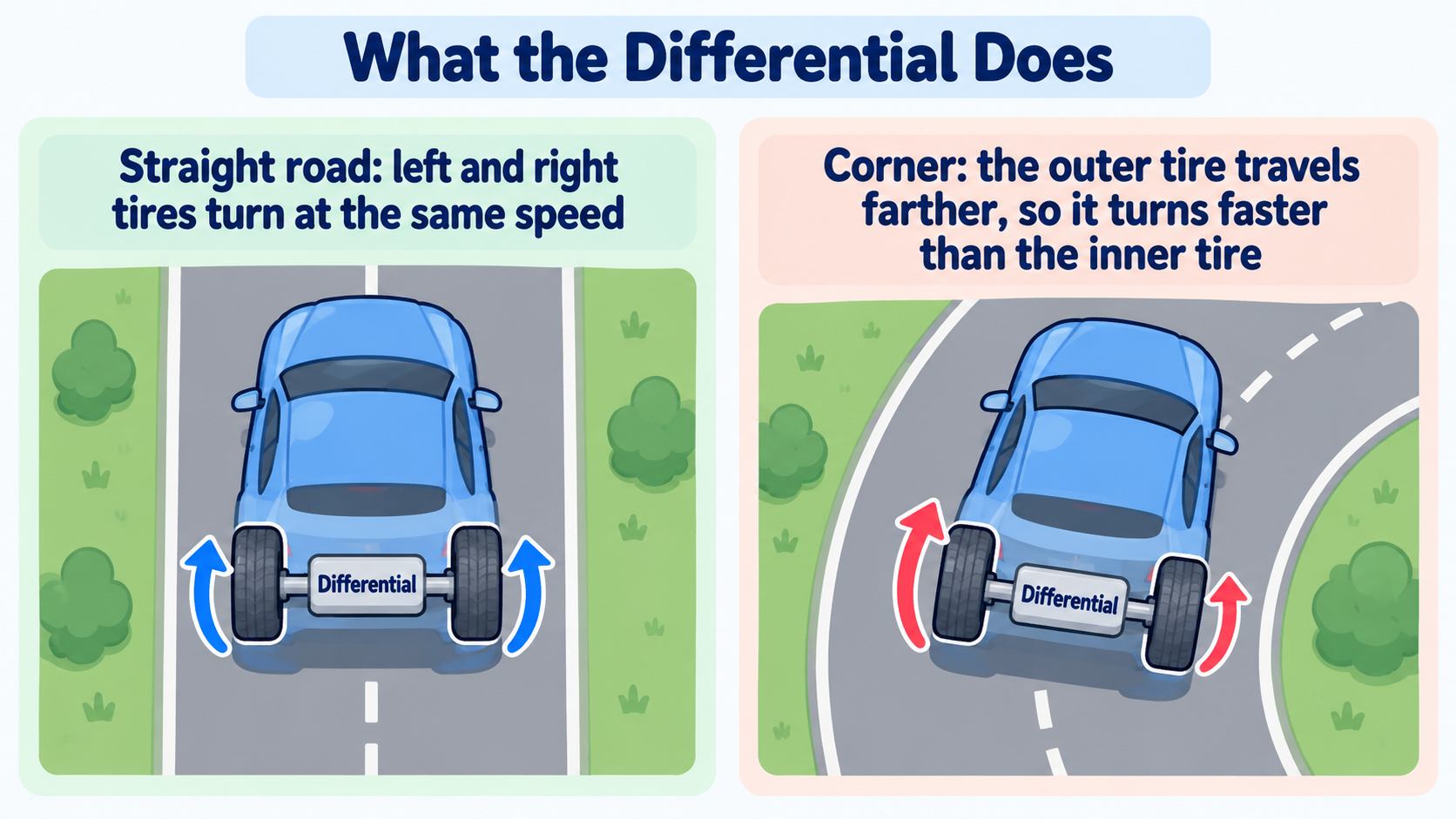
When a car goes around a corner, the outer tire travels farther than the inner tire. To cover a longer distance in the same time, the outer tire has to turn faster.
Britannica describes the differential gear like this: an arrangement that lets the power be passed to a pair of driving wheels, dividing the force equally between them while letting them follow paths of different lengths. On a straight road the wheels rotate at the same speed; in a corner, the outside wheel turns faster than the inner one.
If there were no differential and the left and right sides were locked together, one tire would be dragged in a corner (this is a general explanation).
We could not confirm the Model 3's differential's detailed structure (such as the type of gears) in this article.
3. Rear-wheel drive and all-wheel drive
What the Model 3 manual confirms is the following.
- Rear motor: permanent magnet synchronous motor.
- Front motor (AWD cars): induction motor.
So an all-wheel-drive (AWD) car has motors at both the front and the rear. It is natural to think a rear-wheel-drive (RWD) car has only the rear motor, but we have not confirmed each trim's configuration in this article.
We also could not confirm how force is split between front and rear in AWD.
4. When braking: force flows the other way
When braking, the flow of force reverses. The tires' rotation turns the motor through the reduction gear, and the motor becomes a generator. The electricity it makes goes through the inverter back to the battery (see the previous article).
Tesla's manual says this regenerative braking is operated by the accelerator pedal. When you ease off the pedal, regenerative braking applies.
Because the reduction gear connects the motor and the tires directly, the tires' rotation seems to pass straight to the motor when braking. With no clutch or torque converter in between, as in a gasoline car, this reverse flow seems easy to arrange. But this is my guess, not a confirmed fact.
FAQ
Is the Model 3's 9.03:1 the same on every car?
We have not confirmed it. This is the number in the manual we checked (the Singapore edition). Tesla sometimes changes configurations by model year, trim and region.
Do EVs really have only one gear?
For the Model 3, the manual confirms a single fixed gear. Some other cars are said to have two, but we have not confirmed that in this article.
Do EVs have a differential?
A differential is a general mechanism that lets the left and right wheels travel different distances (Britannica). We have not confirmed the Model 3's differential type in this article.
Does the reduction gear cause losses?
This article's worked example ignores losses. We have not confirmed the size of real losses.
Summary
- The flow of force is motor → reduction gear → differential → tires. When braking, it reverses.
- The Model 3 has a single fixed gear with a ratio of 9.03:1 (manual, Singapore edition).
- With gear ratio R, rotation becomes 1/R and torque becomes R times (a general relation that ignores losses; the same idea as in Gears Magazine's explanation).
- The differential lets the outer tire turn faster in a corner (Britannica).
- The Model 3's motors: rear = permanent magnet synchronous, front (AWD) = induction (manual).
- Regenerative braking is operated by the accelerator pedal (manual).
- The detailed type of differential and the front-rear force split are unconfirmed.
Next: we will go through "the flow of heat: cooling and warming," one of the EV's big challenges, in order (coming soon).
Sources (checked 2026-10-13)
- Tesla, "Model 3 Owner's Manual: Subsystems" (Singapore edition): https://www.tesla.com/ownersmanual/model3/en_sg/GUID-E414862C-CFA1-4A0B-9548-BE21C32CAA58.html
- Britannica, "differential gear": https://www.britannica.com/technology/differential-gear
- Gears Magazine, "The Teacher's Corner" (electric motor torque and total gear ratio, August/September 2025): https://gearsmagazine.com/magazine/electric-motor-torque-total-gear-ratio/
- U.S. Department of Energy, Alternative Fuels Data Center, "How Do All-Electric Cars Work?": https://afdc.energy.gov/vehicles/how-do-all-electric-cars-work
This article is for learning about science and technology, and is not investment advice. Facts and the author's interpretation are kept separate. Figures are AI-generated illustrations.