An EV's battery cannot deliver its full performance when it is too cold or too hot. So coolant is circulated to cool the battery and motor, and in cold weather they are warmed. According to a U.S. Department of Energy page, using the heater on a cold day can cut an EV's range by up to 41%.
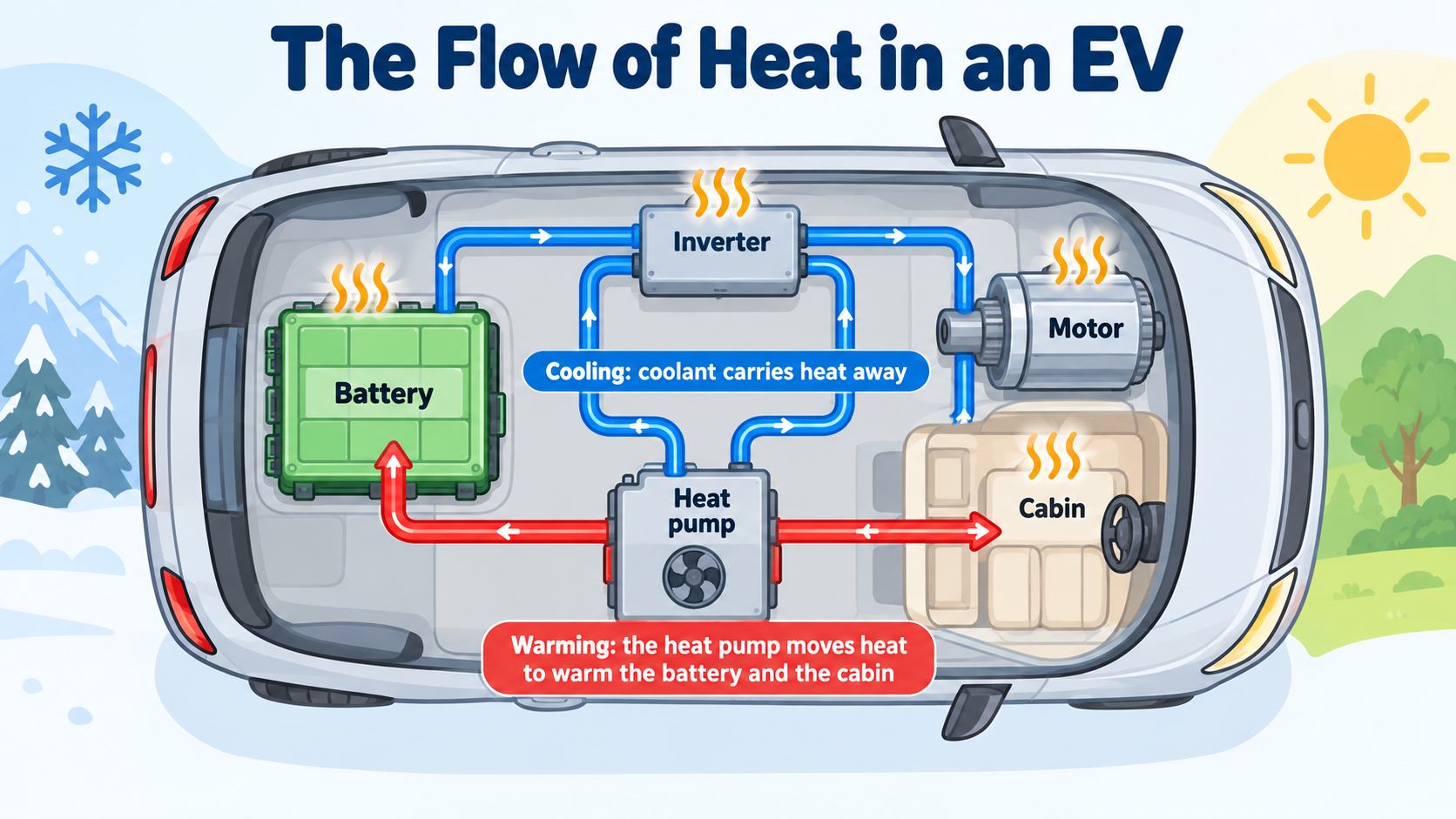
So far we have looked at the flow of electricity and the flow of force. This time we look at the third flow, the flow of heat.
A gasoline car can use the large amount of heat its engine gives off to warm the cabin. An EV cannot. How to cool and how to warm becomes one of the EV's big challenges.
The conclusion: a battery needs warming as well as cooling
The EV's heat story has two parts.
- Cooling: the battery, motor and inverter give off heat when they run. Coolant is circulated to keep them at a suitable temperature.
- Warming: a battery cannot deliver its full force when it is too cold. In cold weather, the battery and the cabin are warmed.
The U.S. DOE's AFDC describes an EV's "thermal system" as keeping the motor, power electronics and other parts within a proper operating temperature range.
1. Cooling: coolant carries the heat away
Here is what can be confirmed in Tesla's Model 3 manual (Singapore edition).
| Part | Cooling |
|---|---|
| High-voltage battery | Liquid-cooled |
| Rear motor | Liquid-cooled |
| Front motor (AWD cars) | Liquid-cooled |
For each part, heat is carried away by a liquid coolant.
Why cool it?
On battery temperature, a Loughborough University paper (Energies, 2022) cites other studies saying that lithium-ion cells show the least degradation when used at 15–35 °C. If it gets too hot, the battery is more easily damaged.
2. Warming: what happens in the cold
It may seem surprising, but for an EV, warming is just as important.
When the battery is cold
Tesla's manual, "Cold Weather Best Practices," says the following.
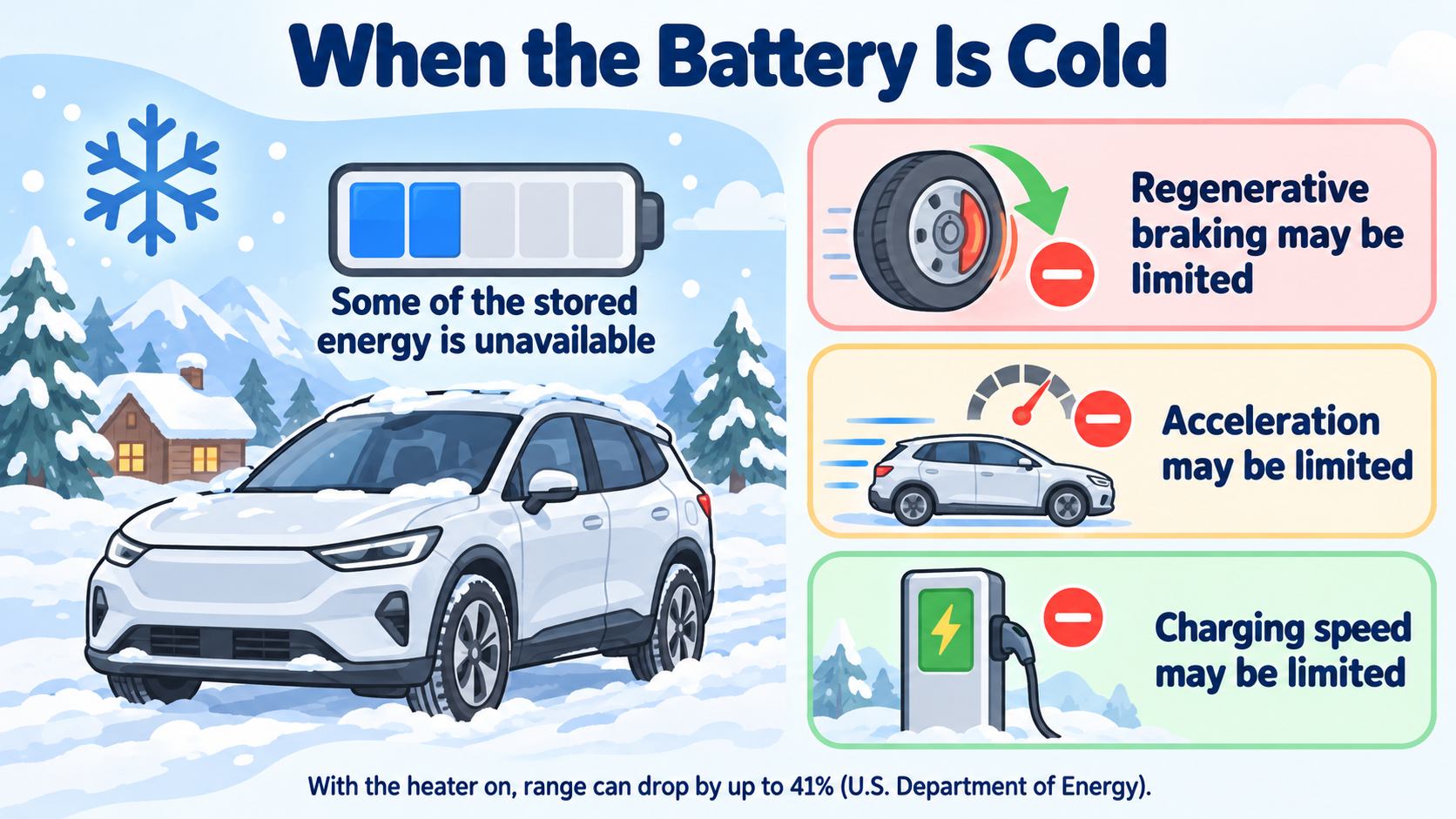
- When the battery is cold, some of the stored energy becomes unavailable. A blue snowflake icon appears on the screen.
- At this time, regenerative braking, acceleration and charging rates may be limited. When the battery is warm enough, the icon disappears.
- Regenerative braking can be limited if the battery is too cold. As you keep driving and the battery warms up, the regenerative power increases.
How much does range fall?
The U.S. DOE's FuelEconomy.gov gives estimates based on a 2019 AAA study.
| Condition | Figure |
|---|---|
| When the heater is used | Range can drop by up to 41% |
| When the heater is not used (20°F compared with 75°F) | Fuel economy is 8% lower and range is about 12% lower |
The same page also says that about two-thirds of the extra energy used goes to heating the cabin.
So the drop in range on a cold day can be read as heating the cabin mattering more than the battery's performance falling (this is my reading of the page's numbers).
Cold-weather tips (from the official sources)
Tesla's manual and FuelEconomy.gov recommend similar steps.
- Warm the car and battery before you drive: use Schedule (setting a departure time) or the app's Climate. Warming the cabin also warms the high-voltage battery as needed. Doing it while plugged in avoids using the battery's electricity.
- Use the seat heaters: they use less energy than the cabin heater.
- When charging, navigate to the charging location: the Model 3 pre-heats the battery so it is at the best temperature on arrival. Tesla recommends using it for at least 30–45 minutes before arrival.
3. How is heat made? The heat pump
An EV's heating cannot use waste heat thrown off by an engine. What is used instead is the heat pump.
A heat pump does not make heat; it moves it. It uses an air conditioner's cooling mechanism in reverse to move heat from the outside air or from parts into the cabin or the battery (this is a general explanation).
Tesla has cars with a heat pump and cars without one. Tesla's manual says you can check whether your car has a heat pump under Controls > Software > Additional Vehicle Information. It also explains that on cars with a heat pump, odorless steam can come from the front while charging at a Supercharger in cold weather (this is normal).
4. The Octovalve: one valve switches where the coolant goes
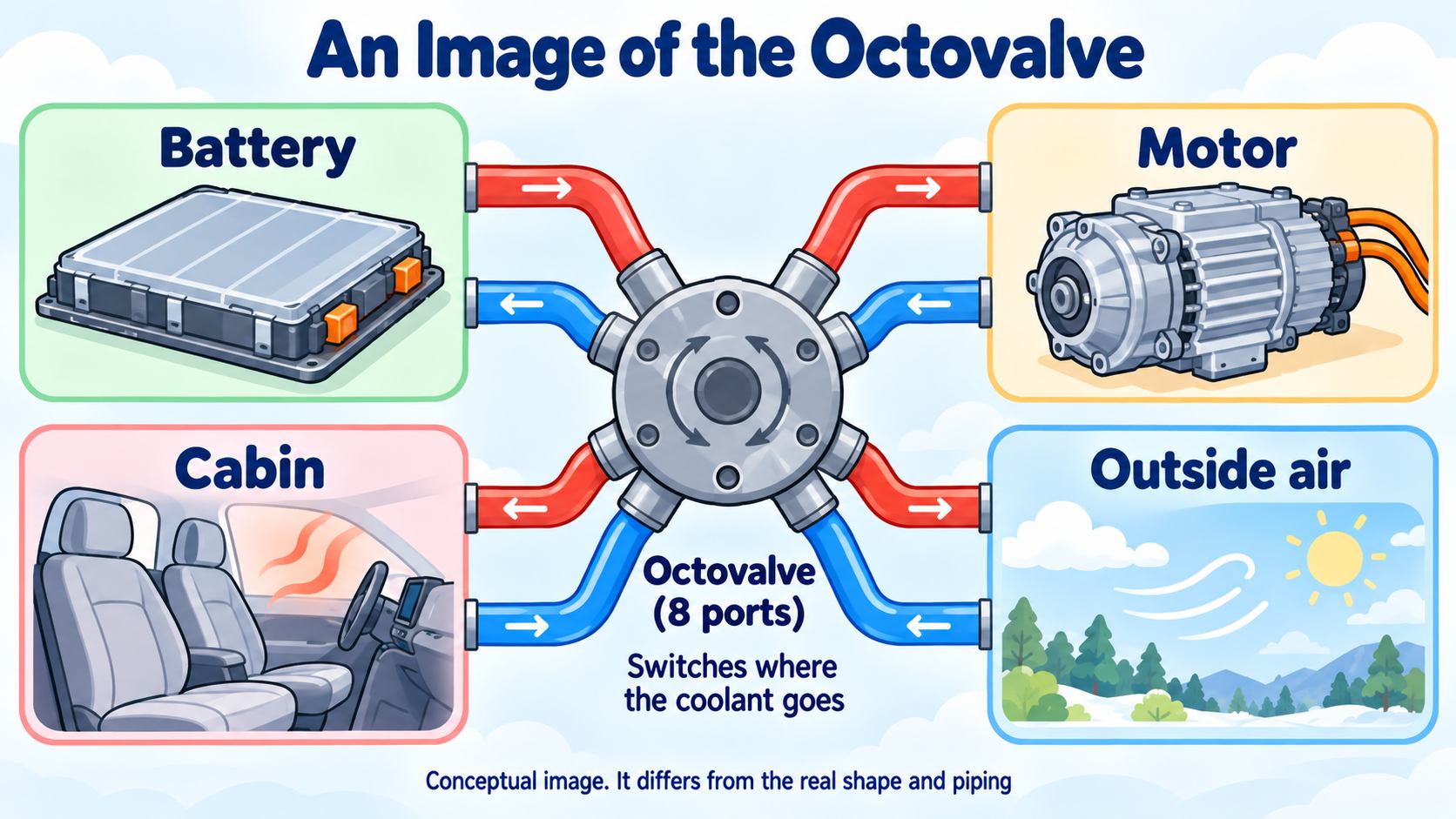
In the Tesla Model Y, a valve called the Octovalve is at the center of heat management.
Based on Tesla's patent, the Loughborough University paper explains it this way.
- One heat pump acts on both the cabin and the coolant, linking the two.
- A rotary valve with eight ports can send coolant through five different loops (the patent's figure shows four loops).
- Heat can move among the cabin, the powertrain and the outside air.
The paper compares this system with an ordinary EV's waste-heat recovery in simulation. Its abstract says the system greatly reduces energy consumption and battery load during warm-up, but the warm-up takes longer.
There are some cautions.
- The CT scan of the production part that the paper cites was released by Sandy Munro (a third party). According to it, the production valve has only four states, which does not match the patent's number of states. The paper also says the patent and the production system "operate largely the same."
- We could not confirm any official Tesla document that explains the Octovalve.
- There are reports that range "grew 10%," but we could not confirm the original, so we do not state it.
According to the paper, EVs throw off little waste heat, so collecting and using heat without wasting it seems to matter more. The Octovalve looks like a device that switches destinations finely for that purpose. But this is my understanding based on the paper and the patent, not Tesla's official explanation.
FAQ
Does an EV's range really fall in the cold?
According to the U.S. DOE page, yes: up to 41% with the heater, and about 12% even without it (estimates based on a 2019 AAA study). It varies by car and conditions.
Why is regenerative braking weaker in the cold?
Tesla's manual says regenerative braking may be limited when the battery is cold. We could not confirm a detailed explanation of the reason.
Does the Model 3 have an Octovalve too?
We could not confirm it. The paper in this article is about the Model Y.
How many minutes slower is fast charging in the cold?
We could not confirm a specific time. Tesla explains that navigating to a charging location pre-heats the battery and shortens charging time.
Summary
- The EV's heat story has two parts: cooling and warming. The battery, motor and inverter are liquid-cooled (Model 3 manual).
- Lithium-ion cells show the least degradation at 15–35 °C (the paper, citing other studies).
- When the battery is cold, some stored energy is unavailable, and regenerative braking, acceleration and charging rates may be limited (Tesla's manual).
- With the heater, range can drop by up to 41%, and about 12% even without it (FuelEconomy.gov, an estimate based on a 2019 AAA study). About two-thirds of the extra energy goes to cabin heating.
- A heat pump does not make heat but moves it. Some cars have one and some do not (manual).
- Octovalve (Model Y): an eight-port rotary valve that can send coolant through five loops (patent, paper). Official explanation unconfirmed.
Next: we will go through the EV's eyes and brain, the "flow of information: cameras → computer," in order (coming soon).
Sources (checked 2026-10-14)
- Tesla, "Model 3 Owner's Manual: Cold Weather Best Practices" (Singapore edition): https://www.tesla.com/ownersmanual/model3/en_sg/GUID-F907200E-A619-4A95-A0CF-94E0D03BEBEF.html
- Tesla, "Model 3 Owner's Manual: Subsystems" (Singapore edition): https://www.tesla.com/ownersmanual/model3/en_sg/GUID-E414862C-CFA1-4A0B-9548-BE21C32CAA58.html
- FuelEconomy.gov (U.S. Department of Energy and Environmental Protection Agency), "Fuel Economy in Cold Weather": https://fueleconomy.gov/FEG/coldweather.shtml
- U.S. Department of Energy, Alternative Fuels Data Center, "How Do All-Electric Cars Work?": https://afdc.energy.gov/vehicles/how-do-all-electric-cars-work
- Alex Wray and Kambiz Ebrahimi (Loughborough University), "Octovalve Thermal Management Control for Electric Vehicle" (Energies 15(17), 6118, August 23, 2022): https://doi.org/10.3390/en15176118
This article is for learning about science and technology, and is not investment advice. Facts and the author's interpretation are kept separate. Figures are AI-generated illustrations.