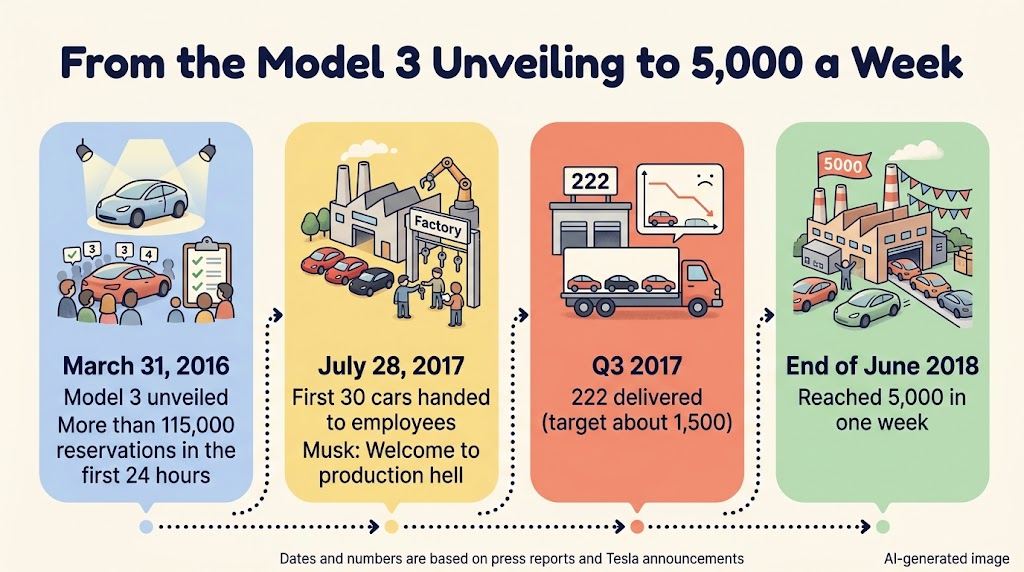
Tesla unveiled the Model 3 on March 31, 2016, and gathered more than 115,000 reservations in the first 24 hours. But in the third quarter of 2017 it could deliver only 222. The battery-module assembly line at Gigafactory 1 was the biggest constraint. In the last week of June 2018, it is reported to have finally reached 5,000 a week.
Reservations passed half a million. And yet the number of cars that reached customers' hands in one quarter was 222.
This article is about what came after, at Tesla. In the previous articles, Tesla got through the 2008 crisis and brought the luxury electric sedan Model S into the world. The next challenge was building a cheaper electric car in enormous numbers. That was the Model 3.
This article follows 2016 to 2018.
March 31, 2016: the Model 3 is unveiled
On March 31, 2016, Musk unveiled the Model 3 at Tesla's design studio in Hawthorne, California (Associated Press).
- The reservation deposit was $1,000.
- The base model is known as a $35,000 car (a later AP article refers to "the $35,000 base model"). Musk estimated the typical sale price with options at about $42,000.
- Reservations were more than 115,000 in the first 24 hours. By Friday morning, Musk said, they had reached 180,000.
- The car would not be available until late 2017 at the earliest.
The Model S was a luxury car made in small numbers. The Model 3 is a car at a price ordinary people can pay, made in the hundreds of thousands. This is where Tesla's real difficulty begins.
July 28, 2017: the first 30 cars, and "production hell"
On July 28, 2017, at its factory in Fremont, California, Tesla handed over the first 30 Model 3s to employee buyers.
That day, according to a wire-service report, Musk said the following.
"Welcome to production hell." "That is where we are for at least six months."
(Original: "Welcome to production hell" / "That is where we are for at least six months." A wire-service report carried by the Gulf Times.)
According to the same report, the outlook Musk gave was as follows.
- 100 in August; 1,500 or more in September.
- 5,000 a week within the year; 10,000 a week in 2018.
- More than 500,000 reservations.
Reservations overflowing. But the ability to build did not reach that far.
Third quarter of 2017: 222 deliveries
Then the real numbers came out.
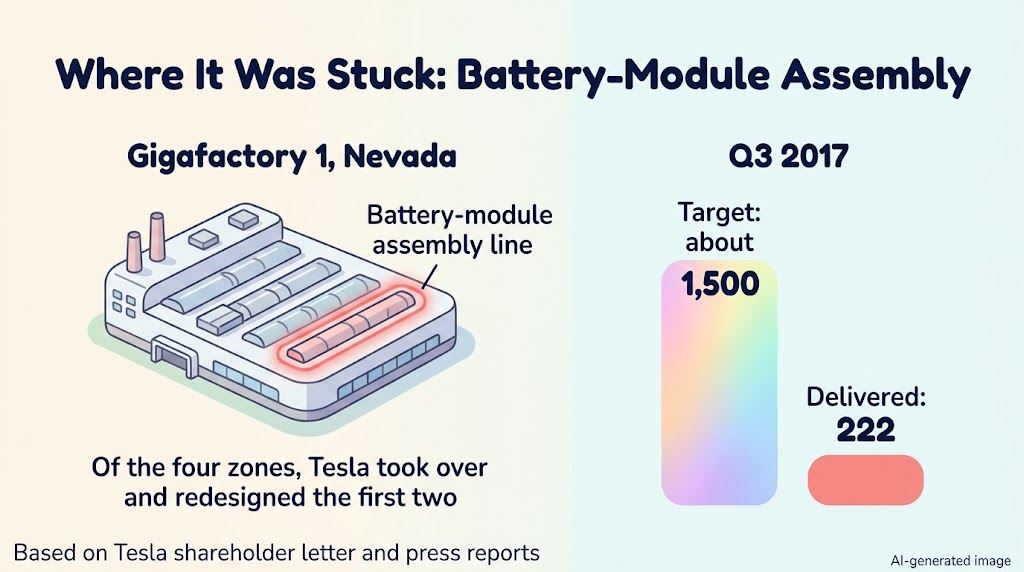
According to Tesla's shareholder letter (November 2017), Tesla delivered 222 Model 3s in the third quarter of 2017. Tesla's total deliveries that quarter were 26,137. The target is reported to have been about 1,500 (TechCrunch).
Why was it short? The biggest constraint the letter named was the battery-module assembly line at Gigafactory 1 in Nevada.
- It is the work of grouping battery "cells" into "modules." A Model 3 battery pack holds four modules.
- The line had four zones. It was originally built by a supplier, but Tesla had to take over the first two zones and redesign them.
- The letter also explains that the Model 3 process is far more automated than other cars, which made the ramp-up harder.
Tesla pushed its 5,000-a-week target back to around the end of the first quarter of 2018. The letter also says that output might grow in "large forward jumps" from week to week.
On the earnings call, Musk said, in effect, that he moves himself to wherever the biggest problem is (TechCrunch).
End of June 2018: under the tent
Now we jump ahead to the middle of 2018.
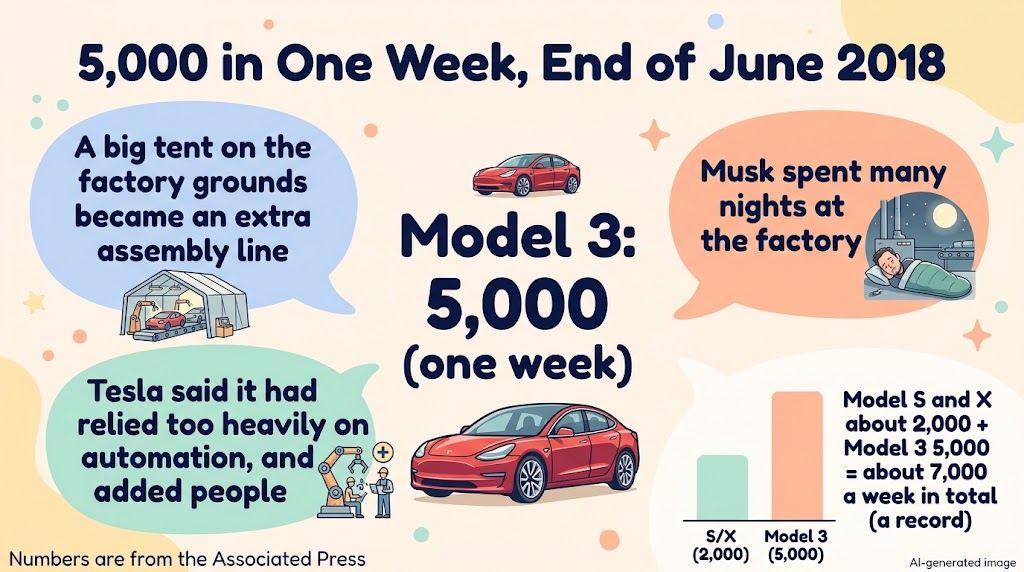
The Associated Press on July 1, 2018, reported that Musk announced Tesla had built 5,000 Model 3s in the last week of June. Musk emailed employees and wrote, in effect, "We did it!" and "I think we just became a real car company." (Electrek reported it, and the AP writes that Tesla confirmed it was authentic.)
As things behind this achievement, the AP lists the following.
- As an extra assembly line, Tesla put up a large tent on the Fremont factory grounds.
- Musk spent many nights at the factory.
- Musk told investors that Tesla had relied too heavily on automation, and that it needed to add people.
In the same week, Model S and Model X production was about 2,000 combined. Overall, it was 7,000 vehicles a week, a record.
"Having reservations pour in" and "building many at an ordinary price" are completely different kinds of difficulty. As with the failed rocket landings we saw, it looks as if time passed in which causes were found and fixed one by one. But I have not confirmed how it actually proceeded inside Tesla.
What was still left after "we did it"
The AP article also notes that it was not all celebration.
- An analyst said that hitting the number once is not enough; what matters is whether it can be sustained with quality.
- At that time, Tesla was selling versions priced from $49,000 to over $70,000, not the $35,000 base model. It had about 450,000 reservations around April, the AP writes.
So 5,000 a week was one summit. But the road to a Model 3 at a price ordinary people could pay still had some way to go.
FAQ
Did Musk first use the phrase "production hell"?
A wire-service report says Musk used the phrase at the July 28, 2017 handover event. Whether he used it earlier is not confirmed in this article. The wording differs slightly between reports.
Is 222 the number built or delivered?
What we could confirm in Tesla's shareholder letter is 222 delivered. The production count is not given in the letter (some reports mention 260, but we could not confirm it in this article's sources).
Did 5,000 a week continue afterward?
This article does not confirm it. The AP conveys an analyst's view that what matters is whether it can be sustained, not a single achievement.
Summary
- March 31, 2016: the Model 3 is unveiled. A $1,000 deposit. More than 115,000 reservations in the first 24 hours (AP).
- July 28, 2017: the first 30 cars handed to employees. Musk says, "Welcome to production hell. At least six months."
- Third quarter of 2017: 222 delivered (target about 1,500). The biggest constraint was the battery-module assembly line at Gigafactory 1 (Tesla's letter).
- Last week of June 2018: 5,000 a week reached (AP). A tent line and more workers helped.
- Even after that, the $35,000 base model had not yet come out (AP).
The history section pauses here for now. Next, as a continuation of Part 1, we take apart "Is a rocket really expensive?" from first principles (coming soon).
Sources (checked 2026-10-13)
- Associated Press (via Vnews), "Orders for lower-priced Tesla hit 198,000" (April 2, 2016, the Model 3 unveiling): https://vnews.com/2016/04/02/news-business-orders-for-lower-priced-tesla-hit-198-000-1293930/
- Gulf Times (wire report), "Tesla begins to deliver its Model 3 electric cars for the masses" (July 2017, the first 30 cars): https://www.gulf-times.com/story/558289/tesla-begins-to-deliver-its-model-3-electric-cars-for-the-masses/amp
- Tesla shareholder letter (third quarter of 2017, filed with the SEC): https://www.sec.gov/Archives/edgar/data/0001318605/000156459017020822/tsla-ex991_6.htm
- TechCrunch, "Tesla predicts production rate of 5K Model 3 cars per week by late Q1 2018" (November 1, 2017): https://techcrunch.com/2017/11/01/tesla-predicts-production-rate-of-5k-model-3-cars-per-week-by-late-q1-2018
- Associated Press (via HeraldNet), "CEO Musk: Tesla hits weekly goal of making 5,000 Models 3s" (July 1, 2018): https://www.heraldnet.com/?p=614326
This article is for learning about science, technology and corporate history, and is not investment advice. Facts and the author's interpretation are kept separate. Figures are AI-generated illustrations.