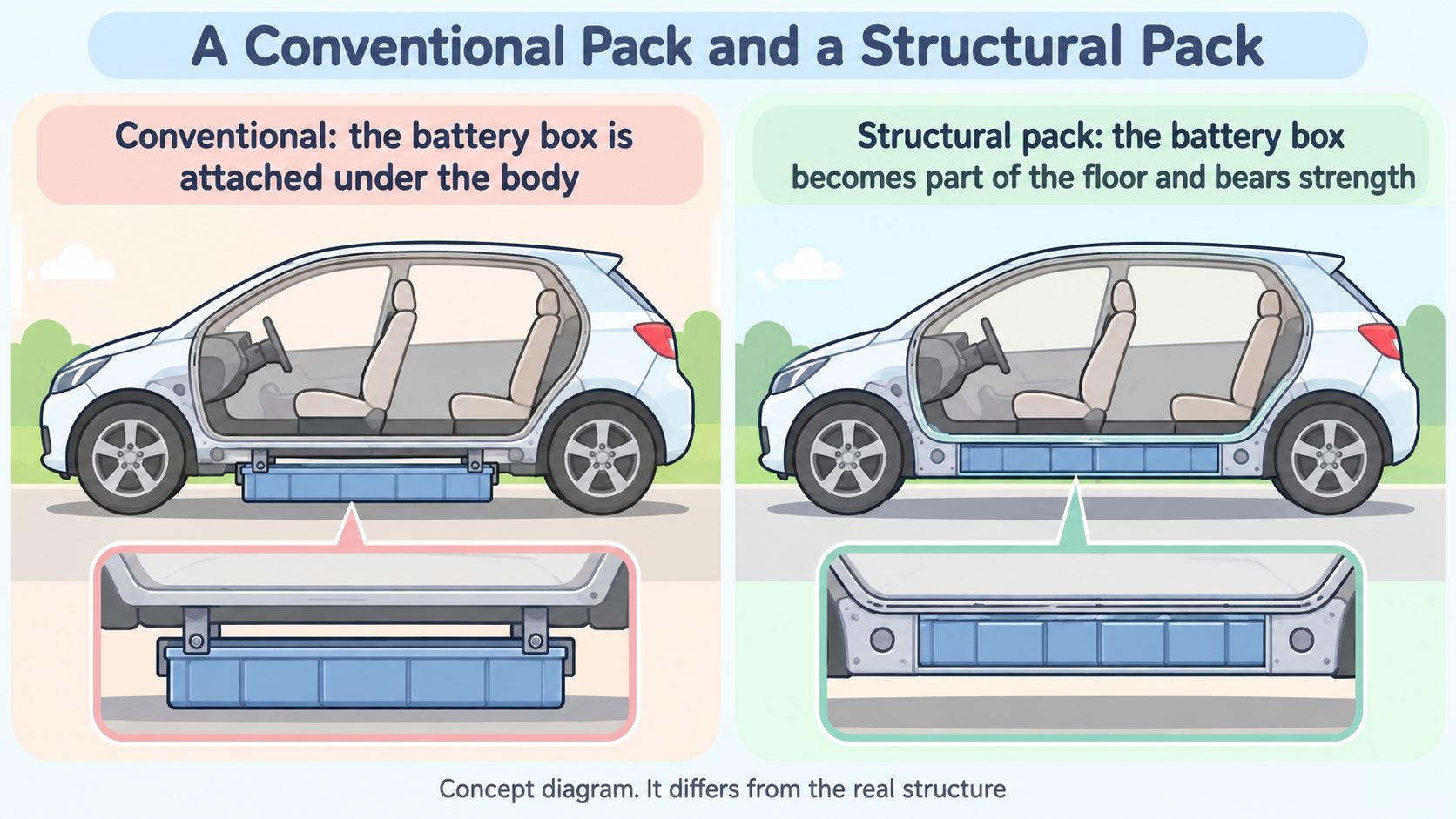
A structural battery pack is a battery box that is part of the car's floor and bears some of the body's strength, instead of hanging under the body. Tesla's patent US11962030B2 (granted April 16, 2024) says the pack "may be formed and used as part of the structural support for a vehicle frame." But we could not confirm the original text of the Battery Day materials, or any comparison of how easy it is to repair.
In Episode 6 we gave only an outline of "making the battery the car's frame." In this article we look at how it works in more detail, checking against Tesla's patents.
The conclusion: the battery box becomes part of the car's floor
A conventional pack is a box of batteries attached under a finished body. The body is strong even without the battery.
In a structural battery pack, the pack itself is part of the car's floor and bears some of the strength. A report (TechCrunch, September 22, 2020) says Tesla explained that the battery would also serve as structure, making the body very stiff while improving efficiency.
What Tesla's patent says
We checked Tesla's U.S. patent US11962030B2, "Integrated energy storage system," on Google Patents.
| Item | Content |
|---|---|
| Applicant | Tesla Inc |
| Granted | April 16, 2024 |
| Priority date | November 21, 2019 |
| Status (Google Patents) | Active. Adjusted expiration: December 19, 2040 |
The abstract says the following (a paraphrase).
- An array of cells forms a single pack with all terminals in one plane.
- The pack contains cooling components that manage heat passively or actively.
- The pack is sealed in potting material (a hardened resin-like filler), which adds to its structure.
- The pack can be installed in a vehicle with or without support struts.
The patent also says this.
"may be formed and used as part of the structural support for a vehicle frame"
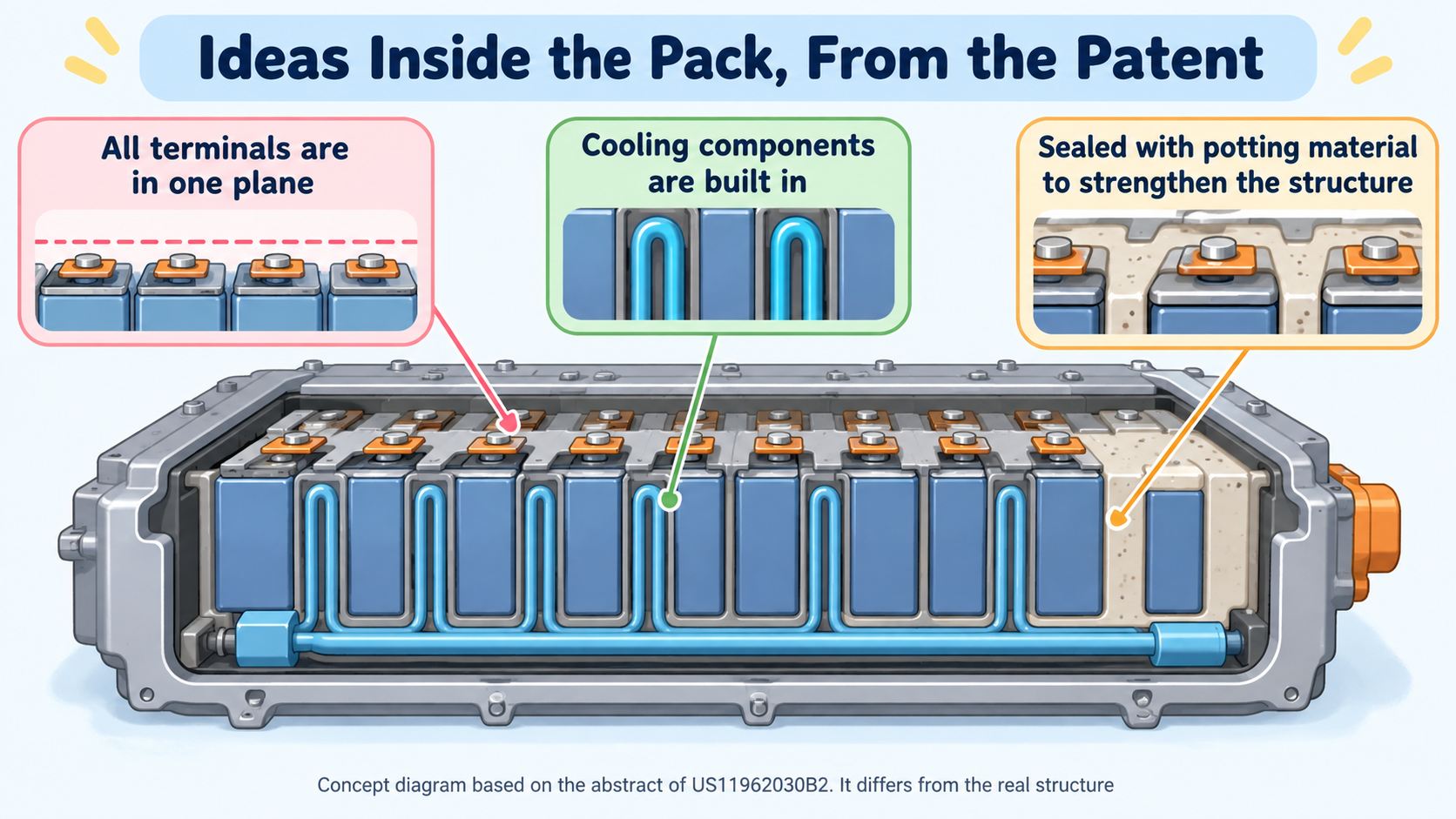
But we could not confirm whether this patent has the same structure as the packs actually in mass production.
Tesla's claims (Battery Day 2020)
According to a report (TechCrunch, September 22, 2020, by Darrell Etherington), Tesla said at Battery Day that a structural pack would remove 370 parts. The comparison is with "the current Tesla battery cell design."
Other reports also say the body's mass falls 10% and range grows 14%, but we could not confirm the originals of those reports in this article. They also read as estimates or targets, not measurements (the author's reading).
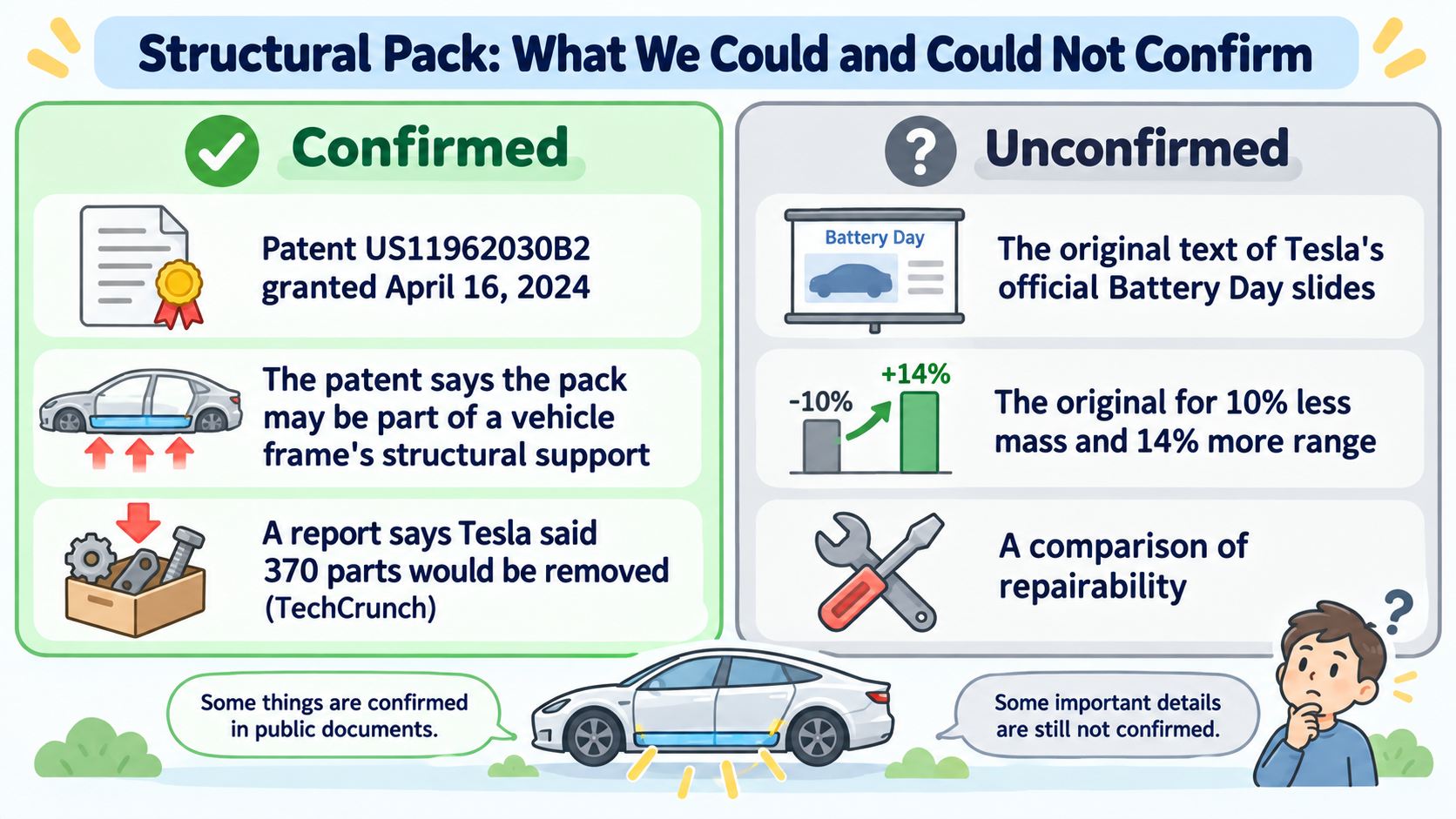
The original text of the official Battery Day slides, and a comparison of repairability and replacement procedures based on official service documents. A ChatGPT Deep Research report contained statements such as "it can be removed in 143 steps," but we could not confirm them in primary sources, so we do not write them.
From the patent and the reports we can read the idea that "making the battery part of the body cuts body parts and makes the body stiffer." There are also remarks that once the battery is one with the body, repair becomes harder after damage, but we could not verify that in official materials. The real numbers for both the benefits and the challenges are still unconfirmed.
FAQ
What is a structural battery pack?
A structure in which the battery pack is part of the car's floor and bears some of the strength. Tesla's patent says the pack can be part of the structural support of a vehicle frame.
Has the structural pack patent been granted?
U.S. patent US11962030B2 was granted on April 16, 2024 (shown as active on Google Patents).
How much does a structural pack extend range?
Reports mention 14%, but we could not confirm the original in official materials in this article.
Is a structural pack easy to repair?
We could not confirm it in this article. We could not find official service information that allows a comparison.
Summary
- A structural battery pack is one where the battery pack is part of the car's floor and bears some of the strength.
- Tesla's patent US11962030B2 (granted April 16, 2024) says the pack can be part of the structural support of a vehicle frame. Its features are cells with terminals in one plane, cooling components and a filler.
- Tesla said at Battery Day that 370 parts would be removed, according to a report (TechCrunch).
- The original Battery Day slides, the originals for 10% less mass and 14% more range, and repairability are unconfirmed.
Next: we will look at another feature of the body, "the cast aluminum alloy used in giga casting" (coming soon).
Sources (checked 2026-10-14)
- U.S. Patent US11962030B2, "Integrated energy storage system" (Tesla Inc, April 16, 2024): https://patents.google.com/patent/US11962030B2/en
- TechCrunch (September 22, 2020, Darrell Etherington), "Future Teslas will have batteries that double as structure, making them extra stiff while improving efficiency, safety and cost": https://techcrunch.com/?p=2050459
This article is for learning about science and technology, and is not investment advice. Facts and the author's interpretation are kept separate. Figures are AI-generated illustrations.