Tesla makes parts of the Model Y's body, such as the rear underbody area, by pouring molten aluminum into a large mold to make big parts. For repair, Tesla's body repair procedure describes cutting the end along a marked cut line and joining a new part with structural adhesive and rivets. But "Giga Casting" is not Tesla's official term, and we could not confirm the structural battery pack's numbers from official materials.
So far we have looked at the four flows: electricity, force, heat and information. This time we look at the body that carries them. Tesla's body is said to be built very differently from an ordinary car's.
The conclusion: instead of welding small panels, make a big part at once
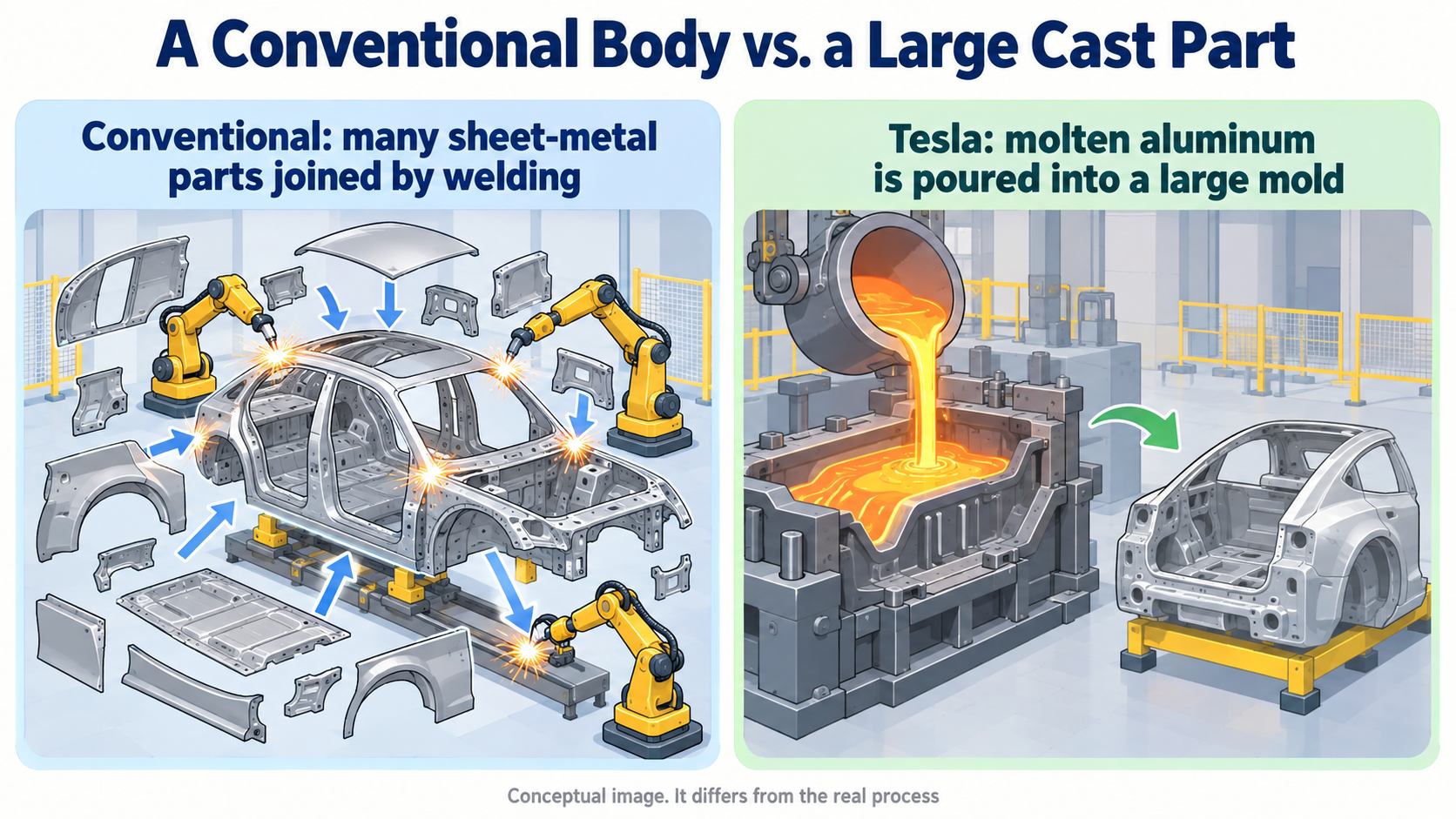
An ordinary car's frame is made from many steel or aluminum panels stamped out by presses and joined by welding.
Tesla makes part of the body (for example, the area around the Model Y's rear floor) by pouring molten aluminum into a large mold to make a large part. This method is commonly called Giga Casting.
But that is not Tesla's official name for it. Tesla's repair documents and patents use terms such as "Cast Rear Under Body" and "Multi-directional unibody casting machine." In this article, for clarity, we call it "large one-piece casting."
1. What is casting?
Casting is a way of making a shape by melting metal, pouring it into a mold, and letting it harden.
A Tesla patent (U.S. Patent Application Publication US20190217380A1, published July 18, 2019) describes a "multi-directional unibody casting machine for a vehicle frame," with Tesla Inc. as the applicant. Its abstract says that die portions meeting at a central hub form "a mold cavity corresponding to a portion of a vehicle frame."
According to the patent database, this application is in an abandoned state (because no response was made to an examiner's notice in November 2020). That is, it was not granted as a patent. In this article we introduce it as a document showing that "Tesla considered this kind of casting machine." We have not confirmed whether the machines actually used in mass production match this patent.
2. How is it repaired when damaged?
One worries that if part of a big single part breaks, the whole thing has to be replaced.
Tesla's body repair procedure, "Rear Rail (Small Section)" (Model Y), describes this flow.
- Mark a cut line on the original part, using a special guide (a cut line jig).
- Remove the original part and cut it on the marked cut line.
- Test-fit the new part and check the gaps (under 4 mm is allowed at the bottom of the frame rail).
- Apply structural adhesive to the mating surfaces.
- Fasten with high-strength structural rivets (6.5 mm) or bolts.
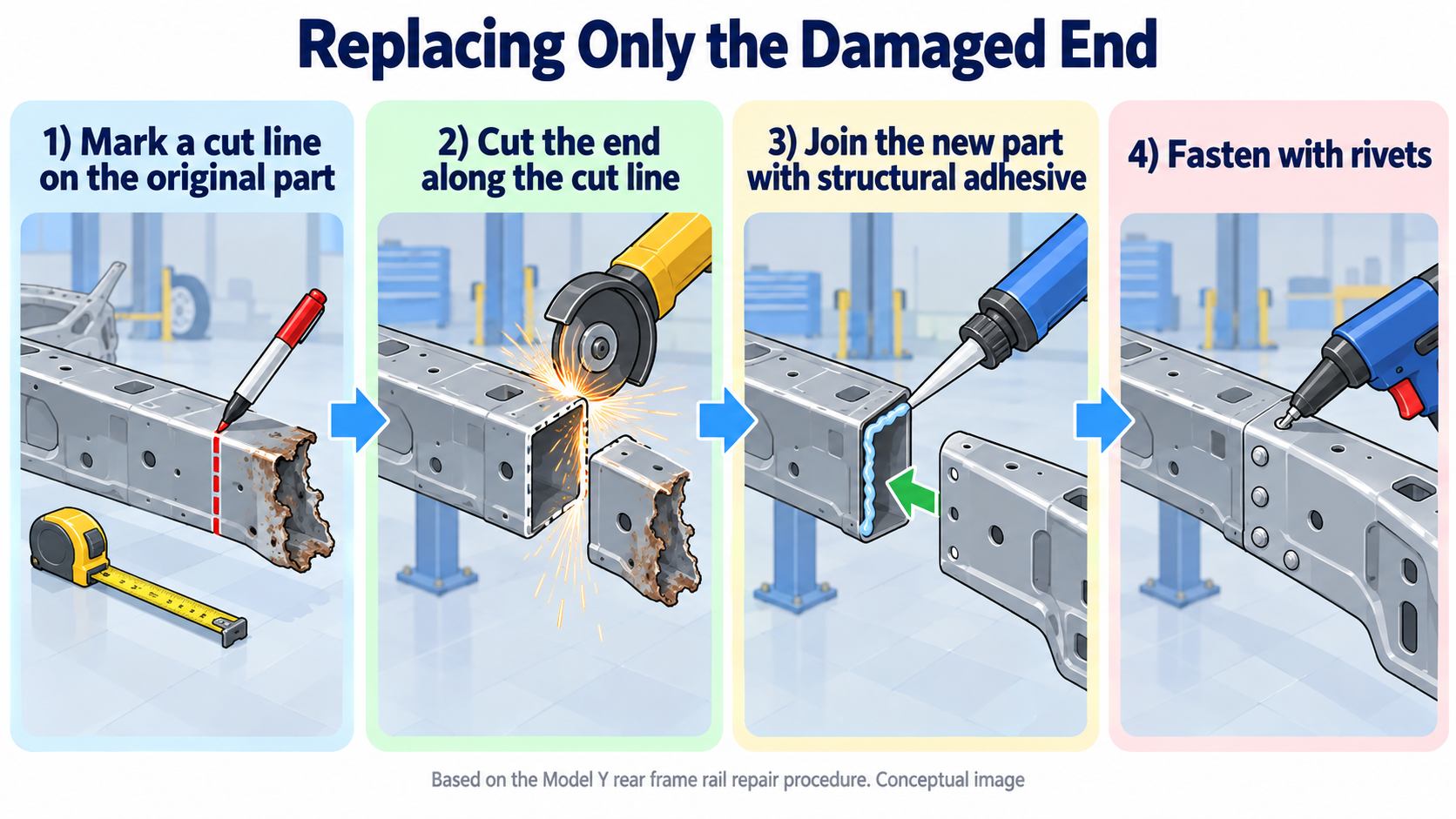
So the procedure for replacing only the damaged end is officially provided. But this is the procedure we checked, for the Model Y's rear frame rail. We have not confirmed whether the same method applies to other parts or other models. The procedure also says additional repairs may be required depending on the damage.
(Among the page titles we found in the same repair documents is "Cast Rear Under Body (2-Piece)." Some cars seem to use a two-piece cast part, but we have not read its contents for this article.)
3. The structural battery pack: the battery as the body's frame
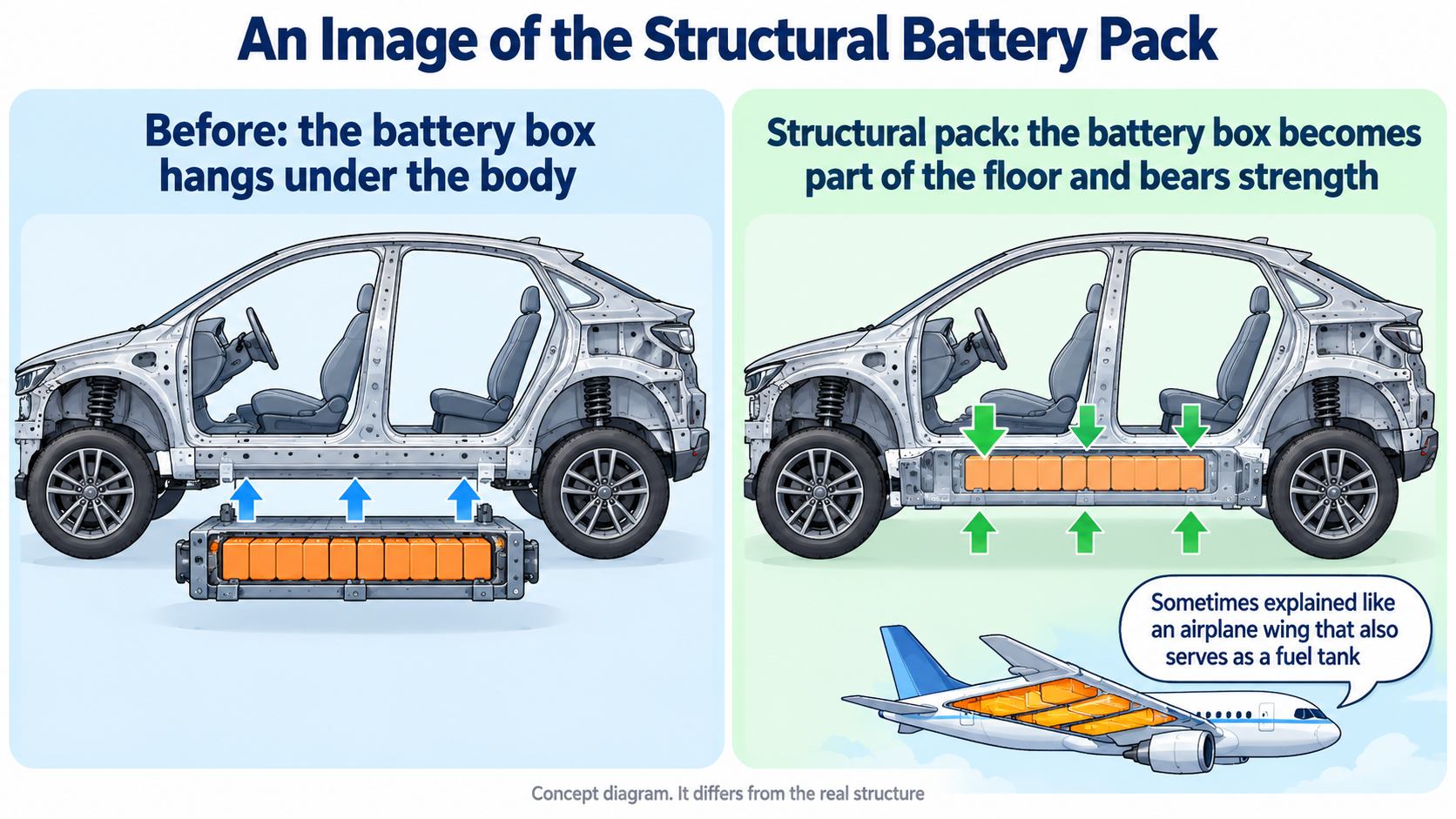
Another feature is the structural battery pack. Instead of simply attaching the battery box under the body, the idea is to make it part of the body, bearing some of its strength.
It is sometimes explained with the example of an airplane wing that also serves as a fuel tank.
But we could not confirm the following in this article.
- The original text of Tesla's Battery Day 2020 official materials explaining the structural pack (we could not reach the official slides).
- Figures such as "range grows 14%" or "weight falls 10%." They appear in press reports, but we do not state them because we could not confirm them in official materials.
- The details of how the 4680 cell contributes to the structure.
4. What about safety?
According to Tesla's official blog (December 22, 2021), the U.S. insurance-industry group IIHS named the Model Y a "Top Safety Pick+", its highest level. The blog says the Model Y scored the highest ratings in all of IIHS's crashworthiness and front crash avoidance tests. It also says that in 2020 the Model Y earned 5 stars in every category from the U.S. Department of Transportation's NHTSA.
But this is the Model Y's result. We have not confirmed the Model 3's awards or later years. And we cannot say anything here about a causal link such as "a large cast part makes it safe."
Fewer parts seem to mean fewer manufacturing steps. But we could not find an official Tesla document showing how much the number of parts and steps actually fell. Many articles say it became "easier" or "cheaper to make," but the numbers are unconfirmed.
FAQ
Is "Giga Casting" Tesla's official term?
Tesla's repair documents and patents use terms such as "Cast Rear Under Body" and "Multi-directional unibody casting machine." "Giga Casting" is a common name, and we have not confirmed whether it is an official term.
If a cast part is damaged, does the whole thing need replacing?
In the Model Y's rear frame rail procedure, a method of cutting the end along a cut line and joining a new part is officially provided. Replacing the whole part may be needed depending on the damage, but we have not confirmed that in this article.
How much does the structural battery pack extend range?
We could not confirm a number from official materials. We do not state the numbers from press reports.
What is the Model 3's body made of?
We could not confirm it in this article.
Summary
- Tesla makes part of the body (the Model Y's rear floor area) as large cast parts by pouring molten aluminum into a mold. "Giga Casting" is a common name.
- Tesla's patent application (US20190217380A1, published 2019) describes a multi-directional unibody casting machine, but it is in an abandoned state.
- For repair, an official procedure exists for cutting the end along a cut line and joining a new part with structural adhesive and rivets (Model Y, rear frame rail).
- The structural battery pack is the idea of making the battery part of the body's frame. Battery Day's official materials and the effect figures are unconfirmed.
- IIHS named the Model Y a "Top Safety Pick+" (Tesla's official blog, December 2021).
Next: to finish Part 2, we will put the four flows (electricity, force, heat, information) and the body together in one "whole map" (coming soon).
Sources (checked 2026-10-14)
- U.S. Patent Application Publication US20190217380A1, "Multi-directional unibody casting machine for a vehicle frame and associated methods" (Tesla Inc., July 18, 2019): https://patents.google.com/patent/US20190217380A1/en
- Tesla Body Repair Procedures, "Rear Rail (Small Section)" (Model Y 2025): https://service.tesla.com/docs/BodyRepair/Body_Repair_Procedures/Model_Y_2025/en-us/GUID-85DBAD37-0CF9-47FA-B723-61653310252D.html
- Tesla, "Model Y Awarded IIHS Top Safety Pick+" (December 22, 2021): https://www.tesla.com/blog/model-y-awarded-iihs-top-safety-pick
This article is for learning about science and technology, and is not investment advice. Facts and the author's interpretation are kept separate. Figures are AI-generated illustrations.