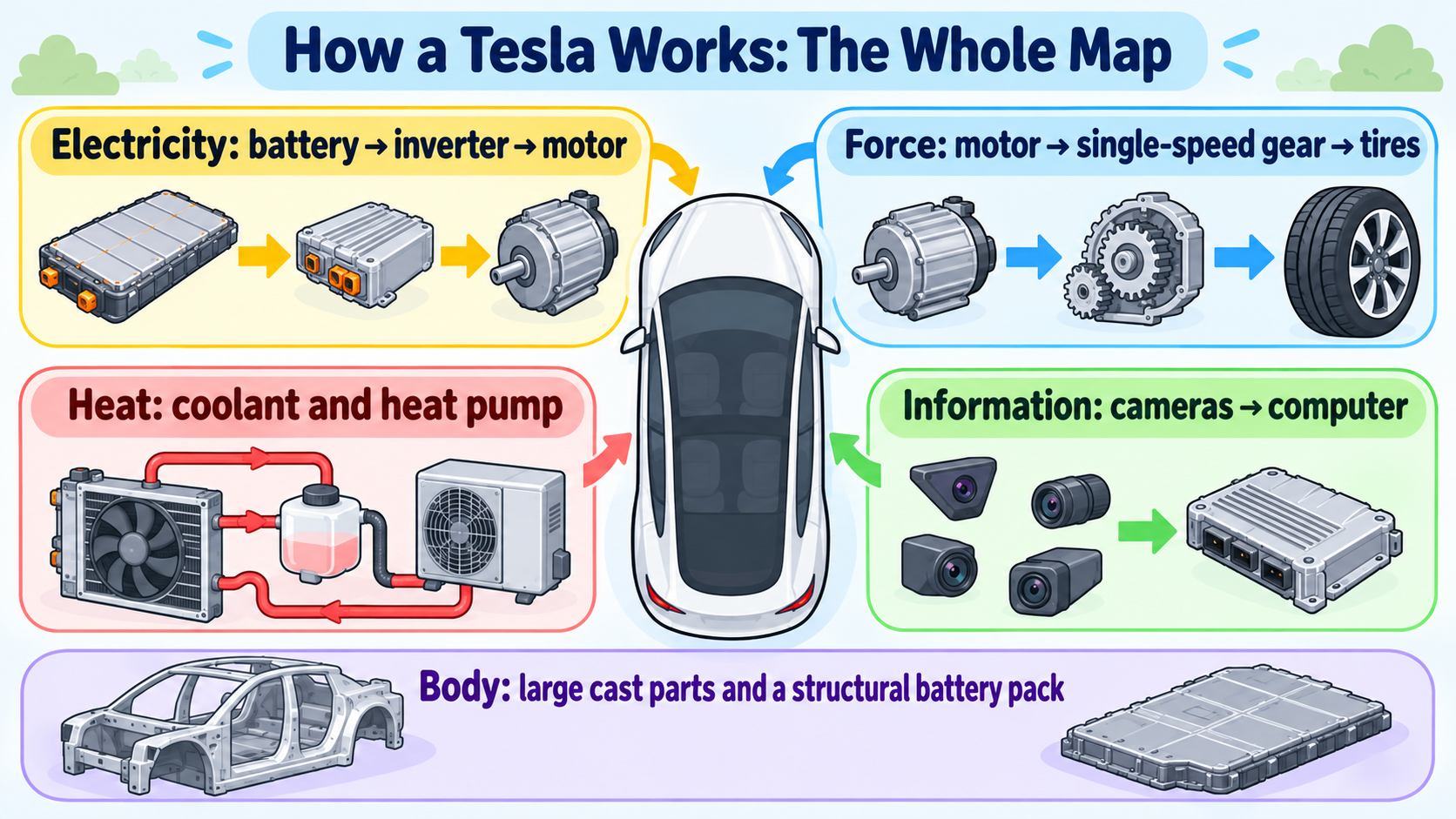
A Tesla Model 3 can be understood as four flows plus the body that carries them: electricity (battery → inverter → motor), force (motor → single-speed gear → tires), heat (coolant and a heat pump), and information (cameras → computer). The high-voltage battery is nominally 355 V and the gear ratio is 9.03:1 (Tesla's manual, Singapore edition).
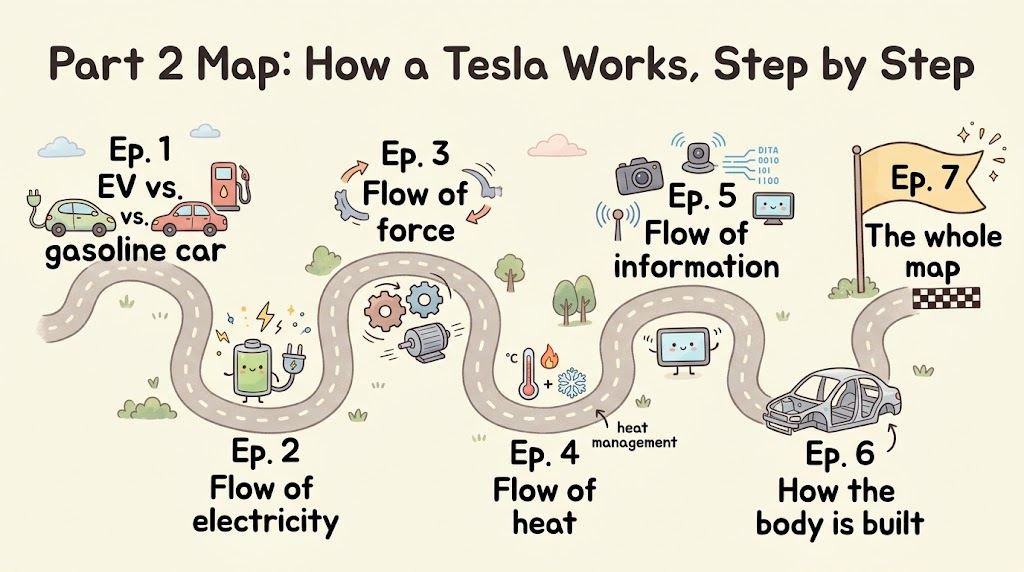
How does a Tesla electric car work? This article is the finale of Part 2: one "whole map" that puts the previous six articles together. We explain it with as few technical terms as possible.
How does a Tesla work, in short?
A Tesla (here, the Model 3, for which official documents are available) can be understood as four flows plus the body that carries them.
| Flow | What flows | Main parts | Details |
|---|---|---|---|
| Electricity | Electric current | Battery → inverter → motor | Episode 2: The flow of electricity |
| Force | Turning force | Motor → single-speed gear → differential → tires | Episode 3: The flow of force |
| Heat | Heat | Coolant, heat pump | Episode 4: The flow of heat |
| Information | Camera images | Cameras → computer → display and control | Episode 5: The flow of information |
| (Body) | ― | Large cast parts, structural battery pack | Episode 6: How the body is built |
If you first want to know how an EV differs from a gasoline car, start with Episode 1: How is an EV different from a gasoline car?
What replaces what, compared with a gasoline car?
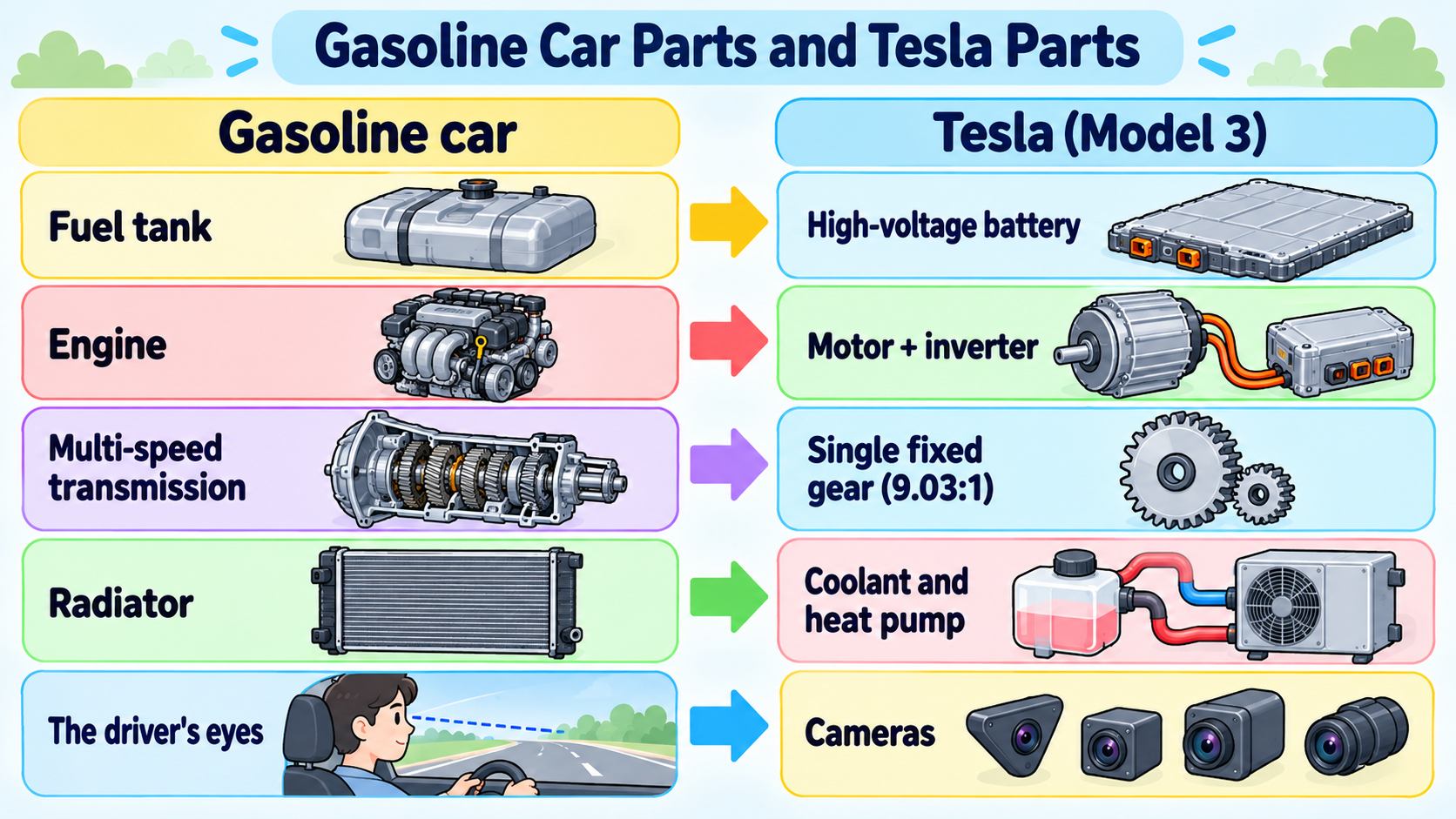
Matching a gasoline car's parts to a Tesla's gives a clear overview.
| Gasoline car | Tesla (Model 3) | What we could confirm officially |
|---|---|---|
| Fuel tank | High-voltage battery | Liquid-cooled lithium-ion, nominal 355 V |
| Engine | Motor + inverter | Rear: permanent magnet synchronous motor; front (AWD): induction motor |
| Multi-speed transmission | Single fixed gear | Gear ratio 9.03:1 |
| Radiator | Coolant and a heat pump (on equipped cars) | Battery and motors are liquid-cooled |
| The driver's eyes | Cameras (7–8 looking outside, plus 1 inside) | The manual's "Cameras" page |
The four flows, one by one
Electricity: battery → inverter → motor
An EV sends the direct-current electricity stored in the battery through an inverter, which changes it to alternating current, to the motor. When braking, the motor becomes a generator and returns electricity to the battery (regenerative braking). The Model 3's high-voltage battery is a liquid-cooled lithium-ion battery, nominally 355 V DC. The rear motor is a permanent magnet synchronous motor, and the front motor (on all-wheel-drive cars) is an induction motor. (Details in Episode 2.)
Force: motor → gear → differential → tires
The motor's rotation passes through a single gear (9.03:1), which slows the rotation to about one-ninth and raises the turning force (torque) about nine times, and then reaches the tires. In corners, the differential lets the outer tire turn faster. (Details in Episode 3.)
Heat: cooling and warming
The battery, motor and inverter are cooled by coolant. Warming the battery matters too: when it is cold, some stored energy is unavailable, and regenerative braking, acceleration and charging speed may be limited. According to a U.S. Department of Energy page, using the heater can cut an EV's range by up to 41%. (Details in Episode 4.)
Information: cameras → computer → display and control
The exterior cameras are above the front-bumper grille (if equipped), above the rear license plate, in each door pillar, two on the windshield, and on each front fender. Tesla calls recognizing the surroundings with cameras alone Tesla Vision. We could not confirm the computer's official specifications. (Details in Episode 5.)
The body
Tesla makes part of the body (the Model Y's rear floor area) as large parts by pouring molten aluminum into a big mold. Its repair documents also include a procedure for replacing only a damaged end. (Details in Episode 6.)
Seeing it all on one map
The four flows look separate, but they are connected.
- When the battery's electricity is used, heat is produced. → The flow of heat cools it.
- When it is cold, the battery has trouble delivering electricity. → The flow of heat warms it.
- What the cameras see (information) is used to control the brakes and steering. → The flows of force and electricity move.
- The battery sits at the center of the body. → Part of the electricity flow also becomes the body's frame.
The four flows look like a way of splitting, into separate parts, what a gasoline car's engine handled all at once: the battery for fuel storage, the inverter and motor for power, coolant and the heat pump for heating and cooling, and so on. This is my own way of organizing it, not Tesla's official explanation.
FAQ
What does a Tesla run on?
It runs on electricity stored in a battery, which turns a motor: battery → inverter → motor. It uses no gasoline and no engine.
Where is a Tesla's motor?
According to the Model 3 manual, there is a motor at the rear. All-wheel-drive cars also have a motor at the front.
How many gears does a Tesla have?
The Model 3 has a single fixed gear, with a ratio of 9.03:1 (Tesla's manual, Singapore edition).
How many cameras does a Tesla have?
Counting the manual's table, there are 8 exterior cameras including the front-bumper camera (if equipped), or 7 without it. There is also a separate camera inside the car.
Does a Tesla's range fall in cold weather?
According to a U.S. Department of Energy page, it can fall by up to 41% with the heater and by about 12% even without it (estimates based on a 2019 AAA study).
Does this article explain how self-driving works?
This article covers the flow up to the cameras. We could not confirm the computer's official specifications or the inside of the neural network, so we do not write about them.
Summary
- A Tesla (Model 3) can be organized as the four flows of electricity, force, heat and information, plus the body.
- Electricity: battery (nominal 355 V) → inverter → motor. Force: motor → single-speed gear (9.03:1) → differential → tires.
- Heat: coolant cools, and in cold weather the battery is warmed. With the heater on, range can drop by up to 41%.
- Information: cameras → computer → display and control. The computer's official specifications are unconfirmed.
- Body: large cast parts. The effect figures for the structural battery pack are unconfirmed.
Part 2 ends here. From Part 3 onward, we will look at the battery, motor, inverter, body and more, one at a time and in finer detail (coming soon).
Sources (checked 2026-10-14)
- Tesla, "Model 3 Owner's Manual" (Singapore edition), "Subsystems," "Cold Weather Best Practices" and "Cameras": https://www.tesla.com/ownersmanual/model3/en_sg/GUID-E414862C-CFA1-4A0B-9548-BE21C32CAA58.html
- FuelEconomy.gov (U.S. Department of Energy and Environmental Protection Agency), "Fuel Economy in Cold Weather": https://fueleconomy.gov/FEG/coldweather.shtml
- U.S. Department of Energy, Alternative Fuels Data Center, "How Do All-Electric Cars Work?": https://afdc.energy.gov/vehicles/how-do-all-electric-cars-work
- Episodes 1 to 6 of this site (each lists its own sources at the end).
This article is for learning about science and technology, and is not investment advice. Facts and the author's interpretation are kept separate. Figures are AI-generated illustrations.