In October 2026, Tesla updated its FSD (Supervised) Vehicle Safety Report (tesla.com/fsd/safety). Over the latest rolling 12 months, Teslas with FSD (Supervised) engaged drove 6,006,200 miles per major collision (one where airbags or other restraints deployed). Tesla's estimated U.S. average is 660,164 miles, so FSD goes about 9 times farther between major collisions. Manually driven Teslas with active safety features went 2,031,221 miles. Cumulative FSD mileage now exceeds about 16.7 billion miles.
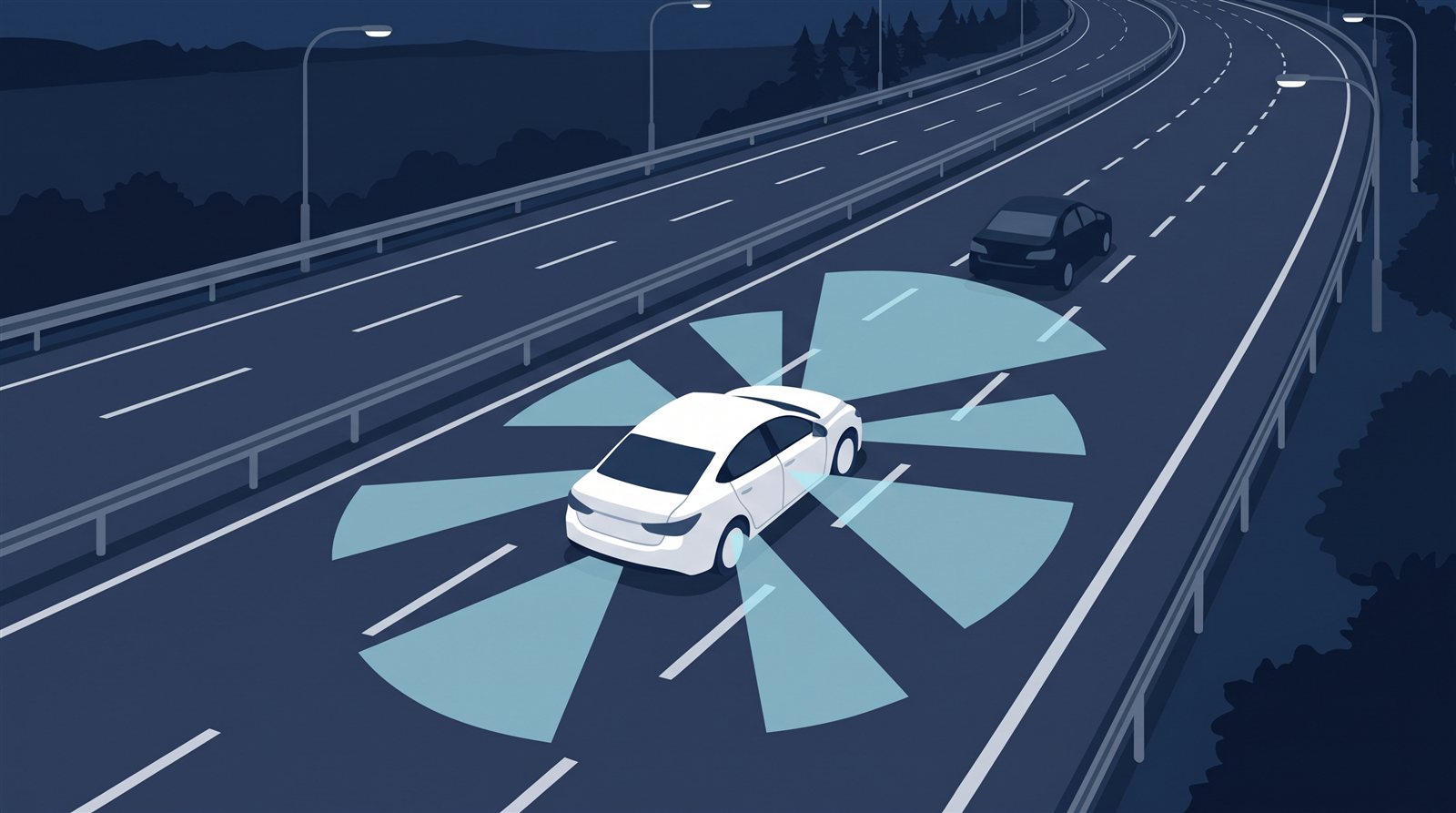
Three-line summary
- Tesla has updated its FSD (Supervised) safety report. Over the latest 12 months, cars with FSD engaged went about 6 million miles per major collision.
- Tesla's estimated U.S. average is about 660,000 miles per major collision, so FSD goes about 9 times farther. Tesla also shows about 7x for minor collisions and about 6x off-highway.
- Cumulative FSD miles: about 16.76 billion (as displayed on October 28, 2026), roughly double the ~8.2 billion reported around February 2026.
Background knowledge: compare per distance, not by count
The key safety yardstick is how far you drive, on average, per collision. If town A has 100 crashes and town B has 10, but town A drives 100 times more miles, town A is actually safer per mile. Raw counts make heavy drivers look dangerous.
So Tesla reports "miles per collision." Bigger is safer. To make it concrete (my own calculation): someone who drives 10,000 km a year would meet a major collision about once every 106 years at the U.S. average rate (660,164 miles ≈ 1.06 million km), and about once every 967 years at the FSD rate (6,006,200 miles ≈ 9.67 million km).
Because major collisions are rare even for humans, proving safety takes enormous mileage. That is why the 12-month denominator of about 9.5 billion FSD miles matters.
Background knowledge: FSD (Supervised) means a human is still in charge
FSD (Supervised) steers, accelerates and brakes, but the driver is responsible and must keep watching. It is different from Robotaxi, where no one sits in the driver's seat. So these numbers describe a machine and a human driving together, not the machine alone.
What happened
Tesla's "Full Self-Driving (Supervised) Vehicle Safety Report" showed the following on October 28, 2026. Collision rates use the latest rolling 12 months and are updated every quarter (China excluded).
Miles driven per major collision (airbag or other restraint deployed)
| How the car was driven | Miles per collision | Miles in 12 months |
|---|---|---|
| Tesla, FSD (Supervised) engaged | 6,006,200 | ~9.48 billion |
| Tesla, manual (active safety features) | 2,031,221 | ~36.1 billion |
| Tesla, manual (no active safety features) | 845,915 | ~0.20 billion |
| U.S. average (Tesla's estimate) | 660,164 | ~3.29 trillion |
Miles per minor collision: FSD 1,760,823; manual with active safety 685,390; manual without about 285,000; U.S. average about 225,000.
The page headlines 9x fewer major collisions, 7x fewer minor collisions and 6x fewer off-highway collisions than the estimated U.S. average. From the table, 6,006,200 ÷ 660,164 ≈ 9.1.
Cumulative FSD mileage was shown as 16,759,675,307 miles, including 6,657,567,198 city miles.
Why it matters
Driver-assistance safety can only be judged by numbers counted with a fixed definition over a fixed period. The page spells out its methodology, and quarterly updates let anyone track whether the rate is improving. Around February 2026, the rate was reported as about 5.3 million miles per major collision (Drive Tesla Canada); it is now about 6.0 million.
How it works: what counts as a "major collision"
Following U.S. rule 49 C.F.R. § 563.5, Tesla uses two categories.
| Category | Definition |
|---|---|
| Major | Airbags or other non-reversible restraints deployed |
| Minor | No deployment, but speed changed by 8 km/h or more within 150 milliseconds |
How strong is 8 km/h in 0.15 s? 8 km/h is about 2.2 m/s, so the deceleration is about 2.2 ÷ 0.15 ≈ 15 m/s², or about 1.5 g. Hard braking is around 1 g, so this is a clear impact.
Two more rules: if FSD was active at any point in the five seconds before a collision, it counts as an FSD collision, even if the driver took over at the last moment. And Tesla does not assign fault; every collision is counted.
How it works: building the "U.S. average"
- Miles: Federal Highway Administration (FHWA) vehicle miles traveled for 2024.
- Collisions: NHTSA's Crash Investigation Sampling System (CISS), police-reported crashes where at least one passenger vehicle was towed.
Tesla chose CISS because towed-vehicle crashes are closest in severity to airbag deployments; NHTSA's CRSS is about 72% property-damage-only crashes, and FARS covers only fatal crashes. Tesla notes the limits: NHTSA estimates that 60% of property-damage-only crashes and 32% of injury crashes go unreported, which can skew the baseline either way.
So Tesla calls the Tesla-to-Tesla comparison the most direct one. On that basis, FSD (6.0 million miles) is about 3 times manual driving with active safety (2.0 million miles).
Background: why this page exists
Tesla published the detailed FSD (Supervised) safety report in its current form in November 2025 (TechCrunch, November 14, 2025) and has updated it quarterly since. According to the page, FSD (Supervised) is available in 17 markets, including the U.S., Canada, Mexico, Australia, New Zealand, South Korea, the Netherlands, Slovakia and Latvia.
Timeline
- 2020: FSD launched; cumulative mileage is counted from here.
- November 2025: Detailed FSD (Supervised) safety report published.
- Around February 2026: ~8.2 billion cumulative miles, ~5.3 million miles per major collision reported (Drive Tesla Canada, Feb 19, 2026).
- October 23, 2026: Tesla published a separate Robotaxi Safety Report.
- As of October 28, 2026: ~6.0 million miles per major collision; ~16.76 billion cumulative miles.
Useful takeaways
- Bigger is safer: "X miles per collision" improves as X grows; "N times safer" is a ratio of these distances.
- Check the comparison group: "9x the U.S. average" and "3x Tesla manual driving" come from the same page. Different baselines, different multiples.
- Where it is used matters: In my view, drivers likely engage FSD where they feel comfortable. Tesla separates highway and non-highway, but cannot equalize every condition such as weather or time of day.
- It is a supervised number: a human plus machine result, not permission to stop watching.
Something to think about next
FSD sees the world through cameras alone. Where are the eight cameras, and what does each one watch?
Read next
- What is Tesla Vision? How many cameras does a Tesla have
- FSD vs. Autopilot: the three levels of Tesla driver assistance
- Tesla publishes a Robotaxi Safety Report
Sources
- Tesla, "Full Self-Driving (Supervised) Vehicle Safety Report" (rolling 12 months; Methodology and FAQ; checked October 28, 2026) → https://www.tesla.com/fsd/safety
- Drive Tesla Canada, "Tesla Releases New FSD Safety Stats After Crossing 8.2 Billion Miles Driven" (February 19, 2026) → https://driveteslacanada.ca/news/tesla-releases-new-fsd-safety-stats-after-crossing-8-2-billion-miles-driven/
- TechCrunch, "Tesla releases detailed safety report after Waymo co-CEO called for more data" (November 14, 2025) → https://techcrunch.com/2025/11/14/tesla-releases-detailed-safety-report-after-waymo-co-ceo-called-for-more-data
Verification status
Figures were checked on Tesla's official page (as of October 28, 2026). The exact start and end dates of the 12-month window are not stated on the page. The February 2026 figures come from press reports. Ratios and year conversions are my own calculations.
Thank you for reading. Was this article useful to you?
Thank you. If you like, tell us what you thought in a line or two.
Optional. No name or email needed.
Received. We will use your words to make better articles.