According to Tesla's Q3 2026 Update, active subscriptions to FSD (Supervised) stood at 1.74 million at the end of the third quarter, up 67% from 1.04 million a year earlier (Q3 2025). The figure includes both upfront payment and monthly subscriptions and excludes free trials. In North America, over 75% of new deliveries included FSD, a nearly 20 percentage point sequential increase. In the EU, Croatia, Slovenia, the Czech Republic and Slovakia approved FSD after the end of Q2, bringing the total to nine countries. FSD (Supervised) requires active driver supervision and does not make the vehicle autonomous.
Three-line summary
- According to Tesla's Q3 2026 Update, active subscriptions to the driver-assistance feature FSD (Supervised) reached 1.74 million, up 67% from 1.04 million a year earlier.
- In North America, over 75% of new deliveries included FSD, up nearly 20 percentage points from the previous quarter and a record, according to the report.
- In the EU, four countries (Croatia, Slovenia, the Czech Republic and Slovakia) were added after the end of Q2, for nine countries in total. EU users exceed 100,000, having driven more than 160 million km.
Background knowledge: "Supervised," subscriptions and attach rate
FSD (Supervised) is a feature that helps you drive; a person is still the driver. FSD stands for "Full Self-Driving," but the word that matters is "Supervised." Every Tesla report notes that it requires active driver supervision and does not make the vehicle autonomous. Think of a skilled assistant who moves the wheel, accelerator and brakes for you, while the person in the driver's seat stays responsible the whole time and must take over the moment the assistant is about to make a mistake. So "more subscriptions" does not mean "more self-driving cars." We sort out the levels in FSD vs Autopilot.
"Active subscriptions" is the water already in the bathtub. It is the total number of subscriptions able to use FSD at a given moment. Tesla's footnote says the figure includes both upfront payments and monthly subscriptions and excludes free trials. New customers are water pouring in from the tap; cancellations are water draining out. From 1.48 million at the end of Q2 to 1.74 million at the end of Q3, the tub gained 260,000 in three months, meaning inflow exceeded outflow by that much (our calculation). The report says net new subscriptions in the quarter were a record.
"Attach rate" is how hard the tap is running right now. It is the share of newly delivered cars that come with FSD. If 75 of 100 deliveries include it, the attach rate is 75%. Subscriptions are a running total built over years, so they move slowly; attach rate reacts quickly to changes in price or features.
Percent and percentage points are different. If an attach rate moves from 55% to 75%, that is a 20-point rise, not a 20% rise (a 20% rise from 55% would be 66%). Tesla's report says North America's attach rate rose "nearly twenty percentage point[s] sequential[ly]," which implies the previous quarter was roughly 55% (our calculation; the report does not give the prior figure).
What happened
In its Q3 2026 Update, published in October 2026, Tesla reported these figures (all as stated in the report, at quarter end).
| Quarter end | Active FSD subscriptions |
|---|---|
| Q3 2025 | 1.04 million |
| Q4 2025 | 1.10 million |
| Q1 2026 | 1.28 million |
| Q2 2026 | 1.48 million |
| Q3 2026 | 1.74 million (up 67% year over year) |
The quarterly increases grew steadily: 60,000, 180,000, 200,000 and 260,000 (our calculation).
The report also states:
- North America attach rate: over 75% of new deliveries included FSD, up nearly 20 points from the previous quarter and a record. Tesla calls North America its "most mature market" and says it believes "FSD is driving demand in markets where it is available."
- EU: four additional approvals since the end of Q2 (Croatia, Slovenia, the Czech Republic and Slovakia), with FSD now available in nine EU countries and used by over 100,000 customers logging more than 160 million km since the initial approval.
- Cumulative deliveries: Tesla has delivered 10.2 million vehicles in total.
Why it matters
Software is becoming a reason to choose a car. Buyers used to decide on driving feel, efficiency, space and price. With more than three in four new North American Teslas delivered with FSD, driver-assistance software is becoming something many people simply expect to have.
It also measures cars that get smarter after purchase. Teslas update their software over the air (OTA updates), and an FSD subscription adds a software feature to a car already on the road. With 1.74 million active subscriptions against 10.2 million cumulative deliveries, that is roughly one in six (our calculation; cumulative deliveries include scrapped and resold cars, so treat it as a rough guide).
Europe has entered the "country by country" phase. In the EU, the approval issued by the Dutch vehicle authority RDW in April 2026 is being recognized by each member state (the Slovakia example). Reaching nine countries in about six months is possible because one approval can be reused across the EU.
Background: why subscriptions are rising
The report does not break down the reasons in detail. What it does say is that the attach rate on new North American cars rose and that FSD became available in more EU countries: in effect, two taps opened wider. In my view, a 20-point jump in a single quarter is hard to explain by feature improvements alone, and changes in pricing or how it is sold may also play a part; but the report gives no reason, so we treat only the numbers as established fact.
How it works: what FSD sees and does
| Part | What it does | Analogy |
|---|---|---|
| Eyes (cameras) | Cameras around the car see the road, vehicles, people and signals | The driver's eyes |
| Brain (neural networks) | Decide where and how fast to go from the video | Driving experience |
| Hands and feet (controls) | Move the steering, accelerator and brakes | Hands and feet |
| Supervisor (the driver) | Watches the screen and road, ready to take over | A driving instructor |
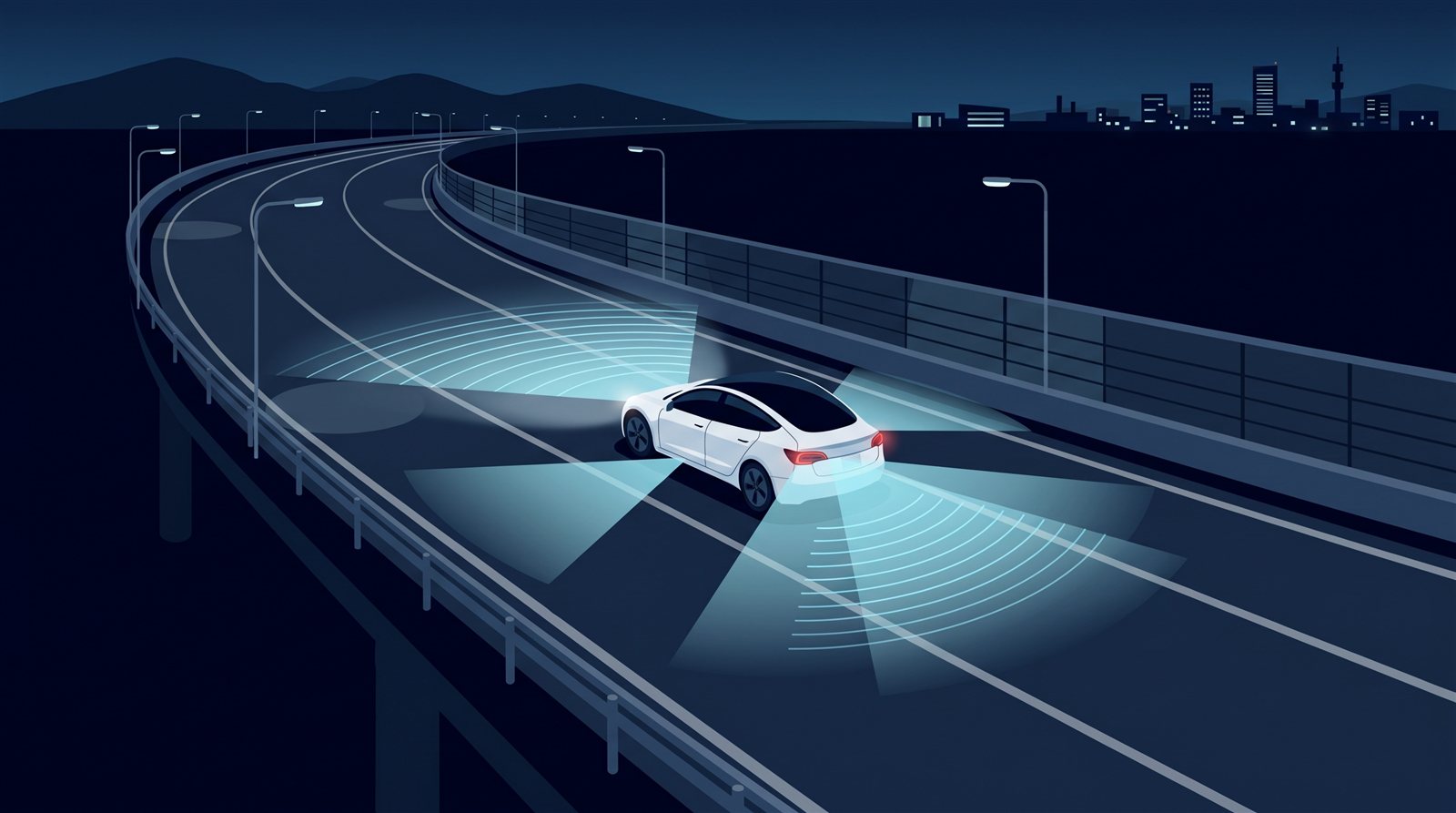
Tesla's driver assistance judges its surroundings from camera video alone (Tesla Vision). The report's chart splits cumulative FSD miles into "V12 and beyond" and "V11 and before." The more miles driven, the more driving data there is to learn from.
Timeline
- End of Q3 2025: 1.04 million active subscriptions.
- April 10, 2026: the Dutch RDW issues a provisional type approval for FSD (Supervised).
- End of Q2 2026: 1.48 million active subscriptions.
- Q3 2026: Croatia, Slovenia, the Czech Republic and Slovakia approve it, for nine EU countries; North America's attach rate passes 75%.
- End of Q3 2026: 1.74 million active subscriptions (up 67% in a year).
The same report says Tesla's Robotaxi service in Austin, Texas, with no safety driver, reached nearly two million cumulative unsupervised miles by quarter end. Supervised FSD and driverless Robotaxi are different stages along the same line of technology (the Robotaxi safety report).
Points you can explain to a friend
- Separate "subscriptions" from "attach rate": subscriptions are the amount in the tub (1.74 million); attach rate is the share of new cars choosing it now (over 75% in North America).
- Separate percent from points: 55% to 75% is a 20-point rise, not a 20% rise.
- A common misconception: more FSD subscriptions does not mean more self-driving cars. FSD (Supervised) is driver assistance that requires driver supervision.
A question to follow
What has to differ for the same software to drive with no one watching, as Robotaxi does, rather than with a supervising driver? The answer seems to lie in limiting where the car drives and in remote monitoring.
Read next
- Tesla FSD vs Autopilot: The Three Levels of Driver Assistance, Sorted Out From Official Descriptions
- What Is Tesla Vision? How Many Cameras Does a Tesla Have? Checked Against the Official Owner's Manual
- Tesla publishes a Robotaxi Safety Report: 3.1 million unsupervised miles, zero injuries, and four cities "coming soon"
Sources
- Tesla, "Q3 2026 Update" (October 2026, pages 3, 5 and 8) → https://assets-ir.tesla.com/tesla-contents/IR/TSLA-Q3-2026-Update.pdf
- Slovakia's recognition of FSD (Supervised) (our article, October 19, 2026) → /en/slovakia-fsd-supervised/
*Subscriptions, attach rate, EU countries, users and distance, and cumulative deliveries were checked against Tesla's Q3 2026 Update (as of 2026-10-24).
Thank you for reading. Was this article useful to you?
Thank you. If you like, tell us what you thought in a line or two.
Optional. No name or email needed.
Received. We will use your words to make better articles.