The Model 3 owner's manual lists the rear motor as an "AC permanent magnet synchronous motor" and the front motor (on AWD cars) as an "AC induction motor." Both are liquid-cooled and driven by a variable frequency drive. In 2018, Tesla's motor designer explained the choice of a permanent magnet motor for the Model 3 as one that "better solved our cost minimization function." But we could not confirm the motor types of every current model, or efficiency figures.
An electric car turns the battery's electricity into motion with a motor. In this article we check the types of motors Tesla uses, and the inverter that drives them, against the official owner's manual and other sources.
The conclusion: some cars use different motor types at the front and rear
The Model 3 owner's manual (Subsystems, vehicle specifications) says this.
"Rear motor: AC permanent magnet synchronous motor, liquid-cooled, with variable frequency drive."
"Front motor (AWD vehicles): AC induction motor, liquid-cooled, with variable frequency drive."
So in the AWD Model 3 (driven by two motors, front and rear), the front and rear motors are of different types.
Motor basics (a general explanation)
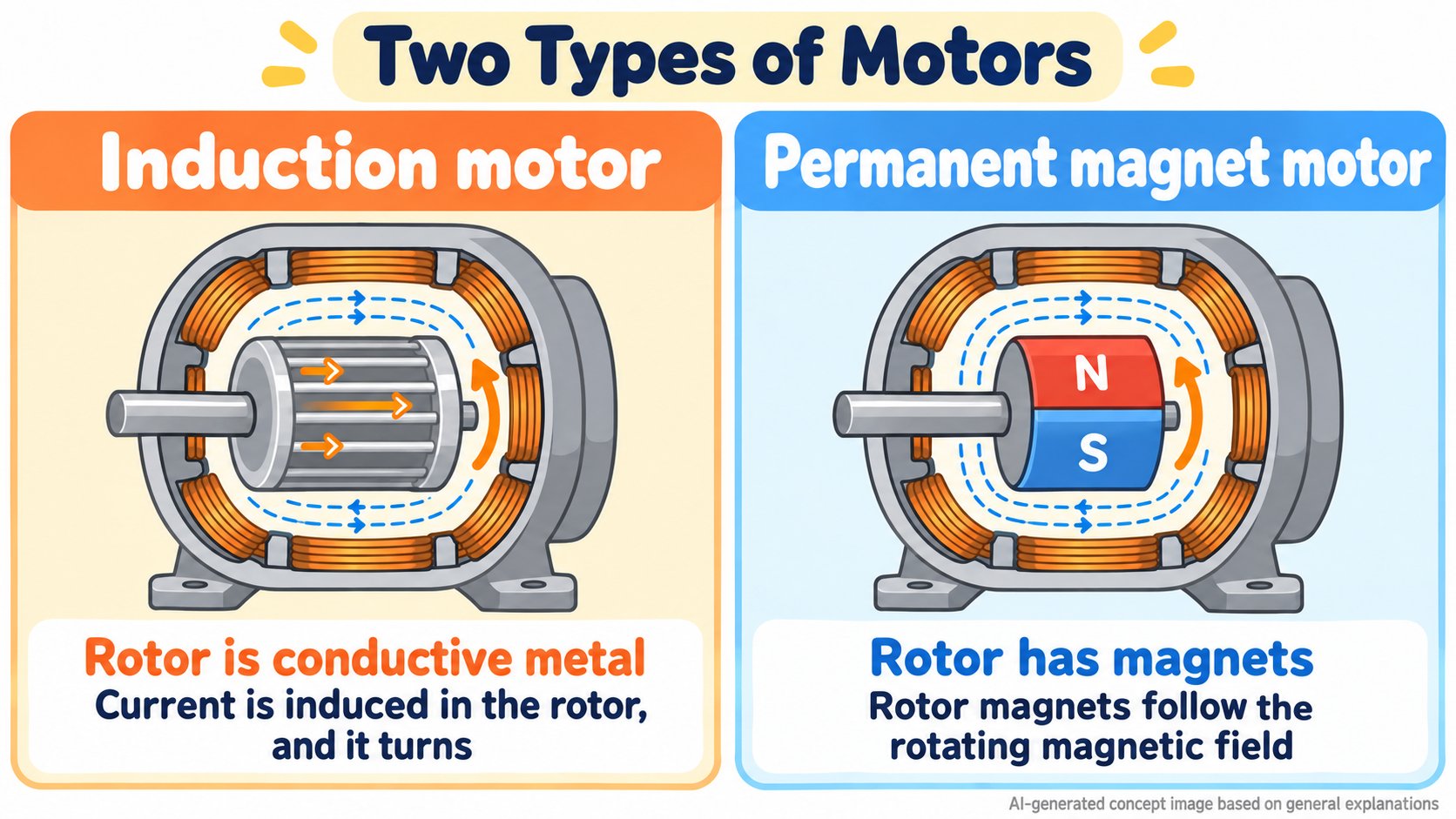
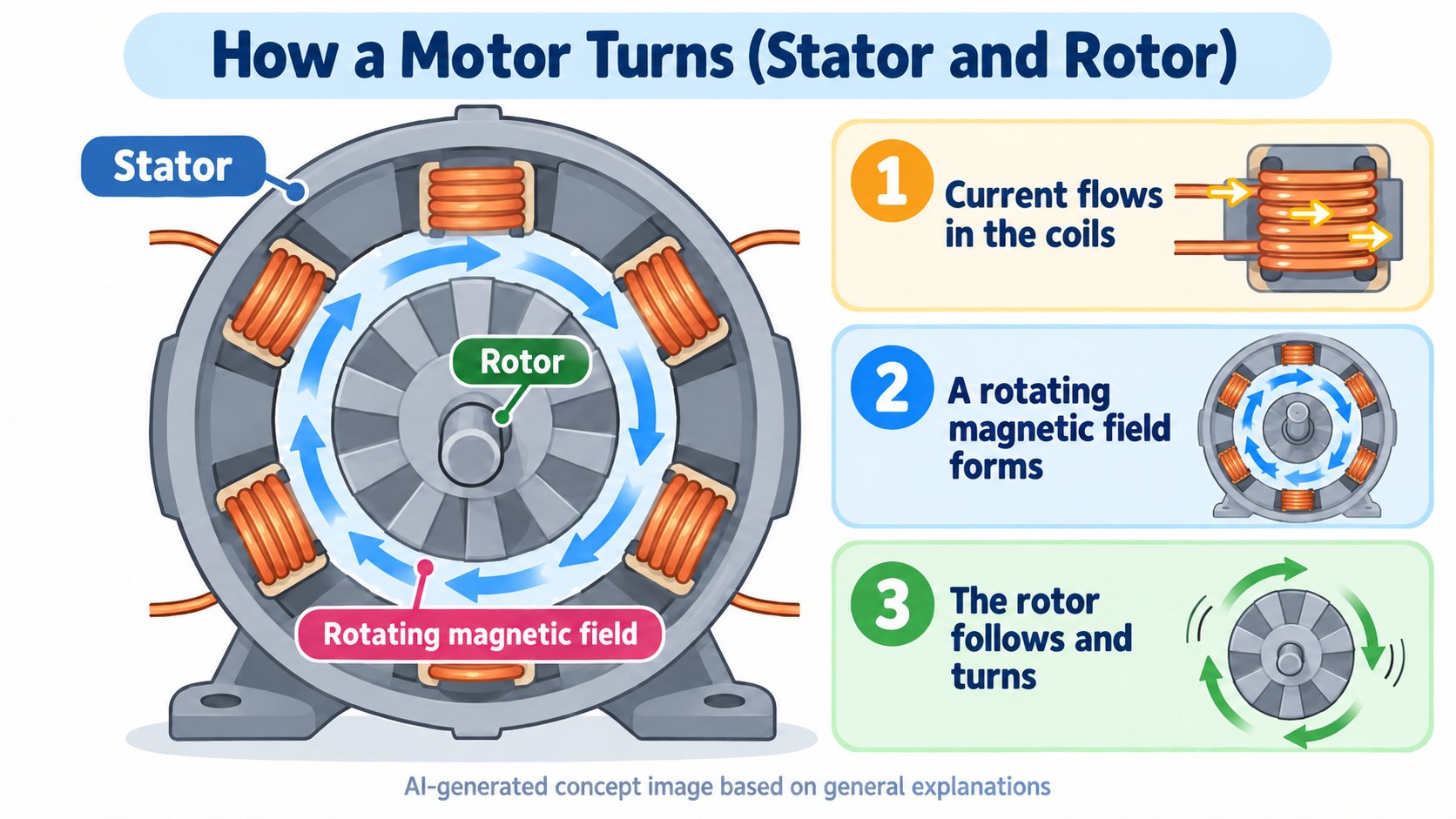
A motor turns a shaft by using magnetic force produced by electricity. The turning part is the rotor, and the fixed part around it is the stator.
- Permanent magnet motor: the rotor contains magnets. The magnets follow the rotating magnetic field made by the stator.
- Induction motor: the rotor has conductive metal (such as copper or aluminum), not magnets. When the stator's field changes, current is induced in the rotor, and that makes it turn.
Why choose a type: the designer's comments (2018)
In 2018, Tesla's principal motor designer, Konstantinos Laskaris, spoke at the CWIEME exhibition in Chicago about the Model 3's motor. A report (Electrek, February 27, 2018, by Fred Lambert) conveys the following.
- A permanent magnet motor benefits from the efficiency of magnet pre-excitation. An induction motor, on the other hand, allows precise adjustment of the magnetic flux to optimize efficiency.
- Tesla chose a permanent magnet motor for the Model 3 because it better solved the cost minimization function.
- Which technology is used in the future will depend on "a tradeoff between motor cost, range and battery cost."
This is a comment conveyed through a report, not the original text of an official Tesla document.
The role of the inverter
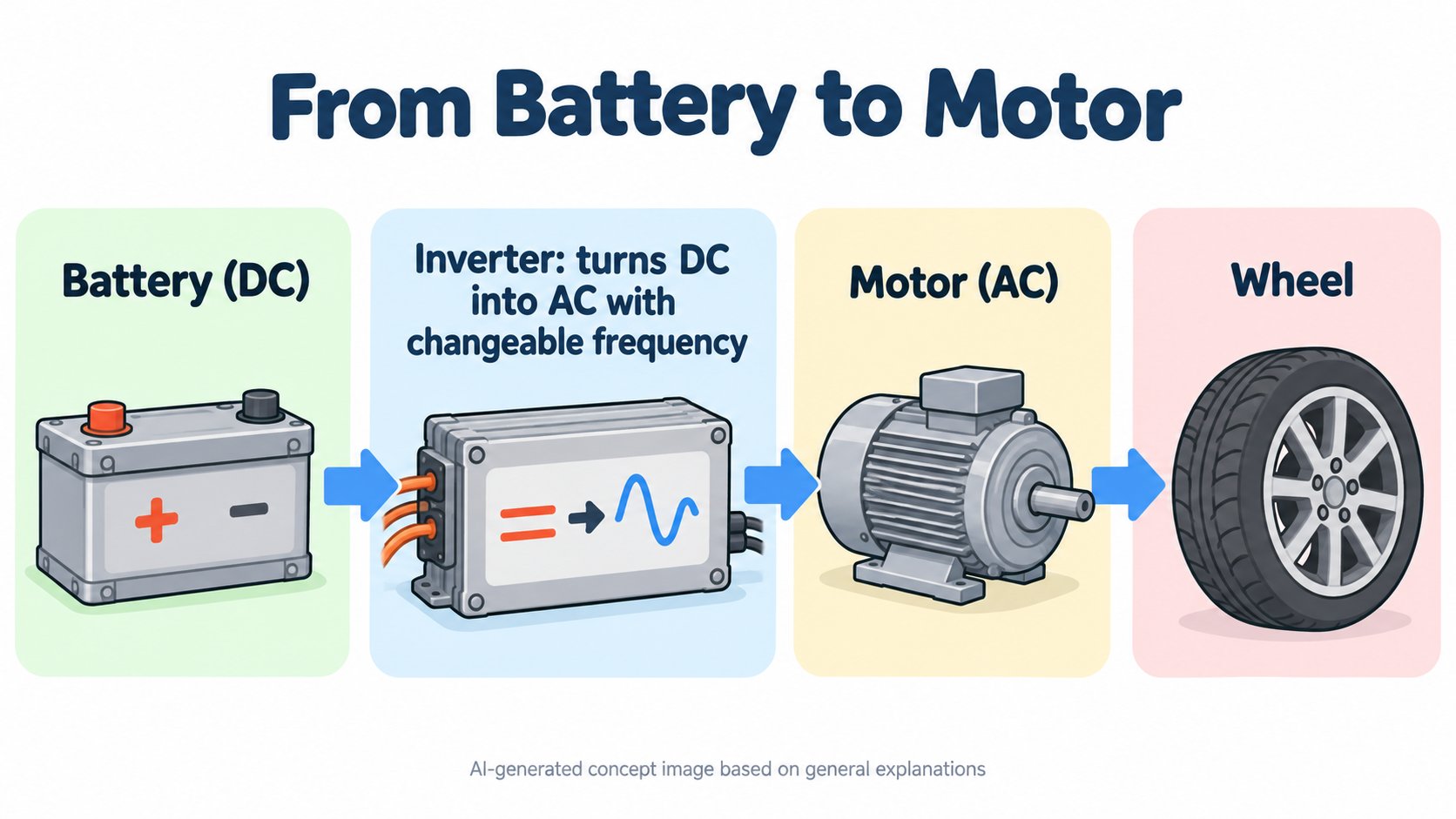
A battery stores direct current (DC). The "variable frequency drive" in the manual is a device that turns DC into alternating current (AC) whose frequency can be changed, in order to run AC motors. Such a device is generally called an inverter (a general explanation).
Changing the AC frequency changes how fast the motor turns. The inverter seems to adjust the electricity sent to the motor to match how far you press the accelerator (the author's reading; the owner's manual does not state this explanation directly).
2023: "the next motor without rare earths"
About Tesla's Investor Day on March 1, 2023, a report (Electrek, March 1, 2023, by Jameson Dow) says Tesla's slide indicated that "the next motor will include a permanent magnet" and that the magnet "will not use rare earth elements." It also says Tesla stated that between 2017 and 2022 it reduced rare earth usage in new Model 3 drive units by 25% while increasing efficiency.
But the report points out that Tesla did not explain which elements would be replaced by what, or when production would start. We could not confirm the original slides or transcript in this article.
What we could not confirm
- The motor types of every current model (Model S, X, Y, Cybertruck and so on).
- The motor's formal name (some third-party articles use names such as "permanent magnet synchronous reluctance motor," but we could not confirm them in official Tesla materials).
- Official figures for the efficiency or output of the motors and inverter.
- The original text of the 2023 event (slides, transcript) and what the rare-earth-free magnets are made of.
From the manual and the designer's comments we can read the idea of "using motors with different strengths at the front and rear to balance efficiency and cost." But we could not confirm how the roles are actually divided between them.
FAQ
How many kinds of motors does Tesla use?
In the Model 3 owner's manual, the rear is a permanent magnet synchronous motor and the front (AWD) is an induction motor. We could not confirm other models in this article.
What is the difference between an induction motor and a permanent magnet motor?
In an induction motor, current is induced in the rotor and it turns. In a permanent magnet motor, magnets in the rotor turn (a general explanation).
What is an inverter?
A device that turns the battery's DC into AC and sends it to the motor. The owner's manual calls it a "variable frequency drive."
Has a rare-earth-free motor been realized?
We confirmed a report of the 2023 announcement. We could not confirm whether it is used in real cars.
Summary
- The Model 3 owner's manual lists the rear as a permanent magnet synchronous motor and the front (AWD) as an induction motor. Both are liquid-cooled and driven by a variable frequency drive.
- In 2018, the designer explained the choice of a permanent magnet motor for the Model 3 as better solving the cost minimization function (a report).
- An inverter turns DC into AC whose frequency can be changed (a general explanation).
- The motors of every current model, efficiency figures and the 2023 originals are unconfirmed.
Next: we will look, in order, at how charging speed changes with temperature and the battery's charge level (coming soon).
Sources (checked 2026-10-15)
- Tesla Model 3 Owner's Manual, "Subsystems" (no date shown): https://www.tesla.com/ownersmanual/model3/en_us/GUID-E414862C-CFA1-4A0B-9548-BE21C32CAA58.html
- Electrek (February 27, 2018, Fred Lambert), "Tesla motor designer explains Model 3's transition to permanent magnet motor": https://electrek.co/2018/02/27/tesla-model-3-motor-designer-permanent-magnet-motor/
- Electrek (March 1, 2023, Jameson Dow), "Tesla is going back to EV motors with no rare earth elements": https://electrek.co/2023/03/01/tesla-is-going-back-to-ev-motors-with-no-rare-earth-elements/
This article is for learning about science and technology, and is not investment advice. Facts and the author's interpretation are kept separate. Figures are AI-generated illustrations.