For the aluminum alloy used in giga-cast body parts, Tesla's patent EP4093894B1, "Die cast aluminum alloys for structural components" (granted October 9, 2024), says the alloy was developed so that no heat treatment is needed after casting. But a patent describes an aim; we could not confirm that the alloy in real production parts is this one.
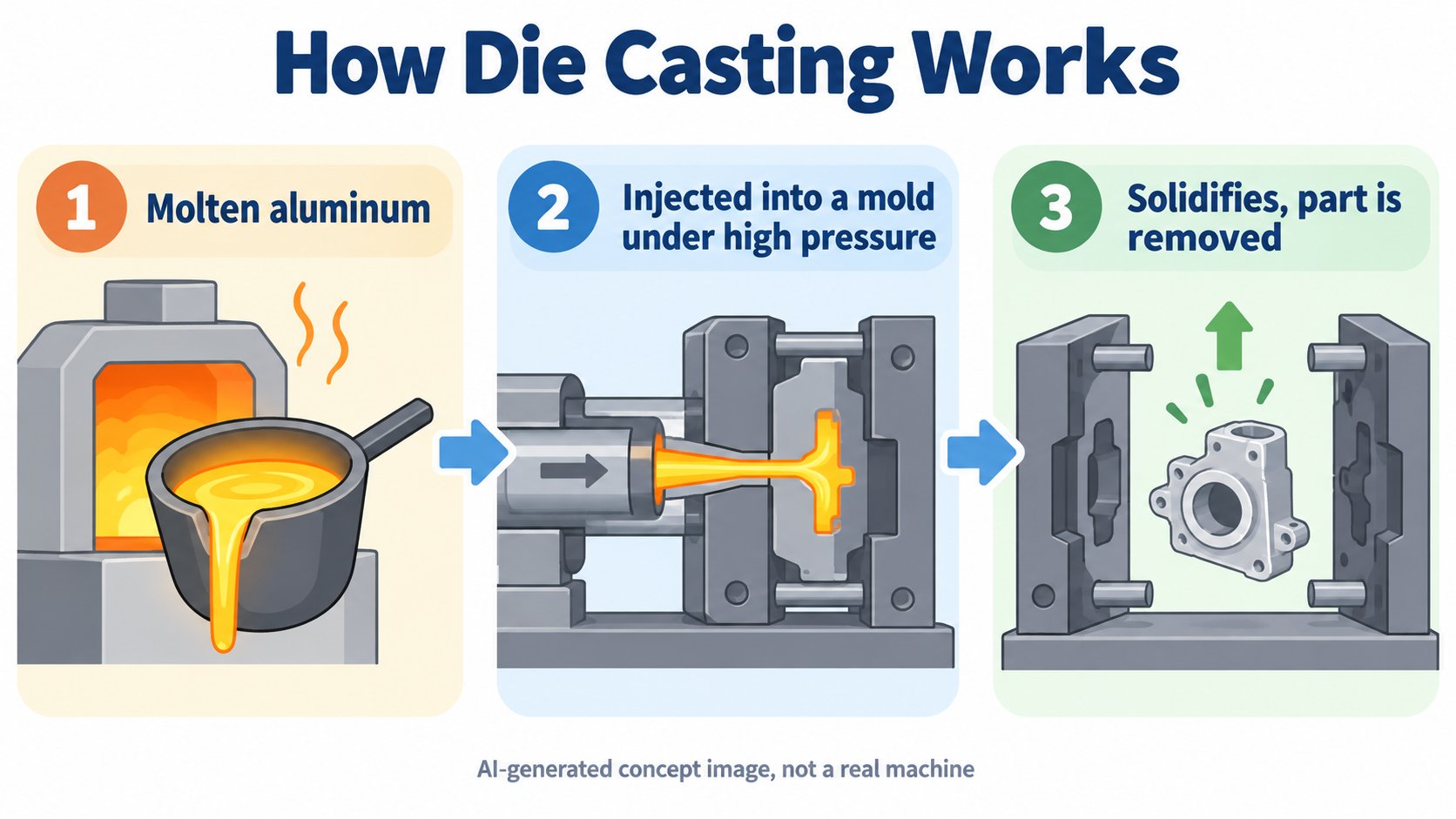
In Episode 6 we explained that Tesla makes part of the body as large parts by pouring molten aluminum into a mold. In this article we look at how the aluminum alloy used there differs from ordinary aluminum, checking against patents.
The conclusion: Tesla's patent aims at "a strong alloy that needs no heat treatment"
Die casting is a method of injecting molten metal into a mold under high pressure to make parts quickly. It suits making complex shapes in large numbers (a general explanation).
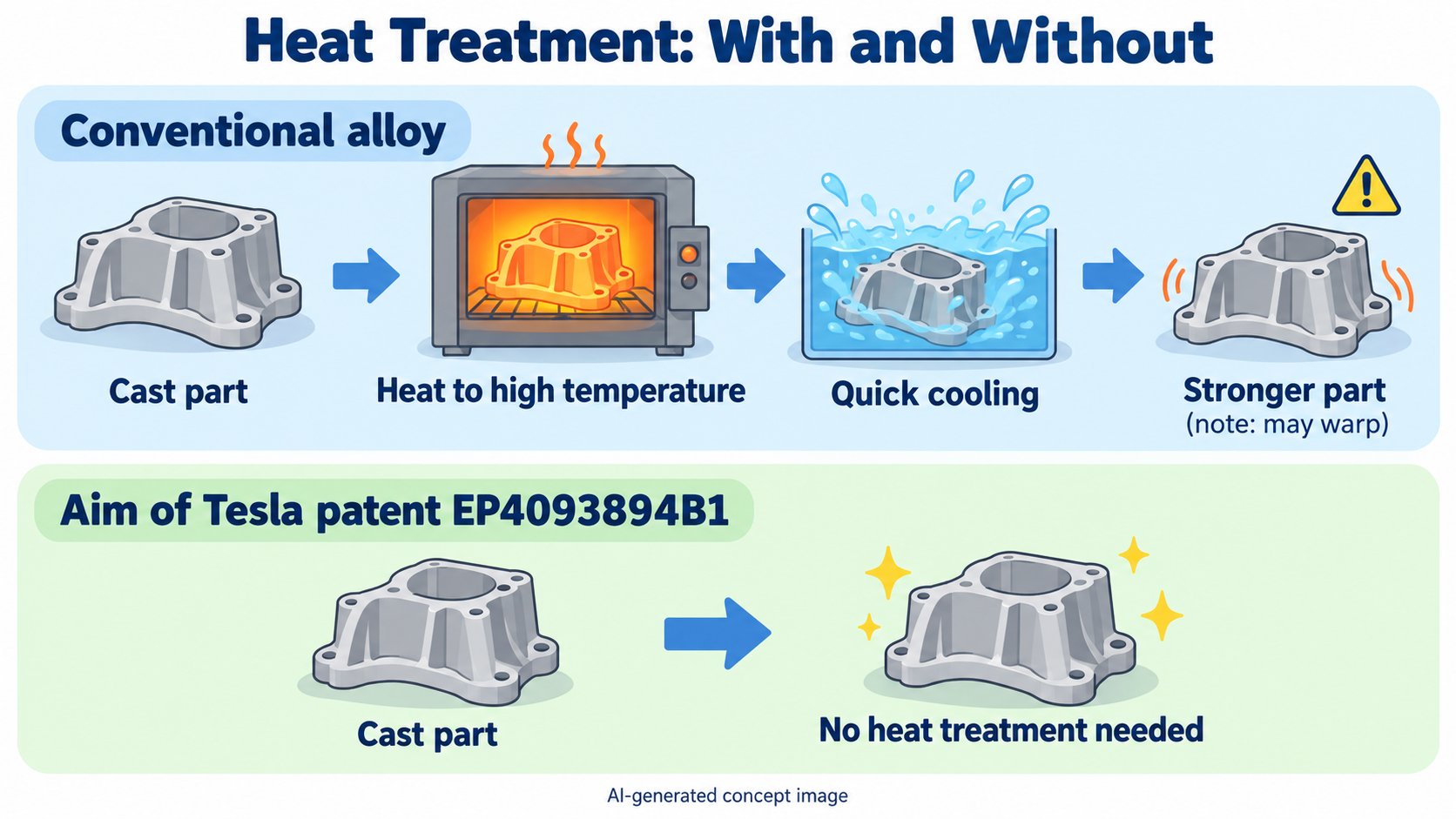
In general, cast parts are sometimes given heat treatment (heating the part to a high temperature and then cooling it quickly) to make them stronger. But quick cooling is said to make parts warp easily and leave internal stress (residual stress) (also a general explanation). The bigger the part, the bigger this problem seems likely to be.
Tesla's patent EP4093894B1 aims at exactly this.
The alloy of this patent was developed to eliminate the need for subsequent heat treatment of the cast alloy.
The patent for structural parts: EP4093894B1
We checked it on Google Patents.
| Item | Content |
|---|---|
| Number and title | EP4093894B1, "Die cast aluminum alloys for structural components" |
| Applicant | Tesla Inc |
| Granted | October 9, 2024 |
| Priority date | January 20, 2020 |
| Status (Google Patents) | Shown as Active. Expiry: January 20, 2041 |
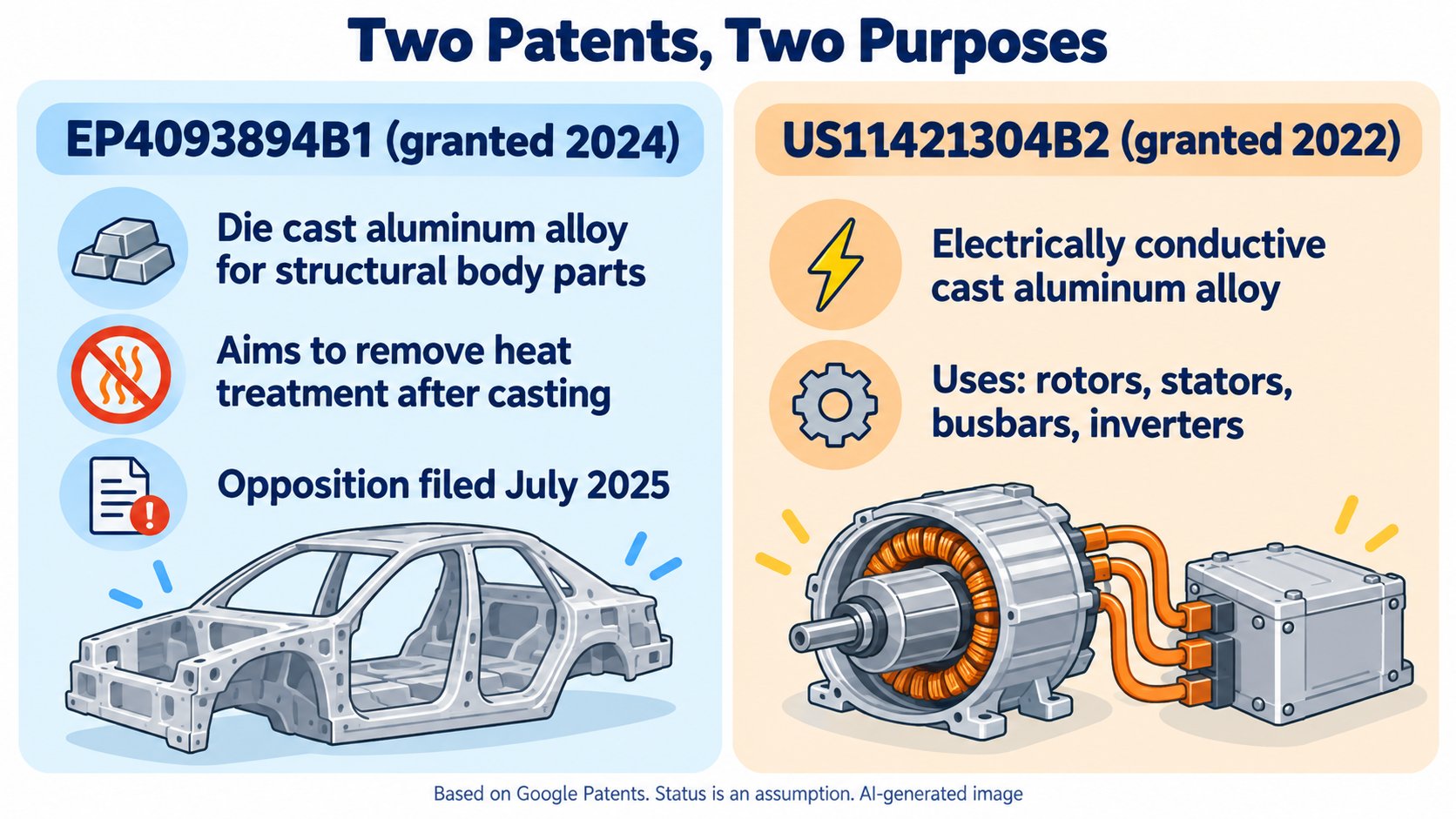
| Note | An opposition (a procedure in which a third party challenges the grant) is recorded as filed in July 2025 |
So this patent has been granted, but an opposition was filed after the grant. We could not confirm the outcome in this article. Google Patents also notes that the status display is "an assumption, not a legal conclusion."
An easily confused patent: US11421304B2
When you look up aluminum alloys, the patent US11421304B2 is sometimes introduced as an alloy for giga casting. We also checked this one in its original text.
| Item | Content |
|---|---|
| Number and title | US11421304B2, "Casting aluminum alloys for high-performance applications" |
| Applicant | Tesla, Inc. |
| Granted | August 23, 2022 |
| Priority date | October 26, 2017 |
| What the abstract says | A cast aluminum alloy with yield strength above 120 MPa and electrical conductivity above 45% IACS. Uses: automotive electrical parts such as rotors, stators, busbars and inverters |
The abstract of this patent describes an alloy that conducts electricity well, and does not say it is for structural body parts. The description also contains a remark, in the sense that "this alloy can be press-quenched and needs no additional solution heat treatment," but the main uses here are electrical parts such as motors.
What we could not confirm
- Whether the cast parts in Tesla's real bodies use the alloy of these patents (we could not confirm a specific alloy name or composition in official materials).
- Detailed information about large casting machines published by the machine makers (we could not confirm the original official announcements).
- Measured data on the strength and life of parts made without heat treatment.
From how the patent is written, we can read the aim of "getting a large part to the needed strength by casting alone." But a patent is a document saying "we thought of this kind of alloy." How much it is used in real cars is a separate matter.
FAQ
How is the aluminum alloy for giga casting different from ordinary aluminum?
Tesla's patent EP4093894B1 explains that the alloy was developed to remove heat treatment after casting. We could not confirm the alloy in real parts.
Has the patent for the giga casting alloy been granted?
EP4093894B1 was granted on October 9, 2024 (shown as active on Google Patents). However, an opposition is recorded as filed in July 2025.
Is US11421304B2 also for giga casting?
Its abstract describes a cast aluminum alloy that conducts electricity well, with electrical parts such as rotors and stators as uses. It does not say it is for structural body parts.
What is good about not needing heat treatment?
In general, less warping and distortion and fewer process steps are expected. Tesla's patent aims at that. We could not confirm figures for the real effect.
Summary
- Die casting injects molten aluminum into a mold under high pressure. The bigger the part, the more likely heat treatment after casting is to cause warping and distortion (a general explanation).
- Tesla's patent EP4093894B1 (granted October 9, 2024) describes an alloy that makes post-casting heat treatment unnecessary. An opposition was filed in July 2025.
- US11421304B2 is a patent for an alloy that conducts electricity well, and does not say it is for the body.
- The alloy name and composition of real parts, and measured data for parts made without heat treatment, are unconfirmed.
Next: we will look, in order, at the "Octovalve" that matters for winter charging (coming soon).
Sources (checked 2026-10-15)
- European Patent EP4093894B1, "Die cast aluminum alloys for structural components" (Tesla Inc, October 9, 2024): https://patents.google.com/patent/EP4093894B1/en
- U.S. Patent US11421304B2, "Casting aluminum alloys for high-performance applications" (Tesla, Inc., August 23, 2022): https://patents.google.com/patent/US11421304B2/en
This article is for learning about science and technology, and is not investment advice. Facts and the author's interpretation are kept separate. Figures are AI-generated illustrations.