NACS is a charging connector Tesla designed and opened to the world on November 11, 2022. Tesla's official blog says it offers AC charging and up to 1 MW DC charging in one slim package. A September 30, 2024 update says NACS is now recognized in SAE recommended practice J3400, and that the design files are inside J3400. But the size and power comparisons are Tesla's own claims, and we could not verify them independently in this article.
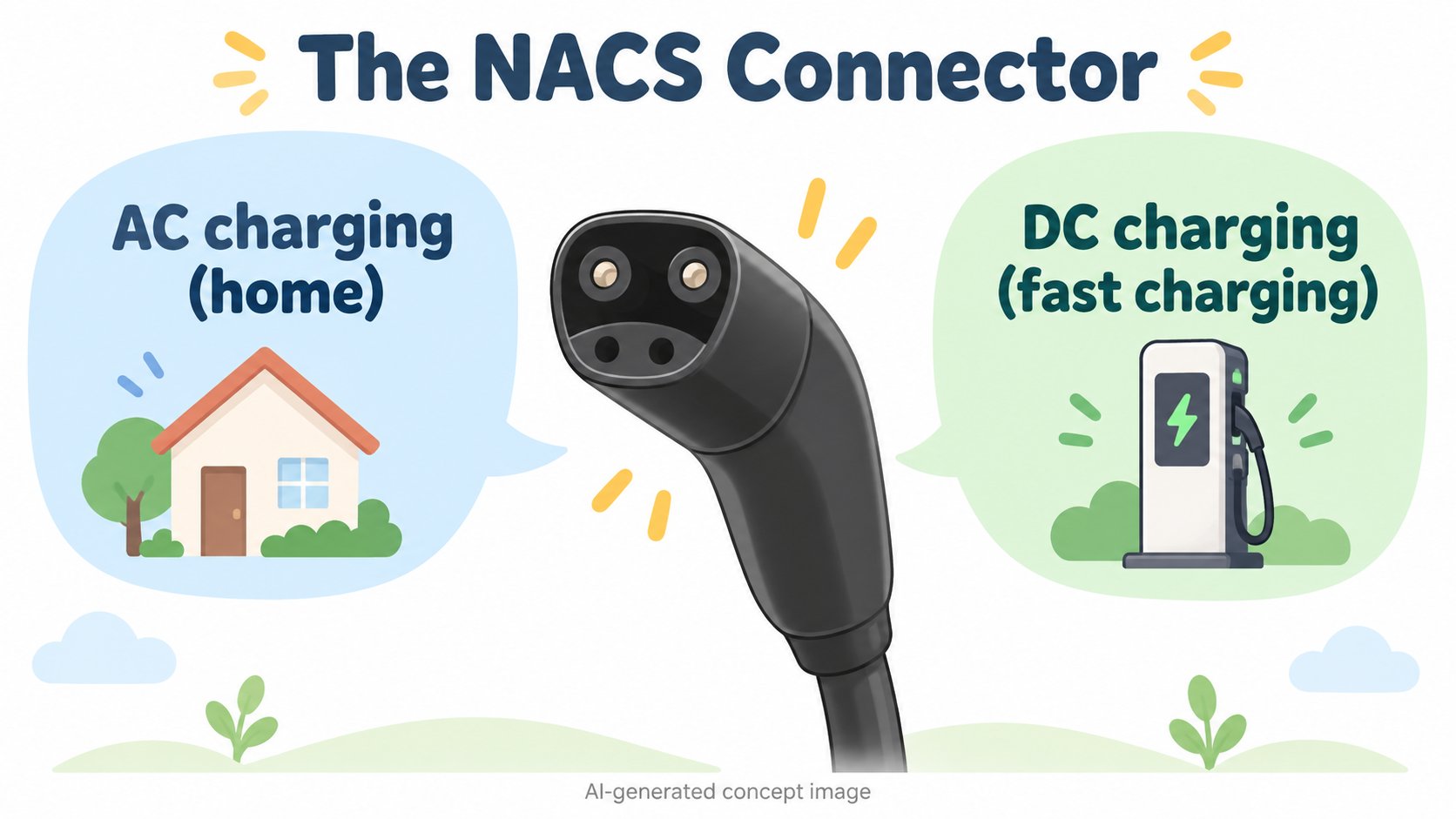
In electric-car charging, the shape of the connector joining the car and the charger can differ by maker and region. In this article we check, against Tesla's official statements, how Tesla's connector became a "standard."
The conclusion: Tesla opened its connector design
Tesla's official blog (The Tesla Team, November 11, 2022) says this.
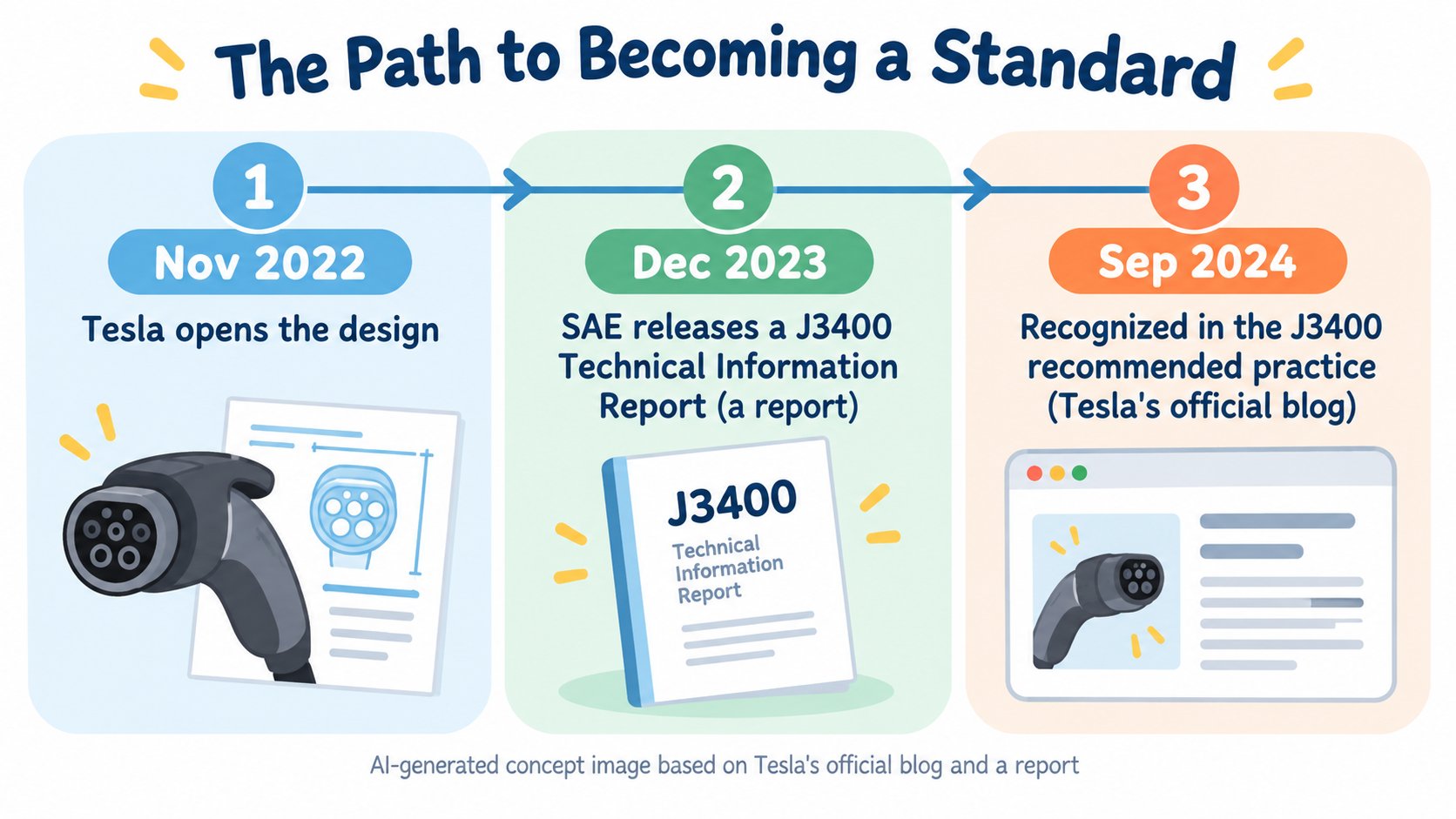
"today we are opening our EV connector design to the world"
The blog calls this connector and charge port the NACS (North American Charging System), and invites charging network operators and automakers to adopt it.
Features Tesla describes
The official blog describes the connector like this.
- It has more than a decade of use and 20 billion EV charging miles.
- It offers AC charging and up to 1 MW DC charging in one slim package.
- It has no moving parts.
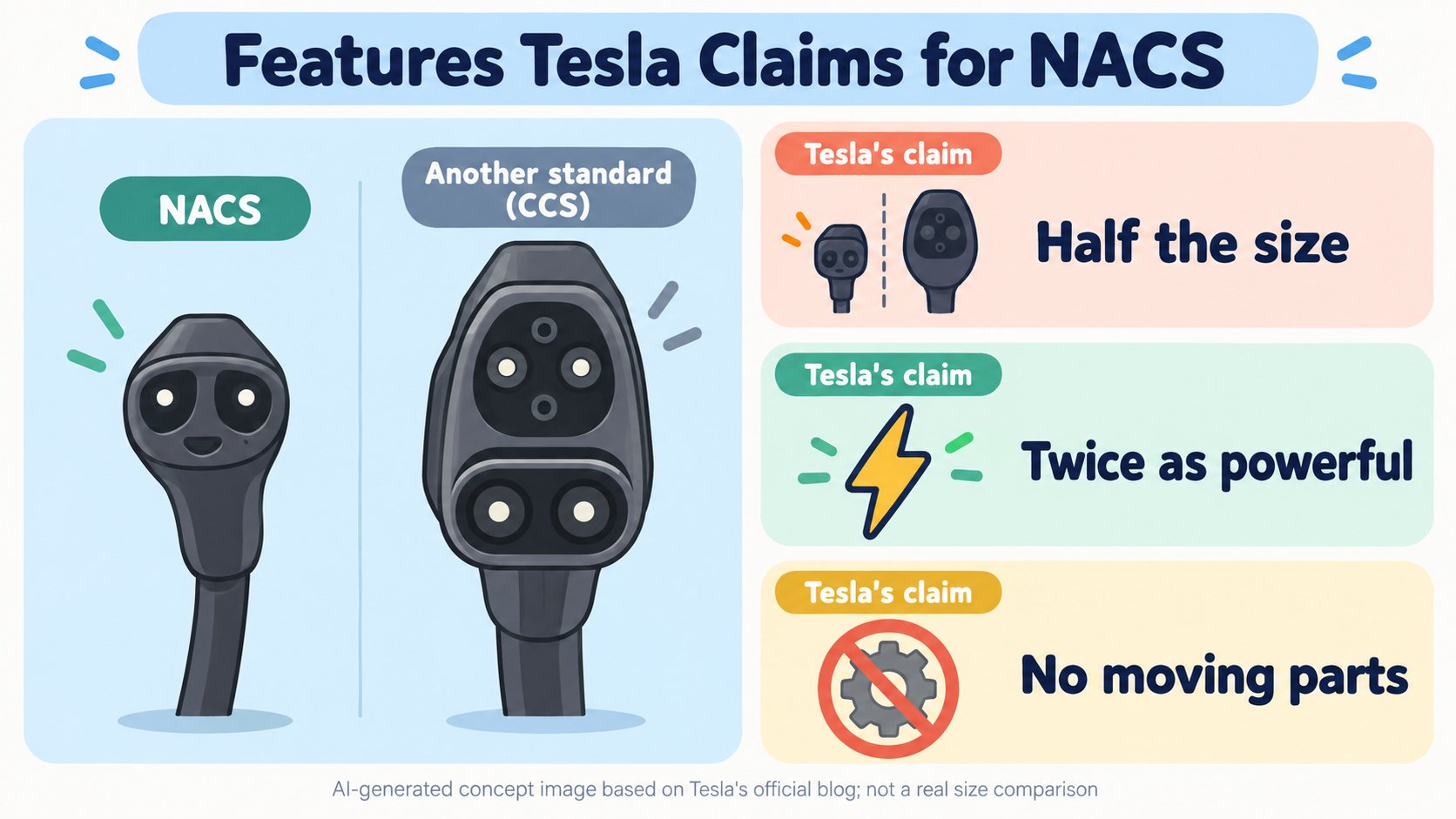
- It is half the size and twice as powerful as CCS (Combined Charging System, another major standard) connectors.
Here, DC charging is the method used for fast charging, and AC charging is the slower charging used at home and similar places.
"Half the size," "twice as powerful" and "up to 1 MW" are Tesla's own claims. We could not confirm them in this article against third-party measurements or standards documents.
Until it became a "standard"
Tesla's blog has an update dated September 30, 2024.
"As NACS is now recognized in a SAE recommended practice (RP) under SAE J3400, we have removed the technical specifications and CAD from our website."
So as of September 30, 2024, the design information is inside a document called SAE J3400. SAE is an organization that makes automotive technical standards.
A report from December 2023 (electrive, December 20, 2023, by Nora Manthey) says SAE released a Technical Information Report (TIR) for J3400. The report explains that a TIR is an early-stage document that comes before a recommended practice and a final standard. The same article also says:
- The U.S. Department of Transportation called the speed of the process "unprecedented."
- The Volkswagen Group agreed to adopt the connector. From 2025, new VW, Audi, Porsche and Scout EVs are planned to have the Tesla port.
What we could not confirm
- The J3400 document itself (a paid document; we could not check its original text). The relationship between TIR, recommended practice (RP) and standard, and its current formal status, should be checked on SAE's official pages.
- Third-party confirmation of "half the size," "twice as powerful" and "up to 1 MW."
- Which automakers have actually adopted it, and since when (reports only convey each company's plans).
- The real charging speeds of cars that adopted it.
From how the blog is written, we can read the aim of "making our own connector a shared shape for the industry." But how widely it has actually spread is not confirmed in this article.
FAQ
What is NACS?
A charging connector and charge port designed by Tesla, whose design was opened on November 11, 2022. The formal name is North American Charging System.
When did NACS become a standard?
An update to Tesla's blog (September 30, 2024) says NACS is now recognized in SAE recommended practice J3400. A report says a J3400 Technical Information Report was released in December 2023.
Is NACS smaller than CCS?
Tesla's official blog claims it is half the size and twice as powerful. We could not verify this independently in this article.
Can other companies' cars use it?
A report says the Volkswagen Group decided to adopt it. We could not confirm each company's current support in this article.
Summary
- NACS is a Tesla-designed connector whose design was opened on November 11, 2022 (Tesla's official blog).
- Tesla claims AC and up to 1 MW DC charging in one slim package. But independent confirmation is unconfirmed.
- Tesla wrote in a September 30, 2024 update that NACS is now covered by SAE J3400.
- The J3400 document itself and each company's real adoption are unconfirmed.
Next: we will look, in order, at the low-voltage (12 V) system in Tesla cars (coming soon).
Sources (checked 2026-10-15)
- Tesla, "Opening the North American Charging System" (The Tesla Team, November 11, 2022, with an update of September 30, 2024): https://www.tesla.com/blog/opening-north-american-charging-system
- electrive (December 20, 2023, Nora Manthey), "Tesla NACS to become an official charging standard in North America": https://electrive.com/2023/12/20/tesla-nacs-is-now-the-official-charging-standard-in-north-america
This article is for learning about science and technology, and is not investment advice. Facts and the author's interpretation are kept separate. Figures are AI-generated illustrations.