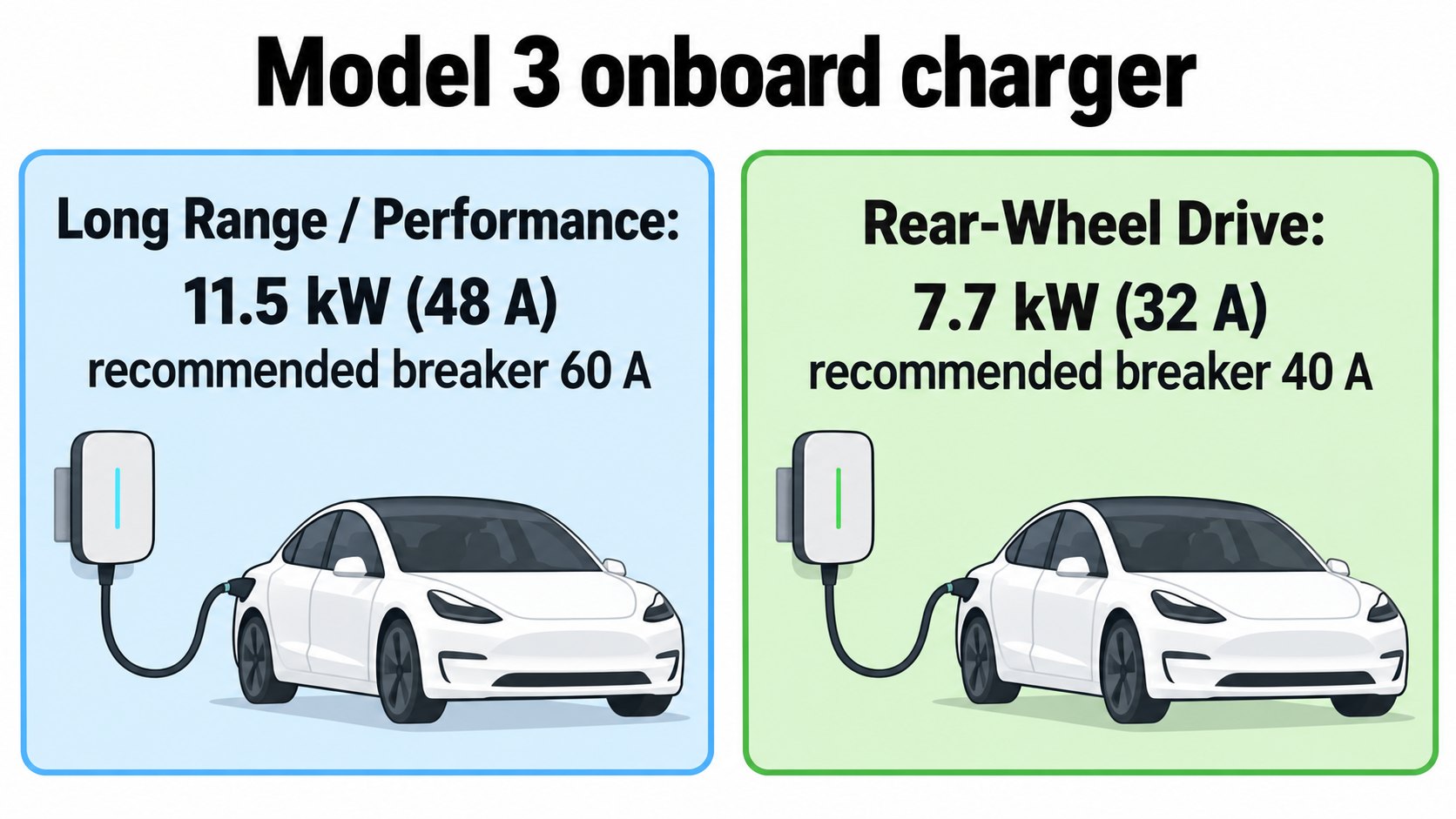
Household electricity is AC, but a battery stores DC. In AC charging, the car's onboard charger converts AC to DC. Tesla's support page lists the Model 3 onboard charger at 11.5 kW (48 A) for Long Range and Performance and 7.7 kW (32 A) for Rear-Wheel Drive, which caps your home charging speed. For example, filling 60 kWh from empty takes about 5.2 hours at 11.5 kW and about 7.8 hours at 7.7 kW (ignoring losses). A Supercharger does the big conversion outside the car, so it is not limited by the onboard charger and can reach up to 250 kW (not every car can charge at 250 kW).
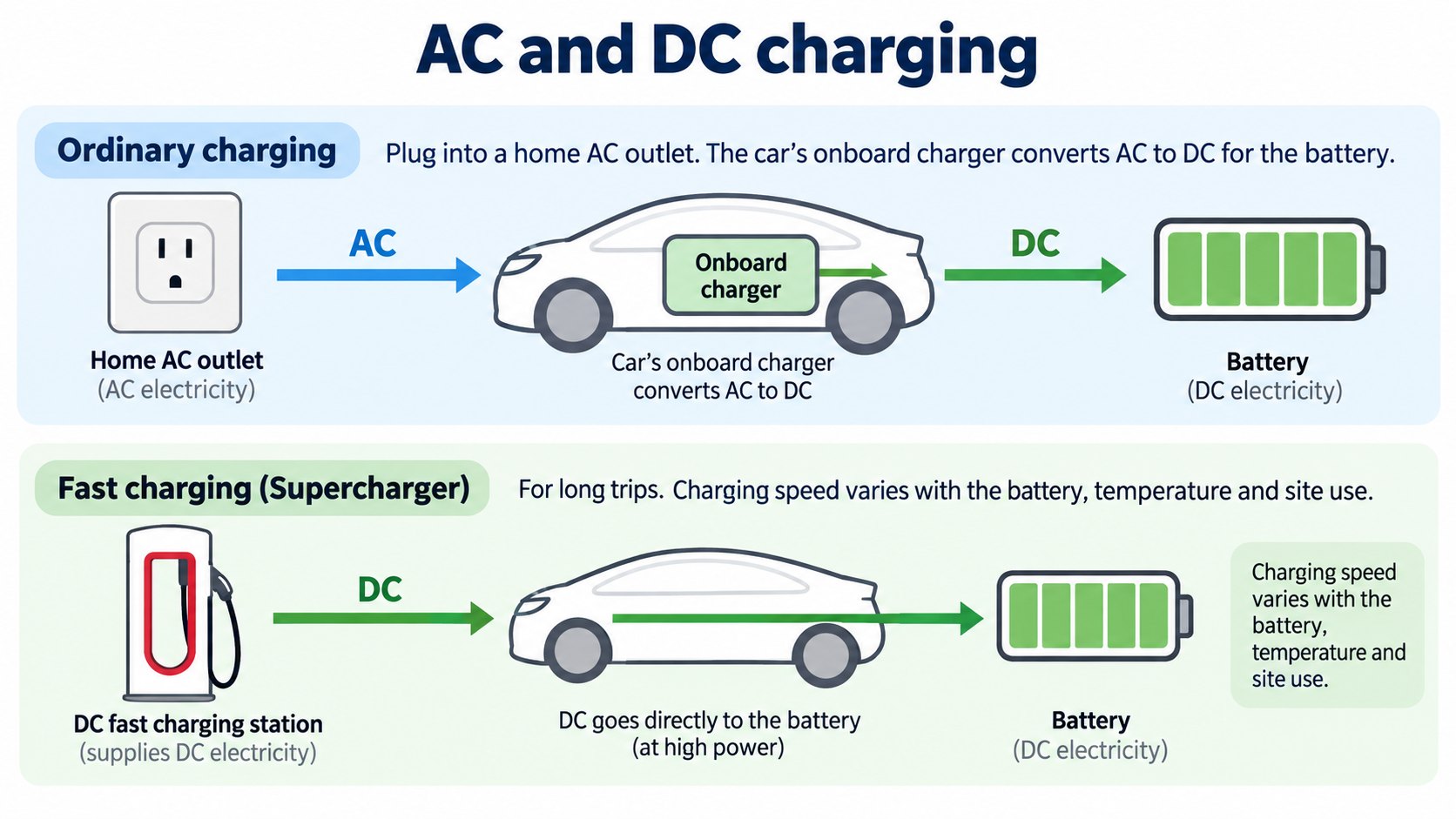
In Part 3 we saw why charging speed changes and the NACS connector. This article comes just before those: what is the difference between "AC charging" and "DC fast charging", and how many hours does it take to fill your car at home? By the end you can calculate it yourself.
Basics 1: AC and DC
Electricity is a flow of electrons through a wire. It flows in one of two ways.
- Direct current (DC): the electricity flows in one direction all the time. Batteries, such as a phone battery, supply DC: from plus to minus, always one way.
- Alternating current (AC): the direction reverses back and forth periodically. The wall outlet supplies AC. In Japan the direction reverses 50 times a second (eastern Japan) or 60 times (western Japan); this rate is called the frequency, in Hz.
Why does AC reach homes? Power plants are far away. When electricity travels far, a higher voltage loses less energy along the way, and AC is easy to step up and down with a transformer (an iron core with coils). That is why power transmission became AC.
But a battery can only store DC. Inside, ions move between the positive and negative materials and energy is stored chemically. That movement matches a one-way flow of electricity, so AC, which keeps reversing, cannot be stored as it is.
So to move energy from the wall (AC) into the battery (DC), something must convert AC to DC. That conversion is the heart of charging.
Basics 2: kW, kWh, and V × A = W
Charging uses similar-looking units. Let's separate them.
| Unit | Meaning | Analogy |
|---|---|---|
| kW (kilowatt) | Power: how much electricity is delivered per second. A "speed" | How hard water flows from a tap |
| kWh (kilowatt-hour) | Energy: an amount of electricity. Using 1 kW for 1 hour is 1 kWh | Water collected in a bucket |
Power is voltage (V) × current (A).
- Voltage (V): the "push" on the electricity, like water pressure.
- Current (A): how much flows, like water volume.
- Power (W) = V × A. 1000 W is 1 kW.
A Japanese household outlet is 100 V. At up to 15 A that is 100 × 15 = 1500 W = 1.5 kW, the rough maximum from an ordinary outlet.
In short: the battery is DC, and AC charging converts inside the car
Tesla's support page "Onboard Charger" says (summarized):
- The Wall Connector and the Mobile Connector send AC electricity to the car.
- The battery stores energy as DC.
- The onboard charger inside the car converts AC to DC so the battery can store it.
So in AC charging, the converter is inside the car, and its size (output) sets the speed limit of home charging. The Wall Connector itself just hands AC to the car, like a safe outlet.
The Model 3 onboard charger output
The support page table says:
| Model | Onboard charger | Recommended circuit breaker (for Wall Connector) |
|---|---|---|
| Model 3 Long Range | 11.5 kW (48 A) | 60 A |
| Model 3 Performance | 11.5 kW (48 A) | 60 A |
| Model 3 Rear-Wheel Drive | 7.7 kW (32 A) | 40 A |
- Touching the lightning bolt icon on the screen shows your car's maximum amps.
- Tesla recommends installing a Wall Connector at home and keeping the Mobile Connector in the trunk as a backup for trips.
You can read these numbers with V × A = W: 11.5 kW ÷ 48 A ≈ 240 V and 7.7 kW ÷ 32 A ≈ 240 V. They assume a North American 240 V supply. The breaker is larger than the current (60 A vs 48 A, 40 A vs 32 A) because power flows for hours, so the current is kept to about 80% of the limit (that 80% is a general North American electrical practice, not wording from the page).
Let's calculate: how many hours to fill up?
Time = energy (kWh) ÷ power (kW). That's all.
Suppose you add 60 kWh from empty (battery sizes differ by model, so this is a practice number):
- 11.5 kW onboard charger: 60 ÷ 11.5 ≈ 5.2 hours
- 7.7 kW onboard charger: 60 ÷ 7.7 ≈ 7.8 hours
- Japanese 100 V outlet (1.5 kW): 60 ÷ 1.5 = 40 hours
In reality some energy is lost as heat in conversion, so it takes a little longer. Still, this shows why filling up overnight (8 to 10 hours) with AC charging works. A 100 V outlet alone adds only about 12 to 15 kWh a night (1.5 kW × 8 to 10 hours), so check whether that covers your daily driving.
Why is DC fast charging fast?
The converter inside the car (onboard charger) is carried on the car, so its size, weight and cost are limited. 11.5 kW is one practical example.
A Supercharger, by contrast, is a large dedicated charger outside the car. It puts the AC-to-DC converter on the charger side (this is the general way DC fast charging works; Tesla's pages do not spell out where the conversion happens). It then sends DC almost directly to the battery. It bypasses the small converter in the car, so it is not limited by it.
Tesla's support page "Supercharging" says (summarized):
- Superchargers are best for long trips and charge quickly. Charging at home is best for daily commuting and local trips.
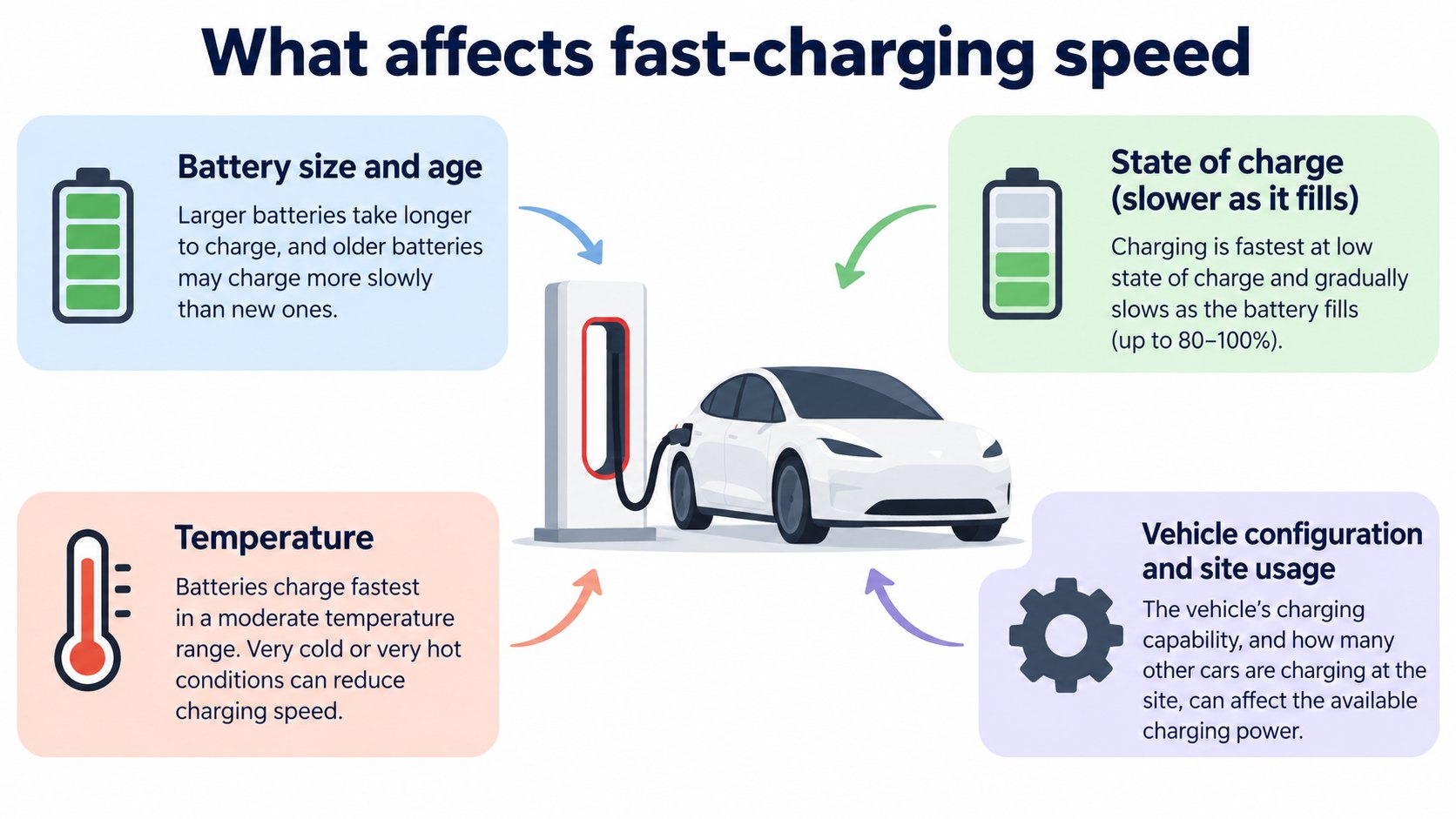
- Speed varies with battery size and age, state of charge, temperature, and vehicle configuration.
- Model 3: up to 175 miles in 15 minutes (Tesla's figure, about 280 km). Model Y 162 miles, Model S 200 miles.
- V3 Superchargers have a maximum of 250 kW, but not every vehicle can charge at 250 kW.
- Speed slows as charging progresses. Charging to 100% usually takes much longer than charging to 80%.
- At busy sites the charge limit may be set to 80% automatically (you can raise it manually).
- If it is slower than expected: the car and charger negotiate the speed, and state of charge, battery temperature, site usage and extreme weather change it.
250 kW is about 22 times 11.5 kW. If you could hold 250 kW, the 60 kWh that takes 5.2 hours at 11.5 kW would take about 14 minutes. But speed drops as charging progresses, so 250 kW does not last. Why it drops is covered in why charging speed changes.
A rule of thumb for choosing
| Situation | Best charging | Why |
|---|---|---|
| Daily commute, local trips | Home AC charging | Fills slowly overnight; Tesla also recommends home charging |
| Long trips | Supercharger (DC) | 15 to 30 minutes of break recovers a lot |
| Suddenly short on the road | Mobile Connector (AC) or a Supercharger | Keep it in the trunk as a backup |
FAQ
What is the difference between AC and DC charging?
Where AC is converted to DC. In AC charging the car's onboard charger converts it, so the car's equipment sets the speed limit. In DC fast charging a large charger outside converts it and sends DC directly, so it is faster.
What is the difference between kW and kWh?
kW is the "speed" (power) and kWh is the "amount" (energy). Using 1 kW for 1 hour is 1 kWh.
Can I charge from a 100 V home outlet?
Electrically yes, but at about 1.5 kW (100 V, 15 A) it is very slow: roughly 40 hours for 60 kWh. For daily use Tesla recommends installing a Wall Connector.
What is an onboard charger?
A charger built into the car that converts AC from home into the DC the battery stores (Tesla support).
Does a Supercharger always charge at maximum speed?
No. It changes with state of charge, temperature, site usage and weather, and slows as charging progresses (Tesla support).
Should I fast charge to 100%?
Tesla says charging to 100% takes much longer than to 80%. On long trips the car's navigation suggests how much you need to reach the next Supercharger.
Summary
- A battery stores only DC, and household electricity is AC. A conversion is needed somewhere.
- kW is speed, kWh is amount. Power (W) = V × A. Time = kWh ÷ kW gives charging time.
- In AC charging the car's onboard charger converts. The Model 3 is 11.5 kW (48 A) for Long Range and Performance and 7.7 kW (32 A) for Rear-Wheel Drive (Tesla).
- A Supercharger converts in a large charger outside the car, up to 250 kW (not every car). Speed drops as charging progresses.
- Basic rule: home AC charging for daily use, Superchargers for long trips.
Next question: why does the speed drop as charging progresses? We look inside the battery in why charging speed changes.
Sources (checked 2026-10-16)
- Tesla Support, "Onboard Charger": https://www.tesla.com/support/charging/onboard-charger
- Tesla Support, "Supercharging": https://www.tesla.com/support/charging/supercharging
This article is for learning about science and technology and is not investment advice. Official statements and general explanations are kept separate (parts marked "general" are not wording from the official pages). Figures are AI-generated illustrations.
Thank you for reading. Was this article useful to you?
Thank you. If you like, tell us what you thought in a line or two.
Optional. No name or email needed.
Received. We will use your words to make better articles.