[PR] This article contains advertising (affiliate links). We only recommend books and materials whose contents we have checked. About advertising
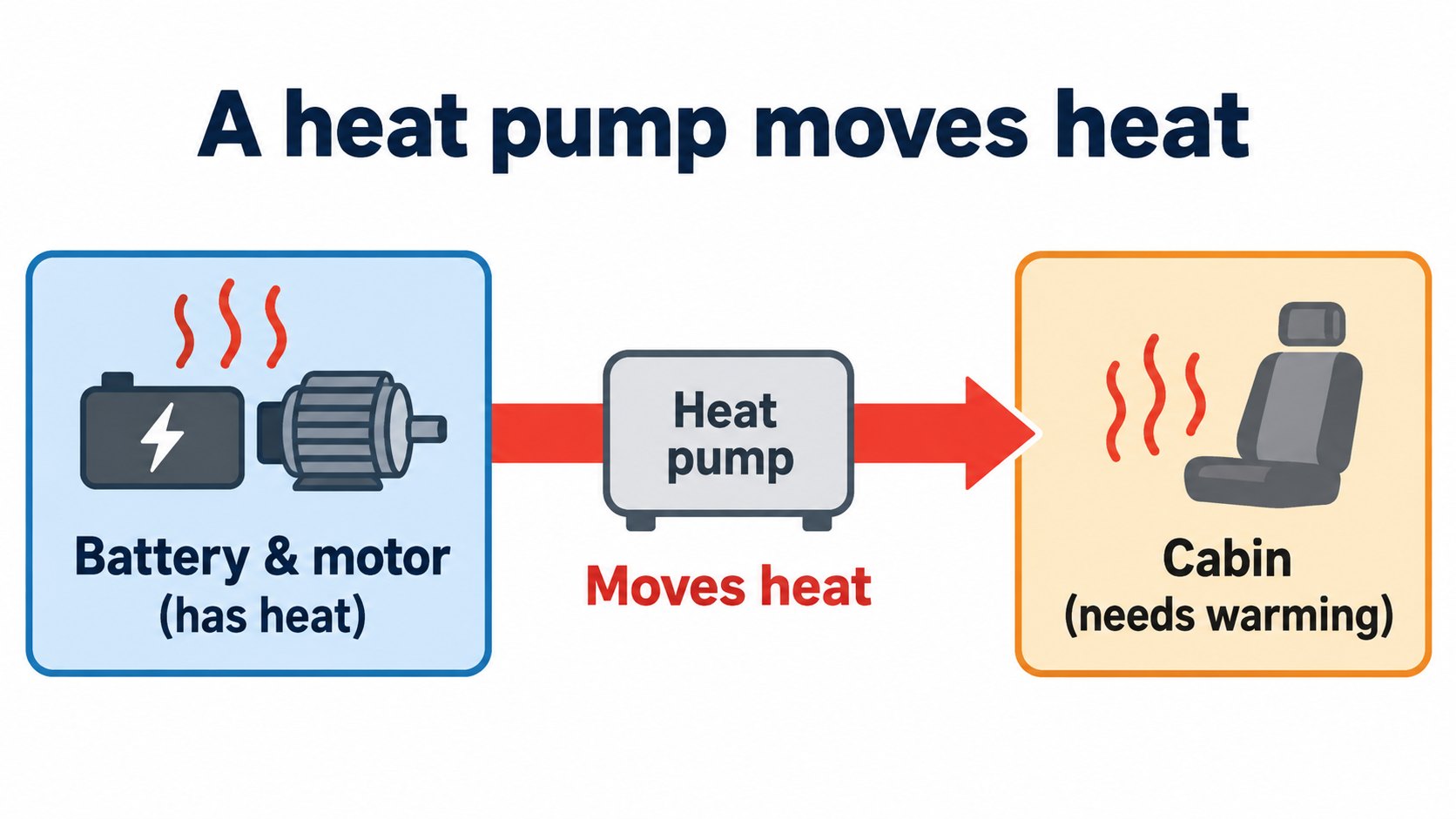
A heat pump does not "make" heat; it "moves" it from one place to another. Tesla's Range Tips page says an electric powertrain produces little waste heat compared with a gasoline car, so cabin heating uses battery energy. On cars with a heat pump, heat is recovered from vehicle components to reduce that energy use. The owner's manual says lowering the acceleration mode lets the heat pump take more heat from the battery to warm the cabin.
In Part 2, The flow of heat, we looked at both cooling and warming in an EV. In this article we check the heat pump, which matters for winter heating, in Tesla's official sources.
The conclusion: a heat pump "moves" heat rather than "making" it
A gasoline engine gives off a lot of heat when it runs, and that heat can warm the cabin in winter. An electric motor is very efficient and gives off little heat. Tesla's Range Tips page says (summary):
- A Tesla's electric powertrain produces minimal waste heat compared with a gasoline car.
- So the car uses battery energy to heat the cabin, which affects range.
- On cars equipped with a heat pump, it recovers heat from vehicle components and reduces the energy used.
[A note for beginners]
Waste heat is heat that escapes when power is produced and cannot be used for the main job. A heat pump works on the same principle as a refrigerator or air conditioner: it uses electricity to move heat from a colder place to a warmer one. In some conditions it can warm a space with less electricity than a plain electric heater that makes heat directly.
[What we could not confirm in this article]
The explanation of the principle above is general knowledge. We could not find, in Tesla's official sources, a diagram of how the heat pump works or a figure such as "how many times more efficient than a heater".
Whose heat does it use? What the official sources confirm
Two points are stated clearly.
- Heat from vehicle components is recovered (Range Tips). The page does not say which components.
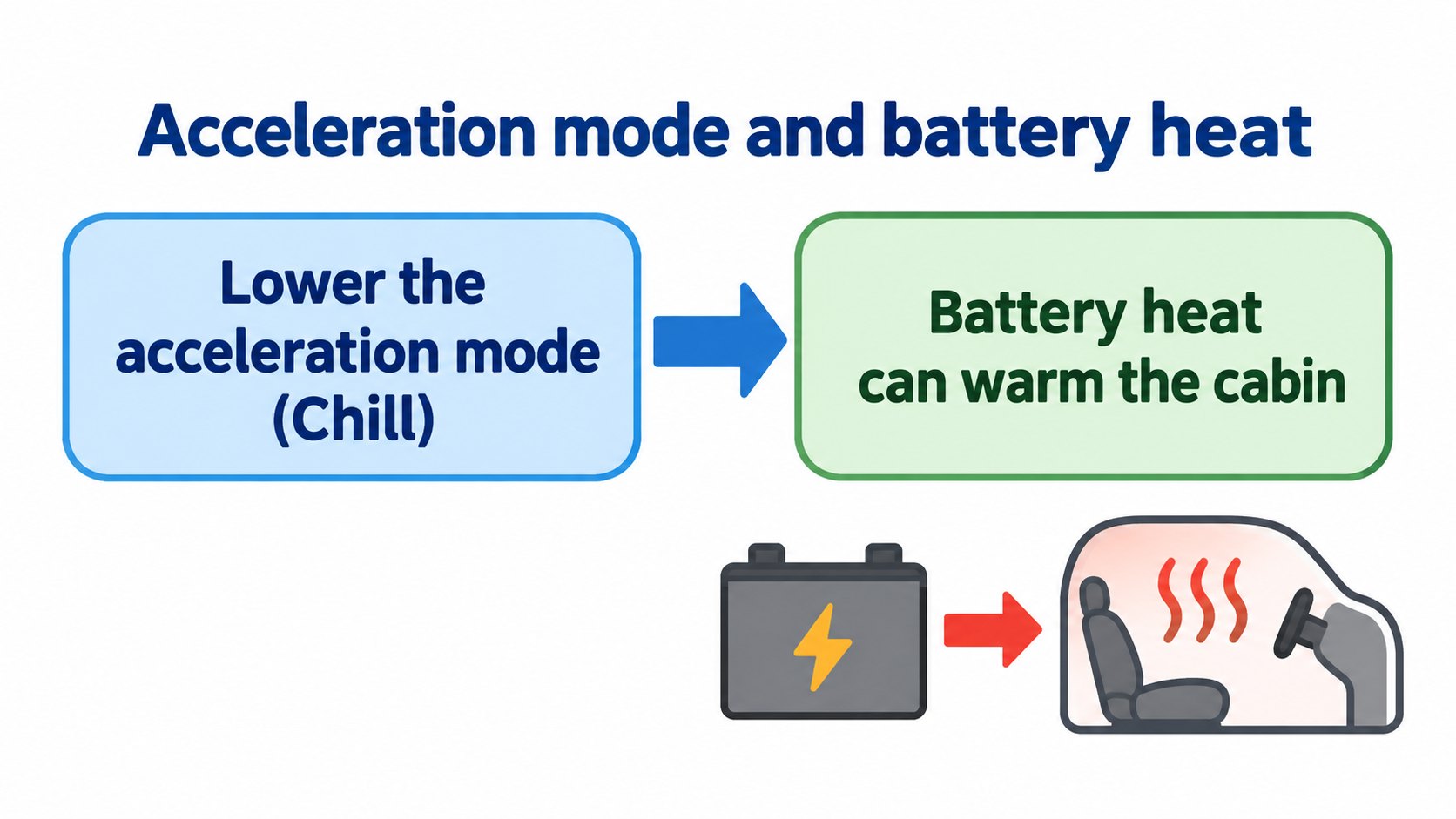
- Battery heat is used. The Model Y owner's manual (North America, software 2026.32) says (summary) that lowering the acceleration mode lets the heat pump take more heat from the battery to warm the cabin, instead of keeping the battery ready for peak acceleration. This helps efficiency in cold weather. When you raise the acceleration mode again, the battery needs time to warm up.
Some articles say heat from the motor and the computer is also used. We could not confirm that on the official pages we read.
Tips for winter efficiency (Tesla's guidance)
Tesla's Range Tips page suggests (summary):
- Set climate control, seat and steering-wheel heating to "Auto". The smaller the gap between outside and set temperature, the less energy is used.
- Reduce the acceleration mode (Controls > Pedals & Steering > Acceleration). "Chill" is the most energy-efficient, especially in cold weather.
- Precondition the battery before you leave, ideally while charging. The heat pump can use the battery's heat to warm the cabin and the battery while driving.
The Model Y owner's manual (Japanese version) also says that on cars with a heat pump, preconditioning lets battery heat warm the cabin while driving, which reduces energy use. We covered preconditioning in Battery preconditioning.
Why does the compressor run on a cold day?
The owner's manual also explains behaviors you may notice:
- Even when it is cold and the car is heating, the air-conditioning compressor and external fan may run and make noise, because the car is designed to maximize efficiency automatically.
- The compressor cools the battery as well as the cabin, so in hot weather it can run even when you turned A/C off.
- Even when parked, you may hear whining or water circulating, as internal cooling runs to maintain the low-voltage and high-voltage batteries.
- A small puddle under the car is condensation from dehumidifying, which is normal.
A compressor running in cold weather fits the idea of a heat pump, which also uses a compressor. But how the compressor is used at each stage of heating is not described in detail in the official sources we read.
Three high-voltage fuses (service manual)
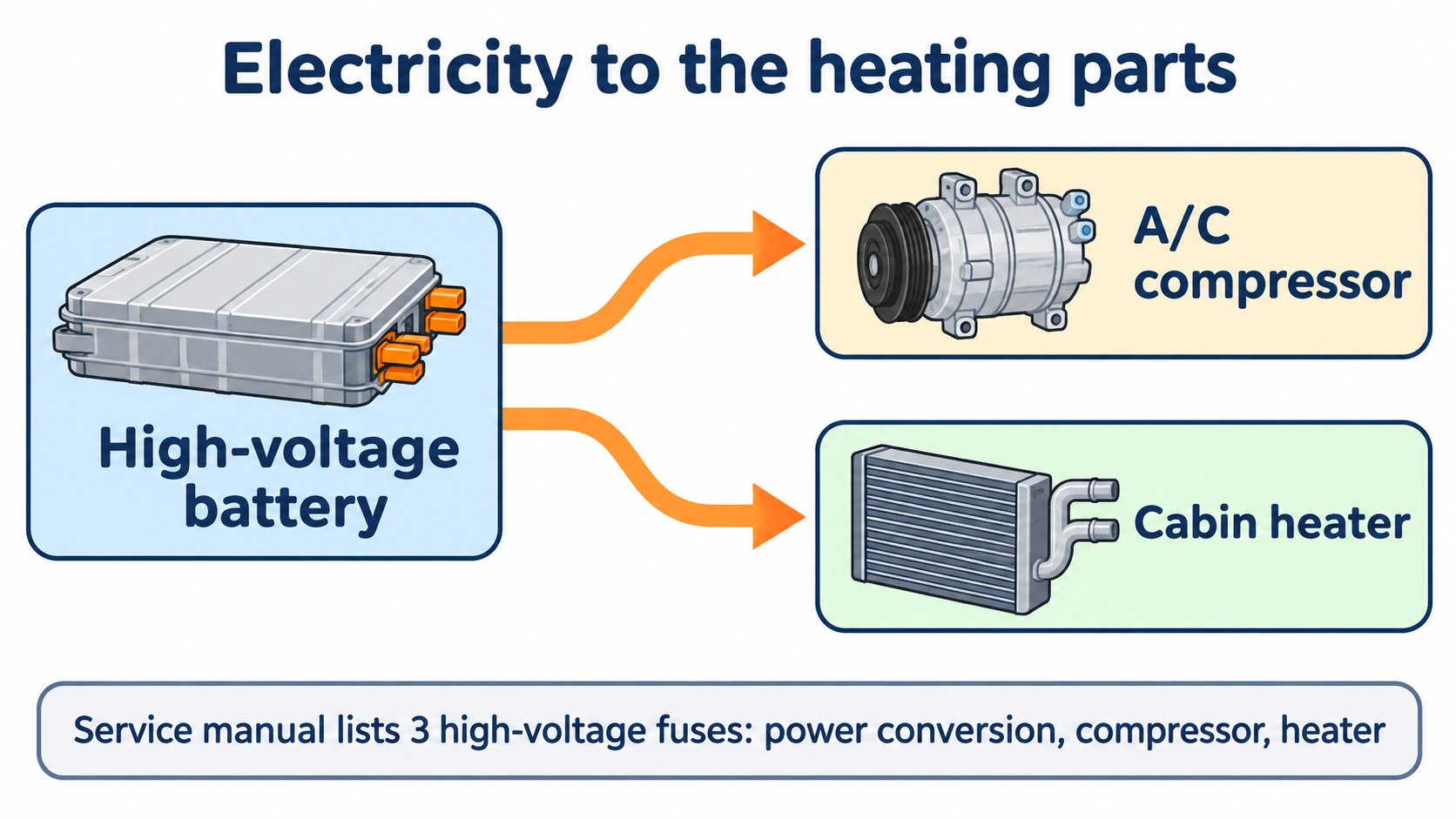
The Model 3 service manual procedure "Fuse - Ancillary Bay" lists three high-voltage fuses: the power conversion system, the A/C compressor and the cabin heater. Its figures distinguish "heat pump vehicles" from "non-heat pump vehicles". This shows the compressor and the cabin heater are parts fed from the high-voltage battery. The procedure is for technicians with high-voltage certification, not for owners.
What we could not confirm
- Efficiency figures for the heat pump (for example, times better than a heater).
- Which models and years have a heat pump, and availability in Japan.
- How heat from the motor and computer is recovered.
- How parts that switch coolant paths, such as the Octovalve, are used in heating (the link between the patent in the Octovalve article and actual heating operation).
[The author's reading, not a confirmed fact]
What the official sources suggest is this: an EV has little waste heat, so heating affects range, and the heat pump is a countermeasure that can also use battery heat. But how much it helps is unknown to us, as we found no figures. It will surely vary with real conditions.
FAQ
What is a heat pump?
A device that moves heat rather than making it. According to Tesla's page, on cars with a heat pump, heat is recovered from vehicle components, reducing the energy used for heating.
How can I be more efficient in winter?
Tesla suggests setting climate control to Auto, lowering the acceleration mode ("Chill" is the most efficient), and preconditioning the battery before departure.
Is it a fault if I hear the A/C when it is cold?
The owner's manual says the compressor and external fan can run and make noise even in cold weather while heating or Supercharging. If you are concerned, check the manual or ask Tesla Service.
Does my car have a heat pump?
We could not confirm that here. Check the official specifications for your car.
> [Continue with a book (PR)]
> Battery heat can warm the cabin in winter. If you now wonder what the battery itself is made of and how it connects to the motor, these Japanese-language books may help.
> - "Zukai Maruwakari: Denki Jidosha no Shikumi" (Kenichi Kawabe, Shoeisha): an illustrated introduction following the battery, motor and control (per the description). Its contents include "Batteries and power supply" and "The motor as power source". There is no chapter on heat or climate control.
> - "Bunkei no tame no Eco Cute Nyumon" (an introduction to Eco Cute for non-science readers) (Mangabito, e-book): a short explanation, without formulas, of how a heat pump "moves heat rather than making it", the refrigeration cycle and refrigerants. It focuses on home water heaters, not cars.
> We checked the contents list and description on DMM Books for both (we have not read the full text). The article's content is not changed by advertising.
Summary
- A heat pump moves heat. An EV has little waste heat, so heating uses battery energy and reduces range (Range Tips).
- Cars with a heat pump recover heat from vehicle components. Lowering the acceleration mode lets it take more heat from the battery (owner's manual).
- In winter, use Auto, lower the acceleration mode and precondition to be more efficient (Range Tips).
- Efficiency figures, which models have it, and recovery of motor heat were not confirmed.
Sources (checked 2026-10-16)
- Tesla Support, "Range Tips": https://www.tesla.com/support/range
- Model Y Owner's Manual, "Operating Climate Controls" (North America, software 2026.32): https://www.tesla.com/ownersmanual/modely/en_us/GUID-4F3599A1-20D9-4A49-B4A0-5261F957C096.html
- Model Y Owner's Manual (Japanese), "Scheduled Precondition and Charge": https://www.tesla.com/ownersmanual/modely/ja_jp/GUID-76995CEC-6402-4BFF-99FA-CEFA36E64A19.html
- Model 3 Service Manual, "Fuse - Ancillary Bay (Remove and Replace)": https://service.tesla.com/docs/Model3/ServiceManual/en-us/GUID-B2E6D454-DF92-4452-B707-CBC9295FCFD9.html
This article is for learning about science and technology and is not investment advice. Facts and the author's reading are kept separate. The figures are AI-generated illustrations.
Thank you for reading. Was this article useful to you?
Thank you. If you like, tell us what you thought in a line or two.
Optional. No name or email needed.
Received. We will use your words to make better articles.