Regenerative braking slows the car when your foot is off the accelerator and feeds surplus power back to the battery. Tesla's Model 3 owner's manual (software 2026.32, North America) says regeneration may be limited when the battery is cold or already fully charged. If you want the same deceleration feel even then, the setting "Apply Brakes When Regenerative Braking is Limited" lets the regular brakes engage automatically.
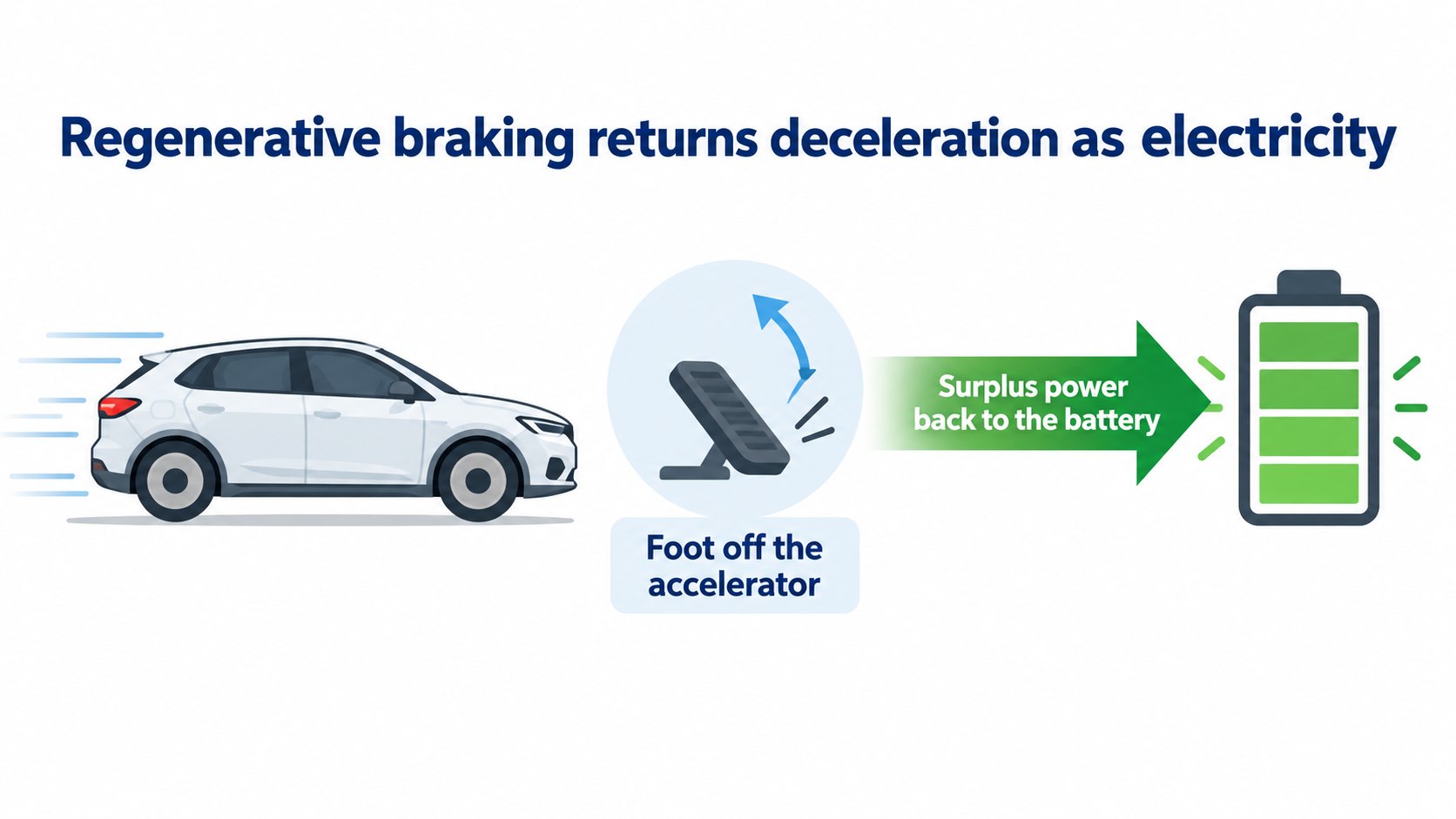
In Part 2, The flow of electricity, we saw electricity flow from the battery to the motor. With regenerative braking, electricity flows the other way, back to the battery. In this article we check what Tesla's owner's manual says.
The conclusion: lifting your foot slows the car and returns electricity, but it depends on the battery
The Model 3 owner's manual (Braking and Stopping, North America, software 2026.32) says (summary):
- Whenever the car is moving and your foot is off the accelerator, regenerative braking slows it down and feeds surplus power back to the battery.
- By anticipating stops and easing off the accelerator, you can use regenerative braking to increase driving range.
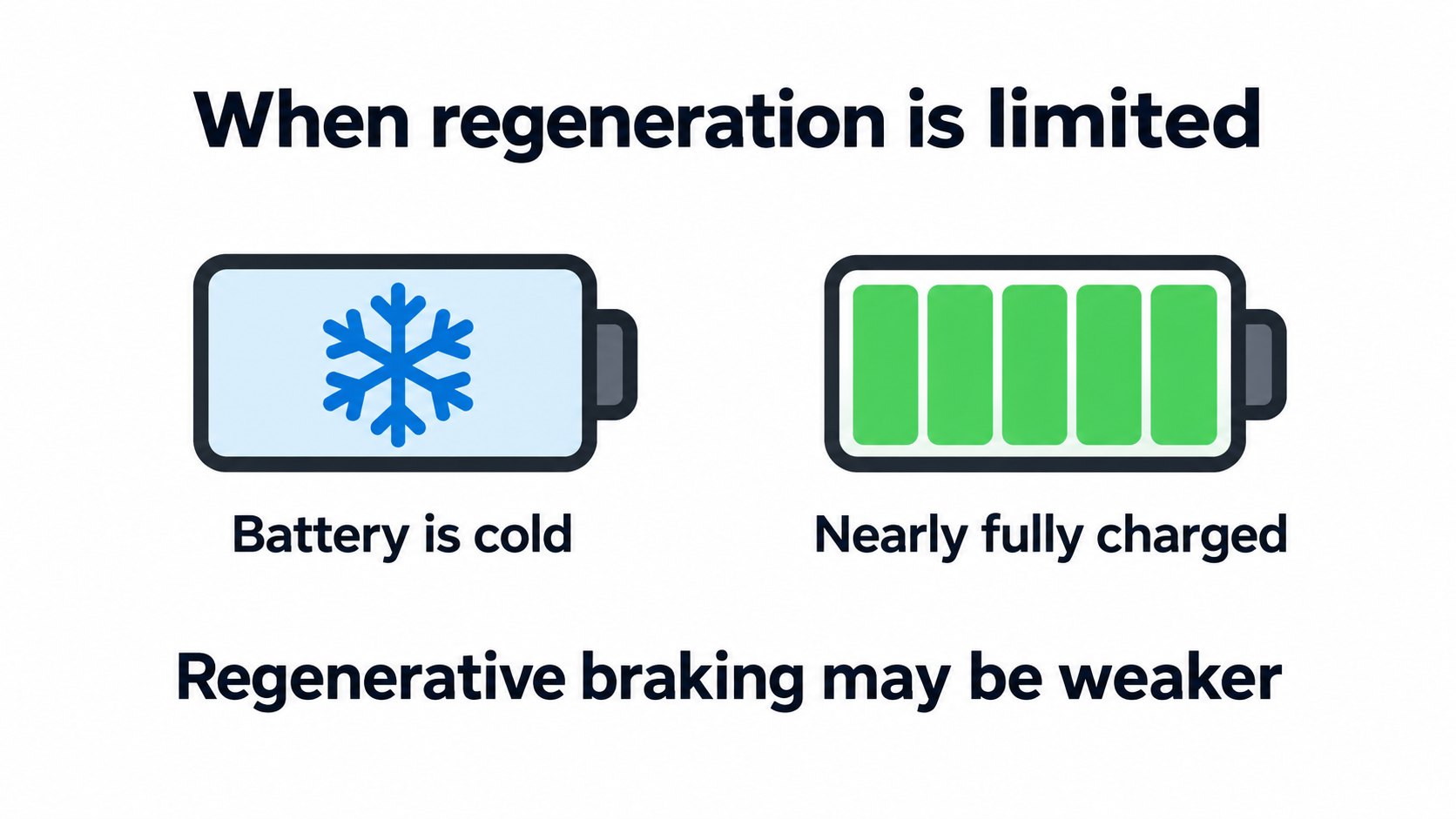
- The amount of deceleration varies with the state of the battery. For example, regeneration may be limited if the battery is cold or already fully charged.
[A note for beginners]
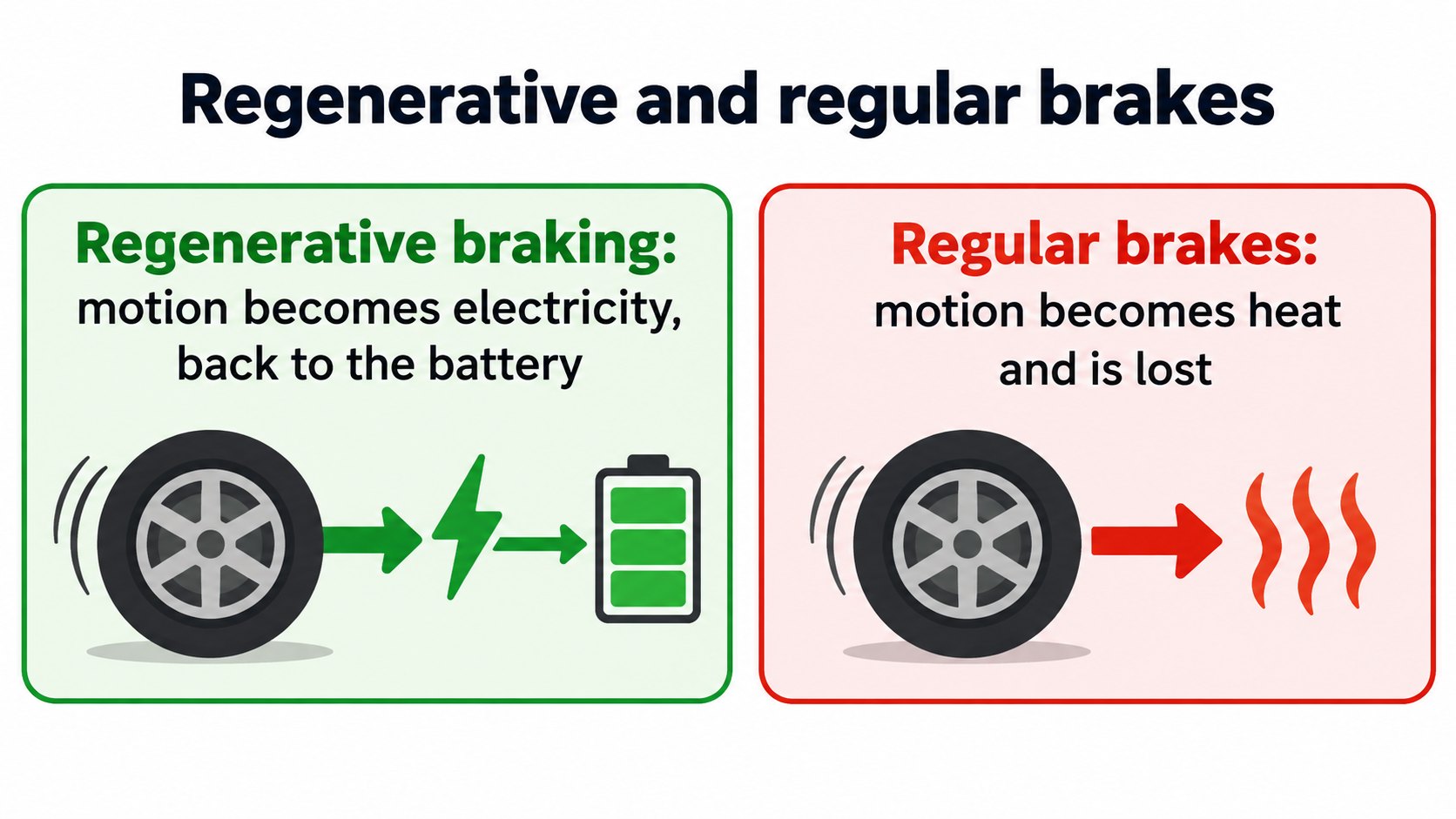
Ordinary brakes press pads against a disc and throw the motion energy away as heat. Regenerative braking uses the motor like a generator and returns the energy as electricity to the battery. (This "motor as generator" explanation is general knowledge; the manual does not describe the mechanism.)
Why does it weaken when the battery is cold or full?
The manual states only the conditions, not the reason. Tesla's Range Tips page also says "regenerative braking is limited in very cold conditions".
[The author's reading, not a confirmed fact]
The electricity goes back into the battery, so it is easy to see that a nearly full battery can accept less. The reason for the cold case is not given in the official sources, so we do not know.
If deceleration feels different on a cold day, this limit may be involved. For warming the battery, see Battery preconditioning.
A setting for a consistent feel
The manual describes a setting for people who want the same deceleration when lifting off the accelerator, even when regeneration is limited.
- In Controls > Dynamics, choose "Apply Brakes When Regenerative Braking is Limited". When regeneration is limited, the regular brakes engage automatically to make up the difference.
- While this is working, the brake pedal may move or feel stiffer when pressed. This is expected and does not change your ability to slow down.
- It may not operate if the brakes are extremely hot.
Seeing the power flow: the power meter
The car status display has a power meter (a thin line).
- Power output by the battery (for example, accelerating) fills the top half.
- Power generated by regeneration shows in green; power used by the regular brakes shows in gray.
When regenerative braking is slowing the car aggressively (for example, foot fully off at highway speed), the brake lights come on to alert others.
Caution: do not rely on regeneration alone
The manual warns that:
- In snowy or icy conditions, the car may lose traction during regenerative braking.
- A heavy load, a steep hill or wet roads change deceleration and stopping distance. Do not rely on regeneration alone; always be ready to use the brake pedal.
- If regeneration is unavailable, an amber brake indicator can appear (also for a brake booster fault). If it does, press the brakes firmly and stop when safe.
- Installing winter tires may temporarily reduce regeneration. According to the manual, the car recalibrates itself and gradually restores it.
Brake corrosion
Regenerative braking means the brake pads are used less often. The manual and maintenance page say:
- With little pad use, rust and corrosion can build up (especially where roads are salted in winter).
- Pressing the brake pedal regularly dries the brake surfaces and helps prevent this. "Burnishing" the brakes is also available when needed.
- Where roads are salted, cleaning and lubricating the brake calipers is recommended every year or 12,500 miles (20,000 km).
FAQ
What is regenerative braking?
When you lift your foot off the accelerator, the car's motion is turned into electricity and surplus power is returned to the battery (Tesla's owner's manual).
How much electricity does it return?
The official sources we read give no figure such as a percentage. We could not confirm it.
Why does it weaken in the cold?
The sources say regeneration can be limited when the battery is cold or full, but do not say why.
Can I keep the same deceleration when regeneration is limited?
According to the manual, choose "Apply Brakes When Regenerative Braking is Limited" in Controls > Dynamics; the regular brakes then make up the difference.
Can regeneration alone stop the car?
The manual says not to rely on it alone and to always be ready to use the brake pedal.
Summary
- Regenerative braking returns surplus power to the battery when your foot is off the accelerator. Used well, it can extend range (owner's manual).
- It can be limited when the battery is cold or full. A setting lets the regular brakes make up the difference.
- Do not rely on regeneration alone; press the brake pedal now and then to help prevent brake rust.
- The amount of electricity returned, the reason for the cold limit and the one-pedal setting were not confirmed.
Sources (checked 2026-10-16)
- Model 3 Owner's Manual, "Braking and Stopping" (North America, 2024+, software 2026.32): https://www.tesla.com/ownersmanual/model3/en_us/GUID-3DFFB071-C0F6-474D-8A45-17BE1A006365.html
- Tesla Support, "Range Tips": https://www.tesla.com/support/range
- Model 3 Do It Yourself, "Maintenance Service Intervals": https://service.tesla.com/docs/Public/diy/model3/en_us/GUID-E95DAAD9-646E-4249-9930-B109ED7B1D91.html
This article is for learning about science and technology and is not investment advice. Facts and the author's reading are kept separate. The figures are AI-generated illustrations.
Thank you for reading. Was this article useful to you?
Thank you. If you like, tell us what you thought in a line or two.
Optional. No name or email needed.
Received. We will use your words to make better articles.