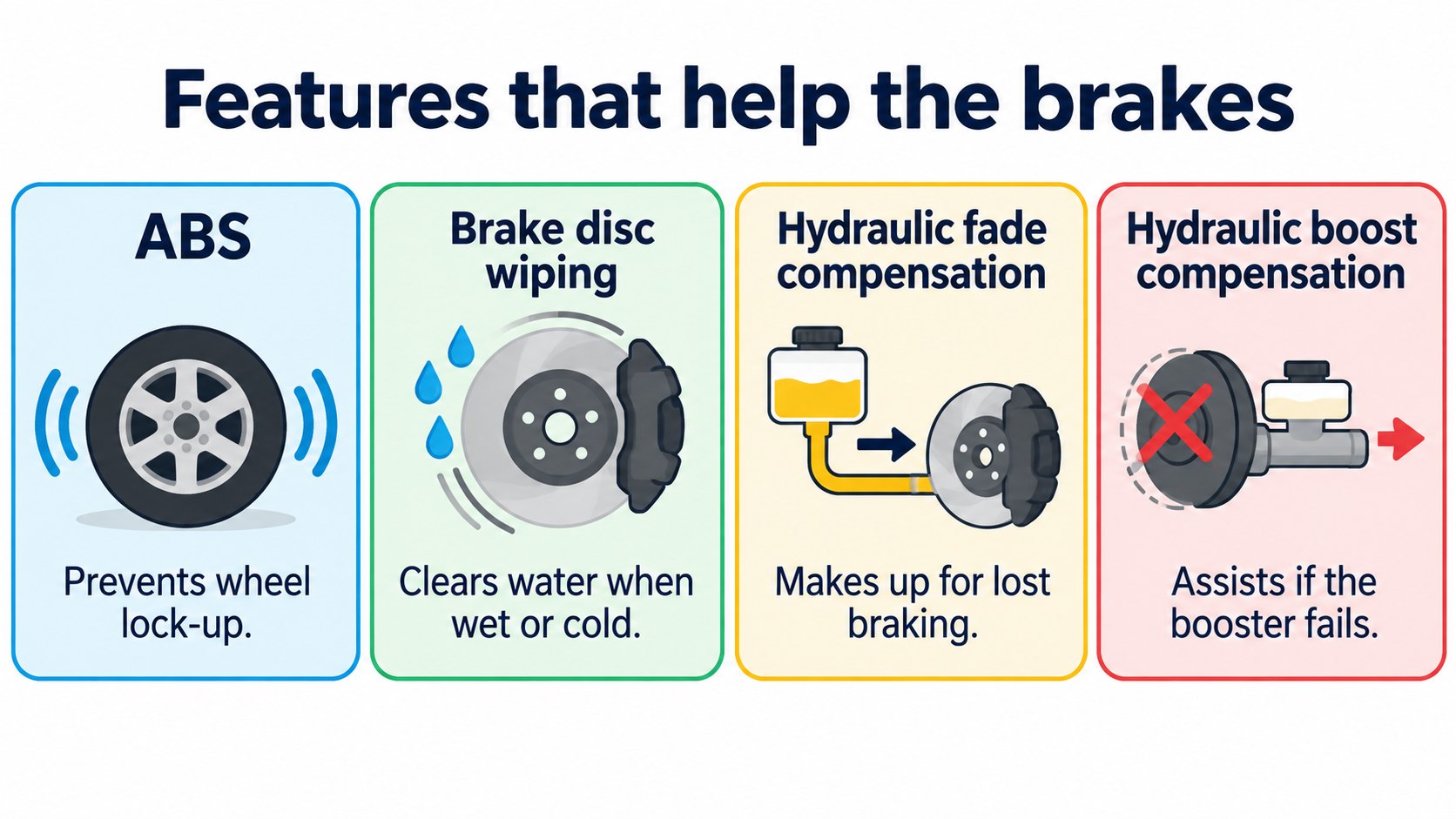
According to Tesla's owner's manual (Model 3, North America), the car has ABS (which prevents wheel lock-up under hard braking), plus brake disc wiping (clearing water from the discs in cold or wet weather), hydraulic fade compensation (assisting when braking performance drops) and hydraulic boost compensation (mechanical assistance if the brake booster fails). If a brake warning appears, press the brakes firmly, stop when safe and contact Tesla.
Regenerative braking covered returning energy while slowing. From the same manual page ("Braking and Stopping", North America, software 2026.32), here is the friction braking side.
The conclusion: ABS plus three assist features; faults are shown by warning lights
The manual says (summary):
- ABS prevents the wheels from locking at maximum brake pressure, helping you steer during hard braking on most surfaces. It monitors each wheel's speed and varies brake pressure with the grip available.
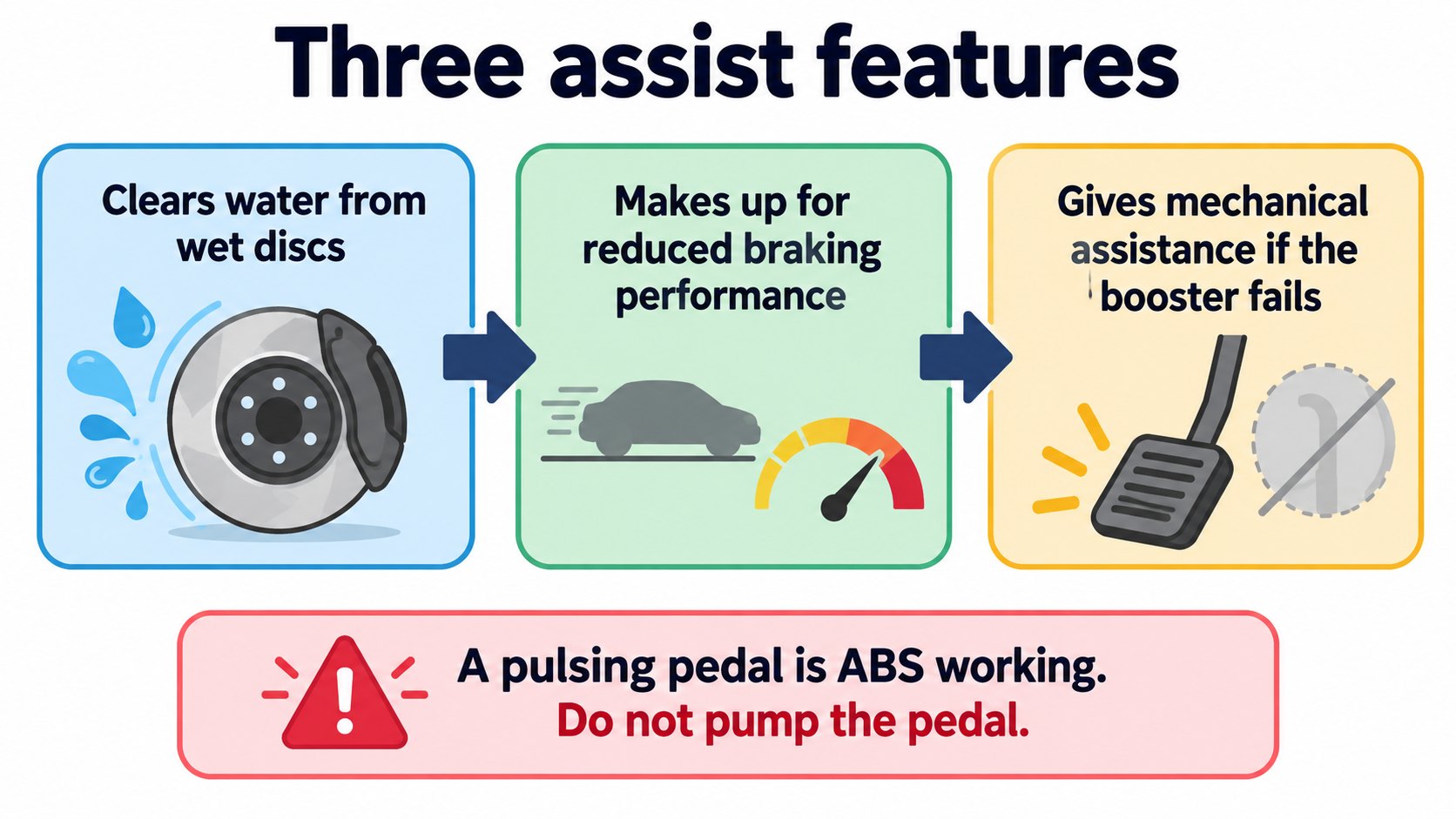
- A pulsing feel in the pedal shows ABS is working and is not a concern. Keep firm, steady pressure. Do not pump the pedal (it interrupts ABS and can lengthen stopping distance).
- If the ABS light comes on other than briefly at start-up, ABS has a fault. The brakes still work, but stopping distance may increase; drive cautiously and contact Tesla.
Three assist features
| Feature | What the manual says |
|---|---|
| Brake disc wiping | When cold or wet weather is detected, it repeatedly applies an imperceptible amount of brake force to remove water from the disc surface |
| Hydraulic fade compensation | Monitors brake pressure and ABS activity. If reduced performance is detected (fade, cold or wet), you may hear a sound, feel the pedal pull away and notice a strong increase in braking. Keep pressing; do not release or pump |
| Hydraulic boost compensation | Mechanical assistance if the brake booster fails. The pedal feels stiffer and you may hear a sound. Stopping distance may increase |
[A note for beginners]
Fade is a loss of braking performance when brakes overheat. A brake booster multiplies pedal force into brake pressure. (General explanations.)
Brake warnings
- Red brake indicator (other than briefly at start-up): a brake system fault or low brake fluid. Contact Tesla immediately; keep the brakes pressed firmly until you can stop.
- Amber brake indicator: a brake booster fault or regenerative braking unavailable. Press firmly and stop when safe. Hydraulic boost compensation may be active.
Emergency stopping and the parking brake
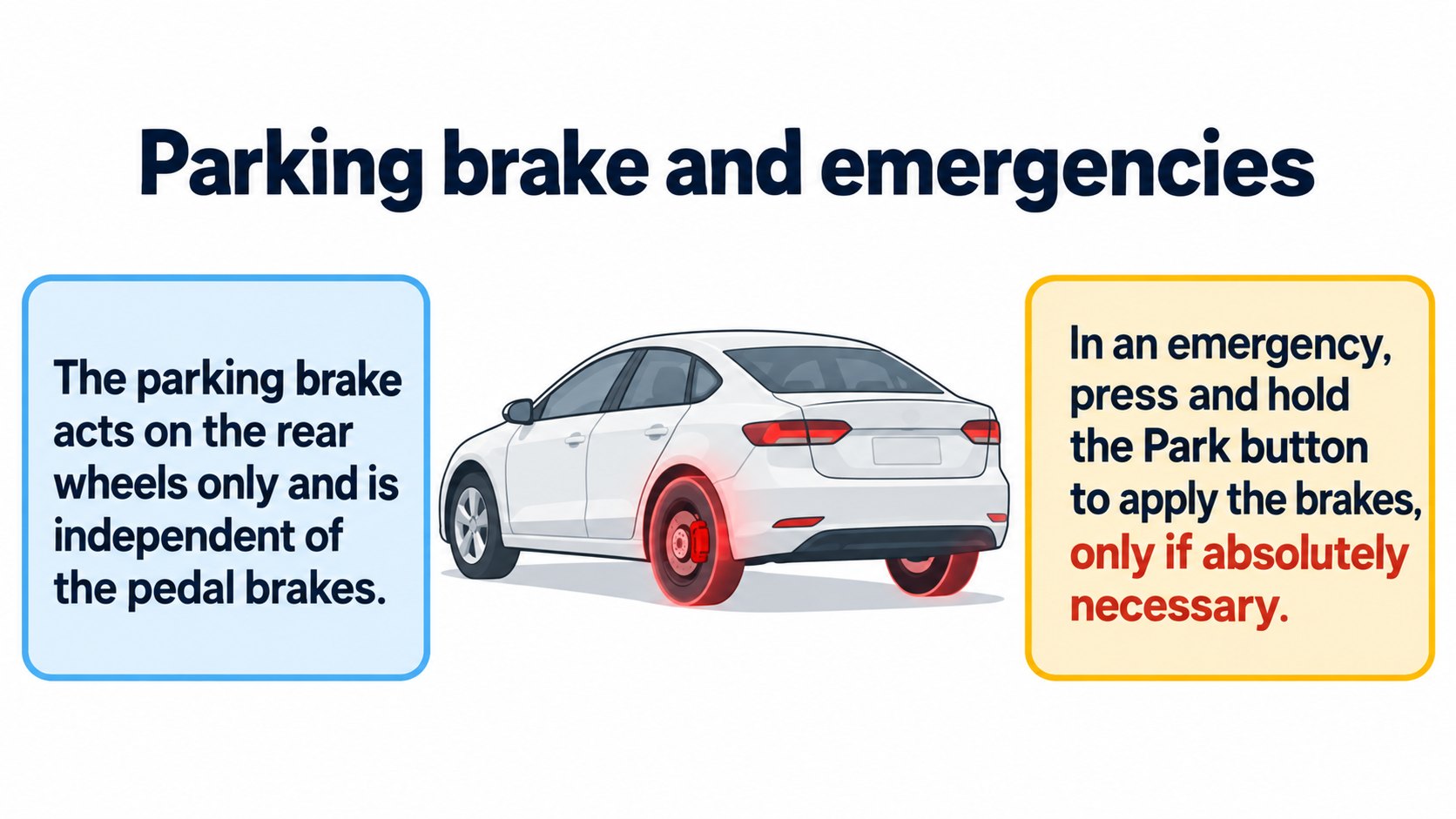
- If the brakes are not working properly in an emergency, press and hold the Park button on the touchscreen's drive mode strip or the overhead console to apply the brakes and remove drive torque while held. Use it only if absolutely necessary. The overhead Park button does not stop the car if Full Self-Driving (Supervised) is engaged (a manual warning).
- Parking brake: touch and hold Park on the screen (or the overhead button). It acts on the rear wheels only and is independent of the pedal brake system. Shifting into gear releases it.
- If the car loses all electrical power, you cannot release the parking brake without jump starting (a manual caution).
Pad wear
- Brake pads have wear indicators (thin metal strips) that squeal against the rotor as the pad wears to its service limit. Then replace them (contact Tesla Service).
- Inspect the brakes visually from time to time with the wheel removed. Where roads are salted, cleaning and lubricating the calipers every year or 12,500 miles (20,000 km) is recommended.
- Neglecting worn pads damages the braking system and is a hazard.
FAQ
Is a pulsing pedal a fault?
It shows ABS working and is not a concern. Press firmly and steadily; do not pump.
What is brake disc wiping?
It repeatedly applies an imperceptible amount of brake force in cold or wet weather to clear water from the discs.
What if a red brake warning appears?
It means a brake system fault or low brake fluid. Contact Tesla immediately and keep pressing firmly until you can stop.
Where does the parking brake act?
On the rear wheels only, independent of the pedal brakes.
Summary
- The Model 3 has ABS plus disc wiping, hydraulic fade compensation and hydraulic boost compensation (owner's manual).
- A pulsing pedal is ABS working; do not pump.
- Red: contact Tesla at once. Amber: booster fault or regeneration unavailable.
- The parking brake is rear-only. Pads squeal to show they need replacing.
Sources (checked 2026-10-16)
- Model 3 Owner's Manual, "Braking and Stopping" (North America, 2024+, software 2026.32): https://www.tesla.com/ownersmanual/model3/en_us/GUID-3DFFB071-C0F6-474D-8A45-17BE1A006365.html
This article is for learning about science and technology and is not investment advice. Facts and the author's reading are kept separate. The figures are AI-generated illustrations.
Thank you for reading. Was this article useful to you?
Thank you. If you like, tell us what you thought in a line or two.
Optional. No name or email needed.
Received. We will use your words to make better articles.