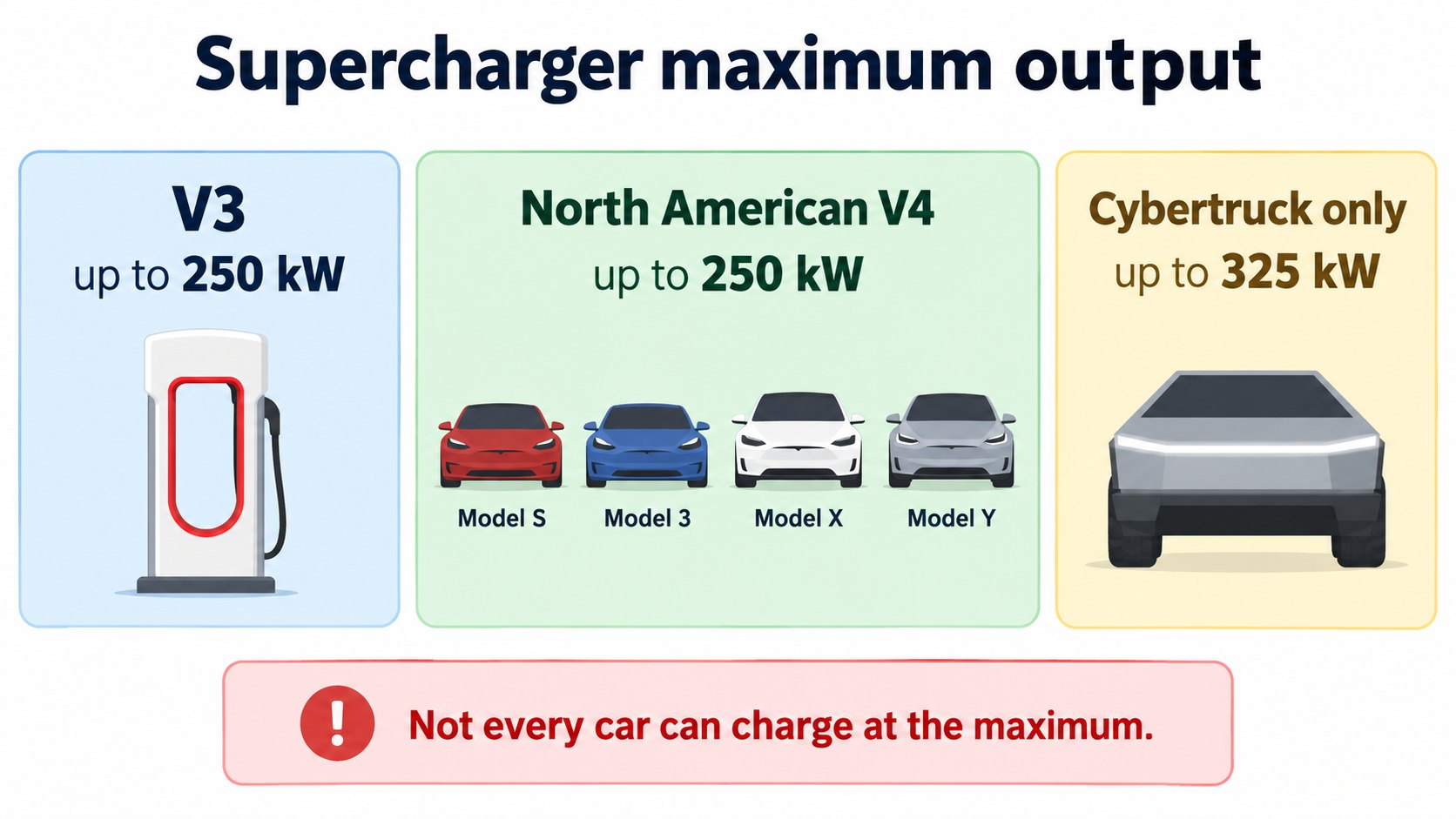
A Supercharger is Tesla's fast charger, built for long-distance travel. According to Tesla's support page, V3 delivers up to 250 kW, and V4 in North America charges Model S, 3, X and Y at up to 250 kW (only the Cybertruck can charge up to 325 kW, at V4). Not every car can charge at the maximum; speed depends on battery size and age, state of charge, temperature and configuration. Tesla lists up to 175 miles in 15 minutes for the Model 3.
AC vs. DC charging gave an overview. Here we cover what Tesla's "Supercharging" support page confirms about Superchargers themselves. We leave out pricing and memberships, which change often.
The conclusion: for long trips; speed depends on the car and conditions
The page says (summary; checked 2026-10-16):
- Superchargers are ideal for long-distance travel; home charging suits daily commutes and local driving.
- Tesla states there are over 80,000 Superchargers worldwide (the page's claim).
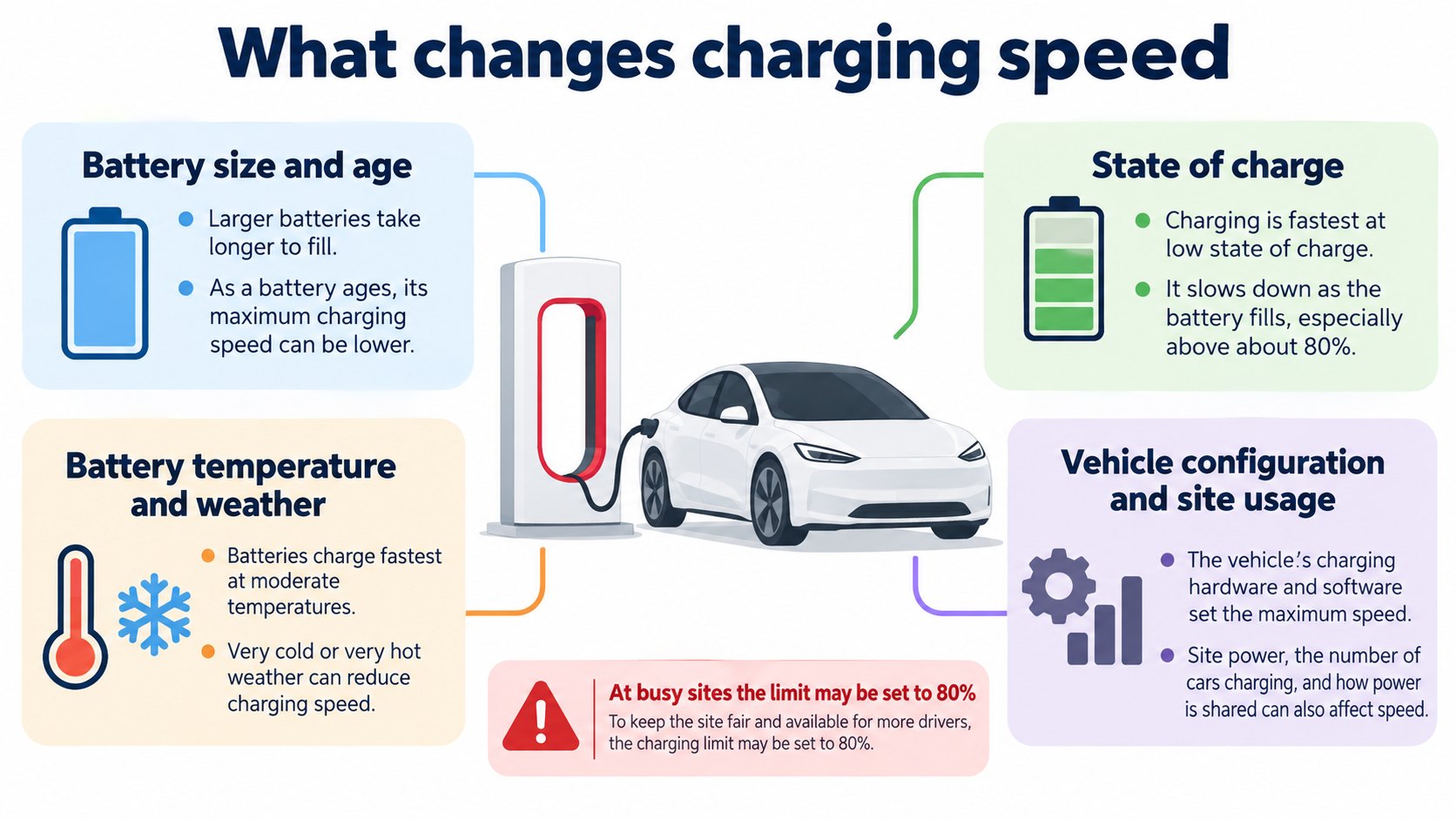
- Charging rates vary with battery size and age, state of charge, temperature and vehicle configuration. Each site's maximum kW is on its pop-up card.
Maximum output of V3 and V4
| Type | Maximum (Tesla's statement) |
|---|---|
| V3 | Up to 250 kW |
| V4 (North America) | Model S, 3, X, Y: up to 250 kW |
| V4 (North America) | Cybertruck only: up to 325 kW |
- Not all Tesla vehicles can charge at 250 kW (the page says so).
- The first V4 site opened in Harderwijk, the Netherlands, in March 2023. All V4 Superchargers have a longer cable for easy access for all EVs.
[A note for beginners]
kW (kilowatts) measures power, the energy delivered per second. A larger number delivers more energy in the same time. (General explanation.)
How to charge (Tesla's guidance)
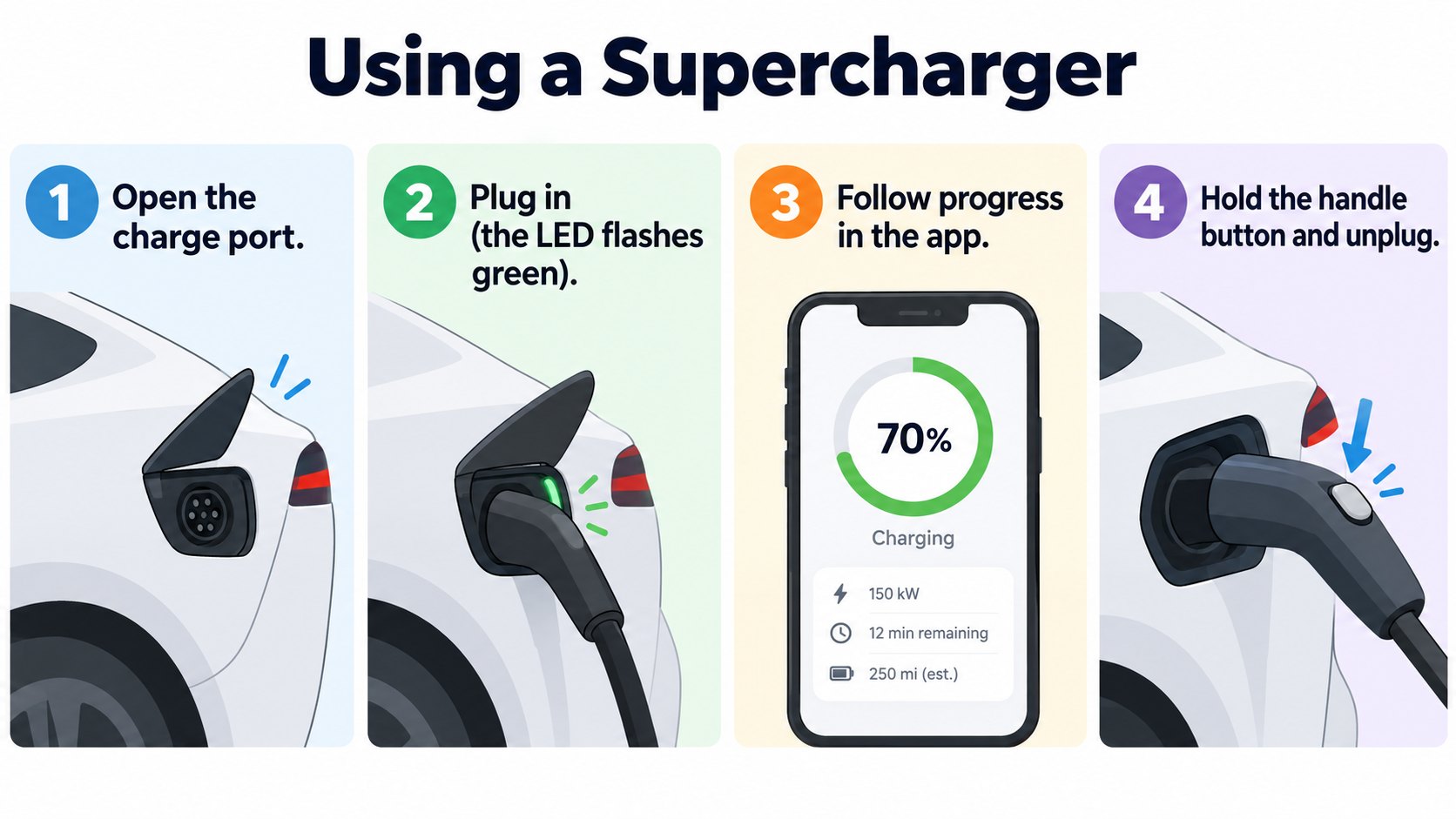
- Open the charge port from the touchscreen or the Tesla app (or press the bottom of the port door while the car is unlocked).
- Plug in. The charge port LED flashes green once charging begins.
- Follow progress in the Tesla app.
- When done, hold the button on the handle and pull it out. The port closes automatically.
For port light colors, see Charge port lights.
"Miles in 15 minutes"
The page's table (Tesla's figures; kilometer conversions are ours):
| Vehicle | Up to, in 15 minutes |
|---|---|
| Model S | 200 miles (about 320 km) |
| Model 3 | 175 miles (about 280 km) |
| Model X | 175 miles (about 280 km) |
| Model Y | 162 miles (about 260 km) |
| Cybertruck | 137 miles (about 220 km) |
The limit may be set to 80%
- With navigation on, the car recommends the charge level needed to reach the next Supercharger.
- At busy Superchargers, the charge limit may be automatically adjusted to 80%. You can raise it manually.
- Speed slows as the battery fills, so reaching 100% typically takes significantly longer than reaching 80%.
When it is slower than expected
- The car and the charger negotiate a rate suited to the car.
- The rate varies with state of charge, battery temperature, current use of the station and extreme weather.
- The car charges faster at a lower state of charge and slows as it fills. Depending on your destination, fully charging is often not necessary.
See also Why charging speed changes.
FAQ
What is a Supercharger?
Tesla's fast charger, for long trips (Tesla support).
How do V3 and V4 differ?
Per Tesla, V3 is up to 250 kW; North American V4 is up to 250 kW for Model S, 3, X, Y and 325 kW only for the Cybertruck. V4 has a longer cable.
How far in 15 minutes?
Tesla lists up to 175 miles (about 280 km) for the Model 3. It varies with conditions.
Should I charge to 100%?
Charging slows as the battery fills, and 100% takes much longer than 80%. Navigation suggests the level needed to reach the next charger.
Is it the same in Japan?
Summary
- A Supercharger is a fast charger for long trips (Tesla).
- Maximums: V3 250 kW, North American V4 250 kW (Cybertruck only 325 kW). Not every car can charge at the maximum.
- Speed depends on battery size and age, state of charge, temperature, configuration and site conditions, and slows as the battery fills.
- At busy sites the limit may be auto-set to 80%.
Sources (checked 2026-10-16)
- Tesla Support, "Supercharging": https://www.tesla.com/support/charging/supercharging
This article is for learning about science and technology and is not investment advice. Facts and the author's reading are kept separate. The figures are AI-generated illustrations.
Thank you for reading. Was this article useful to you?
Thank you. If you like, tell us what you thought in a line or two.
Optional. No name or email needed.
Received. We will use your words to make better articles.