According to Tesla's owner's manual (Model 3, North America), tires with less than 4/32 in (3 mm) of tread are more likely to hydroplane in the wet and should not be used. Tires under 5/32 in (4 mm) do not perform well in snow and slush and should not be used in winter. Tesla recommends replacing tires every six years even if tread remains. Summer and all-season tires do not give adequate traction on snow or ice, so winter tires are recommended in cold regions.
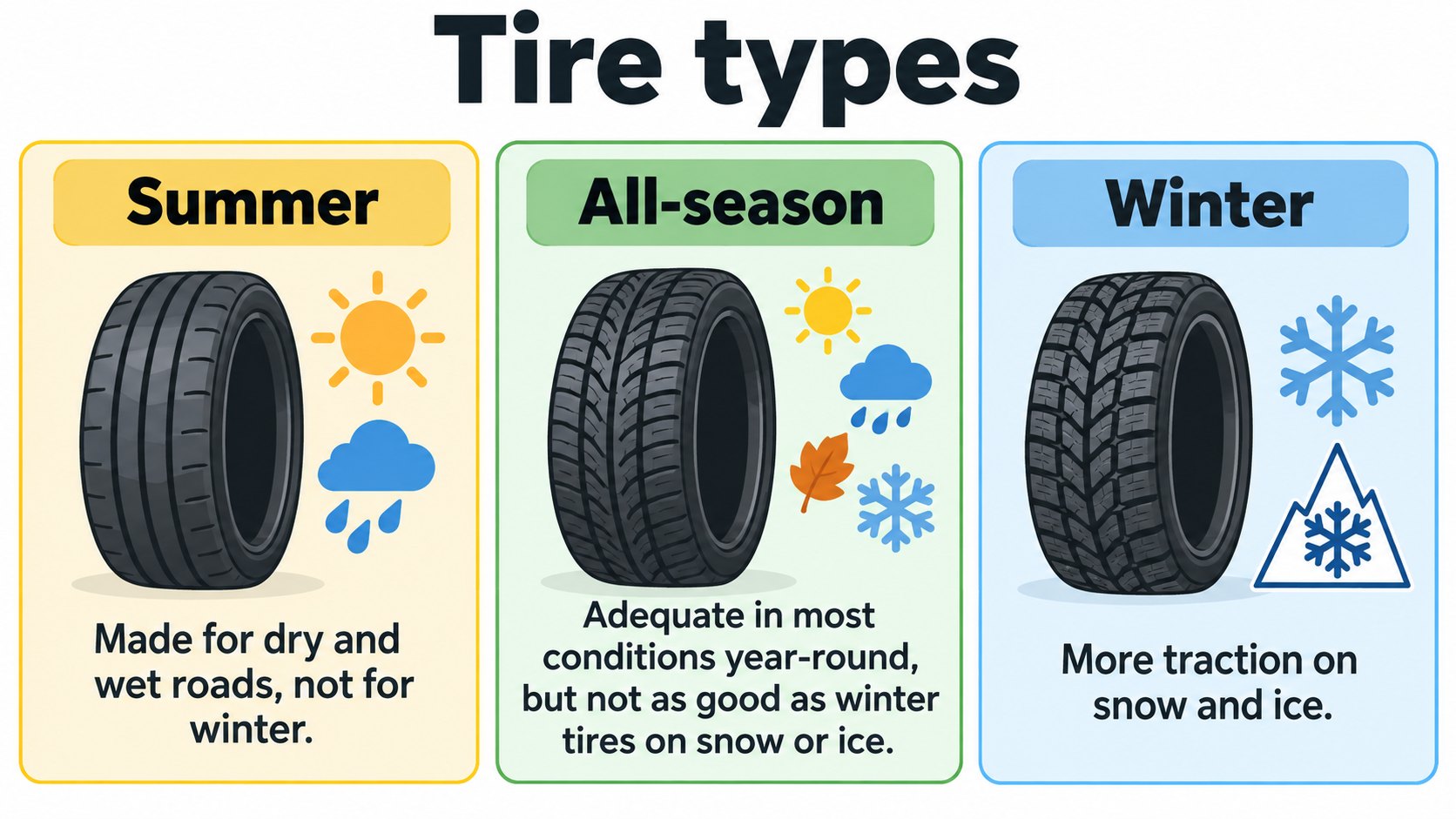
From the same manual page as Tire pressure and TPMS ("Tire Care and Maintenance", North America, software 2026.32), this time tire types and replacement guidelines.
The conclusion: match the tire to conditions; winter tires for cold and snow
| Type | What the manual says |
|---|---|
| Summer and all-season | Designed for maximum dry and wet performance but not for winter. All-season tires give adequate traction in most conditions year-round but not the traction of winter tires in snow or ice. Marked "ALL SEASON" and/or "M+S" |
| Winter | More traction in snow or ice. Marked with a mountain/snowflake symbol. Always install all four at the same time (same diameter, brand, construction and tread pattern). You may get more road noise, shorter tread life and less traction on dry roads |
- For cold temperatures or roads with snow or ice, Tesla recommends winter tires.
- Performance (summer) tires have reduced traction below 40°F (5°C) and are not recommended on snow/ice. They can harden when cold and make rotational noise for the first few miles.
- In low temperatures tires have reduced grip and are more susceptible to impact damage.
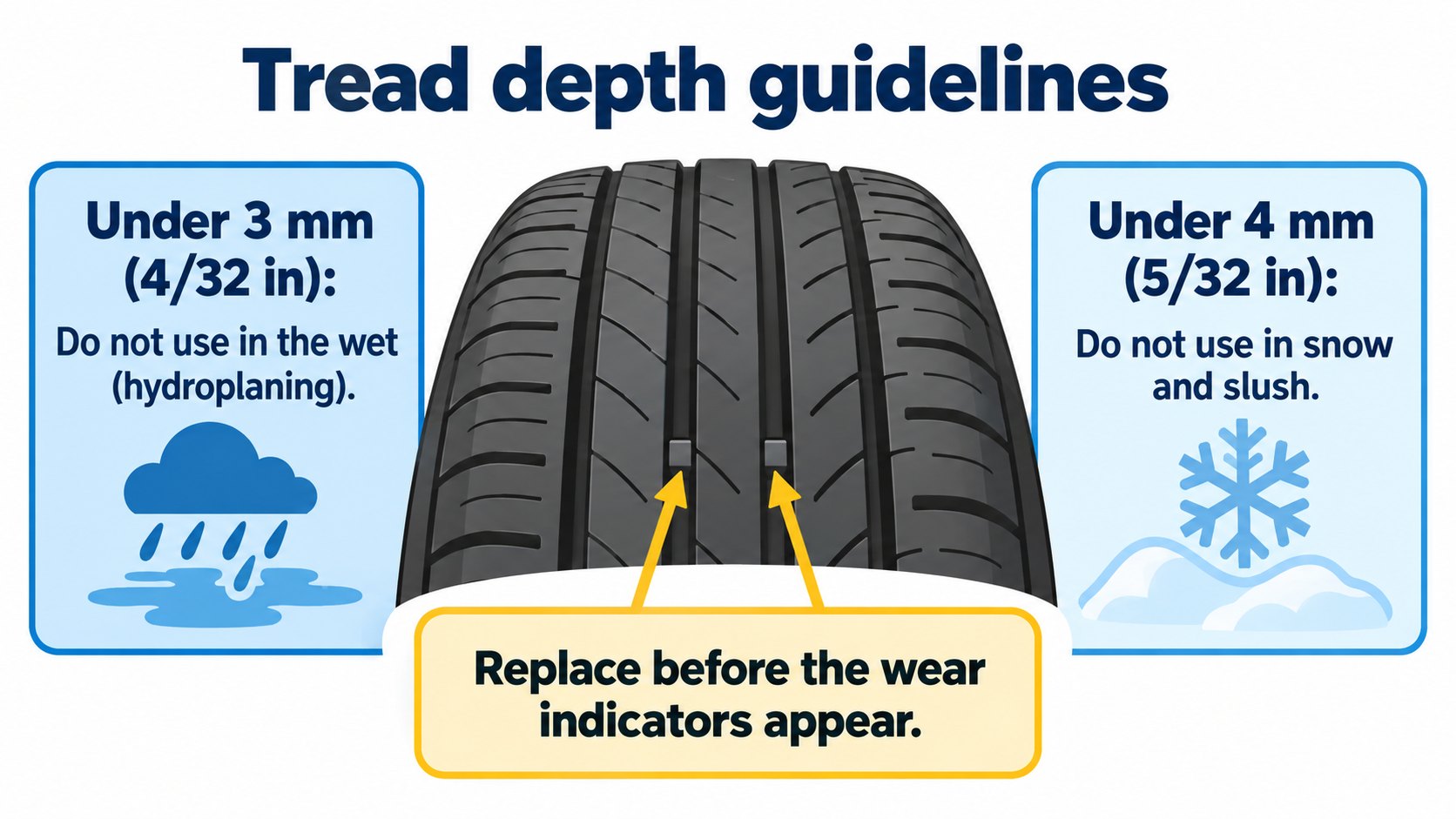
Tread depth and replacement
- Under 4/32 in (3 mm): more likely to hydroplane in the wet. Do not use.
- Under 5/32 in (4 mm): poor in snow and slush. Do not use in winter.
- Original tires have wear indicators; at 4/32 in (3 mm) they appear as a continuous band across the tread. Tesla recommends replacing tires before the indicators appear.
- Tires degrade with UV light, extreme temperatures, high loads and environment. Replacement every six years is recommended even if tread remains.
- Replace all four at once. If an early replacement is needed (for example, a flat), Tesla recommends replacing in pairs (unless the other tires are within 2/32 in (1.5 mm) of the new tire's tread). Put the new pair on the rear.
Tesla-designed and Tesla-approved tires
- Tesla-designed tires are engineered by Tesla in collaboration with top tire manufacturers.
- Tesla-approved tires are aftermarket tires evaluated and approved by Tesla, often identified by a "T-mark" (T0, T1, T2). They are designed for electric drivetrains (performance, safety, comfort and range).
- Approved tires may lack acoustic foam, so there may be a slight increase in road noise and vibration, and they may not have the latest materials or aerodynamic tuning.
- The T-mark number shows a specific tire's progression: a T1 Michelin Primacy is newer than a T0 Michelin Primacy, but not necessarily newer than other models' T0.
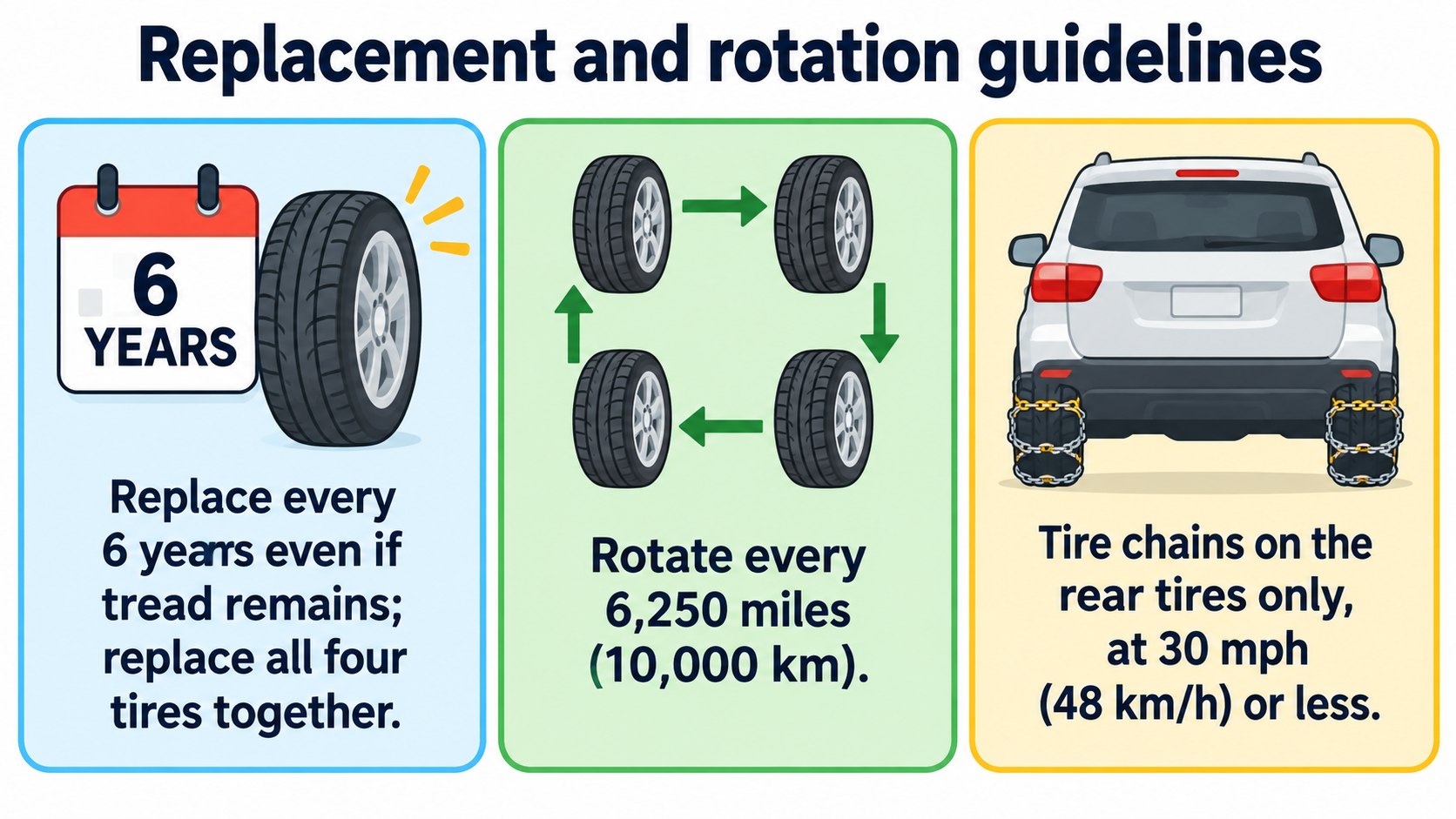
Rotation and chains
- Rotation: every 6,250 miles (10,000 km) or when tread depth differs by 2/32 in (1.5 mm) or more, whichever comes first. Aggressive driving wears tires faster.
- Cars with staggered wheels can be rotated side to side only, not front to back.
- Asymmetric tires (sidewall marked "OUTSIDE") must be mounted correctly; wrong mounting seriously impairs road holding.
- Tire chains: only Tesla-tested and approved chains, on the rear tires only. Remove wheel covers first. Not on summer tires. Do not exceed 30 mph (48 km/h). Never deflate tires to fit chains. Chains are prohibited in some places.
FAQ
Do I need winter tires?
Tesla recommends them for cold regions and for snow or ice. Summer and all-season tires do not give adequate traction on snow or ice.
At what tread depth should I replace?
The manual says not to use tires under 3 mm in the wet or under 4 mm in snow, and recommends replacing before the wear indicators appear.
How old is too old?
The manual recommends replacement every six years even if tread remains.
Can I replace just two tires?
If an early replacement is needed, pairs are recommended and the new pair goes on the rear. A full matching set is recommended.
Summary
- Tires differ: summer, all-season, winter. Winter tires are recommended for snow and ice.
- Do not use tires under 3 mm (wet) or 4 mm (snow) of tread. Replace every 6 years.
- There are Tesla-designed and Tesla-approved (T-mark) tires.
- Rotate every 10,000 km. Chains: rear only, 30 mph or less.
Sources (checked 2026-10-16)
- Model 3 Owner's Manual, "Tire Care and Maintenance" (North America, 2024+, software 2026.32): https://www.tesla.com/ownersmanual/model3/en_us/GUID-94F63B13-EA2C-45D9-83AB-5DCA6295D587.html
This article is for learning about science and technology and is not investment advice. Facts and the author's reading are kept separate. The figures are AI-generated illustrations.
Thank you for reading. Was this article useful to you?
Thank you. If you like, tell us what you thought in a line or two.
Optional. No name or email needed.
Received. We will use your words to make better articles.