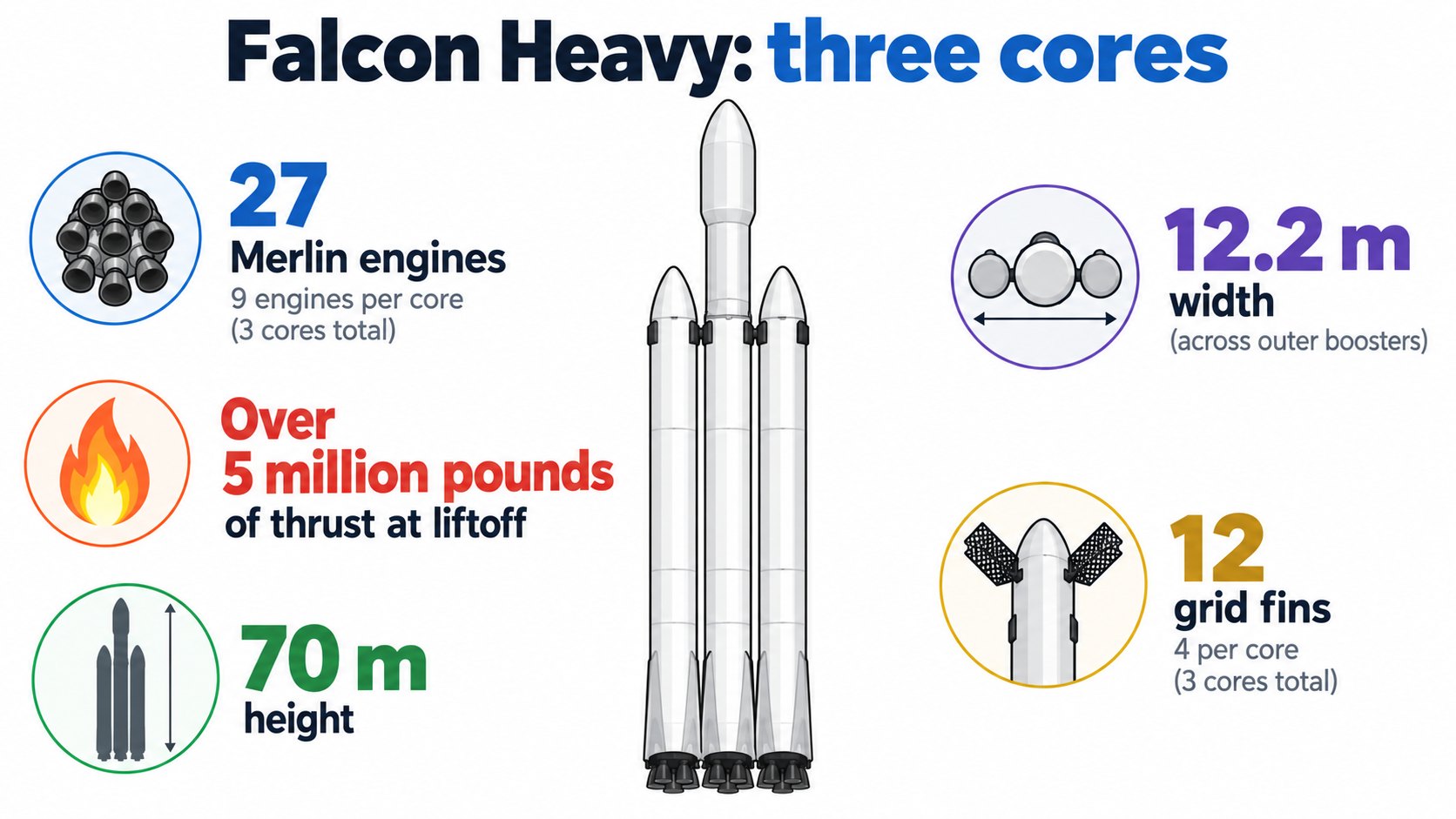
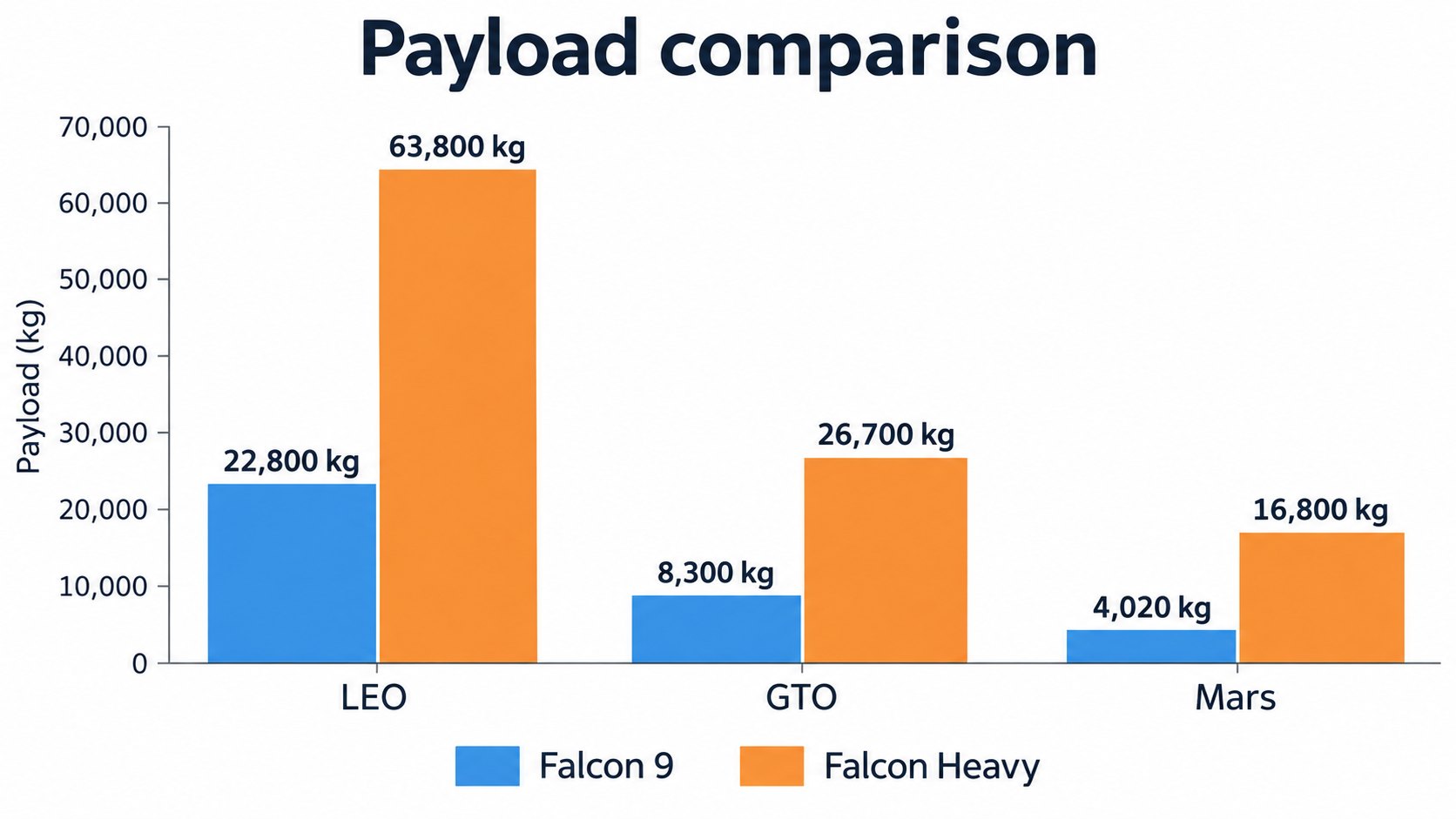
According to SpaceX's official page, Falcon Heavy is made of three Falcon 9 nine-engine cores; its 27 Merlin engines produce more than 5 million pounds of thrust at liftoff (about 22 meganewtons, our conversion), which the page equates to approximately eighteen 747 aircraft. Payload is 63,800 kg to low Earth orbit, 26,700 kg to geostationary transfer orbit and 16,800 kg to Mars.
A sequel to the Falcon 9 article. On SpaceX's official Falcon Heavy page we check the rocket made of three Falcon 9s (checked 2026-10-16).
The conclusion: the power of three Falcon 9s
The page says (summary):
- Falcon Heavy is composed of three reusable Falcon 9 nine-engine cores.
- 27 Merlin engines generate more than 5 million pounds of thrust at liftoff, which the page says equals "approximately eighteen 747 aircraft".
- One of the world's most powerful operational rockets, it can lift nearly 64 metric tons to orbit, which the page compares to a fully loaded 737 jetliner.
| Item | Figure on the official page |
|---|---|
| Height | 70 m (229.6 ft) |
| Width | 12.2 m (39.9 ft) |
| Mass | 1,420,788 kg (3,125,735 lbs) |
| Payload to LEO | 63,800 kg (140,660 lbs) |
| Payload to GTO | 26,700 kg (58,860 lbs) |
| Payload to Mars | 16,800 kg (37,040 lbs) |
[A note for beginners]
27 × 845 kN (one Merlin, from the Falcon 9 page) is about 22.8 meganewtons, consistent with "over 5 million lbf (about 22 MN)". (Our calculation.)
First stage: three cores
- The first stage is three cores. The side cores (boosters) connect to the center core at the nosecone, interstage and octaweb (the engine mount).
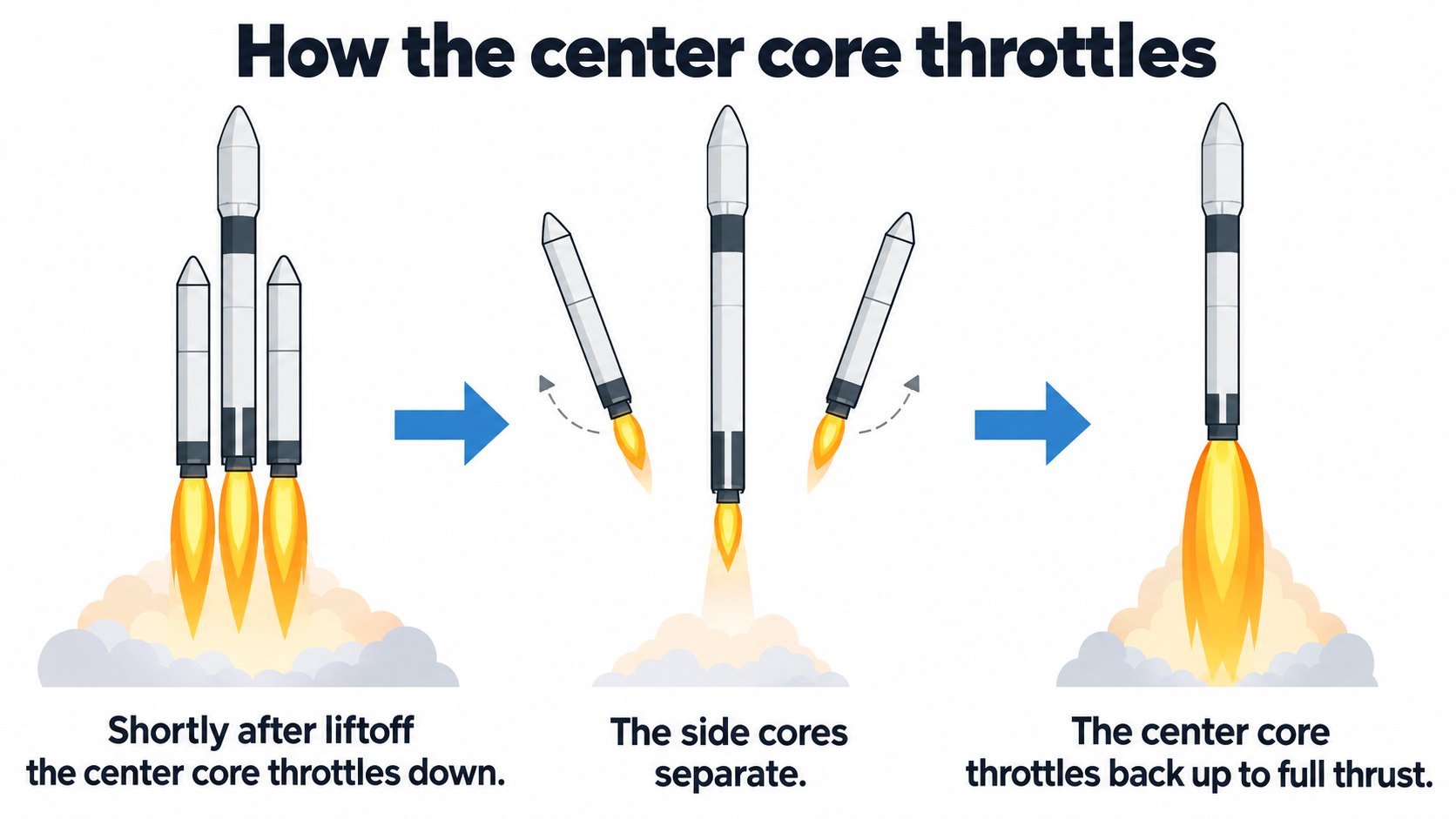
- Shortly after liftoff the center core's engines throttle down; after the side cores separate they throttle back up to full thrust (per the page).
- 12 grid fins (four on each booster) orient the rocket during reentry.
Second stage and fairing
- Second stage: Falcon 9's design with one Merlin Vacuum engine, burn time 397 s, thrust 981 kN. The page says this minimizes stage-separation events and maximizes reliability.
- Fairing: carbon composite, 13.1 m tall and 5.2 m in diameter; SpaceX is recovering fairings for reuse.
Compared with Falcon 9 (the pages' figures)
| Item | Falcon 9 | Falcon Heavy |
|---|---|---|
| Height | 70 m | 70 m |
| Mass | 549,054 kg | 1,420,788 kg |
| Payload to LEO | 22,800 kg | 63,800 kg |
| Payload to GTO | 8,300 kg | 26,700 kg |
| Payload to Mars | 4,020 kg | 16,800 kg |
FAQ
What is Falcon Heavy?
A SpaceX rocket made of three Falcon 9 cores. Its 27 Merlin engines produce over 5 million pounds of thrust at liftoff (official page).
How much more can it carry than Falcon 9?
To low Earth orbit, 63,800 kg versus Falcon 9's 22,800 kg (official page).
Are the three cores reused?
The page describes them as reusable. We did not check recovery results in this article.
Summary
- Falcon Heavy bundles three Falcon 9 first-stage cores: 27 engines, over 5 million lbf at liftoff.
- Payload: LEO 63,800 kg, GTO 26,700 kg, Mars 16,800 kg.
- After liftoff the center core throttles down, then goes back to full thrust after the side cores separate.
Sources (checked 2026-10-16)
- SpaceX, "Falcon Heavy": https://www.spacex.com/vehicles/falcon-heavy
- SpaceX, "Falcon 9" (thrust of one Merlin): https://www.spacex.com/vehicles/falcon-9
This article is for learning about science and technology and is not investment advice. Facts and the author's reading are kept separate. The figures are AI-generated illustrations.
Thank you for reading. Was this article useful to you?
Thank you. If you like, tell us what you thought in a line or two.
Optional. No name or email needed.
Received. We will use your words to make better articles.