According to the Model 3 owner's manual (2026.32), Lane Assist monitors the lane markings and surrounding vehicles and objects, and warns or steers when the car is about to leave its lane. Lane Departure Avoidance can be set to Off, Warning or Assist; when a front wheel crosses a lane marking, a blue line on the screen and steering wheel vibration warn you (North American edition: 40 to 90 mph, 64 to 145 km/h). Emergency Lane Departure Avoidance steers automatically to avoid a collision at 48 to 145 km/h. None of it replaces driving: visual checks and driver responsibility come first.
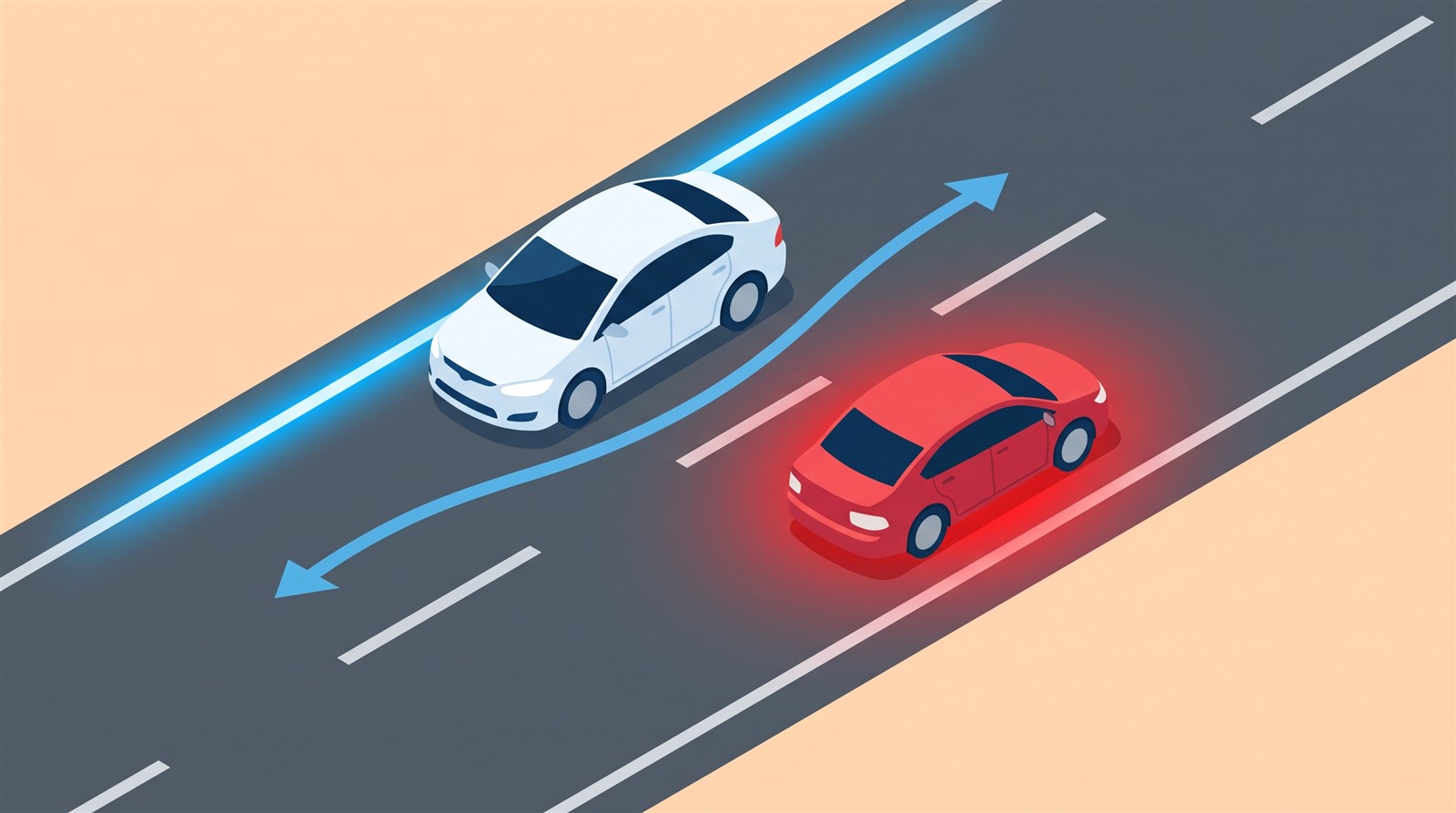
You drift toward the edge of your lane without meaning to. The Tesla feature that warns you, or nudges the steering back, is Lane Assist. This article checks four features (steering interventions, Lane Departure Avoidance, Emergency Lane Departure Avoidance, and blind spot warnings) and when they don't work, in the Model 3 owner's manual (North American and Japanese editions, software 2026.32).
In short: Lane Assist helps; it does not replace you. The manual stresses visual checks and driver responsibility again and again
The manual opens: "Model 3 monitors the markers on the lane you are driving in as well as the surrounding areas for the presence of vehicles or other objects." Then the warnings:
- Lane Assist is not intended to replace your own direct visual checks. Before changing lanes, use the mirrors and check over your shoulder.
- Never depend on it to tell you that you drifted out of the lane or that a vehicle is beside you or in your blind spot.
The four features
| Feature | What it does | Operating speed |
|---|---|---|
| Steering interventions | When you drift toward a lane where an object is detected, steers back to a safer position in your lane | 48 to 140 km/h (30 to 85 mph), on major roads with clearly visible lane markings (same in both editions) |
| Lane Departure Avoidance | Warns when you are drifting out of, or nearing the edge of, your lane (in Assist, it also steers) | North American edition: 40 to 90 mph (64 to 145 km/h). Japanese edition: I did not confirm this figure |
| Emergency Lane Departure Avoidance | Steers automatically to avoid a potential collision | 48 to 145 km/h (30 to 90 mph in the North American edition) (same in both) |
| Blind spot warnings | Lights or a chime when an object is in the blind spot | (I did not confirm a speed statement) |
Steering interventions
According to the manual, when the car drifts toward an adjacent lane where a vehicle or other object is detected, it steers toward a safer position in the driving lane. A warning message briefly appears. The steering is minimal and not meant to move the car out of its lane; the manual warns not to rely on it to avoid side collisions.
Lane Departure Avoidance (warning when drifting)
In Controls > Self-Driving (the Japanese edition says "Drive Assist") > Lane Departure Avoidance, choose from three:
- Off: no warnings of lane departures or possible collisions with a vehicle in the next lane.
- Warning: when a front wheel crosses a lane marking, a blue line appears on the screen and the steering wheel vibrates (on cars with Full Self-Driving (Supervised), only the vibration, in the North American edition).
- Assist: a blue line appears for the line being crossed, and corrective steering keeps the car in a safe position if it drifts into an adjacent lane or near the road edge.
When the turn signal is on, the manual treats it as an intentional lane change and gives neither a warning nor an intervention.
#### Hand detection (while cruise control is active)
If Lane Departure Avoidance is on, Traffic-Aware Cruise Control is active and the car drifts out of its lane with the turn signal off, it also checks whether your hands are on the wheel. If not, the screen shows a series of alerts like those used with Autosteer. If hands are repeatedly not detected, the car gradually slows to 15 mph (25 km/h) below the detected speed limit (or set cruising speed) and the hazard lights flash (the gist of both editions).
Emergency Lane Departure Avoidance
It steers automatically when a collision may occur. The manual lists these situations:
- Leaving the lane and possibly colliding with a vehicle traveling the same way in the next lane (regardless of the turn signal).
- Leaving the lane into an oncoming lane, with the turn signal off, and an oncoming vehicle detected.
- Leaving the road, with the turn signal off (for example, very near the edge).
When it steers, a chime sounds, the screen shows a warning, and the lane marking is highlighted in red. Turn it on or off in Controls > Self-Driving > Emergency Lane Departure Avoidance. Under some conditions it may operate at lower speeds. The manual warns strongly: "not a substitute for attentive driving; never depend on it to prevent a collision."
Blind spot warnings
- Blind Spot Collision Warning Chime: a chime when a vehicle is in the blind spot and a possible collision is detected (Controls > Safety).
- Blind Spot Warning Light: a light in each front door pillar (upper speaker grille).
- Solid red: an object is in the blind spot. - Blinking red: an object is in the blind spot and you are signaling that way. - Rapid blinking red: an object is detected and immediate corrective action is needed.
- Opening a door: if you try to open a door while parked and an approaching object (for example a cyclist from behind) is detected, the light blinks, an alert shows, and the door does not open on the first press. Wait briefly and press again to override if the object is still detected.
The manual warns: don't rely on the blind spot light, and don't assume the door is locked. Always check visually before leaving your lane or opening a door.
When it doesn't work or gives wrong warnings
The manual lists these (and says the list is not exhaustive):
- Lane markings are hard to see (heavy rain, snow, fog).
- Bright light (oncoming headlights, direct sun) interferes with the cameras.
- A vehicle ahead blocks the camera's view.
- The windshield is fogged, dirty or covered by a sticker.
- Markings are worn, show old lines, changed for construction, or branch, cross or merge.
- The road is narrow or winding.
- Strong shadows fall on the markings.
- Cameras or sensors are damaged, dirty or blocked (mud, ice, snow, car bras, wraps, stickers).
- Something mounted on the car, such as a bike rack, interferes with a sensor.
With Track Mode on, driver assistance features are automatically disabled.
[Author's reading (not a confirmed fact)]
By separating "warning", "assist" and "emergency" into stages, and setting speed ranges and the treatment of the turn signal in detail, the design appears to avoid interfering with intentional lane changes and react only to unintended drift. But the real accuracy cannot be known from the manual's text.
FAQ
Does Lane Assist completely prevent leaving the lane?
No. The manual says it is for guidance only, does not replace visual checks, and should not be relied on. The interventions are minimal.
What is the difference between "Warning" and "Assist"?
Warning shows a blue line and vibrates the wheel when a front wheel crosses a line. Assist does that and also steers to keep the car in a safe position (manual).
Does it warn if my turn signal is on?
No. With the turn signal on it is treated as an intentional lane change, with no warning or intervention (Lane Departure Avoidance). Emergency Lane Departure Avoidance works regardless of the turn signal when there is a collision risk with a vehicle traveling the same way in the next lane.
What does a red blind-spot light mean?
An object is in the blind spot. Blinking means you are signaling that way; rapid blinking means immediate action is needed (manual).
Why won't the door open when parked?
The car detected an approaching object (such as a cyclist) from behind. Wait a moment and press the button again to open it (manual).
Summary
- Lane Assist is a group of features that monitor the lane markings and surrounding objects and give warnings or steering corrections. It does not replace driving.
- Steering interventions: 48 to 140 km/h. Emergency Lane Departure Avoidance: 48 to 145 km/h. Lane Departure Avoidance: 64 to 145 km/h in the North American edition .
- With the turn signal on, there is no lane-departure warning or intervention (an intentional lane change).
- The blind spot light shows stages with solid, blinking and rapidly blinking red. A door may not open at first if an object is approaching.
Related articles: Collision avoidance, Autosteer, Traffic-Aware Cruise Control, Pedestrian Warning System, Doors and locks.
Next article: coming soon.
Sources (checked 2026-10-18)
- Tesla, "Model 3 Owner's Manual (2024+, software 2026.32, North America)", Lane Assist: https://www.tesla.com/ownersmanual/model3/en_us/GUID-ADA05DFF-963D-477D-9A51-FA8C8F6429F1.html
- Tesla, "Model 3 Owner's Manual (Japanese edition)", Lane Assist: https://www.tesla.com/ownersmanual/model3/ja_jp/GUID-ADA05DFF-963D-477D-9A51-FA8C8F6429F1.html
This article is for learning about science and technology and is not investment advice. Facts and the author's reading are written separately. Figures are AI-generated illustrations.
Thank you for reading. Was this article useful to you?
Thank you. If you like, tell us what you thought in a line or two.
Optional. No name or email needed.
Received. We will use your words to make better articles.