According to the Model 3 owner's manual (2026.32), Tesla's Pedestrian Warning System emits a sound when driving below about 40 km/h (25 mph) forward, and when reversing, and the sound gets louder as speed increases. On October 7, 2016, Japan's Ministry of Land, Infrastructure, Transport and Tourism (MLIT) announced a safety-standard revision requiring hybrid and electric vehicles to have a "vehicle approach notification device" that alerts pedestrians by sound. If the sound cannot be heard, pedestrians may not notice the car, and the manual warns not to rely on the system.
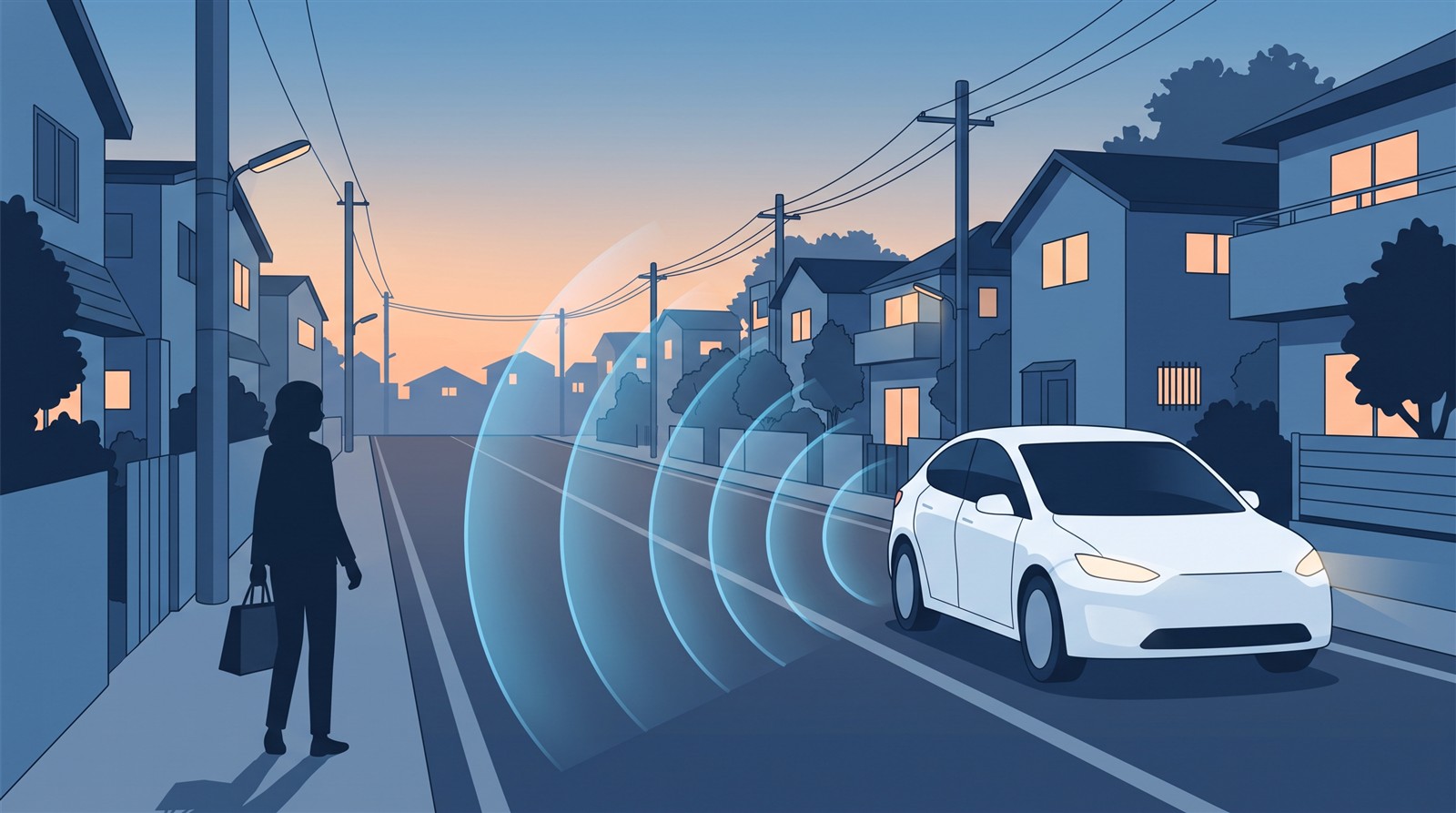
A gasoline car announces itself with engine noise. An electric car runs on a motor and is very quiet, so electric cars deliberately make a sound. This article checks Tesla's "Pedestrian Warning System" in the Model 3 owner's manual (North American and Japanese editions, software 2026.32), and also looks at the background of Japan's requirement, as published by MLIT.
In short: the car makes a sound when moving slowly (below about 40 km/h) and when reversing, and it gets louder as speed rises
| Item | North American edition | Japanese edition |
|---|---|---|
| Speed range | Below about 25 mph (40 km/h), or when reversing | Below 40 km/h forward, or when reversing |
| When it sounds | Whenever the car is shifted out of Park | When the car is in any gear other than Park |
| Sound change | Gets louder as speed increases | Volume rises as speed rises |
| Purpose | EVs are quiet; alerts pedestrians to your approach | EVs make no sound; alerts pedestrians to approach |
The two manuals say almost the same thing.
The manual's warning: don't rely on it
- If the sound cannot be heard, pedestrians may not be aware of your oncoming vehicle, which may lead to serious injury or death.
- Never rely on the Pedestrian Warning System to make sure pedestrians are aware of your vehicle.
- If it is not operating, schedule a service appointment.
In other words, the sound is an aid; the driver must always watch for pedestrians.
Why make a sound: Japan's requirement (MLIT)
On October 7, 2016 (Heisei 28), MLIT announced a partial revision of the Road Transport Vehicle safety standards. I checked the official page and its attachment.
- Hybrid and electric vehicles must be fitted with a "vehicle approach notification device" that alerts pedestrians to the car's approach by sound.
- The background: at the 168th session of UNECE's WP29, "UN Regulation No. 138 on quiet road transport vehicles" was adopted, and Japan introduced a matching standard.
- Scope: vehicles that can run on an electric motor alone (excluding two-wheelers, sidecar two-wheelers, three-wheelers, towed vehicles, and so on).
- Content: the device must conform to the performance requirements of Regulation No. 138, and the device must be one that has no function to stop its operation (as stated in the attachment).
So in Japan the approach-notification sound is a device based on legal standards. How Tesla's system meets that standard is not described in the owner's manual.
How the sound connects to other features
The manual says the Pedestrian Warning System's speaker is used by other features too.
- Summon: the "Completion Sound" (played outside when the car reaches its destination) and "Emissions on Abort" (a sound like an emissions test if a Summon session is aborted) require a Pedestrian Warning System (see Summon and Autopark).
- Sentry Mode live camera (North American edition): on cars with the pedestrian warning speaker, you can press and hold the microphone button in the app to transmit your voice through the car's speaker (see Sentry Mode and Dashcam).
[Author's reading (not a confirmed fact)]
Because the manual says the same speaker is used for Summon's completion sound, it seems that a part for safety sound is reused for other features' sounds. But the actual parts layout cannot be known from the manual's text.
FAQ
Why do electric cars make a sound?
They are very quiet, so pedestrians may not notice them. Tesla's manual states the purpose of alerting pedestrians. In Japan, MLIT announced in 2016 a revision requiring electric and similar vehicles to have a vehicle approach notification device.
Up to what speed does it sound?
The Japanese manual says below 40 km/h; the North American manual says below about 25 mph (40 km/h). It also sounds when reversing, and louder as speed rises.
Can the sound be turned off?
The MLIT attachment says the device must be one with no function to stop its operation. I found no description of a way to stop it in Tesla's manual.
What if the sound stops?
The manual says to schedule a service appointment if the Pedestrian Warning System is not operating.
Does the system make the car safe?
No. The manual warns you not to rely on it and to watch for pedestrians at all times.
Summary
- Tesla's Pedestrian Warning System sounds forward below about 40 km/h and when reversing, and gets louder as speed rises (manual).
- On October 7, 2016, MLIT announced a revision that requires a vehicle approach notification device on electric and similar vehicles, following the adoption of UN Regulation No. 138.
- The manual warns: do not rely on this system.
Related articles: Summon and Autopark, Sentry Mode and Dashcam, Collision avoidance, Regenerative braking.
Next article: coming soon.
Sources (checked 2026-10-18)
- Tesla, "Model 3 Owner's Manual (2024+, software 2026.32, North America)", Pedestrian Warning System: https://www.tesla.com/ownersmanual/model3/en_us/GUID-5D8F5B42-90F9-4ED7-9B36-A54BFED1030C.html
- Tesla, "Model 3 Owner's Manual (Japanese edition)", Pedestrian Warning System: https://www.tesla.com/ownersmanual/model3/ja_jp/GUID-5D8F5B42-90F9-4ED7-9B36-A54BFED1030C.html
- MLIT (Japan), "Partial revision of the Road Transport Vehicle safety standards" (October 7, 2016, in Japanese): https://www.mlit.go.jp/report/press/jidosha07_hh_000220.html
- MLIT, same announcement, attachment (PDF, in Japanese): https://www.mlit.go.jp/common/001148214.pdf
- Tesla, "Model 3 Owner's Manual", Summon: https://www.tesla.com/ownersmanual/model3/en_us/GUID-7D207174-88CD-4795-8265-9162A72AA578.html
This article is for learning about science and technology and is not investment advice. Facts and the author's reading are written separately. Figures are AI-generated illustrations.
Thank you for reading. Was this article useful to you?
Thank you. If you like, tell us what you thought in a line or two.
Optional. No name or email needed.
Received. We will use your words to make better articles.